
MECH 340 Final, Spring 2008
American University of Beirut · Engineering Materials · 12 pages
Showing the first 10 of 12 pages. Download the PDF to see all of it.
More MECH 340 files
- Final · Summer 2006Final examView
- Final · Spring 2006Final examView
- Exam 1 with Solution · Spring 2013Exam · with solutionView
- Exam 2 with Solution · Spring 2013Exam · with solutionView
- Exam 2 with Solution · Spring 2013Exam · with solutionView
- Exam 1 with Solution · Spring 2012Exam · with solutionView
- Exam 1 · Spring 2011ExamView
- Syllabus · Fall 2011LabView
Show the text of this final exam
American University of Beirut
Faculty of Engineering & Architecture
MECG045: Engineering Materials
Dr. Marwan Darwish
Date: 06/02/2002
Final Exam
Duration: 3 hours
Open Book Open Notes
Write clearly all derivations and answers on this Final Exam booklet
Name:
ID#:
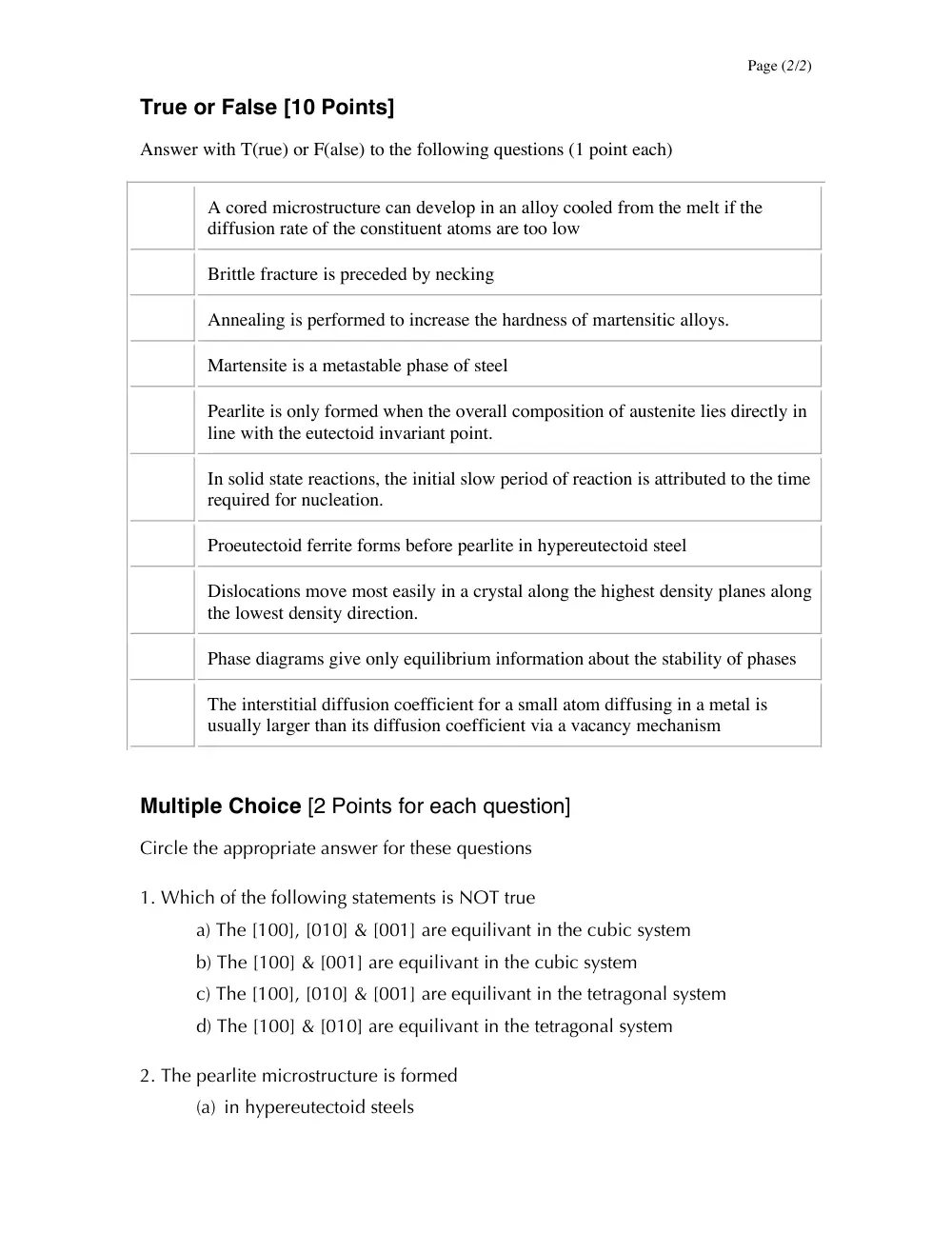
Page (2/2)
True or False [10 Points]
Answer with T(rue) or F(alse) to the following questions (1 point each)
A cored microstructure can develop in an alloy cooled from the melt if the
diffusion rate of the constituent atoms are too low
Brittle fracture is preceded by necking
Annealing is performed to increase the hardness of martensitic alloys.
Martensite is a metastable phase of steel
Pearlite is only formed when the overall composition of austenite lies directly in
line with the eutectoid invariant point.
In solid state reactions, the initial slow period of reaction is attributed to the time
required for nucleation.
Proeutectoid ferrite forms before pearlite in hypereutectoid steel
Dislocations move most easily in a crystal along the highest density planes along
the lowest density direction.
Phase diagrams give only equilibrium information about the stability of phases
The interstitial diffusion coefficient for a small atom diffusing in a metal is
usually larger than its diffusion coefficient via a vacancy mechanism
Multiple Choice [2 Points for each question]
Circle the appropriate answer for these questions
1. Which of the following statements is NOT true
a) The [100], [010] & [001] are equilivant in the cubic system
b) The [100] & [001] are equilivant in the cubic system
c) The [100], [010] & [001] are equilivant in the tetragonal system
d) The [100] & [010] are equilivant in the tetragonal system
2. The pearlite microstructure is formed
(a) in hypereutectoid steels
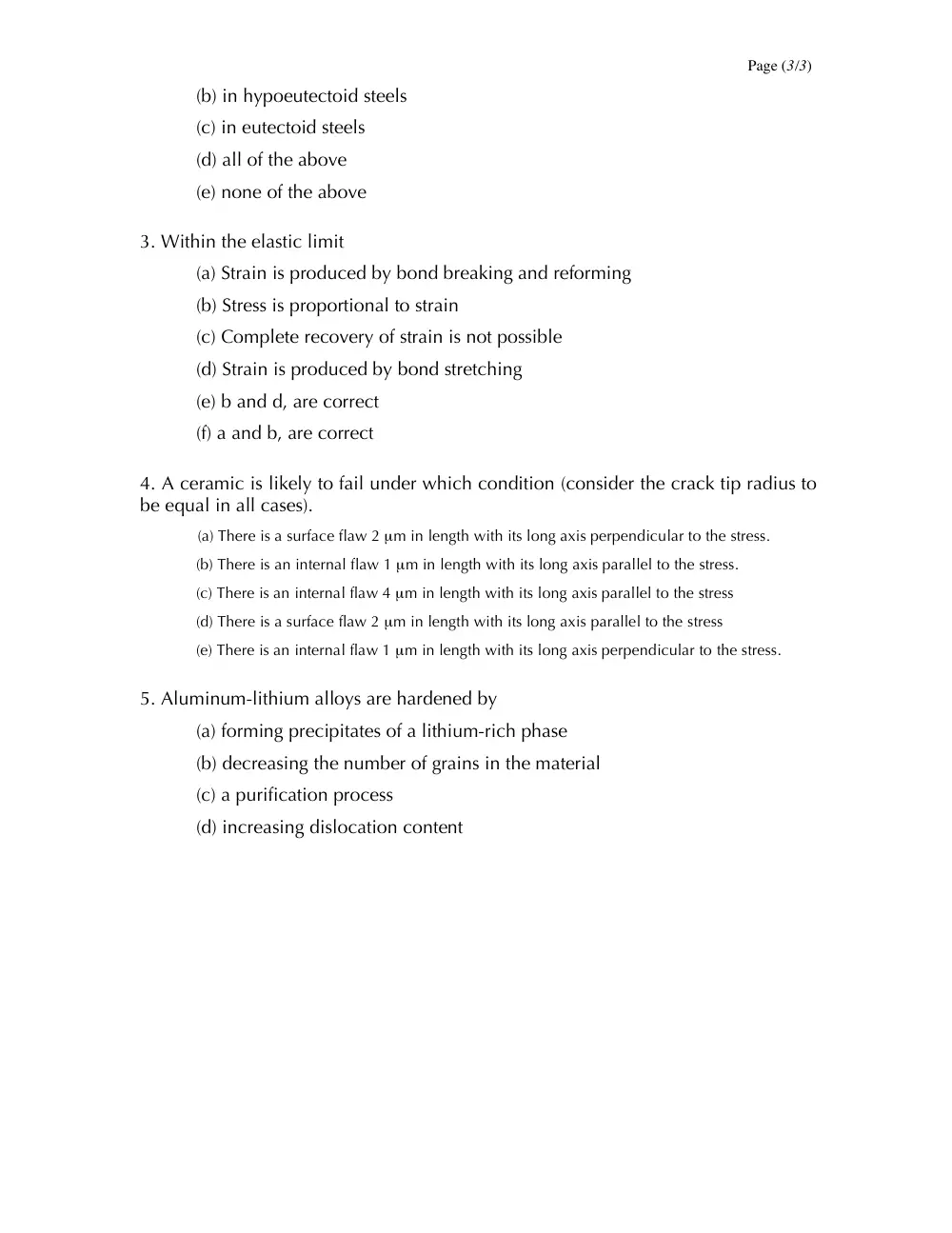
Page (3/3)
(b) in hypoeutectoid steels
(c) in eutectoid steels
(d) all of the above
(e) none of the above
3. Within the elastic limit
(a) Strain is produced by bond breaking and reforming
(b) Stress is proportional to strain
(c) Complete recovery of strain is not possible
(d) Strain is produced by bond stretching
(e) b and d, are correct
(f) a and b, are correct
4. A ceramic is likely to fail under which condition (consider the crack tip radius to
be equal in all cases).
(a) There is a surface flaw 2 µm in length with its long axis perpendicular to the stress.
(b) There is an internal flaw 1 µm in length with its long axis parallel to the stress.
(c) There is an internal flaw 4 µm in length with its long axis parallel to the stress
(d) There is a surface flaw 2 µm in length with its long axis parallel to the stress
(e) There is an internal flaw 1 µm in length with its long axis perpendicular to the stress.
5. Aluminum-lithium alloys are hardened by
(a) forming precipitates of a lithium-rich phase
(b) decreasing the number of grains in the material
(c) a purification process
(d) increasing dislocation content
Page (4/4)
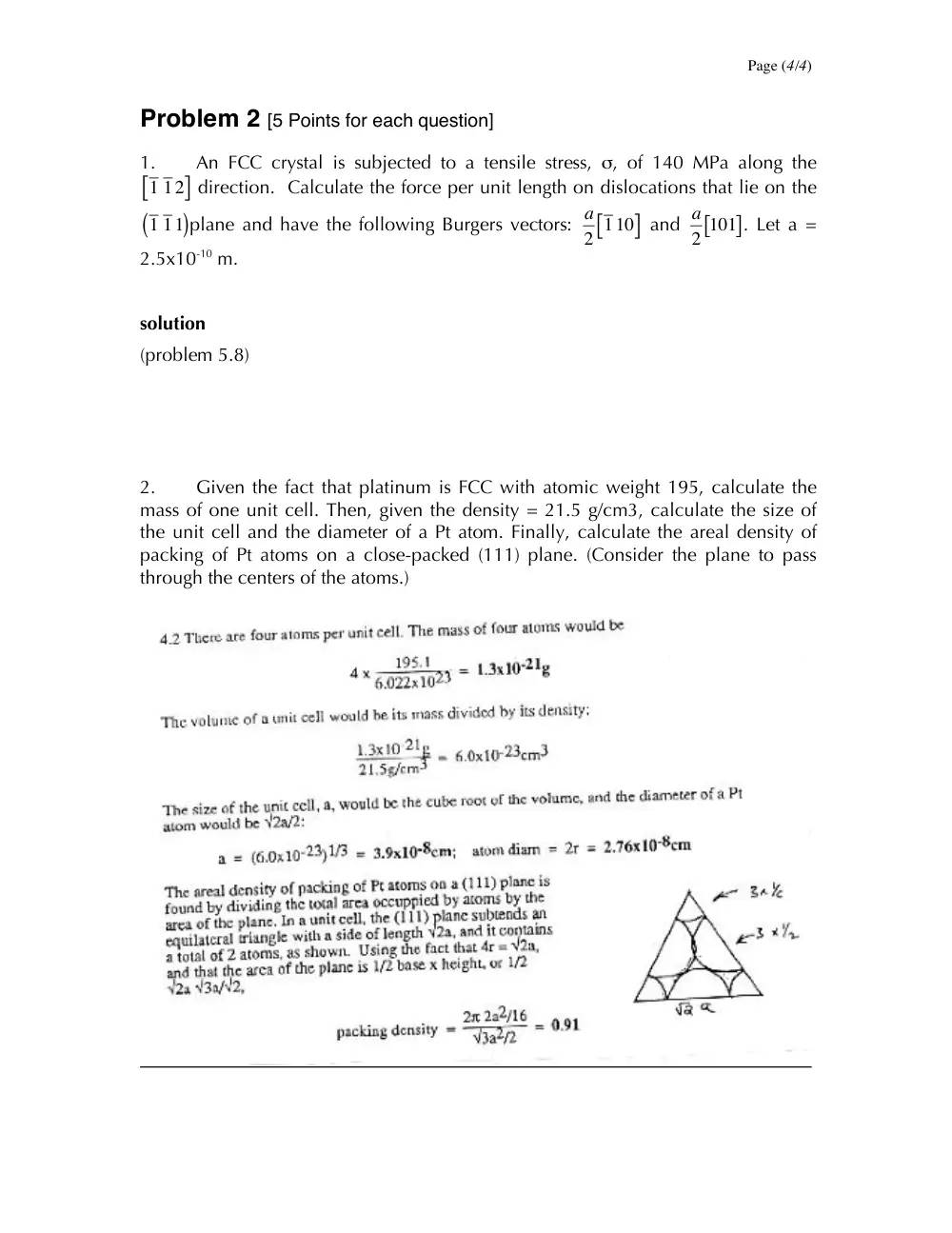
Problem 2 [5 Points for each question]
1.
An FCC crystal is subjected to a tensile stress, σ, of 140 MPa along the
�
[1 1 2
] direction. Calculate the force per unit length on dislocations that lie on the
�
(1 1 1
)plane and have the following Burgers vectors:
�
a
2 1 10
[
] and
�
a
2 101
[
]. Let a =
2.5x10⁻¹⁰ m.
solution
(problem 5.8)
2.
Given the fact that platinum is FCC with atomic weight 195, calculate the
mass of one unit cell. Then, given the density = 21.5 g/cm3, calculate the size of
the unit cell and the diameter of a Pt atom. Finally, calculate the areal density of
packing of Pt atoms on a close-packed (111) plane. (Consider the plane to pass
through the centers of the atoms.)
Page (5/5)
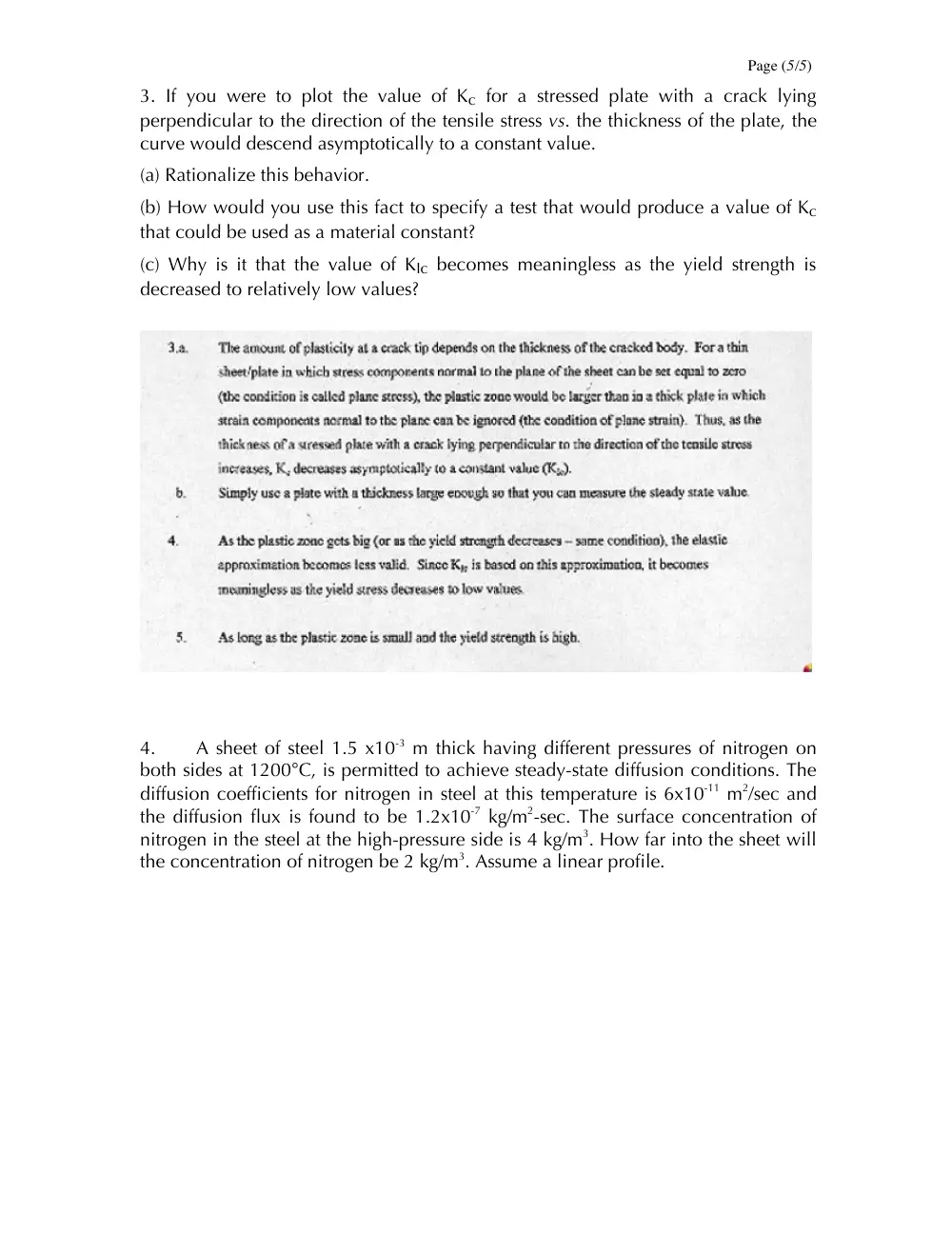
3. If you were to plot the value of Kc for a stressed plate with a crack lying
perpendicular to the direction of the tensile stress vs. the thickness of the plate, the
curve would descend asymptotically to a constant value.
(a) Rationalize this behavior.
(b) How would you use this fact to specify a test that would produce a value of Kc
that could be used as a material constant?
(c) Why is it that the value of KIc becomes meaningless as the yield strength is
decreased to relatively low values?
4.
A sheet of steel 1.5 x10⁻³ m thick having different pressures of nitrogen on
both sides at 1200°C, is permitted to achieve steady-state diffusion conditions. The
diffusion coefficients for nitrogen in steel at this temperature is 6x10-11 m2/sec and
the diffusion flux is found to be 1.2x10⁻⁷ kg/m2-sec. The surface concentration of
nitrogen in the steel at the high-pressure side is 4 kg/m3. How far into the sheet will
the concentration of nitrogen be 2 kg/m3. Assume a linear profile.
Page (6/6)
Problem 3 [5 points each]
1.
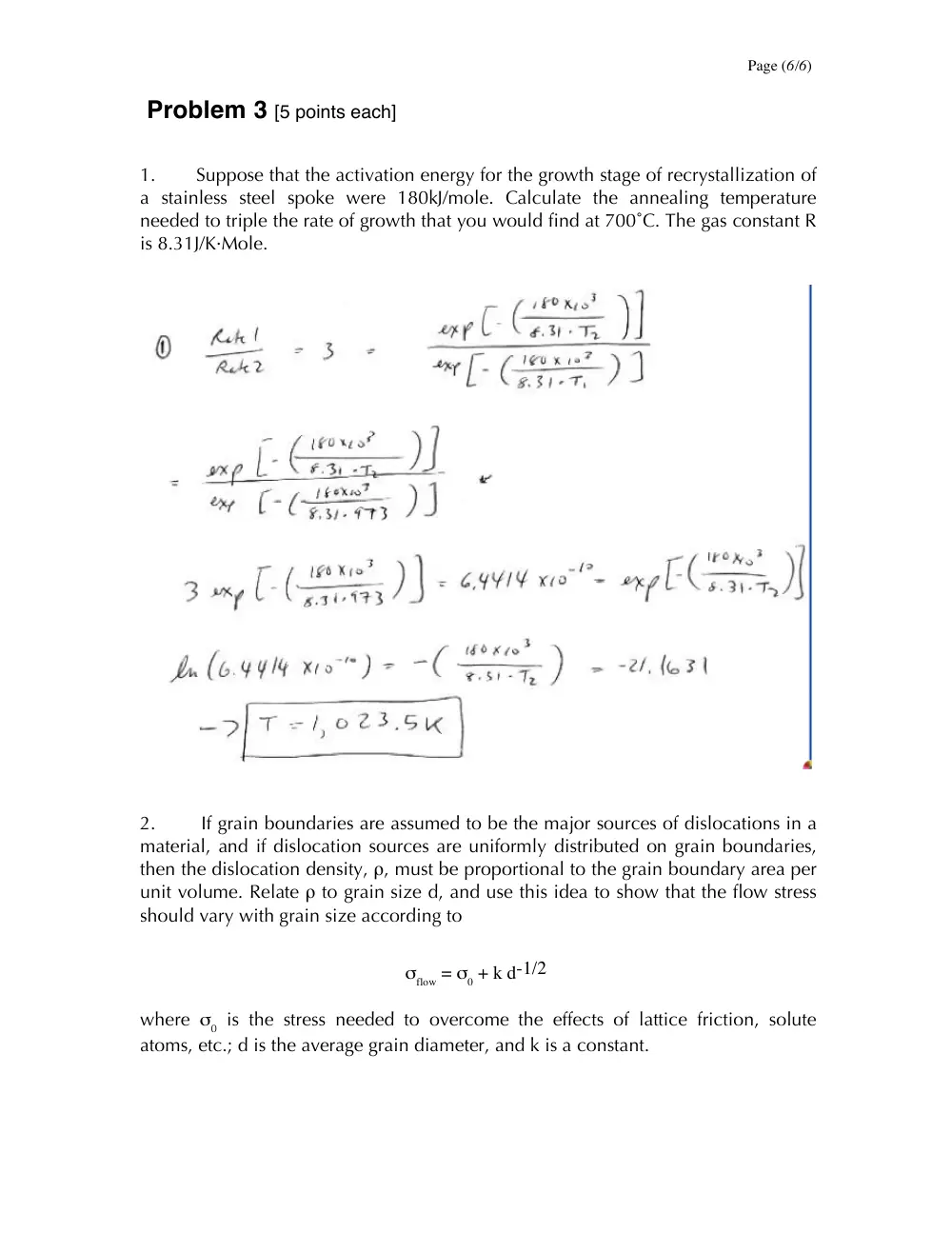
Suppose that the activation energy for the growth stage of recrystallization of
a stainless steel spoke were 180kJ/mole. Calculate the annealing temperature
needed to triple the rate of growth that you would find at 700˚C. The gas constant R
is 8.31J/K·Mole.
2.
If grain boundaries are assumed to be the major sources of dislocations in a
material, and if dislocation sources are uniformly distributed on grain boundaries,
then the dislocation density, ρ, must be proportional to the grain boundary area per
unit volume. Relate ρ to grain size d, and use this idea to show that the flow stress
should vary with grain size according to
σflow = σ0 + k d-1/2
where σ0 is the stress needed to overcome the effects of lattice friction, solute
atoms, etc.; d is the average grain diameter, and k is a constant.
Page (7/7)
3.
We would like to produce a 2in thick steel wear plate for a rock-crushing
unit. To avoid frequent replacement of the wear plate, the hardness should exceed
HRC 38 within 0.25 in of the steel surface. However, the center of the plate should
have a hardness of no more than HRC 32 to assure some toughness. We have only
a water quench available to us. Design the plate, assuming that we only have the
steels given in Figure 11.5 of your book.
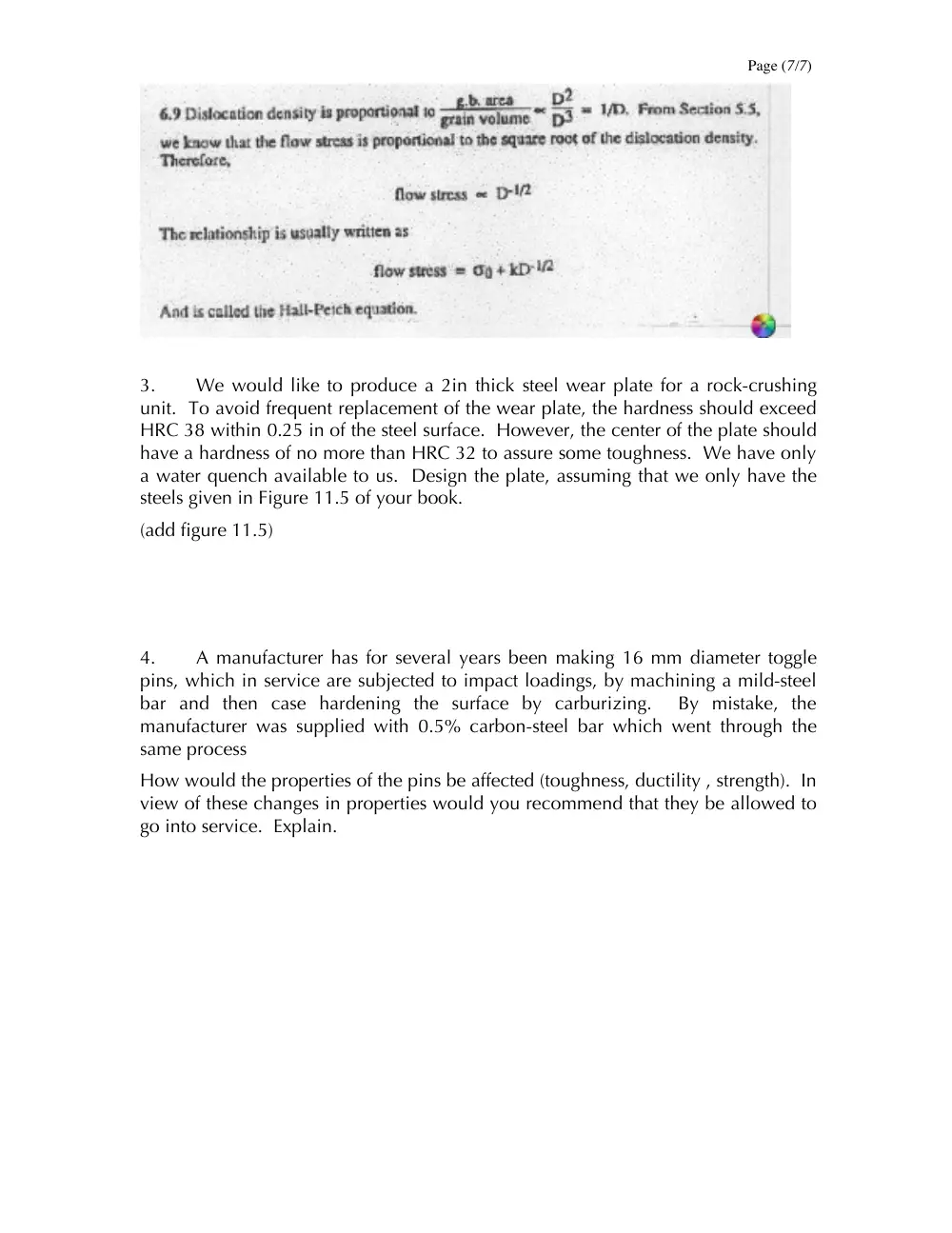
(add figure 11.5)
4.
A manufacturer has for several years been making 16 mm diameter toggle
pins, which in service are subjected to impact loadings, by machining a mild-steel
bar and then case hardening the surface by carburizing. By mistake, the
manufacturer was supplied with 0.5% carbon-steel bar which went through the
same process
How would the properties of the pins be affected (toughness, ductility , strength). In
view of these changes in properties would you recommend that they be allowed to
go into service. Explain.
Page (8/8)
Problem 4 [5 points each]
1.
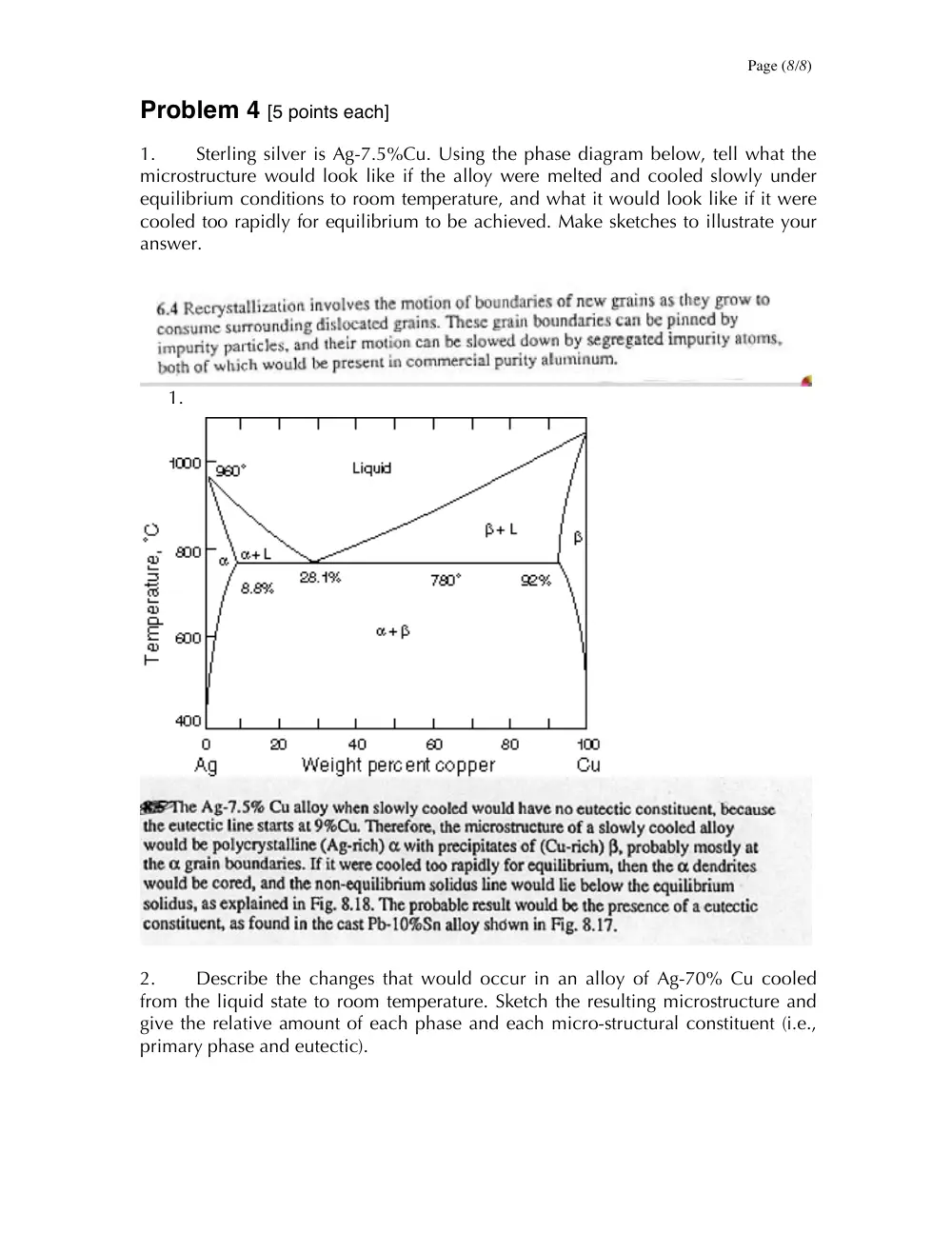
Sterling silver is Ag-7.5%Cu. Using the phase diagram below, tell what the
microstructure would look like if the alloy were melted and cooled slowly under
equilibrium conditions to room temperature, and what it would look like if it were
cooled too rapidly for equilibrium to be achieved. Make sketches to illustrate your
answer.
1.
2.
Describe the changes that would occur in an alloy of Ag-70% Cu cooled
from the liquid state to room temperature. Sketch the resulting microstructure and
give the relative amount of each phase and each micro-structural constituent (i.e.,
primary phase and eutectic).
Page (9/9)
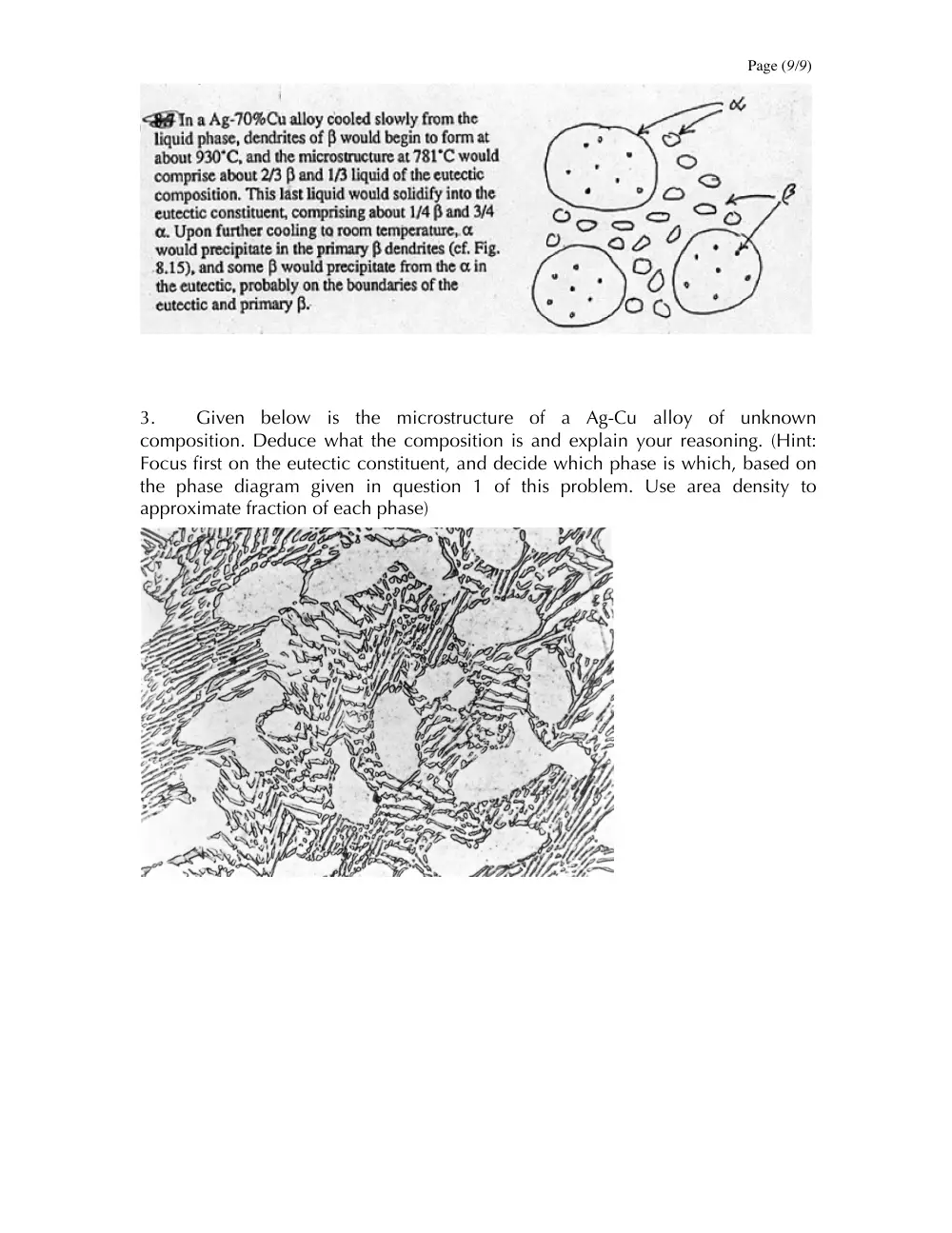
3.
Given below is the microstructure of a Ag-Cu alloy of unknown
composition. Deduce what the composition is and explain your reasoning. (Hint:
Focus first on the eutectic constituent, and decide which phase is which, based on
the phase diagram given in question 1 of this problem. Use area density to
approximate fraction of each phase)
Page (10/10)
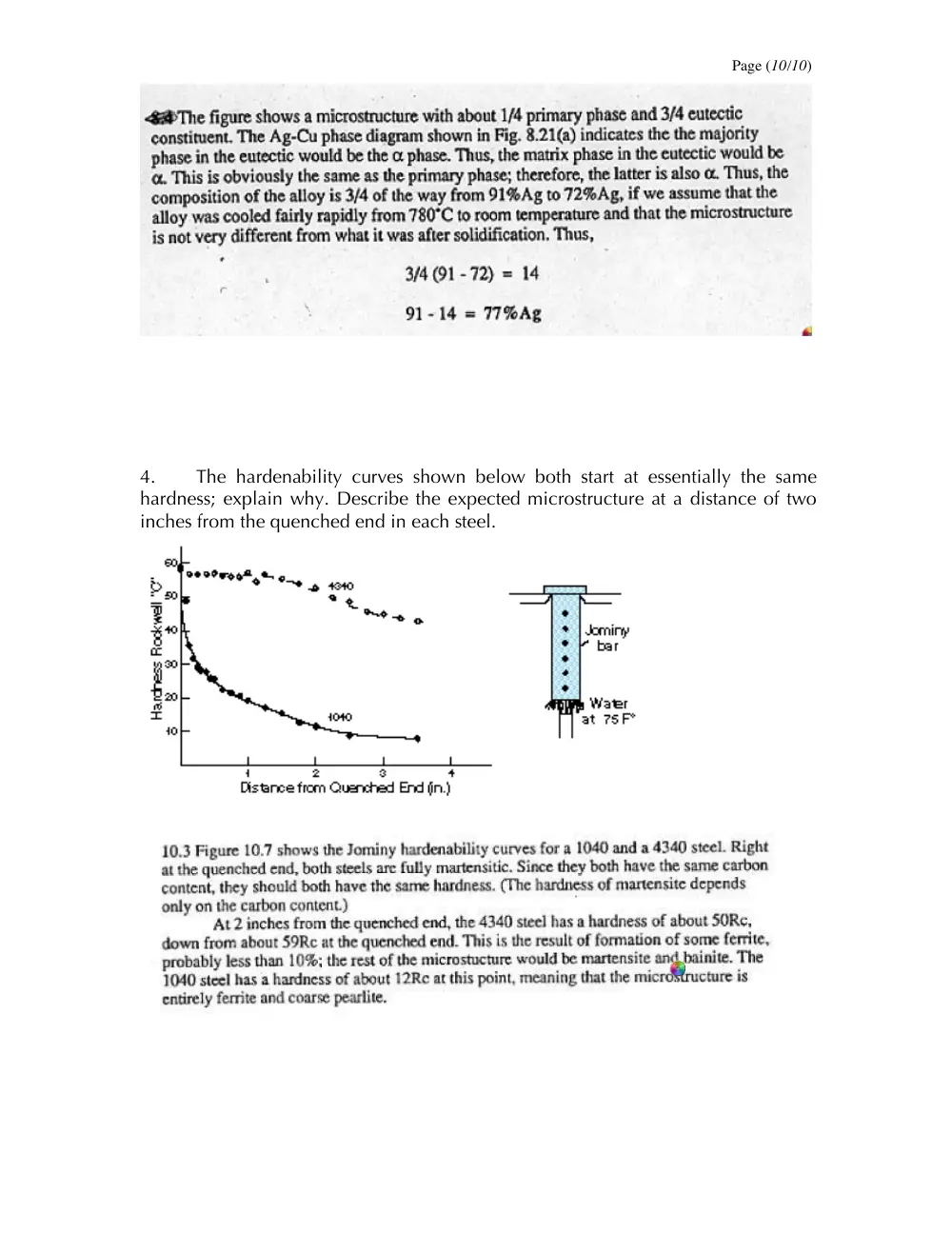
4.
The hardenability curves shown below both start at essentially the same
hardness; explain why. Describe the expected microstructure at a distance of two
inches from the quenched end in each steel.
Page (11/11)
Problem 5 [5 Points each]
1.
The skins of most commercial airplanes are fabricated from panels of
precipitation-hardened aluminum-based alloys. However, these alloys cannot be
used for many supersonic military aircraft; these require skins of stainless steel or
titanium alloys, which results in a weight penalty. Explain why aluminum-based
alloys cannot be used, considering the fact that supersonic flight entails
aerodynamic heating by collisions of the aircraft with gas molecules in the air.
Also Explain why high-purity aluminum recrystallizes at a much lower temperature
than commercial purity aluminum.
2.
Copper with 2% beryllium is a precipitation-hardening alloy; the Cu-rich
end of the phase diagram is given here. Describe the experiments you would do to
devise the heat treatment that gives the maximum hardness in this alloy. (Keep it as
simple as possible.)
Page (12/12)
3.
What kind of solvus line is needed for precipitation hardening? Explain your
answer.
4.
What other important characteristics must an alloy system have in order to
exhibit precipitation hardening? Explain your answer.