
PHYS 204 Exam 2, Fall 2002
American University of Beirut · Classical Physics for Life Sciences · 9 pages



More PHYS 204 files
Show the text of this exam
IRL OS
' &
; @*ouiz H Phys 204,Fall 2002-2003 Dec 12, 2002
American University of Beirut
Physics Department
Physics 204
Name: hey ~ ™
I. D. No:
QUIZ I Phys 204,Fall 2002-2003 Dec 12, 2002
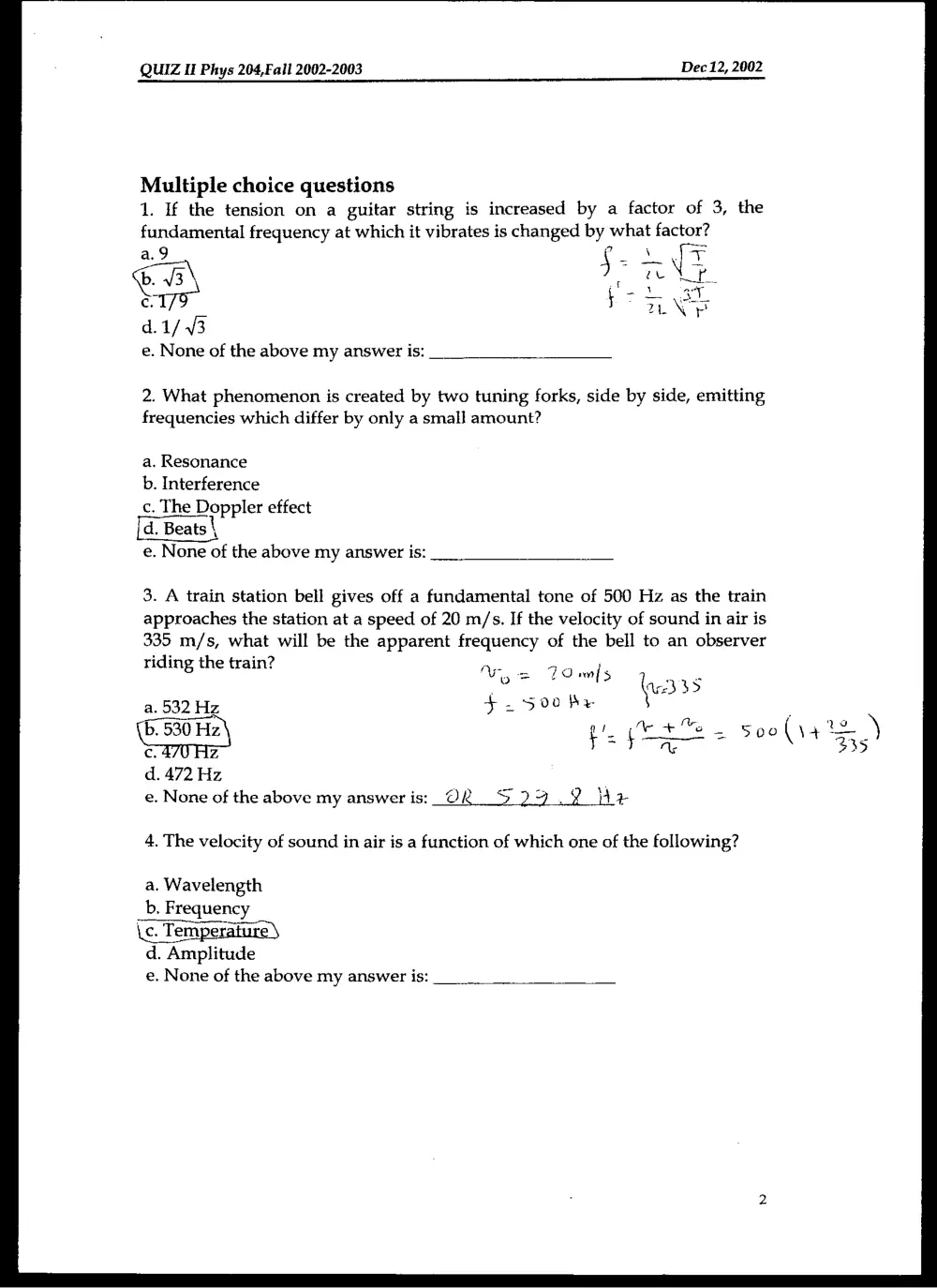
Multiple choice questions
1. If the tension on a guitar string is increased by a factor of 3, the
fundamental frequency at which it vibrates is changed by what factor?
7 at
j 7B
Cc.
d.1/ V3
e. None of the above my answer is:
2. What phenomenon is created by two tuning forks, side by side, emitting
frequencies which differ by only a small amount?
a. Resonance
b. Interference
c. The Doppler effect
d. Beats \
e. None of the above my answer is:
3. A train station bell gives off a fundamental tone of 500 Hz as the train
approaches the station at a speed of 20 m/s. If the velocity of sound in air is
335 m/s, what will be the apparent frequency of the bell to an observer
riding the train? Wy = TO wis
8 ° (ucbss
a. 532 Hz v.00 he
c. 470 Hz
d. 472 Hz ,
e. None of the above my answer is: OR 529.9 Hr
4. The velocity of sound in air is a function of which one of the following?
a. Wavelength
b, Frequency
\¢. Temperature
d. Amplitude
e. None of the above my answer is:
QUIZ II Phys 204,Fall 2002-2003 Dec 12, 2002
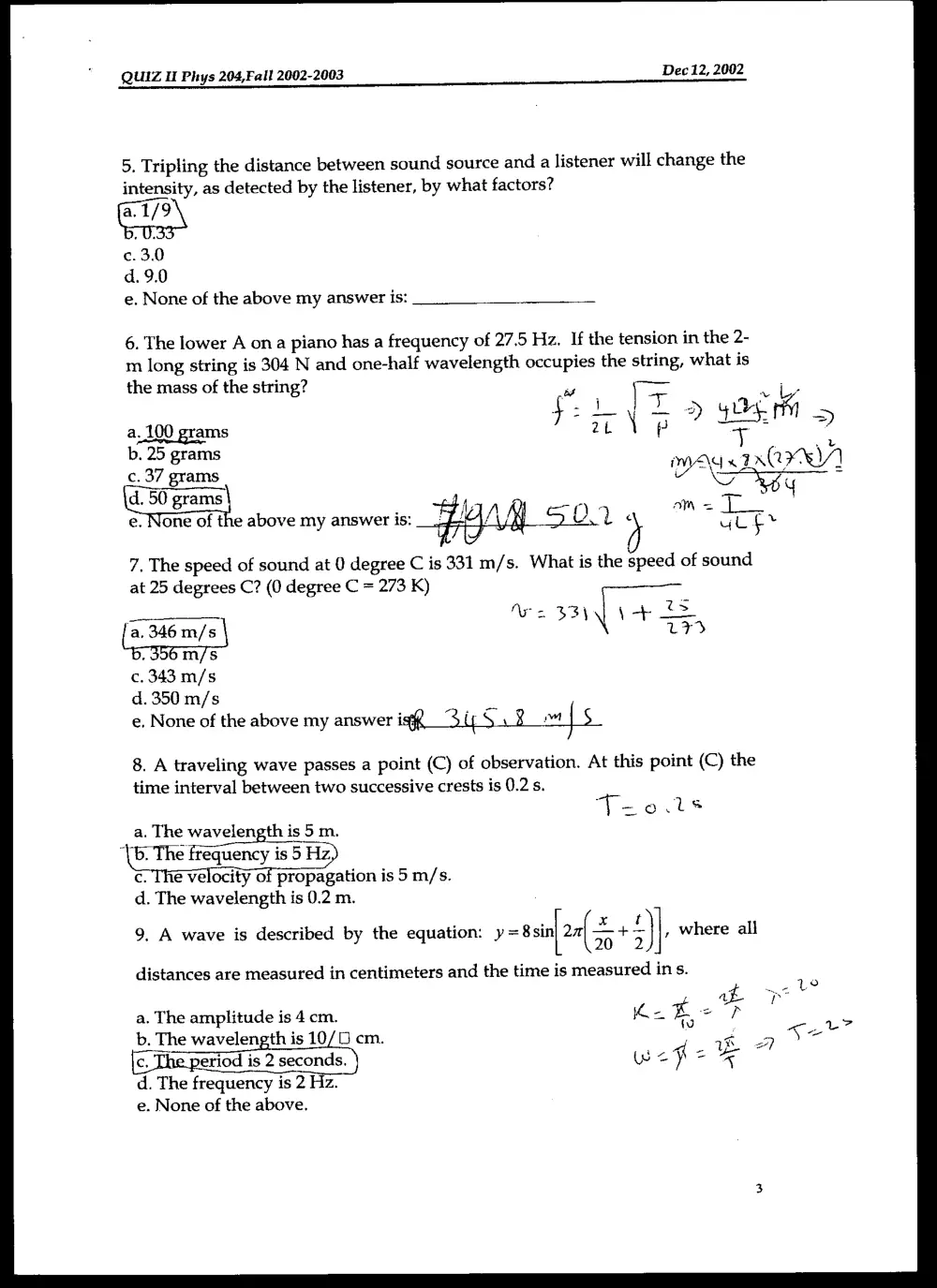
5. Tripling the distance between sound source and a listener will change the
intensity, as detected by the listener, by what factors?
c. 3.0
d. 9.0
e. None of the above my answer is:
6. The lower A ona piano has a frequency of 27.5 Hz. If the tension in the 2-
m long string is 304 N and one-half wavelength occupies the string, what is
the mass of the string? Le
ly
Pei G2 ar >
a. 100 grams
b, 25 grams
T -
x )
c. 37 grams ima\ am OFRY]
\d. 50 grams an am Ss sey
e. None of the above my answer is: Poh 50.1 ) — ul t*
7. The speed of sound at 0 degree C is 331 m/s. What is the speed of sound
at 25 degrees C? (0 degree C = 273 K)
— Wwe 33) \ V+ 2
a. 346 m/s + Ltd
b. 306 m/s
c.343 m/s
d. 350 m/s
e, None of the above my answer ig 34 Sik { $
8. A traveling wave passes a point (C) of observation. At this point (C) the
time interval between two successive crests is 0.2 s. +
Toots
a. The wavelength is 5 m.
¢. The velocity of propagation is 5 m/s.
d. The wavelength is 0.2 m.
9. A wave is described by the equation: y=8sin2n( +5) where all
distances are measured in centimeters and the time is measured ins.
a) ~<a
a. The amplitude is 4 cm. Me B, < ae /
b. The wavelength is 10/0 cm. we v
we fia ”
d. The frequency is 2 Hz.
e. None of the above.
QUIZ II Phys 204,Fall 2002-2003 Dec 12, 2002
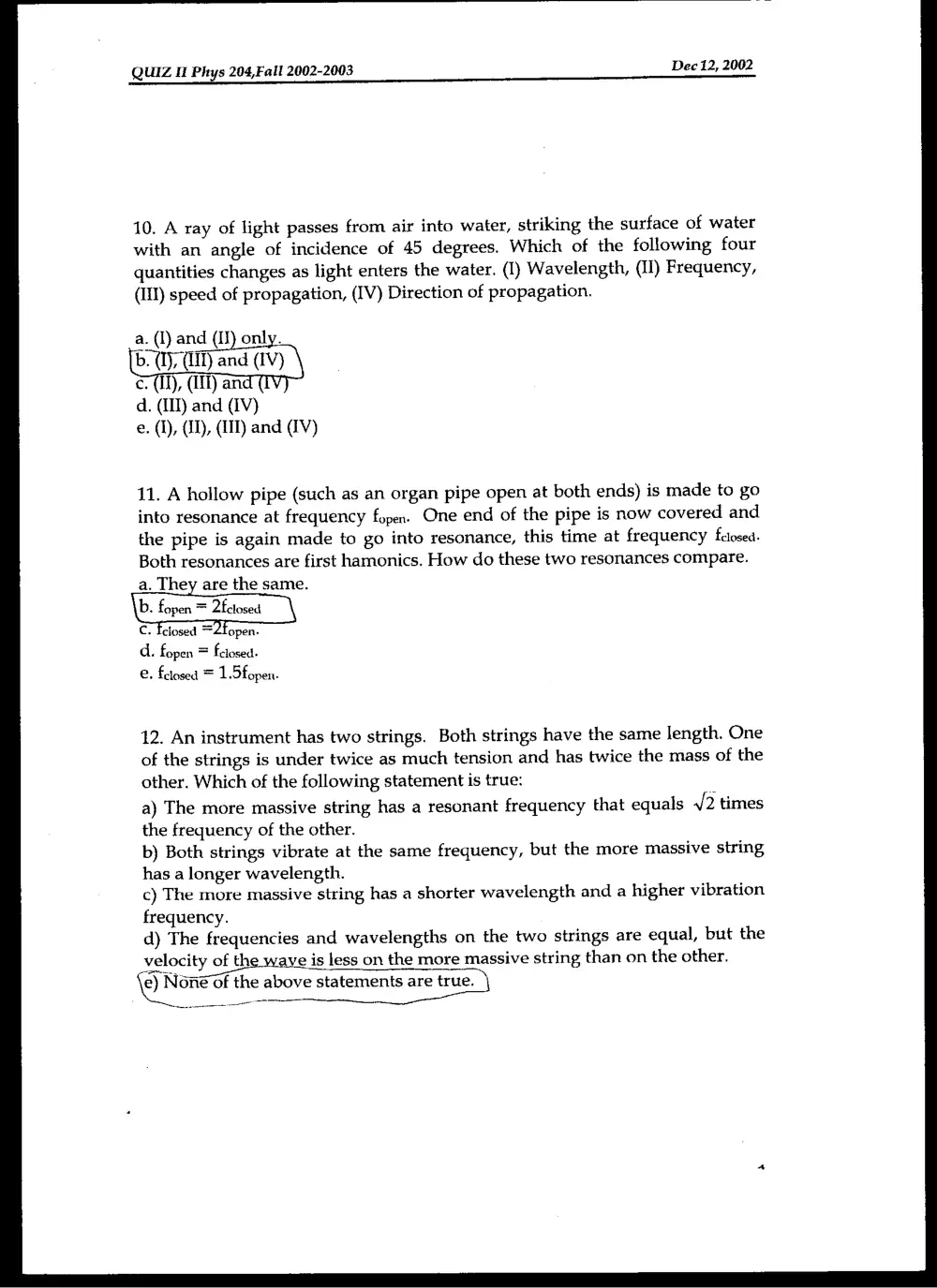
10. A ray of light passes from air into water, striking the surface of water
with an angle of incidence of 45 degrees. Which of the following four
quantities changes as light enters the water. (1) Wavelength, (II) Frequency,
(III) speed of propagation, (IV) Direction of propagation.
a. (I) and (IJ) only.
b. (1), (il) and (IV)
&. (I), (fl) an
d. (III) and (IV)
e. (1), (I), (Il) and (IV)
11. A hollow pipe (such as an organ pipe open at both ends) is made to go
into resonance at frequency fopen. One end of the pipe is now covered and
the pipe is again made to go into resonance, this time at frequency folosed.
Both resonances are first hamonics. How do these two resonances compare.
a. They are the same.
b. fopen = 2fctosed
C. Iclosed =<Iopen.
d. fopen = felosed-
e. folosed = 1.5fopen-
12. An instrument has two strings. Both strings have the same length. One
of the strings is under twice as much tension and has twice the mass of the
other. Which of the following statement is true:
a) The more massive string has a resonant frequency that equals /2 times
the frequency of the other.
b) Both strings vibrate at the same frequency, but the more massive string
has a longer wavelength.
c) The more massive string has a shorter wavelength and a higher vibration
frequency.
d) The frequencies and wavelengths on the two strings are equal, but the
velocity of the wave is less on the more massive string than on the other.
e) None of the above statements are true.
QUIZ II Phys 204,Fall 2002-2003 Dec 12, 2002
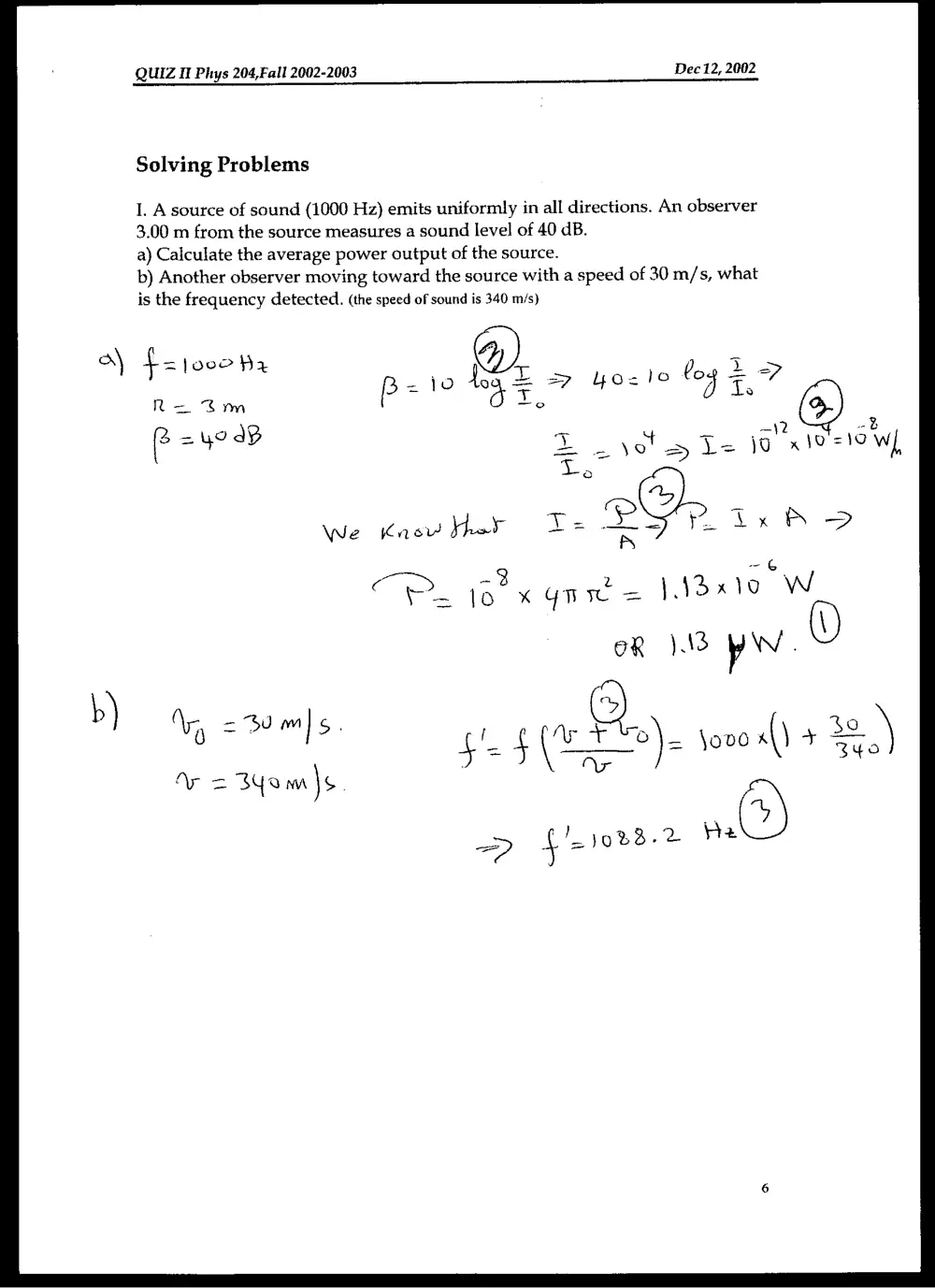
Solving Problems
I. A source of sound (1000 Hz) emits uniformly in all directions. An observer
3.00 m from the source measures a sound level of 40 dB.
a) Calculate the average power output of the source.
b) Another observer moving toward the source with a speed of 30 m/s, what
is the frequency detected. (the speed of sound is 340 m/s)
a) fajooo Ba
Ra 3m
2 =4e3b
QUIZ I Phys 204,Fall 2002-2003 Dec 12, 2002
II. Two stereo loudspeakers are separated by a distance of 2. 12 m. Assume
the amplitude of the sound from each speaker is the same at the position ofa
listener, who is 3.75 m directly in front of one of the speakers; (see the figure
below).
For what frequencies in the audible range (from 20 Hz up to 20,000 Hz) will
there be a maximum signal. (the speed of sound is 340 m/s)
Speaker
Tn order 4o her y DE Que x aK
Sound inkemoihy We
Should have *
cy
Speaker
+4
2) 37S m ®B
2 I69S 4G.) =e
USO —-3.45 = me » ee mc >
$
m 242 609 rm Where men soheger
—_
(
0 ‘By
& rse2? 37 ours ¢ rn LF 32.
G09 @
. bo BU
DO
Wn =
a
QUIZ IT Phys 204,Fall 2002-2003 Dec12, 2002
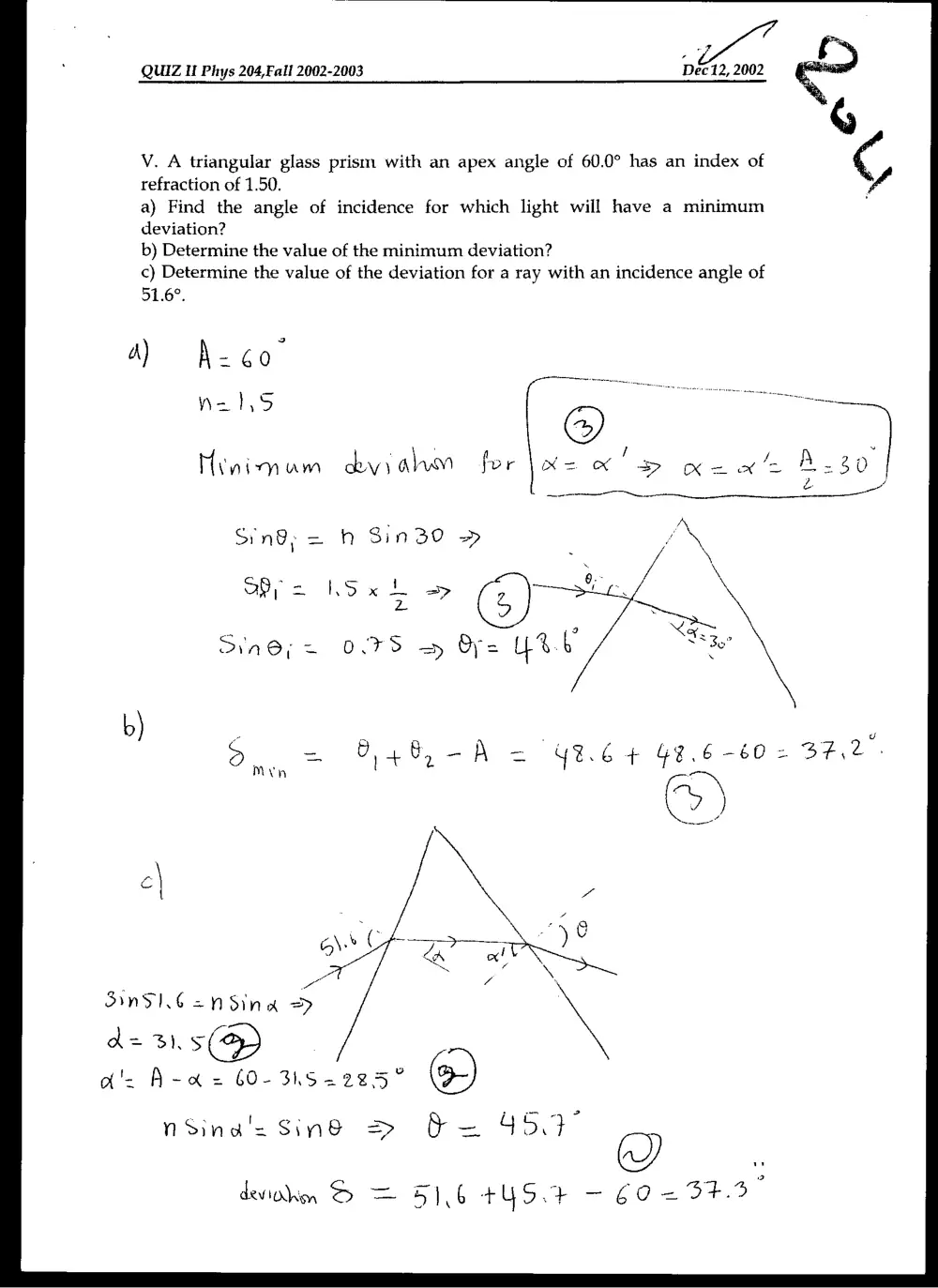
V. A triangular glass prism with an apex angle of 60.0° has an index of
refraction of 1.50.
a) Find the angle of incidence for which light will have a minimum
deviation?
b) Determine the value of the minimum deviation?
c) Determine the value of the deviation for a ray with an incidence angle of
51.6°.
A) \- 60
n2},S
Henimam dy alm fer
QUIZ II Phys 204,Fall 2002-2003 Dec 12, 2002
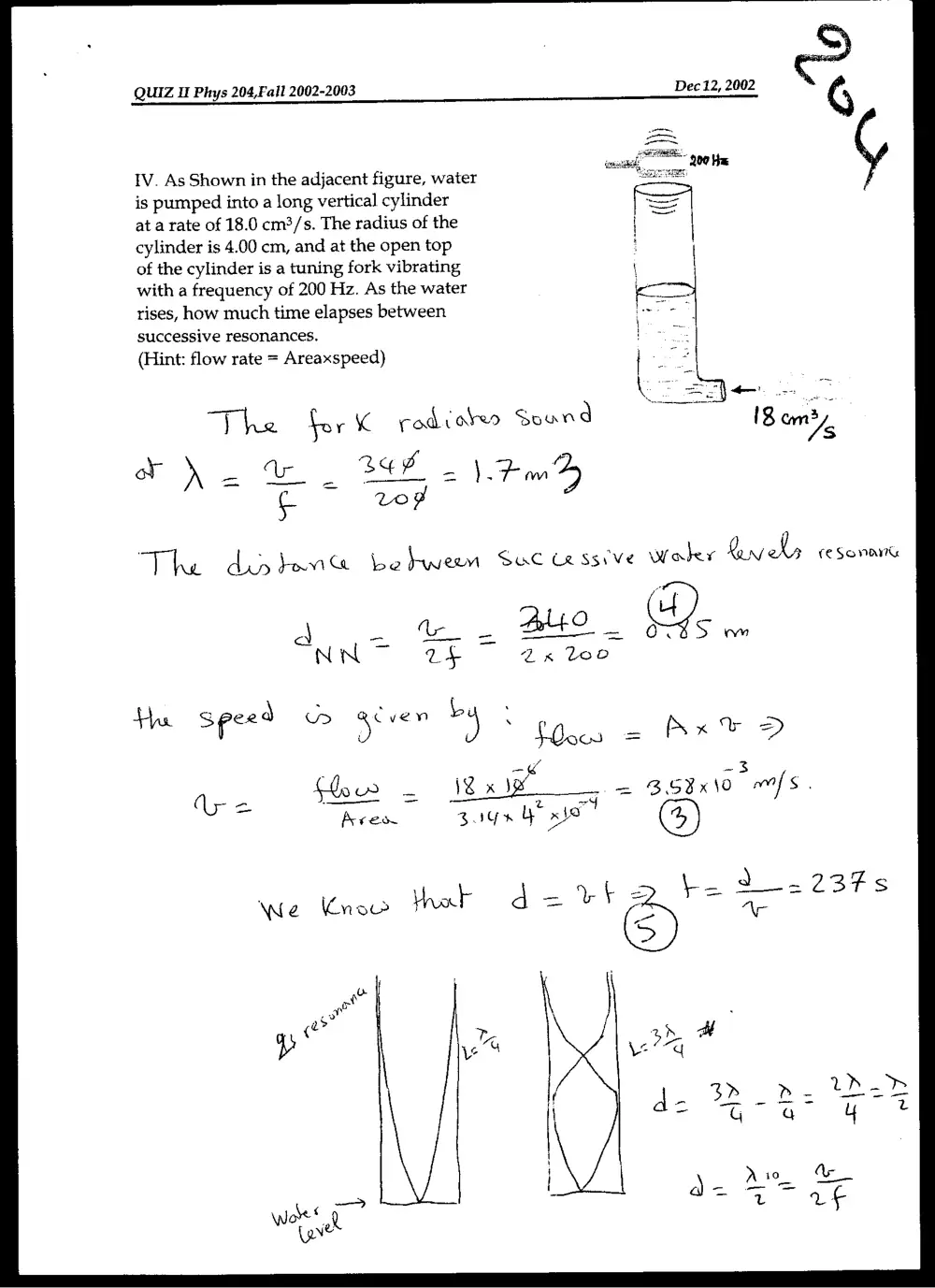
IV. As Shown in the adjacent figure, water
is pumped into a long vertical cylinder
at a rate of 18.0 cm3/s. The radius of the
cylinder is 4.00 cm, and at the open top
of the cylinder is a tuning fork vibrating
with a frequency of 200 Hz. As the water
rises, how much time elapses between
successive resonances.
(Hint: flow rate = Areaxspeed)
IB emi
aD A ce
d =< Fes 2
The dir dor be Seen Sac Ce 8s\Ve water Qrvels re Sonar
auc We
QUIZ II Phys 204,Fall 2002-2003 Dec 12, 2002
pl)
III. A sample of an ideal gas goes through
the process shown in the adjacent figure.
From A to B the process is adiabatic; from
B to C it is isobaric, with 100 kJ of energy
flowing into the system by heat. From C
to D, the process is isothermal; From D to Poof ;
A, it is isobaric, with 150 kJ of energy a ts: eo ue iat mt)
flowing out of the system by heat.
a) determine the change in internal energy
during the process BC. (Ein. - Einc=?)
b) Determine the difference in internal
energy during the process B>A. (Eints ~ Ein, a=?)
Figure P20.52
Awa 8 ad iobohc A= ra)
= jor? -
KCL FA
b) U,- Ups?
U,-We= 2 @®
Won = LC Va- Vp) = Vy Ob x 18” = (0, t-\. 2) 2 ~\ay Ky
EXE Uy-u,= Wary (ve) = 4B FNS
Un- U
J, Up = ~ [Ue - Ug) + (Up -¥e) #We MY
as,