
PHYS 204 Other, Fall 2010
American University of Beirut · Classical Physics for Life Sciences · 46 pages

Showing the first 10 of 46 pages. Download the PDF to see all of it.
More PHYS 204 files
Show the text of this file
9
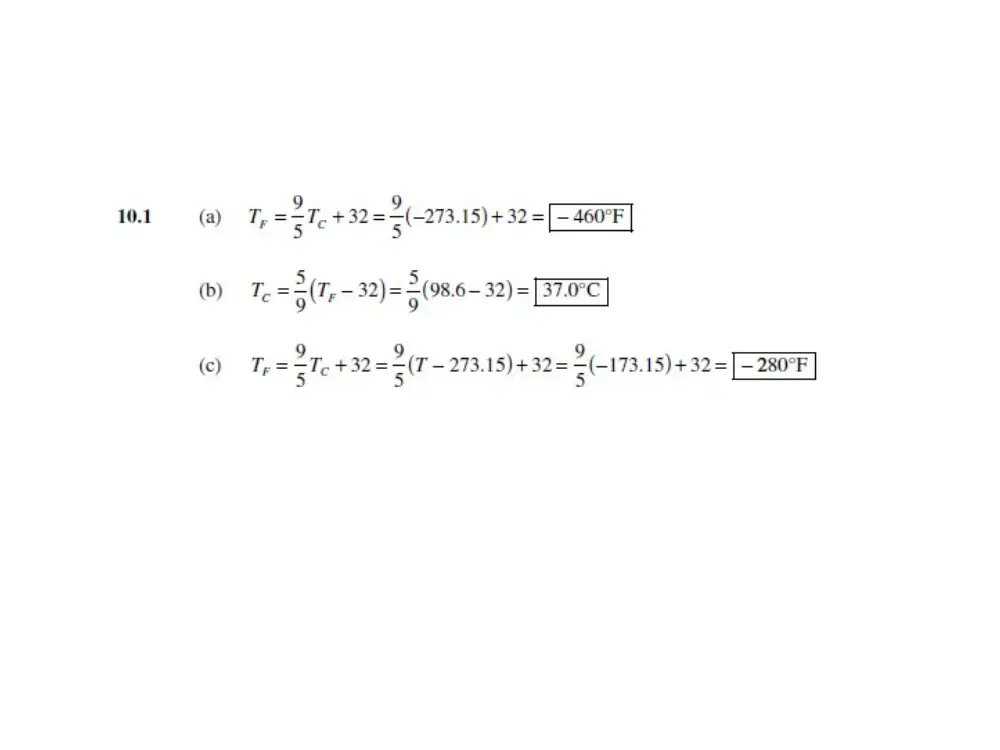
10.1 (a) T, ~gte +32 =—(-273.15)+ 32 =| —460°F
a 5
6) T.=5(T,—32)=5 (986-32) = [370°C
5
9 9
Te +32 =—(T — 273.15)+32= 3 (-173.15) +32= — 280°F
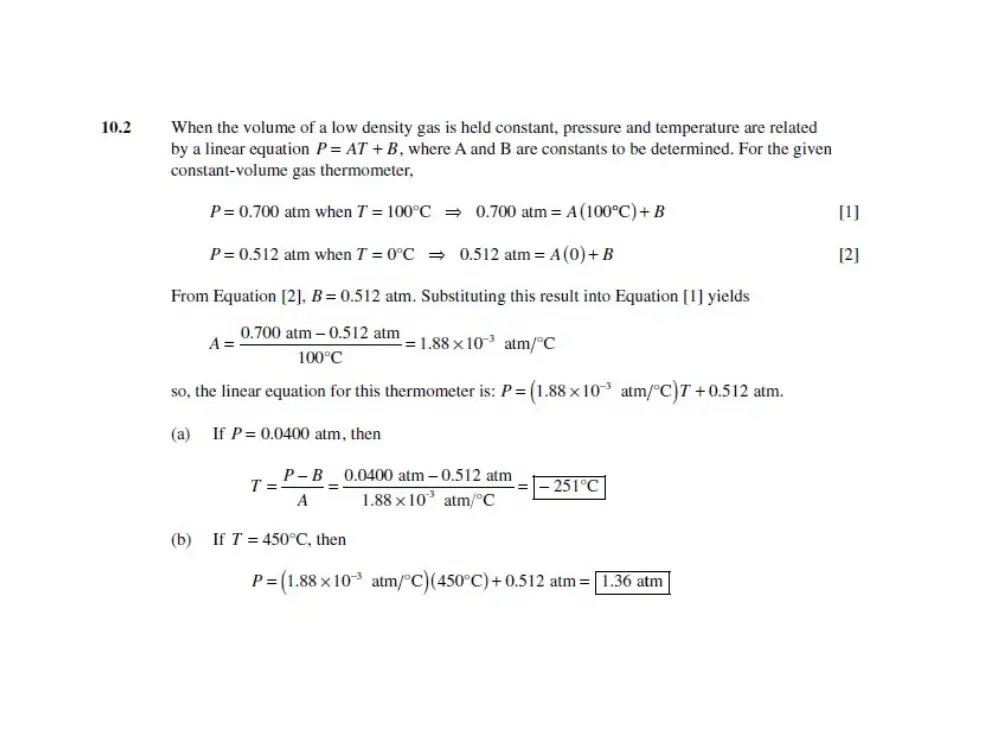
10.2
When the volume of a low density gas is held constant, pressure and temperature are related
by a linear equation P= AT + 8, where A and B are constants to be determined. For the given
constant-volume gas thermometer,
P= 0.700 atm when T=100°C = 0.700 atm= A(100°C)+B fl]
P=0.512 atm when T=O0°C = 0.512 atm=A(0)+B [2]
From Equation [2], B= 0.512 atm. Substituting this result into Equation [1] yields
_ 0.700 atm — 0.512 atm
1o0°c
A =1.88x10% atm/*C
so, the linear equation for this thermometer is: P = (1.88 x10 atm/°C)T +0.512 atm.
(a) If P= 0.0400 atm, then
_ P-B_ 0.0400 atm—0.512 atm _
T Sa
A 1.88 x10° atm/"C
— 251°C
(b) If T = 450°C, then
P =(1.88 x10 atm/°C)(450°C) + 0.512 atm = [1.36 atm
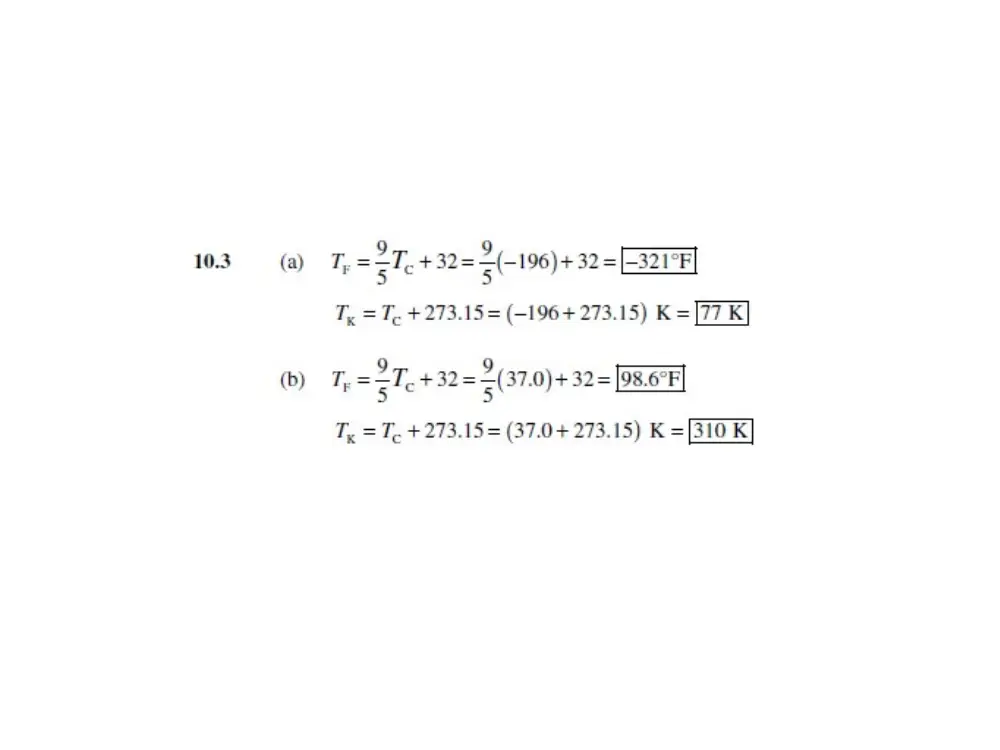
10.3
(a) T,= 21. +32= 2(-196)+ 32 =[-321°F
T,, = T, + 273.15 = (-196 + 273.15) K =
(b) T, = 27 +32=2(37.0)+ 32= 8.6°F
TIK
T,, = T+ 273.15 = (37.0 + 273.15) K =
310K
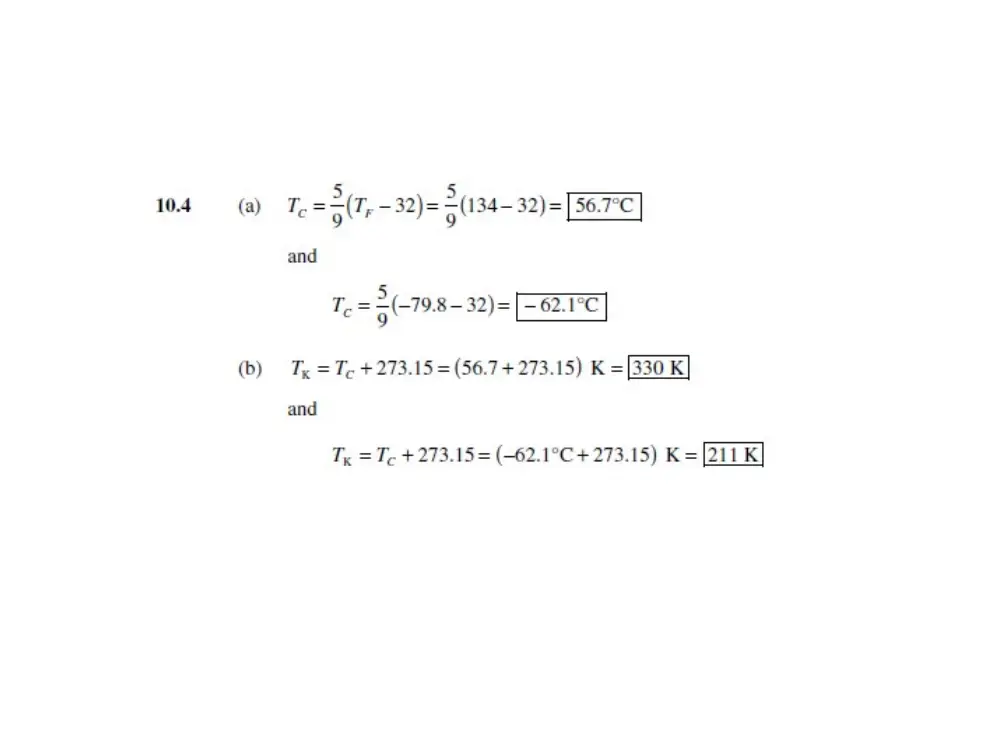
10.4
(a) T= 2 (I, ~32)=3(134-32)= 56.7°C
5
T= hintaan 32)=|-—62.1°C
(b) Ty =T, +273.15=(56.7+ 273.15) K =B30 K
and
T= Te + 273.15 = (-62.1°C + 273.15) K=
211K
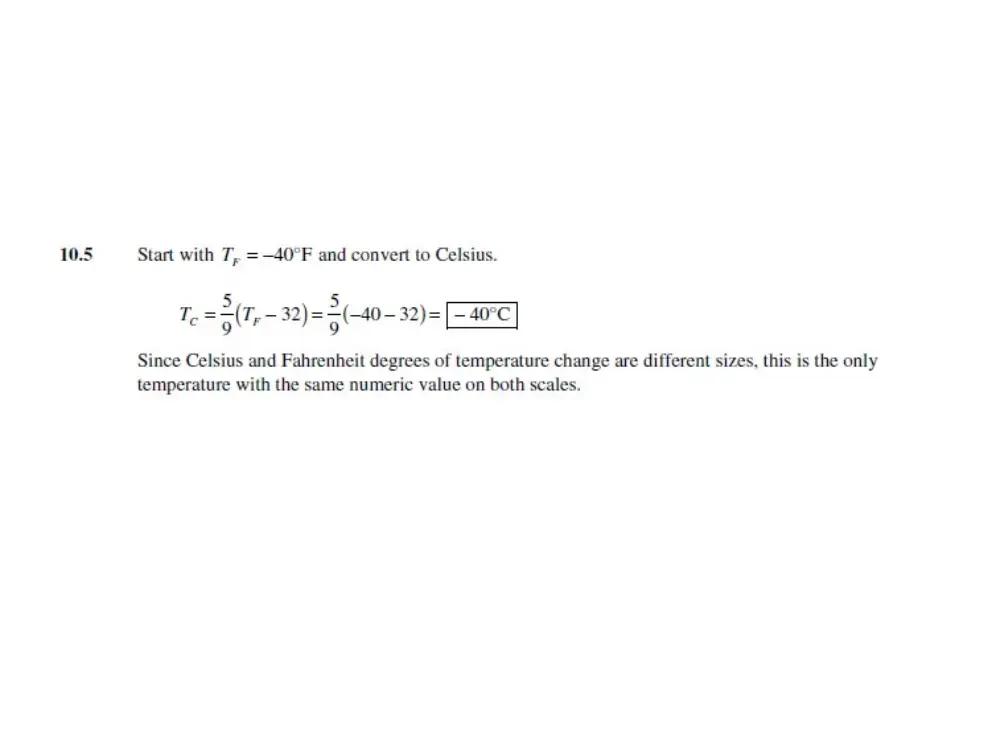
10.5 Start with T, =—40°F and convert to Celsius.
‘= (7, —32)= =(-40- 32)=[-40°C
Since Celsius and Fahrenheit degrees of temperature change are different sizes, this is the only
temperature with the same numeric value on both scales.
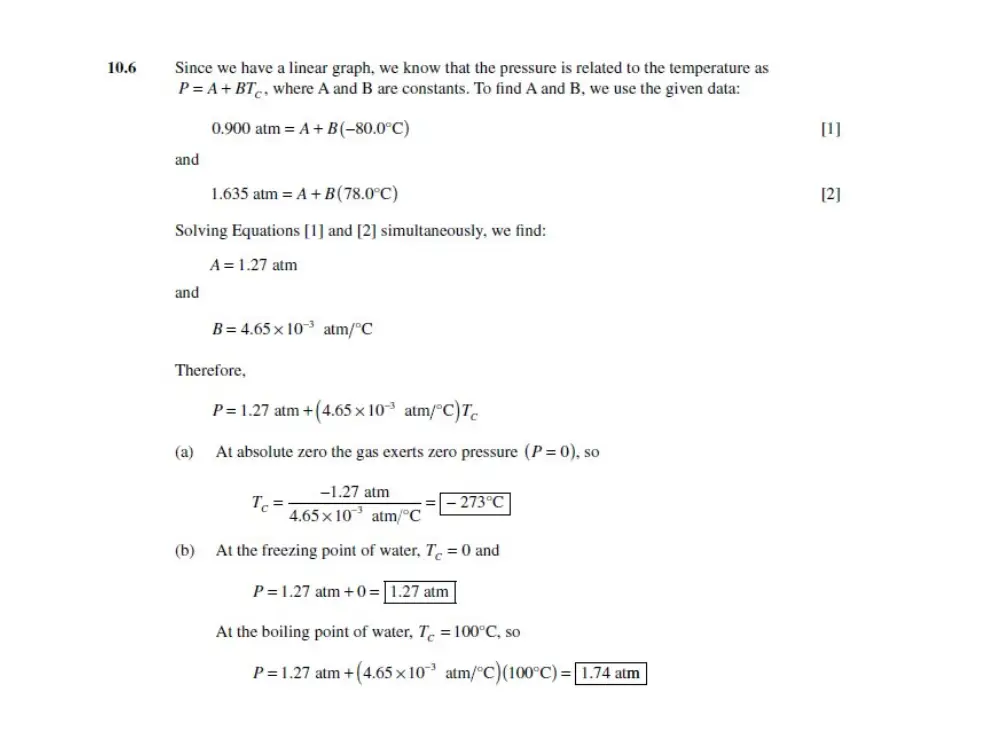
10.6
Since we have a linear graph, we know that the pressure is related to the temperature as
P=A+BT,, where A and B are constants. To find A and B, we use the given data:
0.900 atm = A + B(-80.0°C)
and
1.635 atm = A + B(78.0°C)
Solving Equations [1] and [2] simultaneously, we find:
A=1.27 atm
and
B=4.65x10™ atm/°C
Therefore,
P=1.27 atm+(4.65x 10⁷ atm/°C)T,
(a) At absolute zero the gas exerts zero pressure (P = 0), so
_ —1.27 atm ¥.
4.65107 atm/°C
T,
c
— 273°C
(b) At the freezing point of water, T, = 0 and
P=1.27 atm+0=|1.27 atm
At the boiling point of water, T,, = 100°C, so
P=1.27 atm+(4.65x10™ atm/°C)(100°C) = [1.74 atm
(1)
[2]
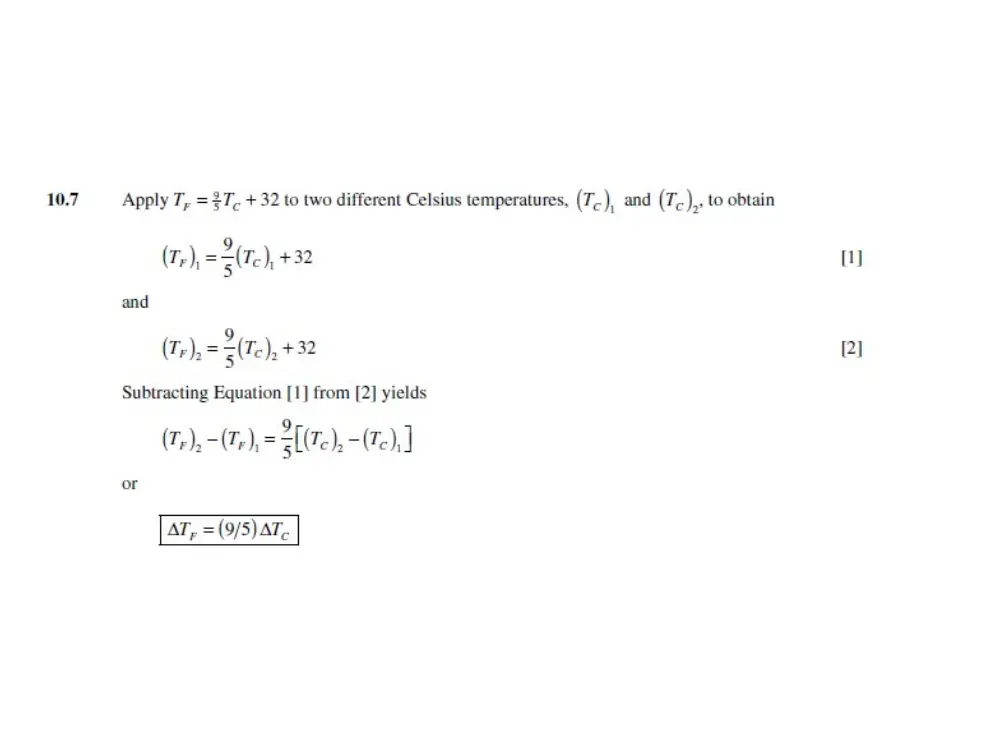
10.7 Apply T, =27T,, +32 to two different Celsius temperatures, (T.), and (T,. e; to obtain
(T;),= (Te ), +32 [1]
and
9
(Tr), = sll); +32 [2]
Subtracting Equation [1] from [2] yields
(T,), -(T;), — =[(r), ay (T.), |
or
AT, = (9/5) AT,
10.8 (a) Using the result of Problem 10.7 above, AT, = 3(AT, )= 3(57.0)°C =BL7°C].
(b) AT, = (Tega $273.15) — (Teas, 273-15) = (Tear — Teun )= AT: = LT K
cul
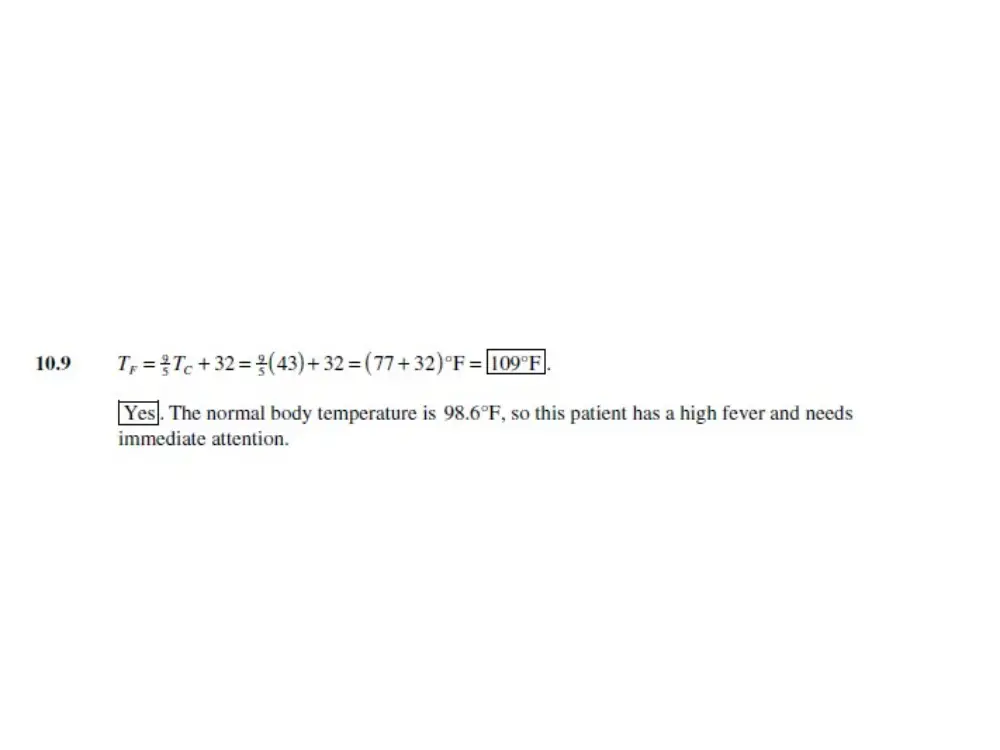
10.9 Ty =2T, +32 =2(43)+32 =(77+32)°F =[109°F].
Yes|. The normal body temperature is 98.6°F, so this patient has a high fever and needs
immediate attention.
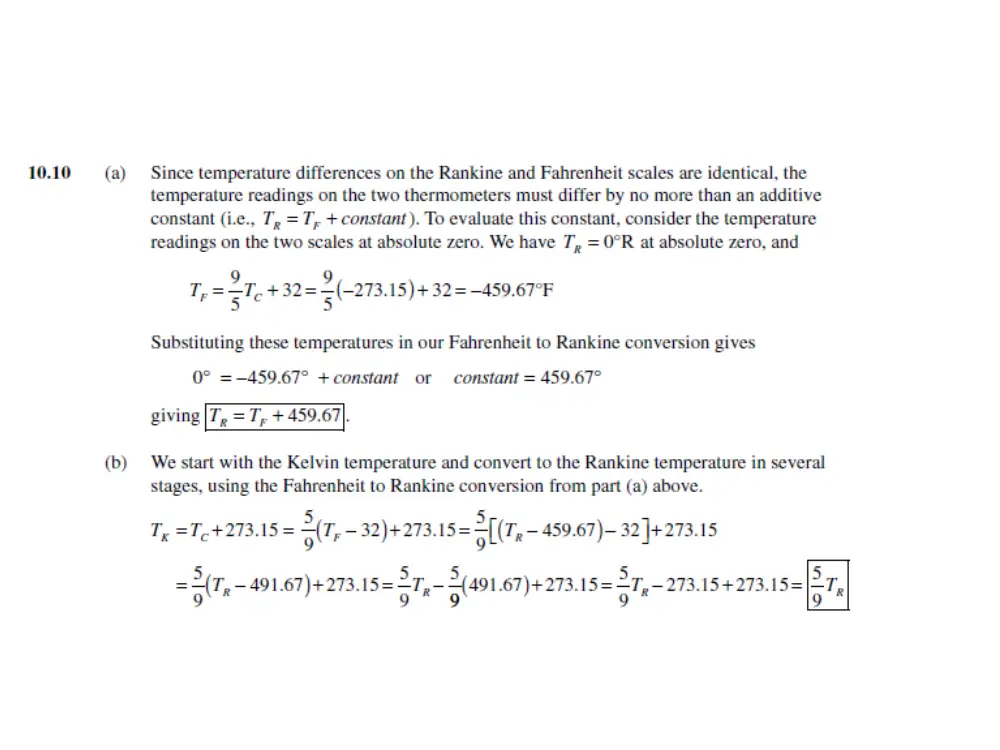
10.10
a)
_
(b)
Since temperature differences on the Rankine and Fahrenheit scales are identical, the
temperature readings on the two thermometers must differ by no more than an additive
constant (Le., 7, = 7, + constant). To evaluate this constant, consider the temperature
readings on the two scales at absolute zero. We have 7, = O0°R at absolute zero, and
9 9
T, =—T,, + 32=—(-273.15)+ 32=-459.67°F
5 5
Substituting these temperatures in our Fahrenheit to Rankine conversion gives
O° =—459.67° +constant or constant = 459.67°
giving |T, =7, + 459.67].
We start with the Kelvin temperature and convert to the Rankine temperature in several
stages, using the Fahrenheit to Rankine conversion from part (a) above.
Ty =T,.+273.15= =r, —32)+273. 5=[(7,- 459.67) — 32 ]+273.15
= (1, — 491.67)+273.15= oT, =(491 67)+273.15= 21, 273.15+273.15= aT,