
PHYS 204 Final, Fall 2005
American University of Beirut · Classical Physics for Life Sciences · 10 pages



More PHYS 204 files
Show the text of this final exam
American University of Beirut
Physics Department
PHYSICS 204
Fall 2005
Instructor: Prof. Tarek Ibrahim
FINAL EXAM
Print your name here:__________________________Student ID # _______________
Section_______________________________
Important instructions --please read carefully before you begin the exam.
Work each problem in part (B) on the sheet of paper provided (use the back of the same sheet of
necessary) and write your last name on the top of each page. This is essential, as the pages will
be separated for grading purposes.
Put a box around your final answer together with the correct units, but show your work
clearly in the spaces provided on each page.
A detachable formula sheet is included
as the last page of the exam. Please do
NOT hand it in with your work.
Part A (10 points)
Part B (40 points)
Total (50 points)
Part A: (10 points)
(1) As ice floats in water, about 10% of the ice floats above the surface of the water. If we float
some ice in a glass of water, what will happen to the water level as the ice melts?
a. The water level will rise 10% of the volume of the ice that melts.
b. The water level will rise, but not as much as the 10% indicated in answer A.
c. The water level will remain unchanged.
d. The water level will become lower.
(2) Spherical particles of density 2.0 g/cm
3 are shaken in a container of water (viscosity = 1.0
10
-3
3). The water is 8.0 cm deep and is allowed to stand for 30 minutes. What is the
radius of the largest particles still in suspension at that time?
-6 m
-6 m
-6 m
-6 m
(3) In cloud formation, water vapor turns into water droplets which get bigger and bigger until it
rains. This will cause the temperature of the air in the clouds to:
a. get warmer.
b. get cooler.
c. will not affect the temperature of the air in the clouds.
d. There is no air in clouds
(4) A 5-g lead bullet traveling horizontally in 20°C air at 300 m/s strikes a flat steel plate and
stops. What is the final temperature of the lead bullet? (Assume the bullet retains all heat.)
The melting point of lead is 327°C. The specific heat of lead is 128. J/kg⋅°C. The heat of
fusion of lead is
3 J/kg.
a. 227°C
b. 260°C
c. 293°C
d. 327°C
(5) Water spiders, although more dense than water, can walk on the surface of a pond.
Therefore:
a.
b. The liquid surface can exert forces which are not present in the interior of the liquid
c. Weight and mass are not proportional for living things
d. The spider uses the buoyant force due to displaced air
(6) A tuning fork is sounded above a resonating tube (one end closed), which resonates at a
length of 0.200 m and again at 0.600 m. What is the frequency of the fork when the speed of
sound is taken to be 340 m/s?
a. 567 Hz
b. 425 Hz
c. 1 700 Hz
d. 950 Hz
(7) A ray of light in water (refractive index of 1.333) is incident on its surface (with air) at the
critical angle. Some oil (refractive index of 1.678) is now floated on the water. The angle between
the ray in the oil and the normal is:
a. 90
0
b. 49 0
c. 37 0
d. 53 0
(8) The object-lens distance, for a converging lens, is 40 cm. The inverted image is three
times the size of the object. To make the image five times, the size of the object-lens
distance must be changed to:
a. 36 cm
b. 54 cm
c. 60 cm
d. 72 cm
(9)
-slit apparatus is set up. The source wavelength is 430 nm and the
double-slit spacing is 0.040 mm. At what distance from the double slits should the
screen be placed if the spacing between alternating bright fringes is to be 2.4 cm?
a. 1.6 m
b. 2.2 m
c. 2.4 m
d. 2.9 m
(10) A light spectrum is formed on a screen using a diffraction grating. The entire
apparatus (source, grating and screen) is now immersed in a liquid of index
1.333. As a result, the pattern on the screen:
a. remains the same
b. spreads out
c. crowds together
d. becomes reversed, with the previously blue end becoming red
Part B: (40 points)
Answer five questions out of the following
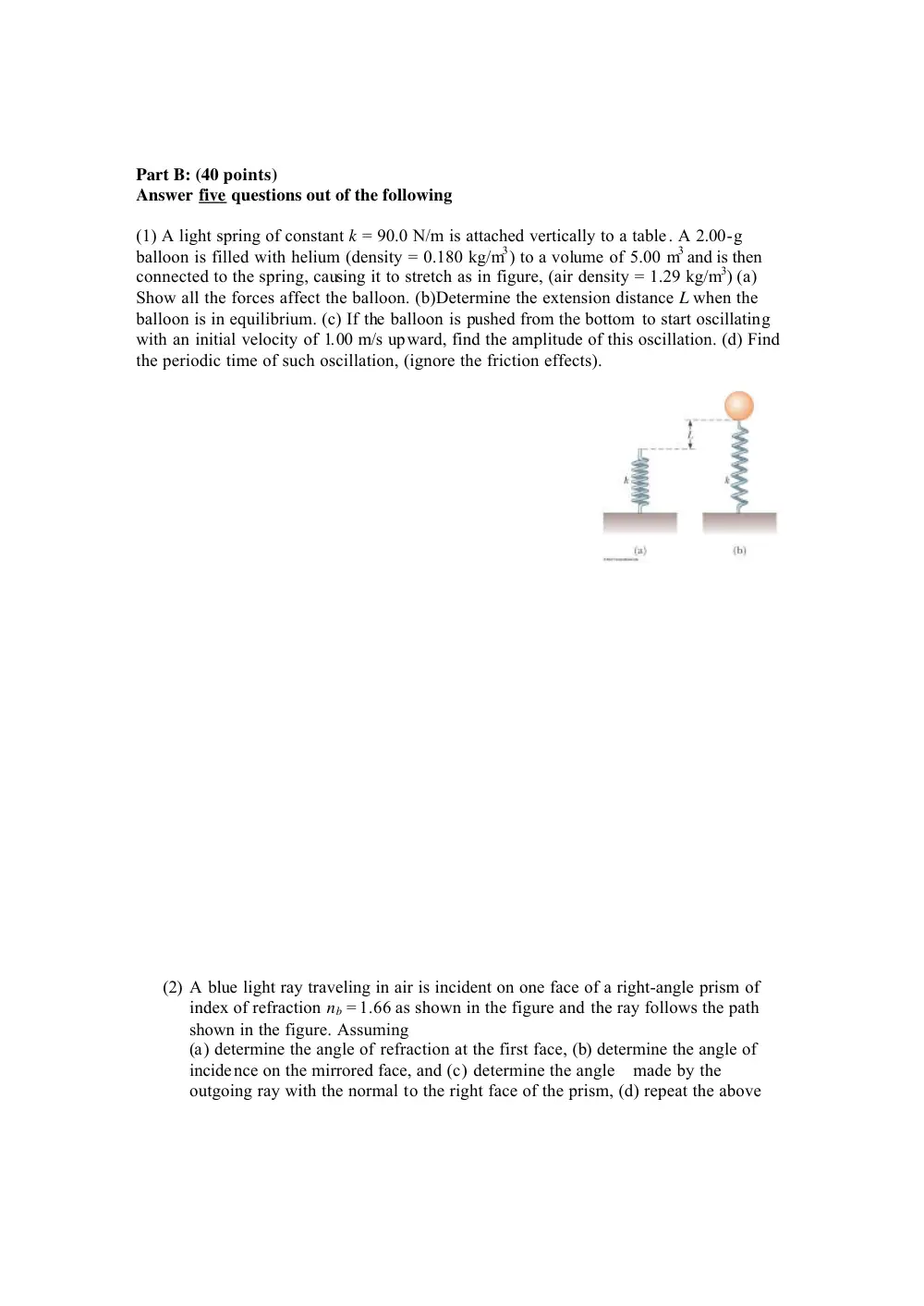
(1) A light spring of constant k = 90.0 N/m is attached vertically to a table. A 2.00-g
balloon is filled with helium (density = 0.180 kg/m3) to a volume of 5.00 m3 and is then
connected to the spring, causing it to stretch as in figure, (air density = 1.29 kg/m3) (a)
Show all the forces affect the balloon. (b)Determine the extension distance L when the
balloon is in equilibrium. (c) If the balloon is pushed from the bottom to start oscillating
with an initial velocity of 1.00 m/s upward, find the amplitude of this oscillation. (d) Find
the periodic time of such oscillation, (ignore the friction effects).
(2) A blue light ray traveling in air is incident on one face of a right-angle prism of
index of refraction nb = 1.66 as shown in the figure and the ray follows the path
shown in the figure. Assuming
(a) determine the angle of refraction at the first face, (b) determine the angle of
incidence on the mirrored face, and (c) determine the angle made by the
outgoing ray with the normal to the right face of the prism, (d) repeat the above
parts for a red light ray whose refractive index nr = 1.62. (The angles drawn in the
figure are not equal to the actual ones!)
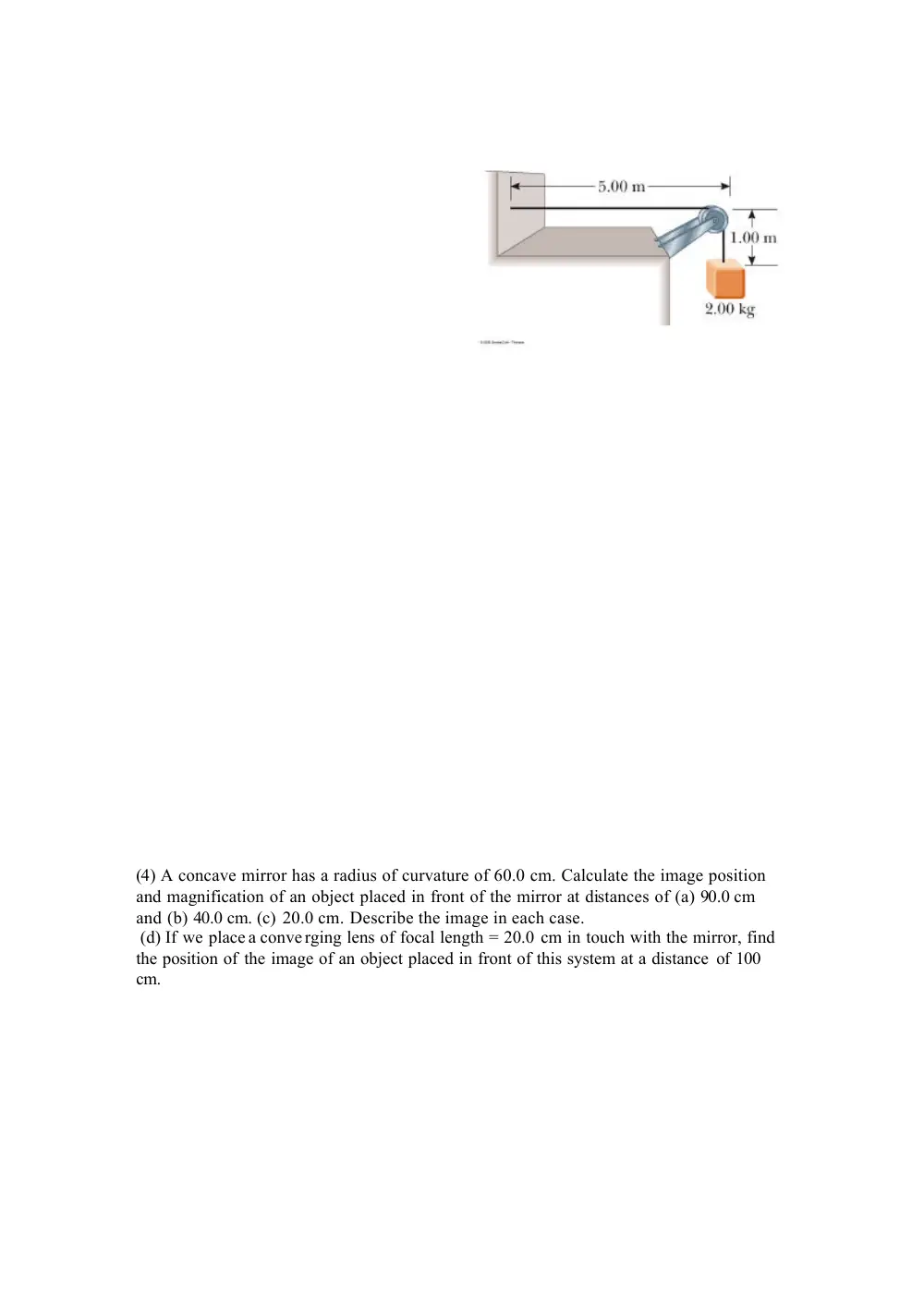
(3) A uniform string has a mass of 0.030 kg and a length of 6.00 m. Tension is
maintained in the string by suspending a block of mass 2.00 kg from one end. (a)
Find the speed of a transverse wave pulse on this string. (b) Find the time it takes
the pulse to travel from the wall to the pulley. (c) Find the fundamental frequency
of this string when it vibrates. (d) Repeat part (c) if we immerse the block whose
density is 2.00 g/cm3 in water, whose density is 1.00 g/cm3.
(4) A concave mirror has a radius of curvature of 60.0 cm. Calculate the image position
and magnification of an object placed in front of the mirror at distances of (a) 90.0 cm
and (b) 40.0 cm. (c) 20.0 cm. Describe the image in each case.
(d) If we place a converging lens of focal length = 20.0 cm in touch with the mirror, find
the position of the image of an object placed in front of this system at a distance of 100
cm.
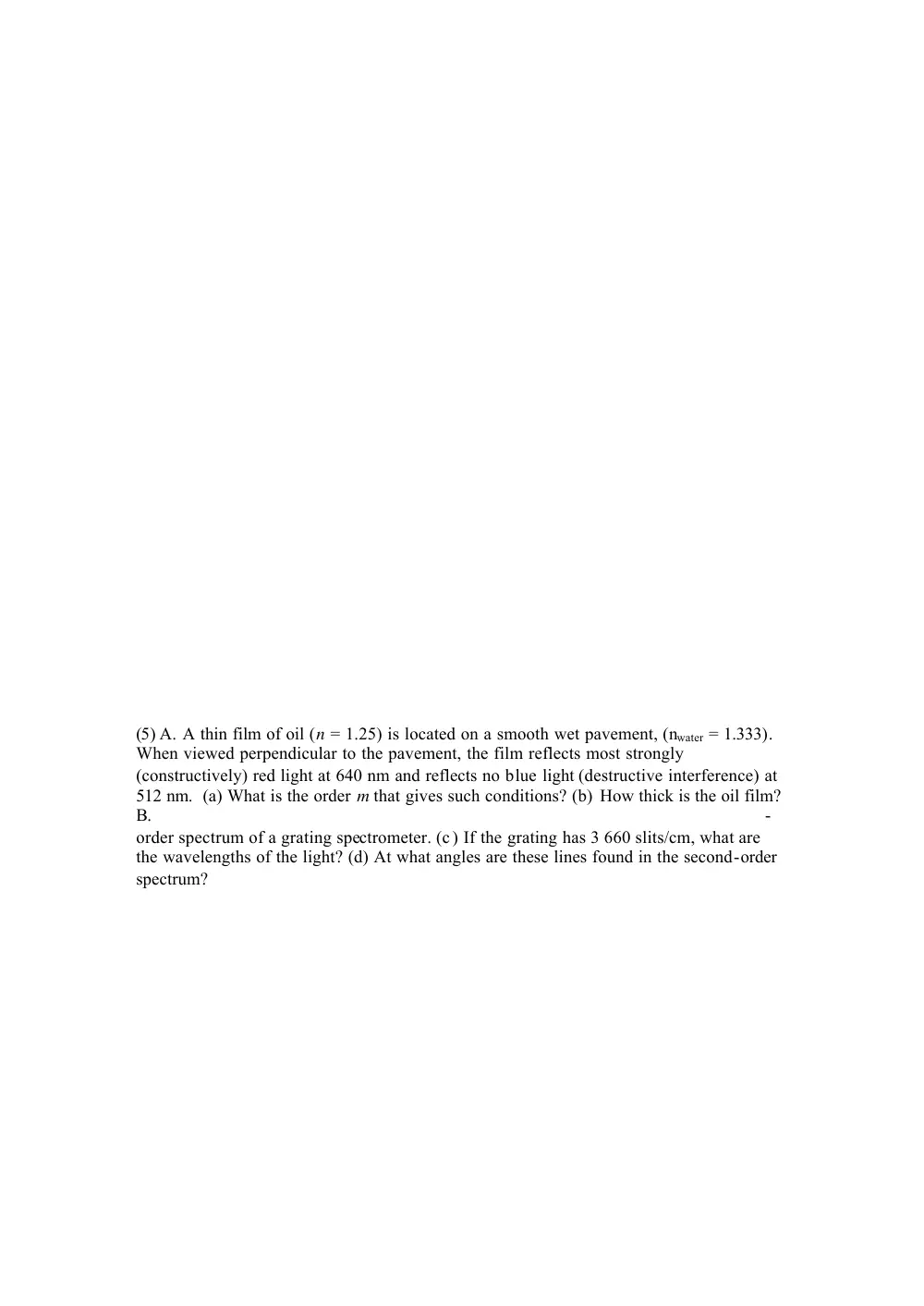
(5) A. A thin film of oil (n = 1.25) is located on a smooth wet pavement, (nwater = 1.333).
When viewed perpendicular to the pavement, the film reflects most strongly
(constructively) red light at 640 nm and reflects no blue light (destructive interference) at
512 nm. (a) What is the order m that gives such conditions? (b) How thick is the oil film?
B.
-
order spectrum of a grating spectrometer. (c) If the grating has 3 660 slits/cm, what are
the wavelengths of the light? (d) At what angles are these lines found in the second-order
spectrum?
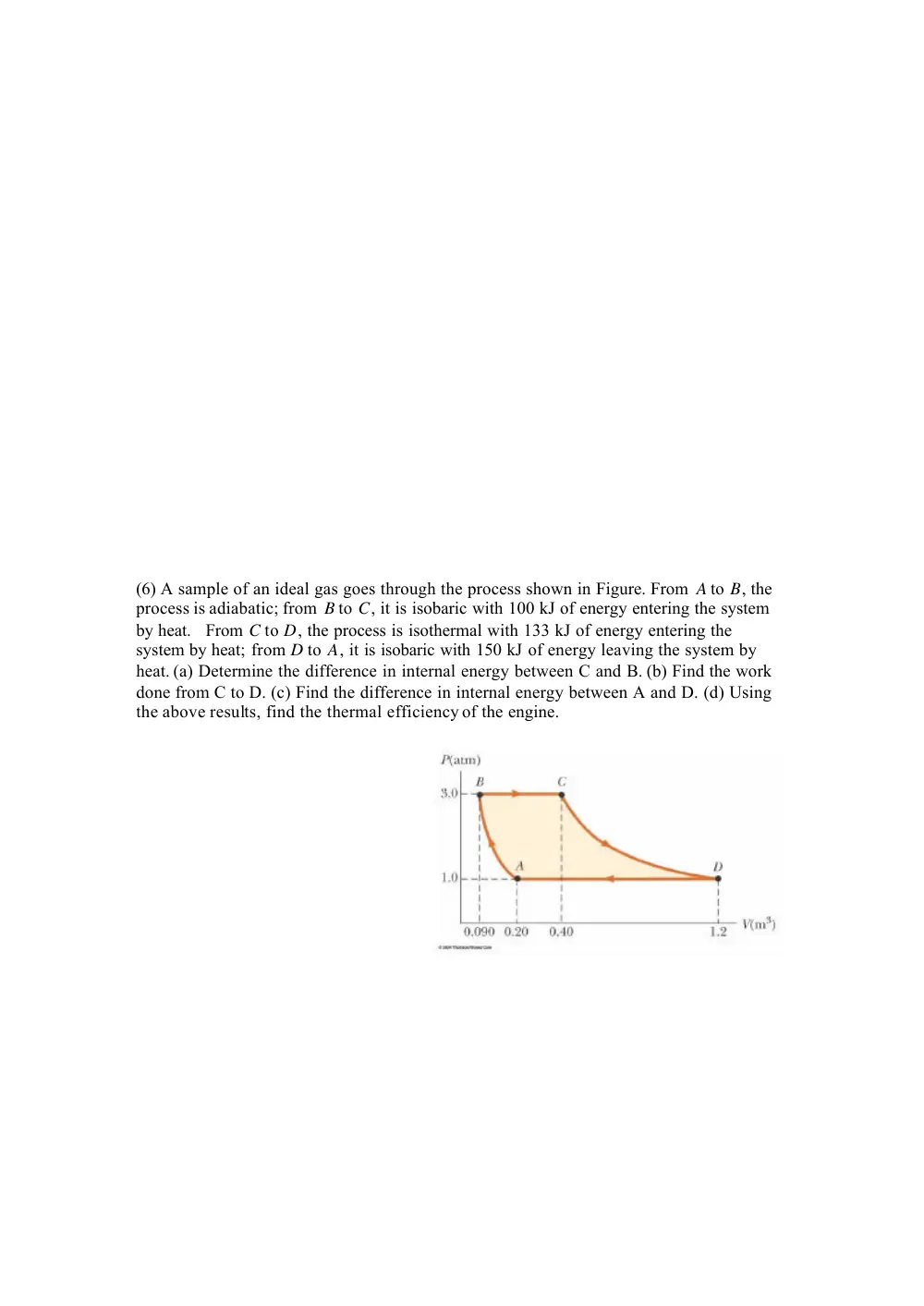
(6) A sample of an ideal gas goes through the process shown in Figure. From A to B, the
process is adiabatic; from B to C, it is isobaric with 100 kJ of energy entering the system
by heat. From C to D, the process is isothermal with 133 kJ of energy entering the
system by heat; from D to A, it is isobaric with 150 kJ of energy leaving the system by
heat. (a) Determine the difference in internal energy between C and B. (b) Find the work
done from C to D. (c) Find the difference in internal energy between A and D. (d) Using
the above results, find the thermal efficiency of the engine.
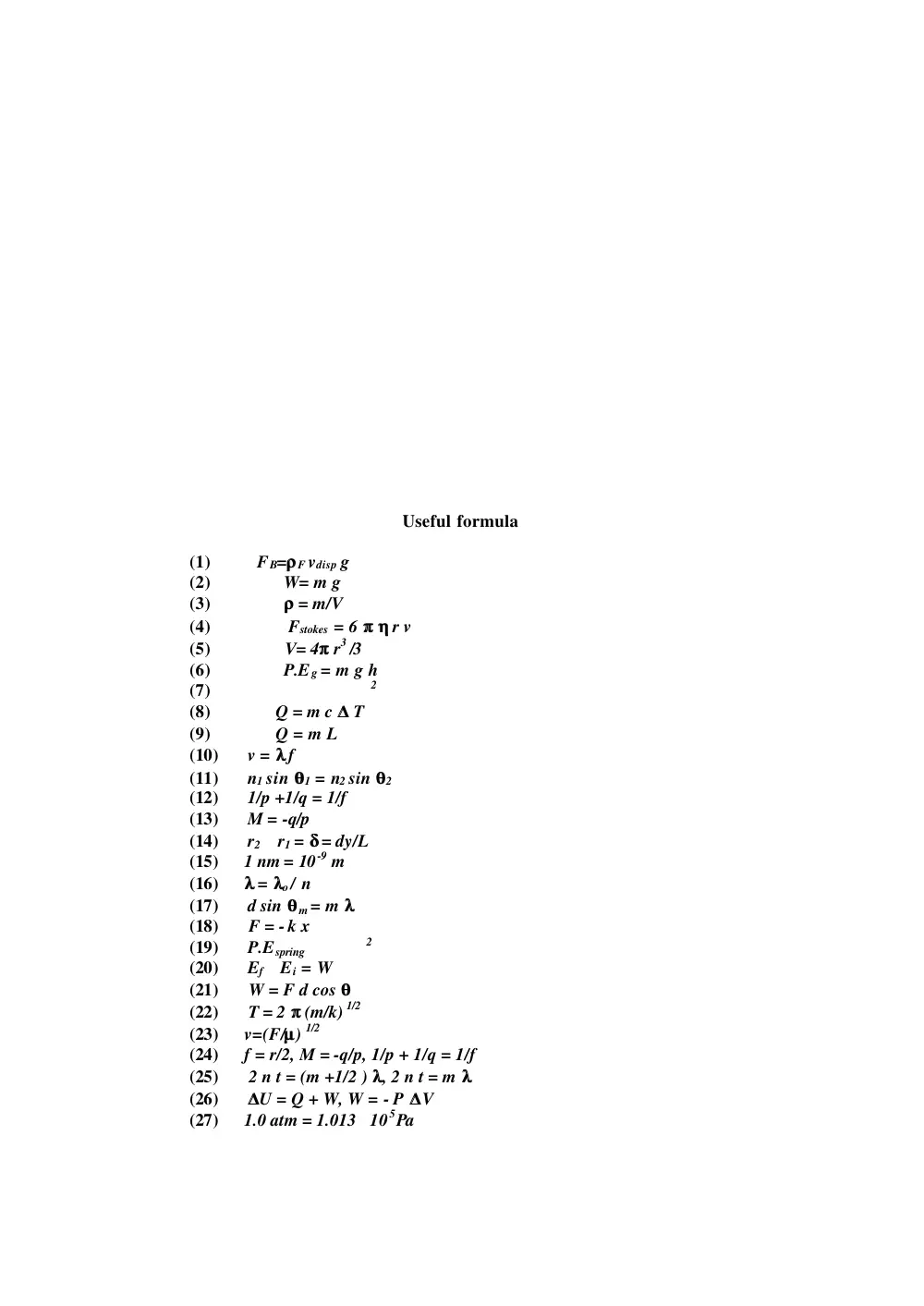
Useful formula
(1)
FB=ρρ F vdisp g
(2) W= m g
(3) ρρ = m/V
(4) Fstokes = 6 ππ ηη r v
(5) V= 4ππ r3 /3
(6) P.E g = m g h
(7)
2
(8) Q = m c ∆∆ T
(9) Q = m L
(10)
v = λλ f
(11)
n1 sin θθ1 = n2 sin θθ2
(12)
1/p +1/q = 1/f
(13)
M = -q/p
(14)
r2 r1 = δδ = dy/L
(15)
1 nm = 10 -9 m
(16)
λλ = λλo / n
(17)
d sin θθ m = m λλ
(18)
F = - k x
(19)
P.Espring
2
(20)
Ef Ei = W
(21)
W = F d cos θθ
(22)
T = 2 ππ (m/k) 1/2
(23)
v=(F/µµ) 1/2
(24)
f = r/2, M = -q/p, 1/p + 1/q = 1/f
(25)
2 n t = (m +1/2 ) λλ, 2 n t = m λλ
(26)
∆∆U = Q + W, W = - P ∆∆V
(27)
1.0 atm = 1.013 10 5Pa
(28)
e = Weng / |Qh|
(29)
U = n Cv T