
PHYS 210 Final, Fall 2005
American University of Beirut · Introductory Physics II · 7 pages
More PHYS 210 files
- Final Collection Finals with Solution · Spring 2017Final exam · with solutionView
- Final 2015 · Spring 2017Final examView
- Final · Fall 2014Final examView
- Final · Fall 2014Final examView
- Final · Fall 2014Final examView
- Final With Solutions · Fall 2013Final exam · with solutionView
- Final · Fall 2011Final examView
- Final · Fall 2011Final examView
Show the text of this final exam
AUB
Physics Department
Phys 210
Final exam
Jan. 23, 2006
Time:100 min
Name :________________________________
ID. NO :________________________________
Major
:________________________________
INFO:
♦No make up of this exam
No make up of this exam
♦All questions are obligatory. Only one answer can be
crossed in case of multiple questions. Your answer
must be identified uniquely.
Page Grade
3)____________
4)____________
5)____________
6)____________
7) ____________
Total:
/ 22
/ 21
/ 35
/ 12
/ 10
4 questions
4 question
7 questions
Problem 1
problem2
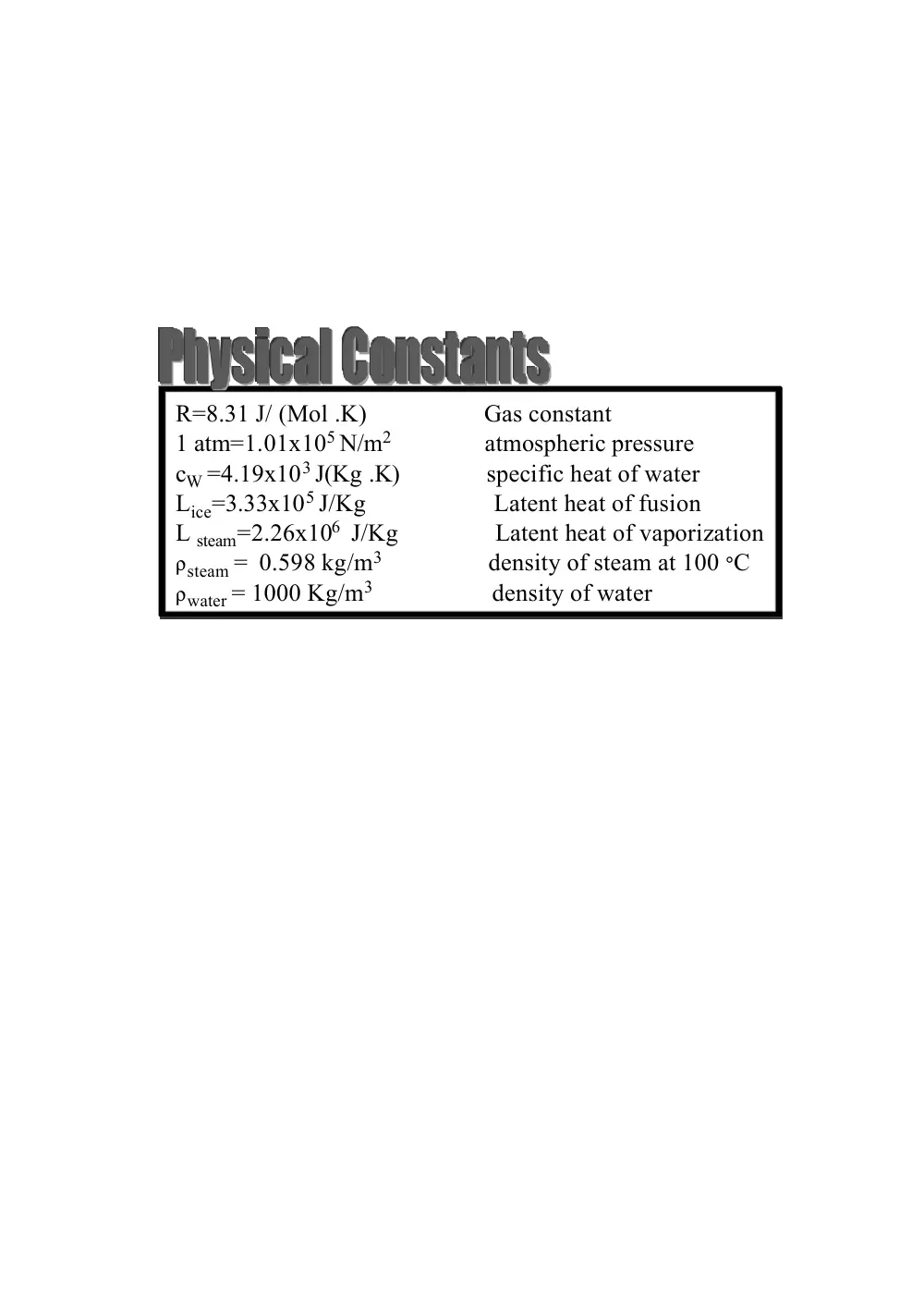
R=8.31 J/ (Mol .K) Gas constant
1 atm=1.01x10⁵ N/m2 atmospheric pressure
cW =4.19x10³ J(Kg .K) specific heat of water
Lice=3.33x10⁵ J/Kg Latent heat of fusion
L steam=2.26x10⁶ J/Kg Latent heat of vaporization
ρsteam = 0.598 kg/m3 density of steam at 100 °C
ρwater = 1000 Kg/m3 density of water
♥ (5 points) Five moles of an ideal gas undergo free expansion from an initial volume
of 20 cm 3 to a final volume of 100 cm3. The change in entropy ∆S of this gas (in J / K) is:
) 71
67
)
) 67
) 52
191
)
e
d
c
b
a
♥(5 points) Three engines operates between reservoirs separated by 300 K.
Engine A operates between 1000 K and 700 K.
Engine B operates between 800 K and 500 K.
Engine C operates between 600 K and 300 K.
a) All these engines have the same efficiency , because the temperature
difference is the same
b) Engine A has the highest efficiency
c) Engine C has the highest efficiency
d) Engine B has the highest efficiency
♥ (6 points)
1) Which of the following is true for the entropy change (∆S) of a system that
undergoes a reversible adiabatic process?
a) ∆ S < 0 b) ∆ S> 0 c) ∆ S =0
2) What is the answer if the process is adiabatic but irreversible?
a) ∆ S < 0 b) ∆ S> 0 c) ∆ S =0
Score: 22
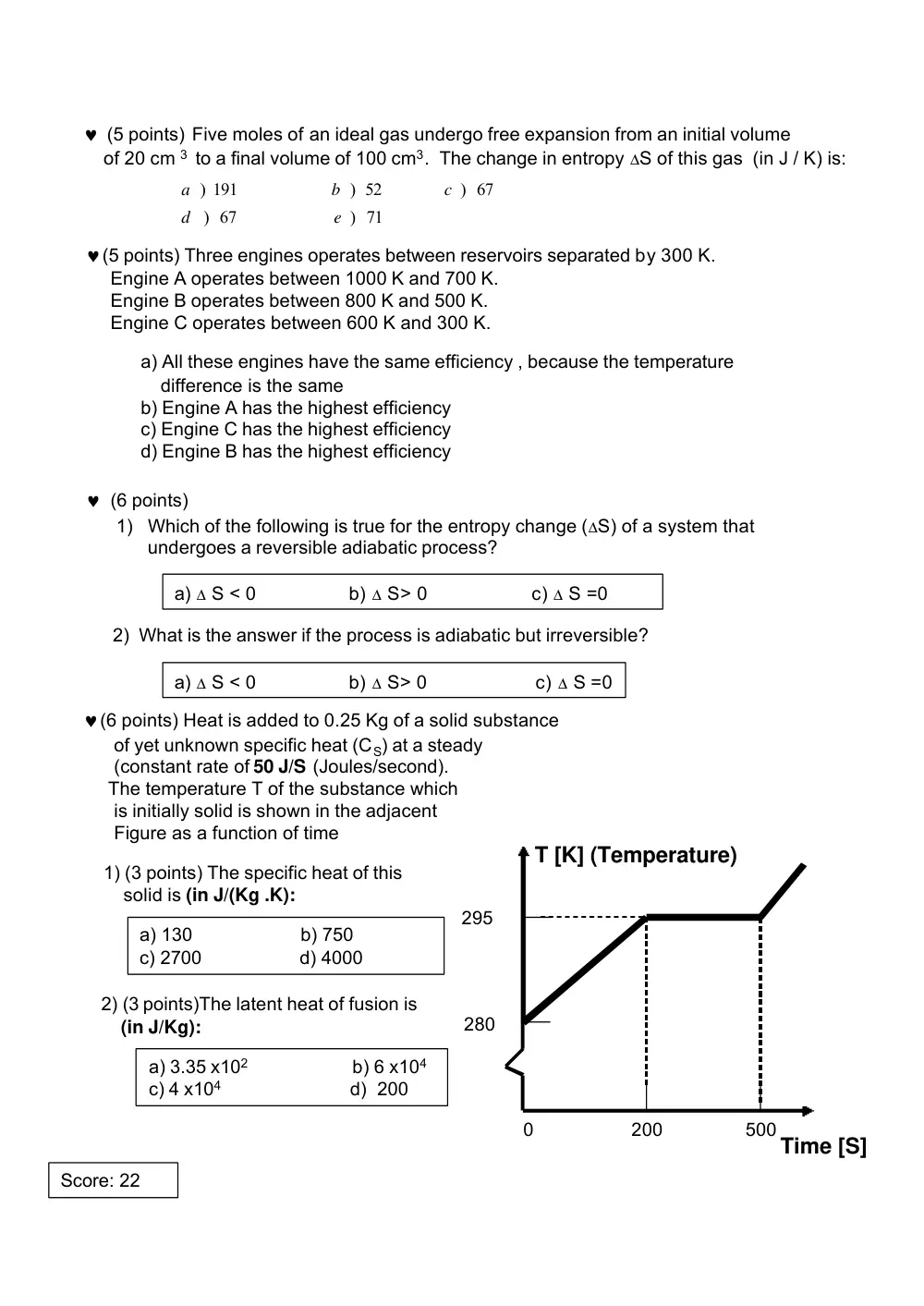
♥(6 points) Heat is added to 0.25 Kg of a solid substance
of yet unknown specific heat (CS) at a steady
(constant rate of 50 J/S (Joules/second).
The temperature T of the substance which
is initially solid is shown in the adjacent
Figure as a function of time
T [K] (Temperature)
280
0
200
500 Time [S]
295
1) (3 points) The specific heat of this
solid is (in J/(Kg .K):
a) 130 b) 750
c) 2700 d) 4000
2) (3 points)The latent heat of fusion is
(in J/Kg):
a) 3.35 x10²
b) 6 x10⁴
c) 4 x10⁴ d) 200
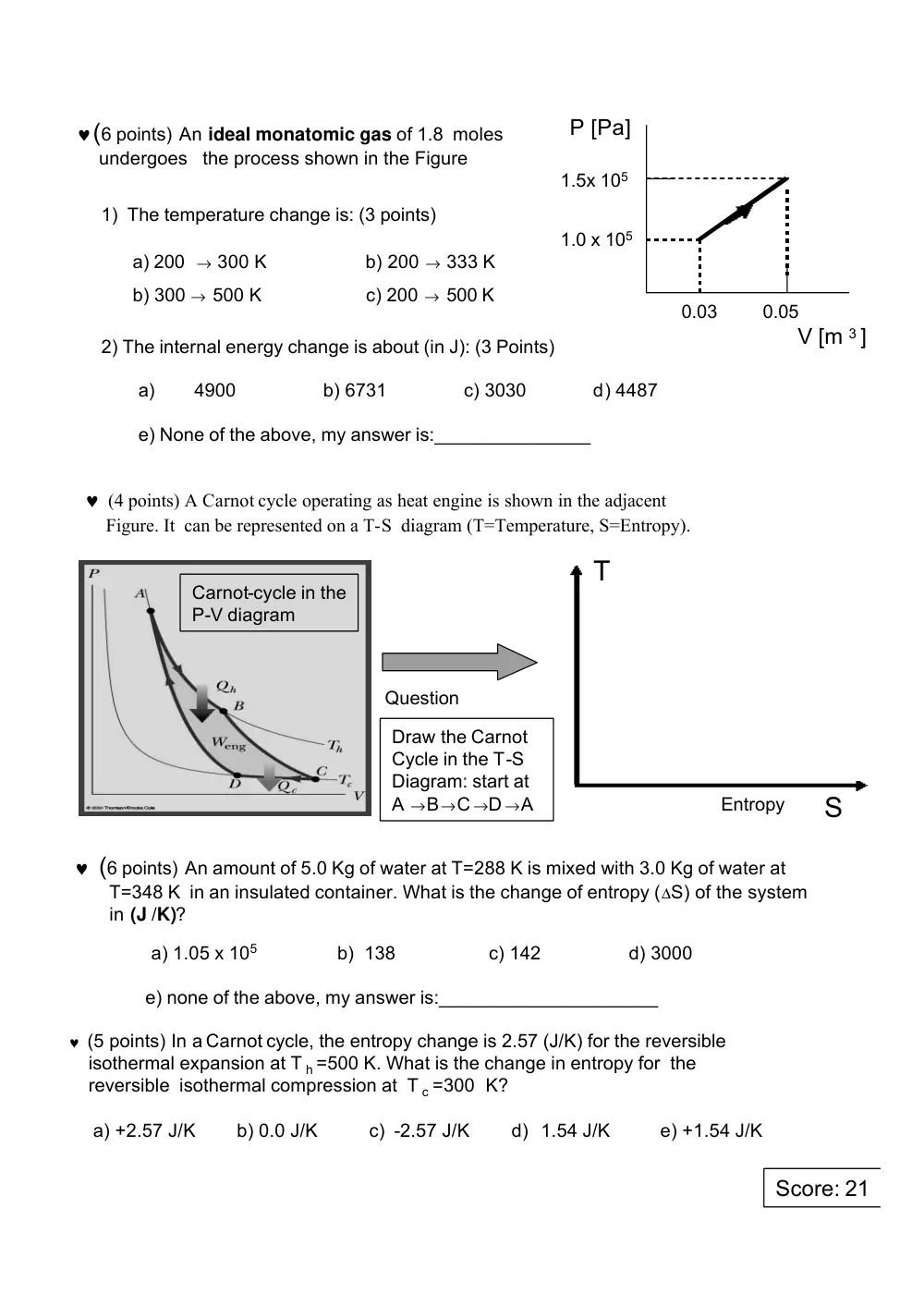
♥(6 points) An ideal monatomic gas of 1.8 moles
undergoes the process shown in the Figure
1.5x 10⁵
1.0 x 10⁵
V [m 3 ]
P [Pa]
0.03
0.05
1) The temperature change is: (3 points)
a) 200 → 300 K b) 200 → 333 K
b) 300 → 500 K c) 200 → 500 K
2) The internal energy change is about (in J): (3 Points)
a)
4900 b) 6731 c) 3030 d) 4487
e) None of the above, my answer is:_______________
♥ (4 points) A Carnot cycle operating as heat engine is shown in the adjacent
Figure. It can be represented on a T-S diagram (T=Temperature, S=Entropy).
T
S
Draw the Carnot
Cycle in the T-S
Diagram: start at
A →B→C →D →A
Question
Carnot-cycle in the
P-V diagram
♥ (6 points) An amount of 5.0 Kg of water at T=288 K is mixed with 3.0 Kg of water at
T=348 K in an insulated container. What is the change of entropy (∆S) of the system
in (J /K)?
a) 1.05 x 10⁵ b) 138 c) 142 d) 3000
e) none of the above, my answer is:_____________________
Score: 21
♥ (5 points) In a Carnot cycle, the entropy change is 2.57 (J/K) for the reversible
isothermal expansion at T h =500 K. What is the change in entropy for the
reversible isothermal compression at T c =300 K?
a) +2.57 J/K b) 0.0 J/K c) -2.57 J/K d) 1.54 J/K e) +1.54 J/K
Entropy
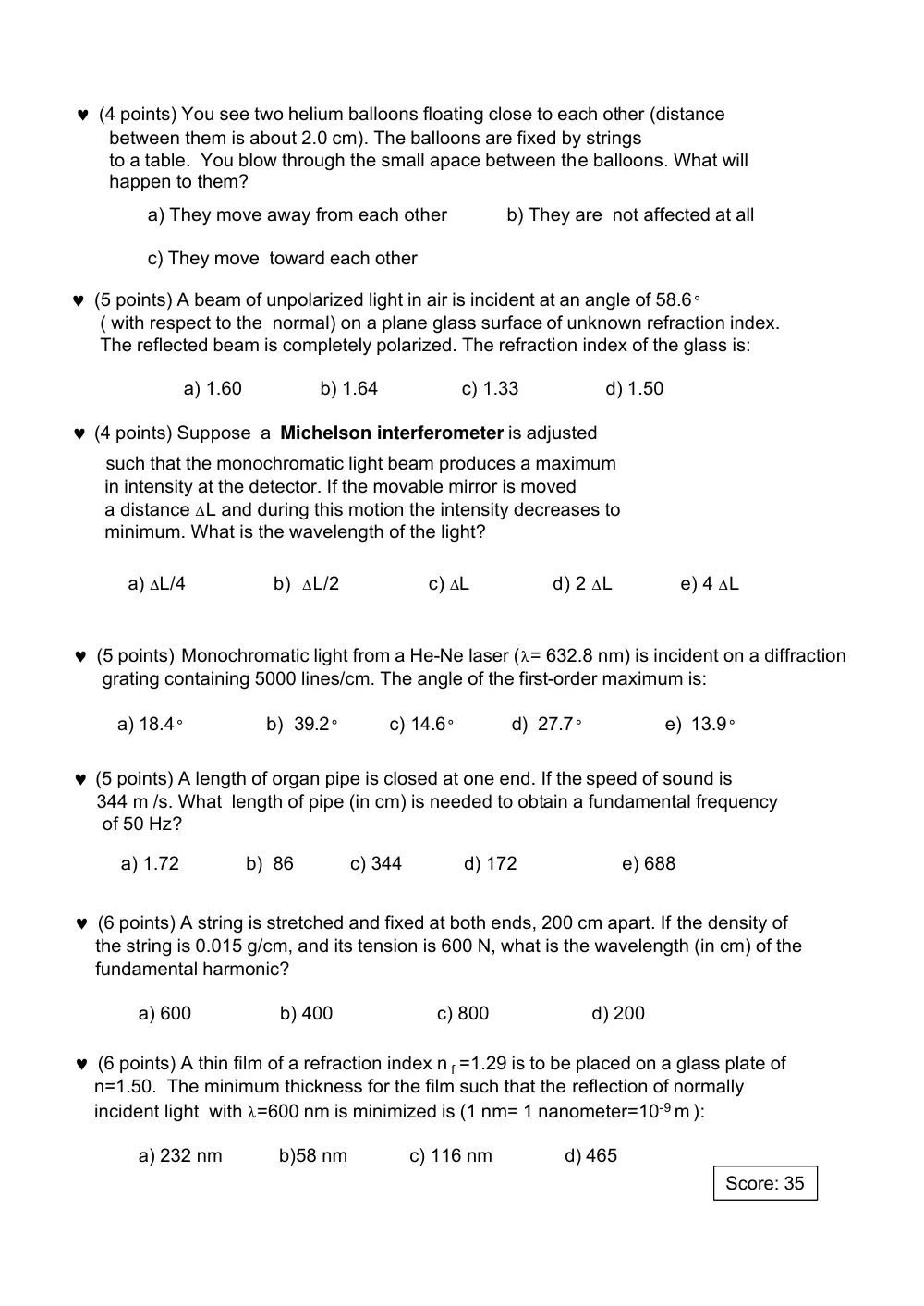
♥ (4 points) You see two helium balloons floating close to each other (distance
between them is about 2.0 cm). The balloons are fixed by strings
to a table. You blow through the small apace between the balloons. What will
happen to them?
a) They move away from each other b) They are not affected at all
c) They move toward each other
♥ (4 points) Suppose a Michelson interferometer is adjusted
such that the monochromatic light beam produces a maximum
in intensity at the detector. If the movable mirror is moved
a distance ∆L and during this motion the intensity decreases to
minimum. What is the wavelength of the light?
a) ∆L/4 b) ∆L/2 c) ∆L d) 2 ∆L e) 4 ∆L
♥ (5 points) Monochromatic light from a He-Ne laser (λ= 632.8 nm) is incident on a diffraction
grating containing 5000 lines/cm. The angle of the first-order maximum is:
a) 18.4°
b) 39.2°
c) 14.6°
d) 27.7°
e) 13.9°
♥ (5 points) A length of organ pipe is closed at one end. If the speed of sound is
344 m /s. What length of pipe (in cm) is needed to obtain a fundamental frequency
of 50 Hz?
a) 1.72 b) 86 c) 344 d) 172
e) 688
♥ (5 points) A beam of unpolarized light in air is incident at an angle of 58.6 °
( with respect to the normal) on a plane glass surface of unknown refraction index.
The reflected beam is completely polarized. The refraction index of the glass is:
a) 1.60 b) 1.64 c) 1.33
d) 1.50
♥ (6 points) A string is stretched and fixed at both ends, 200 cm apart. If the density of
the string is 0.015 g/cm, and its tension is 600 N, what is the wavelength (in cm) of the
fundamental harmonic?
a) 600 b) 400 c) 800
d) 200
♥ (6 points) A thin film of a refraction index n f =1.29 is to be placed on a glass plate of
n=1.50. The minimum thickness for the film such that the reflection of normally
incident light with λ=600 nm is minimized is (1 nm= 1 nanometer=10-9 m ):
a) 232 nm b)58 nm c) 116 nm d) 465
Score: 35
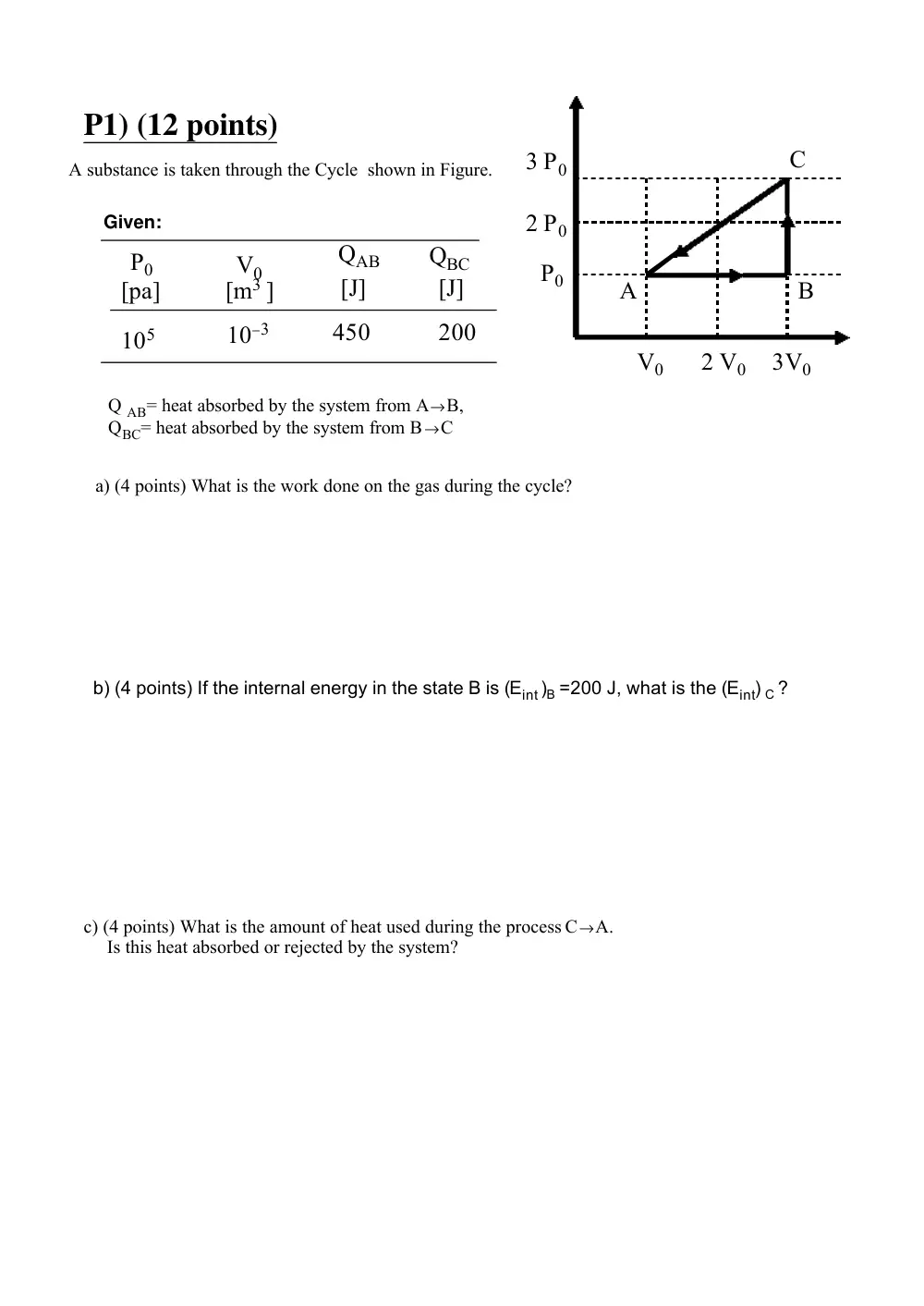
A substance is taken through the Cycle shown in Figure.
A
B
C
P0
2 P0
3 P0
V0
3V0
2 V0
P0
V0
QAB
QBC
105
[pa]
[m3 ]
[J]
[J]
10−3
450
200
Q AB= heat absorbed by the system from A→B,
QBC= heat absorbed by the system from B→C
a) (4 points) What is the work done on the gas during the cycle?
c) (4 points) What is the amount of heat used during the process C→A.
Is this heat absorbed or rejected by the system?
P1) (12 points)
Given:
b) (4 points) If the internal energy in the state B is (Eint )B =200 J, what is the (Eint) C ?
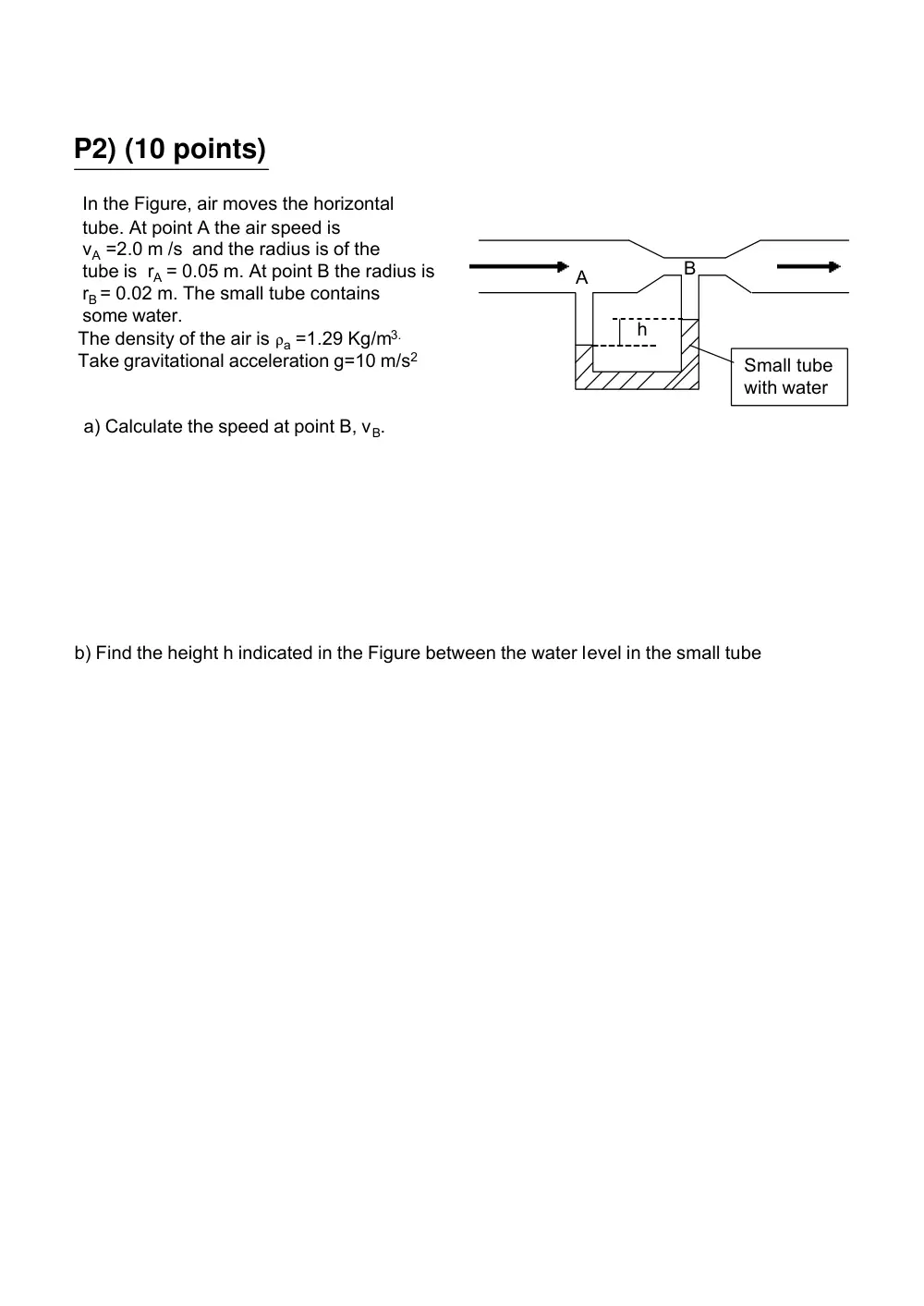
P2) (10 points)
h
A
B
In the Figure, air moves the horizontal
tube. At point A the air speed is
vA =2.0 m /s and the radius is of the
tube is rA = 0.05 m. At point B the radius is
rB = 0.02 m. The small tube contains
some water.
The density of the air is ρa =1.29 Kg/m3.
Take gravitational acceleration g=10 m/s2
Small tube
with water
a) Calculate the speed at point B, vB.
b) Find the height h indicated in the Figure between the water level in the small tube