
PHYS 210 Final, Fall 2007
American University of Beirut · Introductory Physics II · 7 pages

More PHYS 210 files
- Final Collection Finals with Solution · Spring 2017Final exam · with solutionView
- Final 2015 · Spring 2017Final examView
- Final · Fall 2014Final examView
- Final · Fall 2014Final examView
- Final · Fall 2014Final examView
- Final With Solutions · Fall 2013Final exam · with solutionView
- Final · Fall 2011Final examView
- Final · Fall 2011Final examView
Show the text of this final exam
You are logged in as rabih Mahmasani (Logout)
E-Learning Time Remaining
1:59:2:
\~
(info Results | Preview Y Edit )
This quiz has been locked so that it is only accessible from certain locations. Your computer is not on an allowed subnet. As teacher you are allowed to preview anyway.
Note: This quiz is not currently available to your students
Preview Finalexam-f0708-v2
Students will see this quiz in a secure window
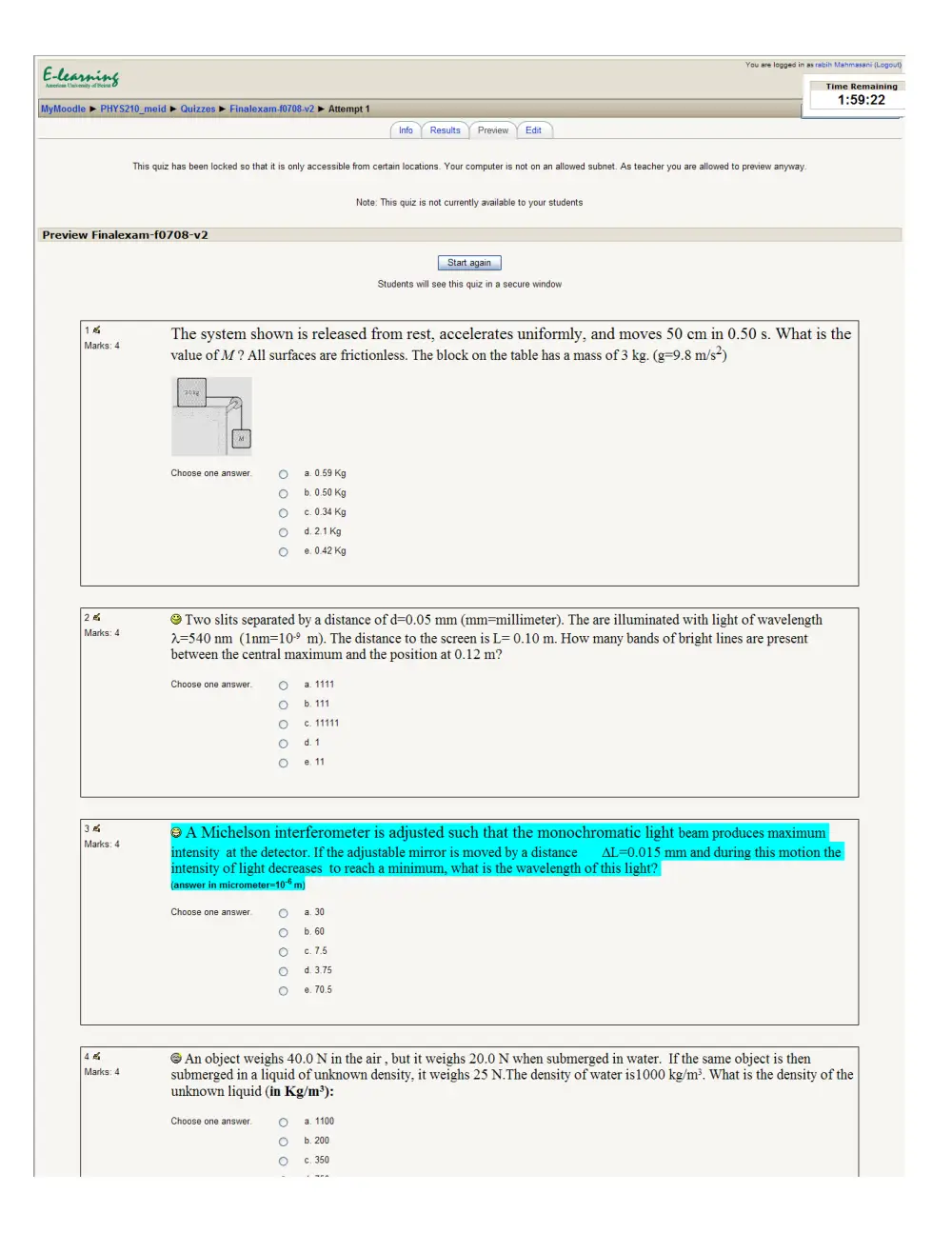
an 4 The system shown is released from rest, accelerates uniformly, and moves 50 cm in 0.50 s. What is the
jarks: sae
value of M? All surfaces are frictionless. The block on the table has a mass of 3 kg. (g=9.8 m/s)
Choose one answer. © a. 0.59Kg
© b.0.50Kg
© ¢.034Kg
O 421K
© 2.042Kg
28 © Two slits separated by a distance of d=0.05 mm (mm=millimeter). The are illuminated with light of wavelength
Me 2=540 nm (1nm=10*° m). The distance to the screen is L= 0.10 m. How many bands of bright lines are present
between the central maximum and the position at 0.12 m?
Choose one answer. oO alt
oO bi
O «111
Oo 41
oO et
38
Marks: 4
Choose one answer. oO a3
Oo »60
O «75
OQ 4375
O e705
48 @ An object weighs 40.0 N in the air , but it weighs 20.0 N when submerged in water. If the same object is then
Marks: 4 submerged in a liquid of unknown density, it weighs 25 N.The density of water is1000 kg/m}. What is the density of the
unknown liquid (in Kg/m?):
Choose one answer. © a. 1100
© b.200
© ©3680
O aru
Oo e500
58 ® A closed-open organ pipe of length 2.6 m contains air for which the speed of sound is 340 m/s. The frequency of the
Marks: 4 standing wave of the third harmonics is:
Choose one answer Qa. 98Hz
OQ b.33Hz
O ©. 196Hz
©. 4.163 Hz
O e.63Hz
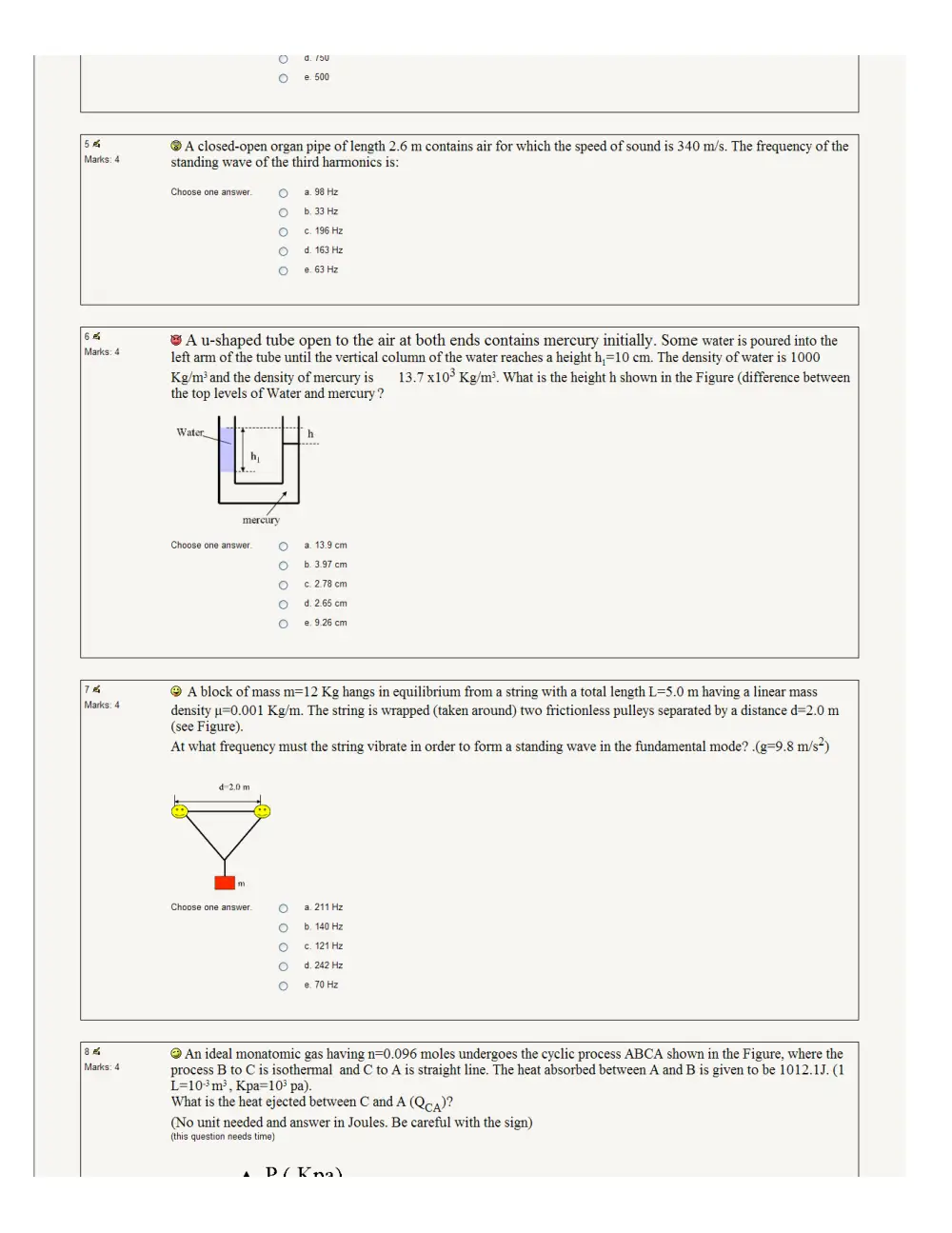
6 & A u-shaped tube open to the air at both ends contains mercury initially. Some water is poured into the
Mts left arm of the tube until the vertical column of the water reaches a height h,=10 cm. The density of water is 1000
Kg/m' and the density of mercury is 13.7 x10³ Kg/m3. What is the height h shown in the Figure (difference between
the top levels of Water and mercury ?
Choose one answer © a139cm
© b.397cm
© ¢.278cm
OQ 4.265cm
© 29.26cm
74 ® A block of mass m=12 Kg hangs in equilibrium from a string with a total length L=5.0 m having a linear mass
Marks: 4 density 1=0.001 Kg/m. The string is wrapped (taken around) two frictionless pulleys separated by a distance d=2.0 m
(see Figure).
At what frequency must the string vibrate in order to form a standing wave in the fundamental mode? .(g=9.8 m/s*)
Choose one answer. = Qa. 211 Hz
© »b. 140 Hz
O ¢12thz
OQ 4.242Hz
O e.70Hz
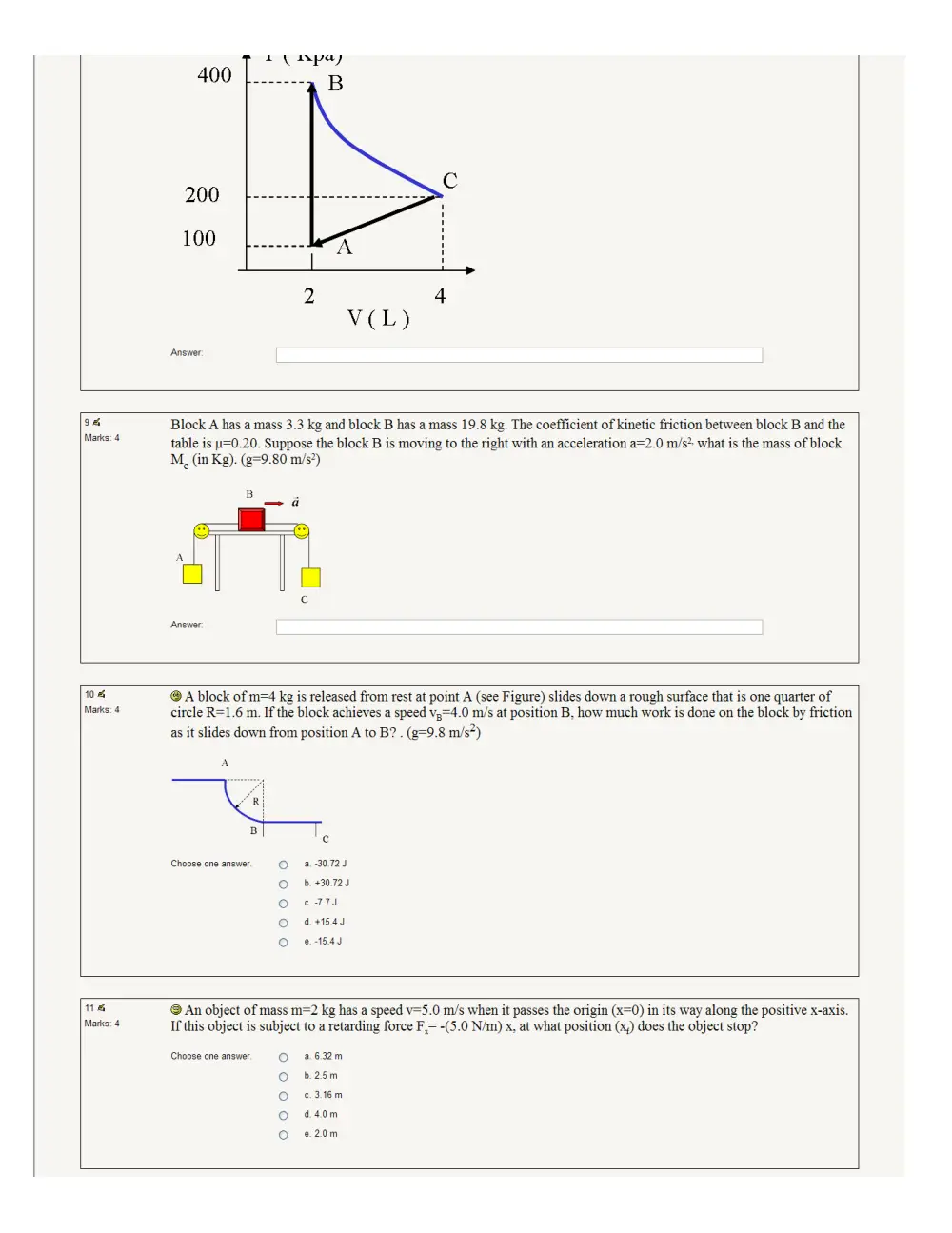
an 1 @ An ideal monatomic gas having n=0.096 moles undergoes the cyclic process ABCA shown in the Figure, where the
jarks:
process B to C is isothermal and C to A is straight line. The heat absorbed between A and B is given to be 1012.1J. (1
L=10*? m3, Kpa=10? pa).
What is the heat ejected between C and A (Qc.4)?
(No unit needed and answer in Joules. Be careful with the sign)
(this question needs time)
a Df Kuna
- -. \ axpa)
400 |. B
200 [-------
100 [ow K
Answer:
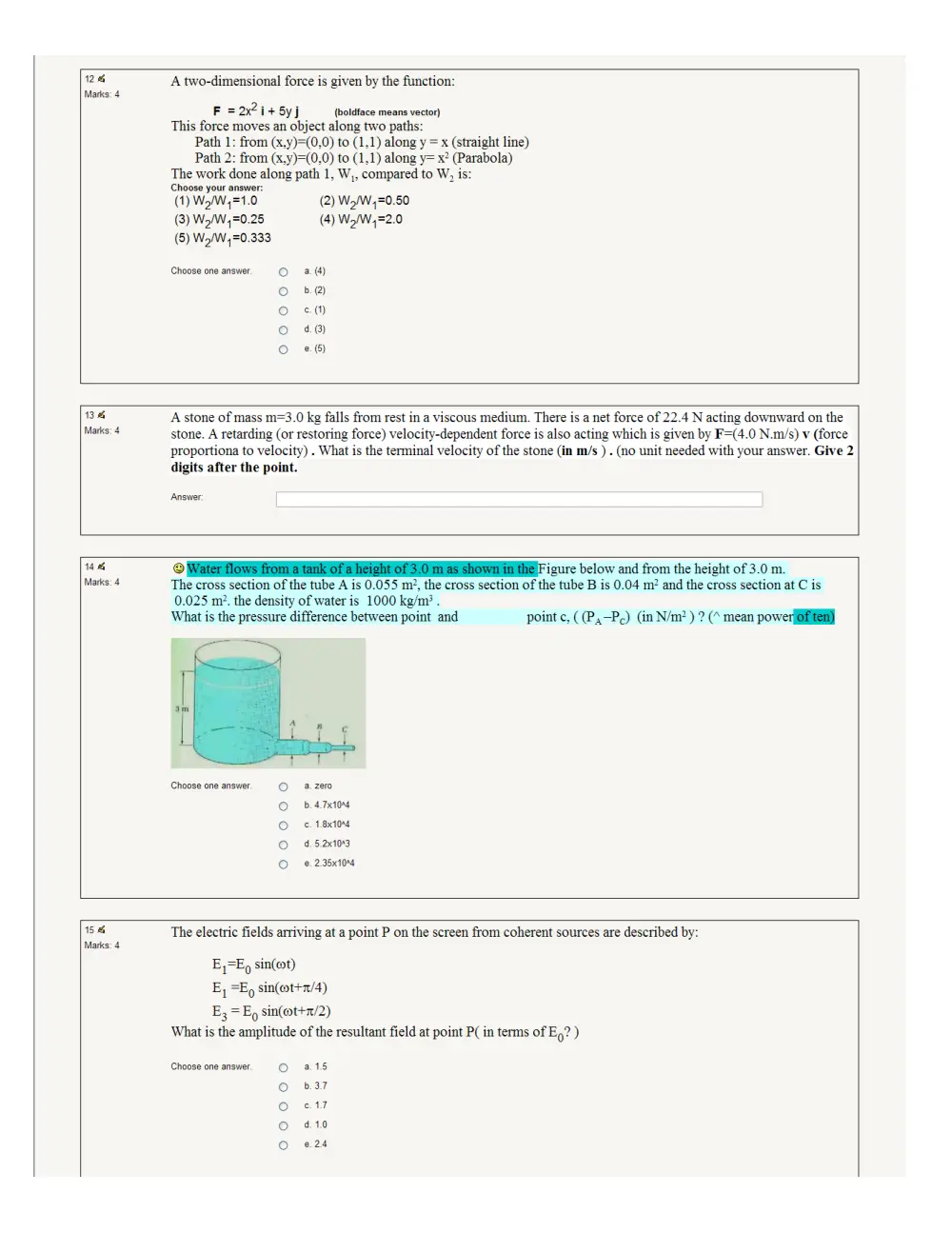
94 Block A has a mass 3.3 kg and block B has a mass 19.8 kg. The coefficient of kinetic friction between block B and the
MBs table is 1»=0.20. Suppose the block B is moving to the right with an acceleration a=2.0 m/s what is the mass of block
M, (in Kg). (g=9.80 m/s”)
B
— a
A
c)
Answer:
104 @ A block of m=4 kg is released from rest at point A (see Figure) slides down a rough surface that is one quarter of
Marks: 4 circle R=1.6 m. If the block achieves a speed v,=4.0 m/s at position B, how much work is done on the block by friction
as it slides down from position A to B? . (g=9.8 m/s”)
A
Choose one answer. OQ a-30.72J
© b.+3072U
O c-T17
OQ 44154)
O e-154J
14 @ An object of mass m=2 kg has a speed v=5.0 m/s when it passes the origin (x=0) in its way along the positive x-axis.
Marks: 4
If this object is subject to a retarding force F = -(5.0 N/m) x, at what position (x,) does the object stop?
Choose one answer. OQ a632m
OQ b25m
OQ ¢.3.16m
© 440m
QO e20m
128
Marks: 4
A two-dimensional force is given by the function:
F = 2x7i+ Syj {boldface means vector)
This force moves an object along two paths:
Path 1: from (x.y)=(0,0) to (1,1) along y = x (straight line)
Path 2: from (x.y)=(0,0) to (1,1) along y= x? (Parabola)
The work done along path 1, W,, compared to W, is:
Choose your answer:
(1) Wo/W4=1.0 (2) Wo/W=0.50
(3) Wo/W4=0.25 (4) WoW =2.0
(5) WoW =0.333
Choose one answer. a. (4)
b. (2)
c. (1)
d. (3)
e. (6)
oo00o0°0
13.4
Marks: 4
A stone of mass m=3.0 kg falls from rest in a viscous medium. There is a net force of 22.4 N acting downward on the
stone. A retarding (or restoring force) velocity-dependent force is also acting which is given by F=(4.0 N.m/s) v (force
proportiona to velocity) . What is the terminal velocity of the stone (in m/s ) . (no unit needed with your answer. Give 2
digits after the point.
Answer:
144
Marks: 4
© (ATER RIOWS Htoinla ano alNEISHE OF SIO asl SHOW MAME) Figure below and from the height of 3.0 m.
The cross section of the tube A is 0.055 m/, the cross section of the tube B is 0.04 m? and the cross section at C is
0.025 m2. the density of water is 1000 kg/m? .
What is the pressure difference between point and point c, ((P,—P,) (in N/m? ) ? (* mean powerf@ftten)
Choose one answer.
a. zero
b. 4.7x10%4
c. 1.8x10"4
d. 5.2x10*3
oo0o0°0
e@. 235x104
15%
Marks: 4
The electric fields arriving at a point P on the screen from coherent sources are described by:
E,=E sin(ot)
E, =E sin(@t+7/4)
E,=E, sin(@tt+z/2)
What is the amplitude of the resultant field at point P( in terms of Ep? )
a15
b.3.7
c.17
d.1.0
e24
Choose one answer.
oo00o0°0
164
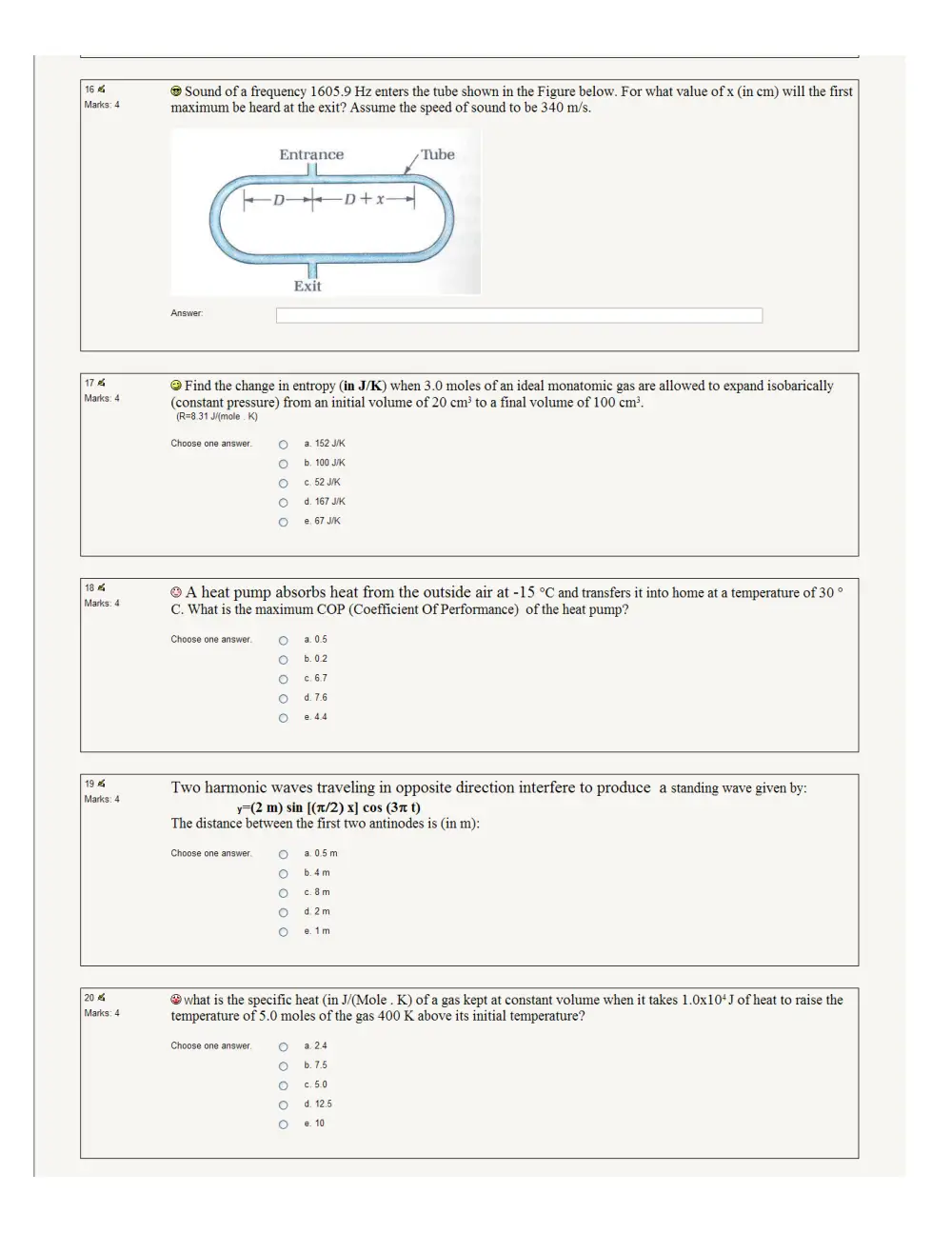
© Sound of a frequency 1605.9 Hz enters the tube shown in the Figure below. For what value of x (in cm) will the first
Marks: 4 maximum be heard at the exit? Assume the speed of sound to be 340 m/s.
Entrance Tube
Answer
74 @ Find the change in entropy (in J/KK) when 3.0 moles of an ideal monatomic gas are allowed to expand isobarically
[ELSE (constant pressure) from an initial volume of 20 cm! to a final volume of 100 cm’.
(R=8.31 Ji(mole . K)
Choose one answer Qa. 182K
fe) b. 100 JK
© ¢.82JiK
O 4. 167JK
Oo e67JiK
i ‘ 4 © A heat pump absorbs heat from the outside air at -15 °C and transfers it into home at a temperature of 30 °
ans C. What is the maximum COP (Coefficient Of Performance) of the heat pump?
Choose one answer. © a0
OQ b02
O ©67
O 476
O e44
ve F Two harmonic waves traveling in opposite direction interfere to produce a standing wave given by:
as y=(2 m) sin [(x0/2) x] cos (32 t)
The distance between the first two antinodes is (in m):
Choose one answer. 9 a. 0.8m
OQ b4m
O 8m
OQ 42m
O e1m
208 @ what is the specific heat (in J/(Mole . K) of a gas kept at constant volume when it takes 1.0x10*J of heat to raise the
Marks: 4
temperature of 5.0 moles of the gas 400 K above its initial temperature?
Choose one answer. =O
oooo°o
a
b.
c.
24
75
5.0
12.5
10
218 @ A 0.40-kg particle moves under the influence of a single conservative force. At point A where the particle has a speed
Marks: 4 of 10 m/s, the potential energy associated with the conservative force is +40 J. As the particle moves from A to B, the
force does +20 J of work on the particle. What is the value of the potential energy at point B?
Choose one answer. O a-40oJ
O b+)
oO c.+40J
O 4+65J
O e-20J
O £4204
228 A thin film has a coating with a refraction index n=1.50 and is on glass having n, =1.60. What is the smallest thickness
(EGSEG t (in nm)of this film for which destructive interference can take place by reflection?. The light used has a wavelength
671.4 nm falls nearly vertical on the film.
(answer: 2 digits after the point)
Answer
23 4 Two harmonic waves described by
Mating y, =Gem) sin(8x x/m+2z t/s)
y 2=@Gem) sin(87x/m — 27 t/s)
What is the smallest positive value of x (in cm) corresponding to a node of the resulting wave?
Choose one answer. © a025cm
© b.00cm
Oo c¢.60cm
© 4.1.5cm
© e3em
24 © Monochromatic light is used in a double-slit experiment where the slits are d=0.25 mm (mm=millimeter) apart and
Marks: 4 the distance to the screen is L=1.0 m. It is known that the spacing between two adjacent (neighboring) dark fringes is
2.2 mm. Assume the angle of deviation is small. What is the wavelength (in nanometer=nm) of the used light?
Choose one answer. Qa. 632nm
© b.550nm
© ¢.520nm
© 4.600nm
© 2. 650nm
25 & A standing wave with one antinodes exists on a 1.60-m long string which is held fixed at each end. The string vibrates at
Maria a frequency of 7.2 Hz.
The wave function of this standing wave is:
(1) y=A sin (45t) cos (3.9x) (2) y=A cos(45t) sin (1.96x)
(3) y=A sin(45t) cos (1.96x) (4) y=A cos (45t) sin (3.9x)
Choose one answer. Oo a(t)
oO 62
o ¢@)
o 4
@ Moodle Docs for this page
(Saxe without submitting Submit all and finish
You are logged in as rabih Mahmasani (Logout)
PHYS210_meid