
PHYS 210L Final, Spring 2003
American University of Beirut · Introductory Physics Laboratory II · 5 pages


More PHYS 210L files
- Notes Lab Summary for Final Revision (Fall 2015) · Fall 2015Final examView
- Final · Fall 2015Final examView
- Final 1st Exercise with Solution · Fall 2008Final exam · with solutionView
- Final · Fall 2007Final examView
- Notes Data Analysis Formula Paper · Spring 2017NotesView
- Lab Report · Fall 2017LabView
- Lab Spectrometer · Fall 2014LabView
- Useful File Summary · Spring 2014FileView
Show the text of this final exam
Physics 210L- Final exam
May 2003
Name:____________________________
Section number:___________________
Instructor’s Name:__________________
ID number:_________________________
DO NOT START THE EXAM BEFORE YOU ARE TOLD TO BEGIN
Grading
I
II
III
IV
TOTAL
The duration of this exam is 60 minutes.
No notes or books allowed.
Scientific calculators are allowed
All results should be given with the exact number of significant figures.
Check here if solution is continued in the back.
Score:_______
_
1
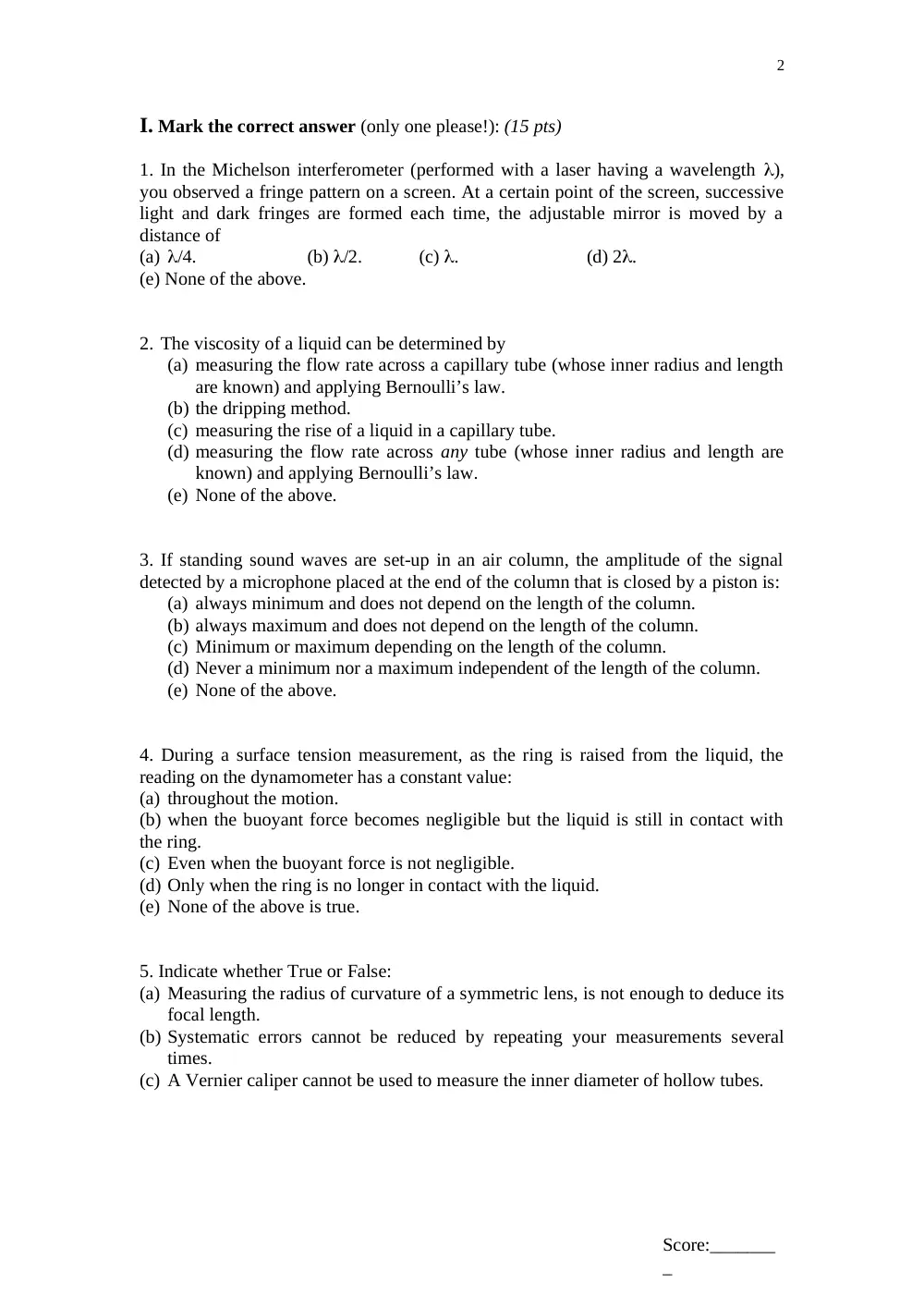
I. Mark the correct answer (only one please!): (15 pts)
1. In the Michelson interferometer (performed with a laser having a wavelength ),
you observed a fringe pattern on a screen. At a certain point of the screen, successive
light and dark fringes are formed each time, the adjustable mirror is moved by a
distance of
(a) /4.
(b) /2.
(c) .
(d) 2.
(e) None of the above.
2. The viscosity of a liquid can be determined by
(a) measuring the flow rate across a capillary tube (whose inner radius and length
are known) and applying Bernoulli’s law.
(b) the dripping method.
(c) measuring the rise of a liquid in a capillary tube.
(d) measuring the flow rate across any tube (whose inner radius and length are
known) and applying Bernoulli’s law.
(e) None of the above.
3. If standing sound waves are set-up in an air column, the amplitude of the signal
detected by a microphone placed at the end of the column that is closed by a piston is:
(a) always minimum and does not depend on the length of the column.
(b) always maximum and does not depend on the length of the column.
(c) Minimum or maximum depending on the length of the column.
(d) Never a minimum nor a maximum independent of the length of the column.
(e) None of the above.
4. During a surface tension measurement, as the ring is raised from the liquid, the
reading on the dynamometer has a constant value:
(a) throughout the motion.
(b) when the buoyant force becomes negligible but the liquid is still in contact with
the ring.
(c) Even when the buoyant force is not negligible.
(d) Only when the ring is no longer in contact with the liquid.
(e) None of the above is true.
5. Indicate whether True or False:
(a) Measuring the radius of curvature of a symmetric lens, is not enough to deduce its
focal length.
(b) Systematic errors cannot be reduced by repeating your measurements several
times.
(c) A Vernier caliper cannot be used to measure the inner diameter of hollow tubes.
Check here if solution is continued in the back.
Score:_______
_
2
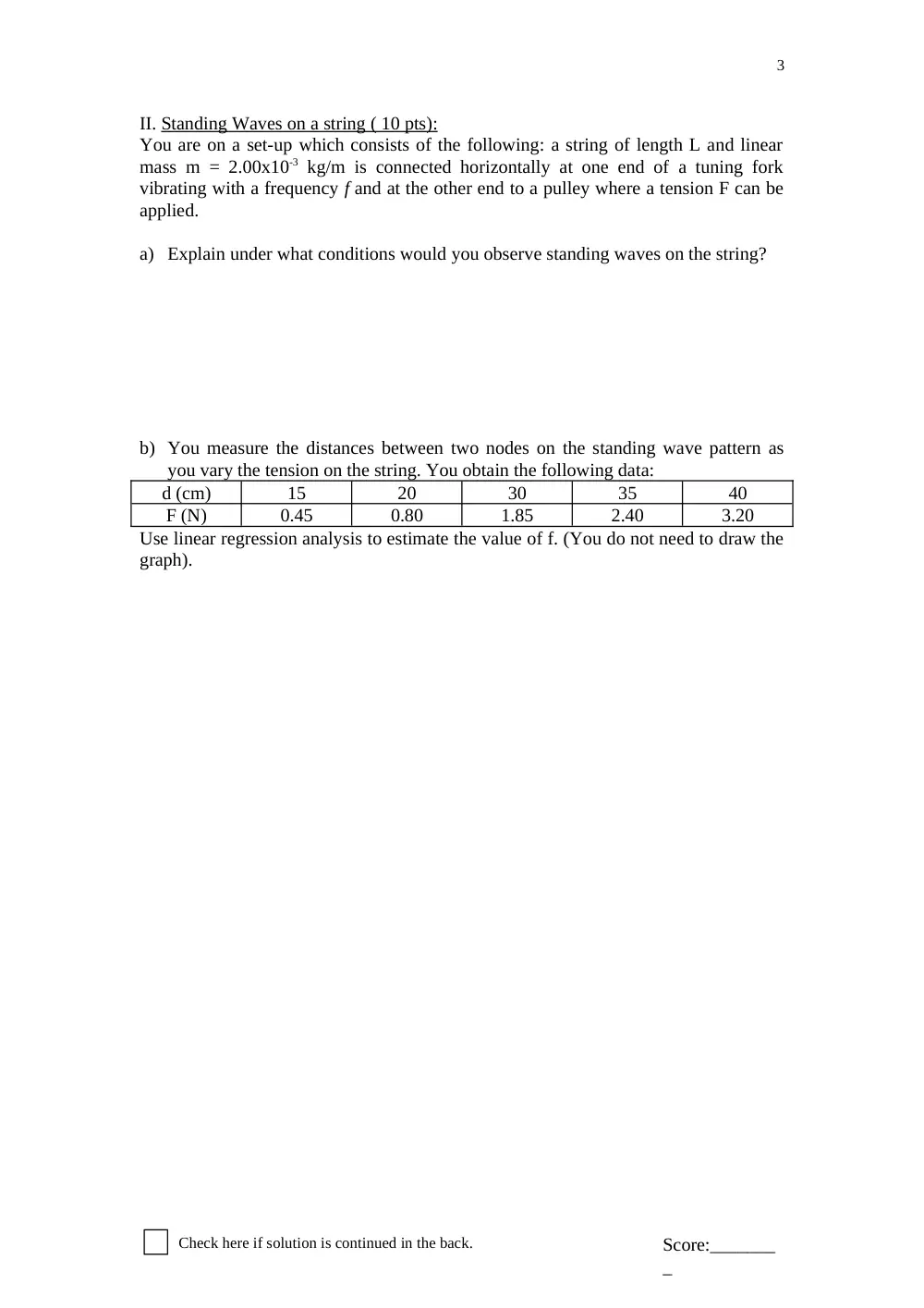
II. Standing Waves on a string ( 10 pts):
You are on a set-up which consists of the following: a string of length L and linear
mass m = 2.00x10⁻³ kg/m is connected horizontally at one end of a tuning fork
vibrating with a frequency f and at the other end to a pulley where a tension F can be
applied.
a) Explain under what conditions would you observe standing waves on the string?
b) You measure the distances between two nodes on the standing wave pattern as
you vary the tension on the string. You obtain the following data:
d (cm)
15
20
30
35
40
F (N)
0.45
0.80
1.85
2.40
3.20
Use linear regression analysis to estimate the value of f. (You do not need to draw the
graph).
Check here if solution is continued in the back.
Score:_______
_
3
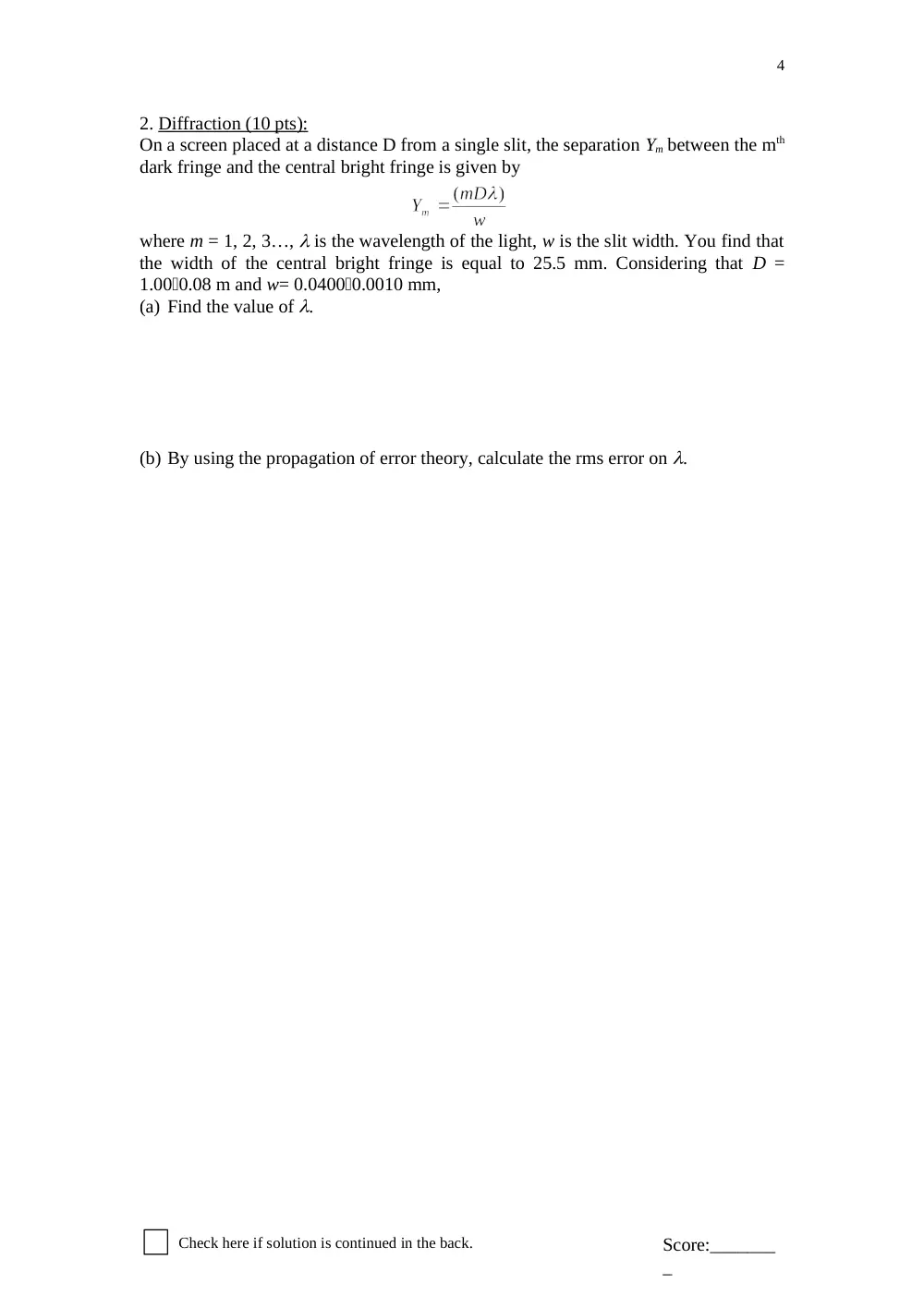
2. Diffraction (10 pts):
On a screen placed at a distance D from a single slit, the separation Ym between the mth
dark fringe and the central bright fringe is given by
where m = 1, 2, 3…, is the wavelength of the light, w is the slit width. You find that
the width of the central bright fringe is equal to 25.5 mm. Considering that D =
1.000.08 m and w= 0.04000.0010 mm,
(a) Find the value of .
(b) By using the propagation of error theory, calculate the rms error on .
Check here if solution is continued in the back.
Score:_______
_
4
3. Mechanical equivalent of Heat (10 pts):
You are doing the experiment with a calorimeter made of carbon and you obtain the
following values for the increase of temperature T of the water in the calorimeter:
19.10, 19.50, 19.20, 19.30 and 18.90 K.
(b) Estimate the average value of T and its rms error.
(c) Estimate the specific heat of carbon. (Hint: the mechanical work done is given by
W= 2nrMg) Useful values: Radius of calorimeter r=2.340 cm; number of turns
n=300; Mass attached M=5.00 kg; g=9.81 m/s2; Mass of calorimeter m=207.1 kg.
(c) Does carbon follow the law of Dulong and Petit? Justify your answer.
Check here if solution is continued in the back.
Score:_______
_
5