
PHYS 211 Exam 1, Fall 2012
American University of Beirut · Electricity and Magnetism · 8 pages · Dr. Ghassan Antar
More PHYS 211 files
- Exam 2 · Fall 2017ExamView
- Exam 1 85% Solved · Fall 2016Exam · with solutionView
- Exam 2 Fall 1617 with Solution · Fall 2016Exam · with solutionView
- Exam 1 · Fall 2014ExamView
- Exam 1 Quiz 1 Solution Fall 2014 · Fall 2014Exam · with solutionView
- Exam 2 Fall 2014 Quiz 2 Solution · Fall 2014Exam · with solutionView
- Exam 2 · Spring 2014ExamView
- Exam 2 · Fall 2014ExamView
Show the text of this exam
Score:________
Check if solution is continued on the back.
1
PHYSICS 211
Quiz I
TIME: 60 minutes
November 18, 2012
DO NOT OPEN THIS EXAM BEFORE YOU ARE TOLD TO BEGIN
NAME________________________________________________
ID Number ________________________
Useful information
0=8.85x10⁻¹² C2/N.m2.
0=4 x 10⁻⁷ Tm/A.
q = 1.6 1019 C
me= 9.1x10⁻³¹ kg. mp= 1.67×10⁻²⁷ kg.
ke=8.9875x10⁹ Nm2/C2
Grading
A
B
TOTAL
Score:________
Check if solution is continued on the back.
2
Part A: Multiple choice questions (12)
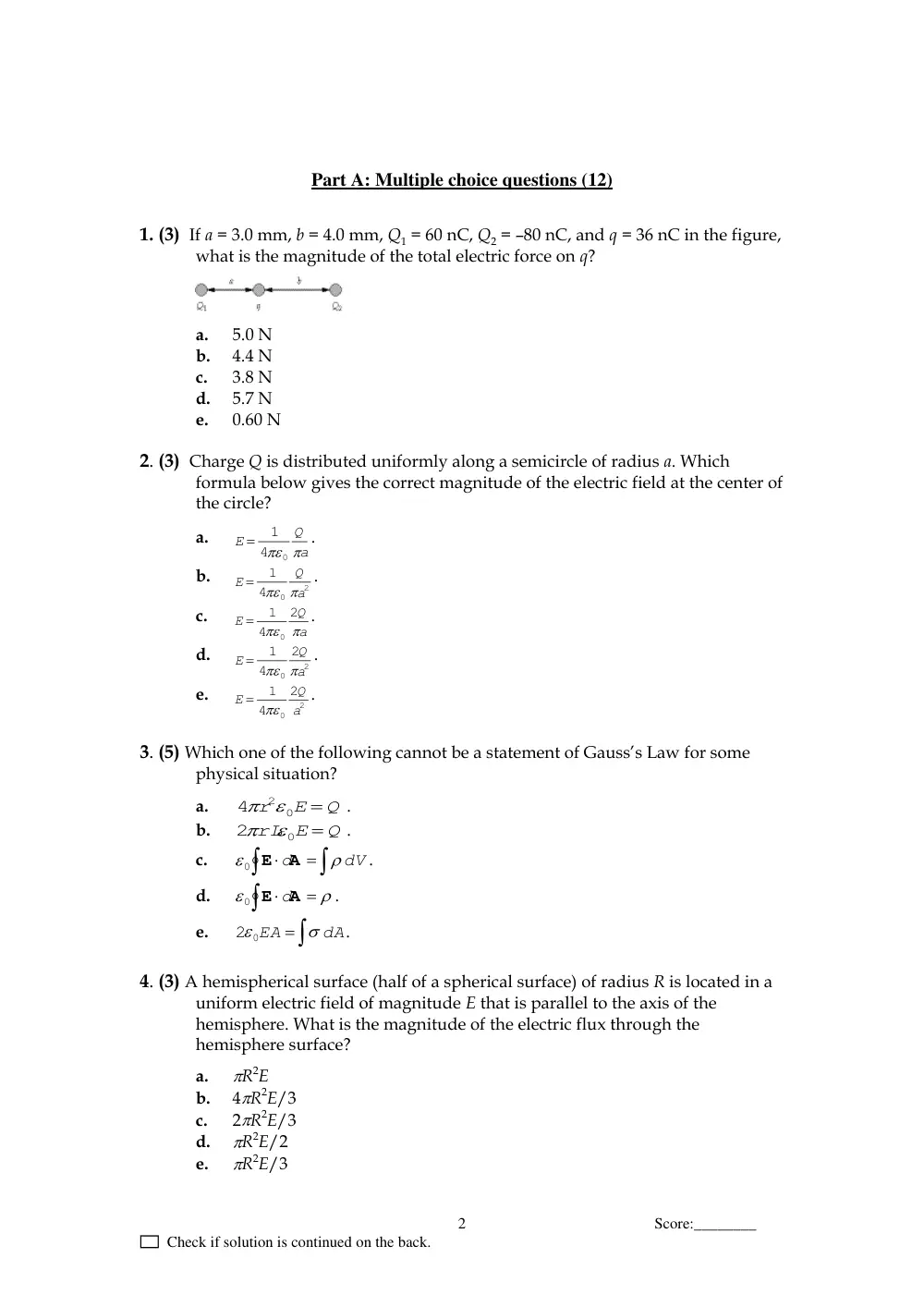
1. (3) If a = 3.0 mm, b = 4.0 mm, Q1 = 60 nC, Q2 = –80 nC, and q = 36 nC in the figure,
what is the magnitude of the total electric force on q?
a.
5.0 N
b.
4.4 N
c.
3.8 N
d.
5.7 N
e.
0.60 N
2. (3) Charge Q is distributed uniformly along a semicircle of radius a. Which
formula below gives the correct magnitude of the electric field at the center of
the circle?
a.
a
Q
E
0
4
1
.
b.
2
0
4
1
a
Q
E
.
c.
a
Q
E
2
4
1
0
.
d.
2
0
2
4
1
a
Q
E
.
e.
2
0
2
4
1
a
Q
E
.
3. (5) Which one of the following cannot be a statement of Gauss’s Law for some
physical situation?
a.
Q
E
r
0
2
4
.
b.
Q
rL E
0
2
.
c.
dV
d
A
0 E
.
d.
A
0 E d
.
e.
dA
EA
20
.
4. (3) A hemispherical surface (half of a spherical surface) of radius R is located in a
uniform electric field of magnitude E that is parallel to the axis of the
hemisphere. What is the magnitude of the electric flux through the
hemisphere surface?
a.
R2E
b.
4R2E/3
c.
2R2E/3
d.
R2E/2
e.
R2E/3
Score:________
Check if solution is continued on the back.
3
Part B: Problems (88)
2. (44%) Gauss’s law
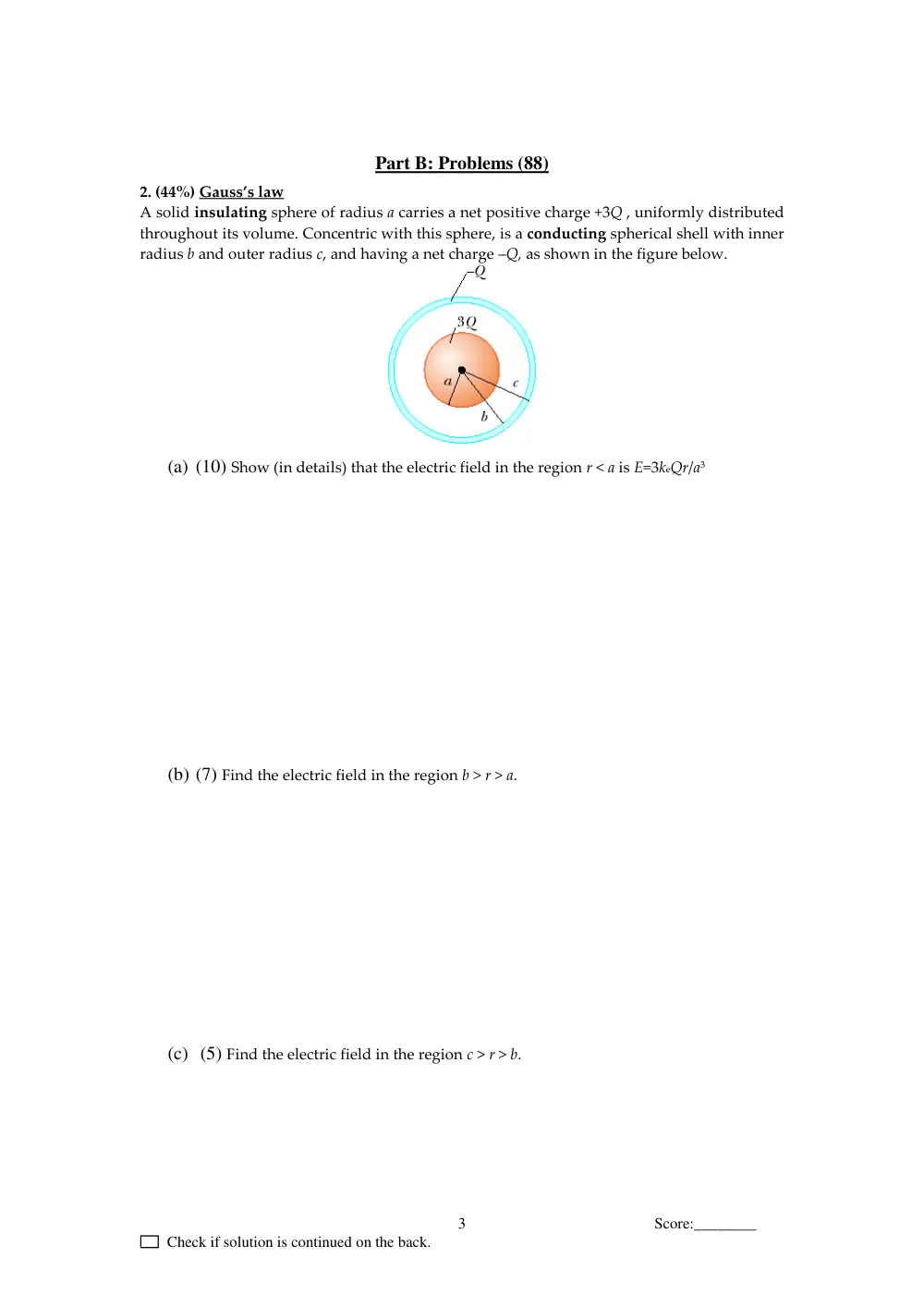
A solid insulating sphere of radius a carries a net positive charge +3Q , uniformly distributed
throughout its volume. Concentric with this sphere, is a conducting spherical shell with inner
radius b and outer radius c, and having a net charge –Q, as shown in the figure below.
(a) (10) Show (in details) that the electric field in the region r < a is E=3keQr/a3
(b) (7) Find the electric field in the region b > r > a.
(c) (5) Find the electric field in the region c > r > b.
Score:________
Check if solution is continued on the back.
4
(d) (6) Determine the charge on the inner surface of the conducting shell (at r=b).
(e) (6) Find the electric field at r > c.
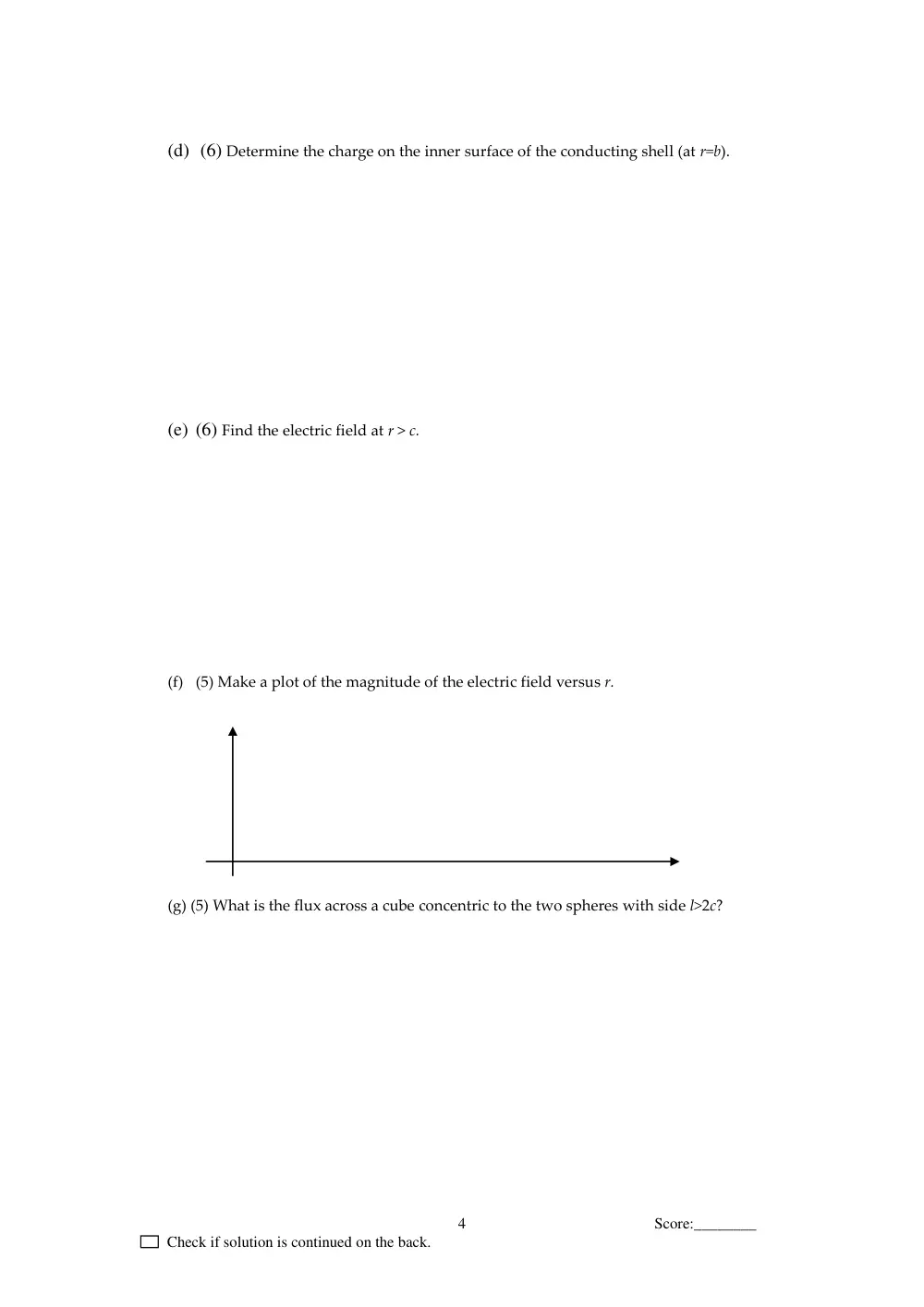
(f) (5) Make a plot of the magnitude of the electric field versus r.
(g) (5) What is the flux across a cube concentric to the two spheres with side l>2c?
Score:________
Check if solution is continued on the back.
5
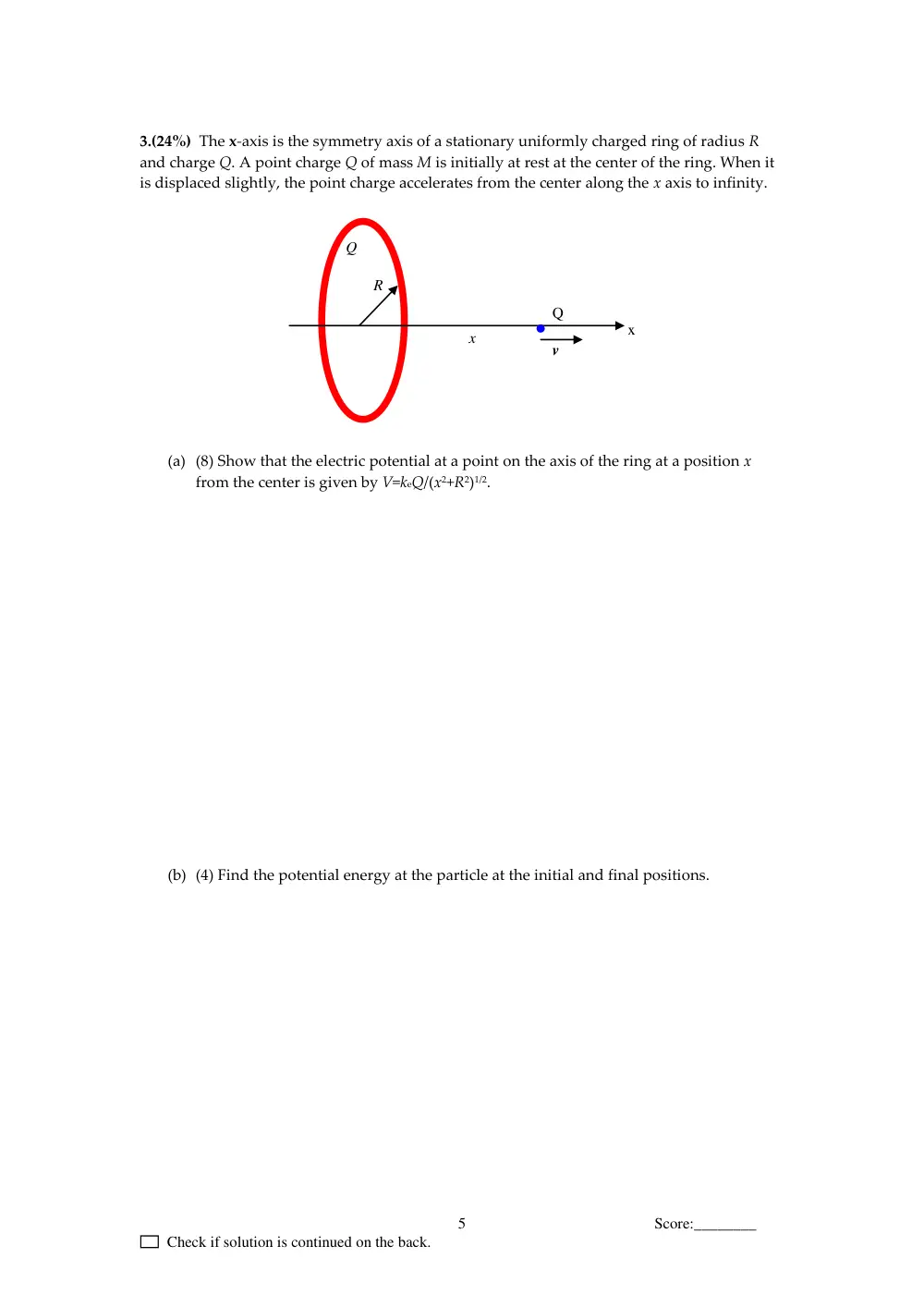
3.(24%) The x-axis is the symmetry axis of a stationary uniformly charged ring of radius R
and charge Q. A point charge Q of mass M is initially at rest at the center of the ring. When it
is displaced slightly, the point charge accelerates from the center along the x axis to infinity.
(a) (8) Show that the electric potential at a point on the axis of the ring at a position x
from the center is given by V=keQ/(x2+R2)1/2.
(b) (4) Find the potential energy at the particle at the initial and final positions.
v .
R
Q
Q
x
.
x
Score:________
Check if solution is continued on the back.
6
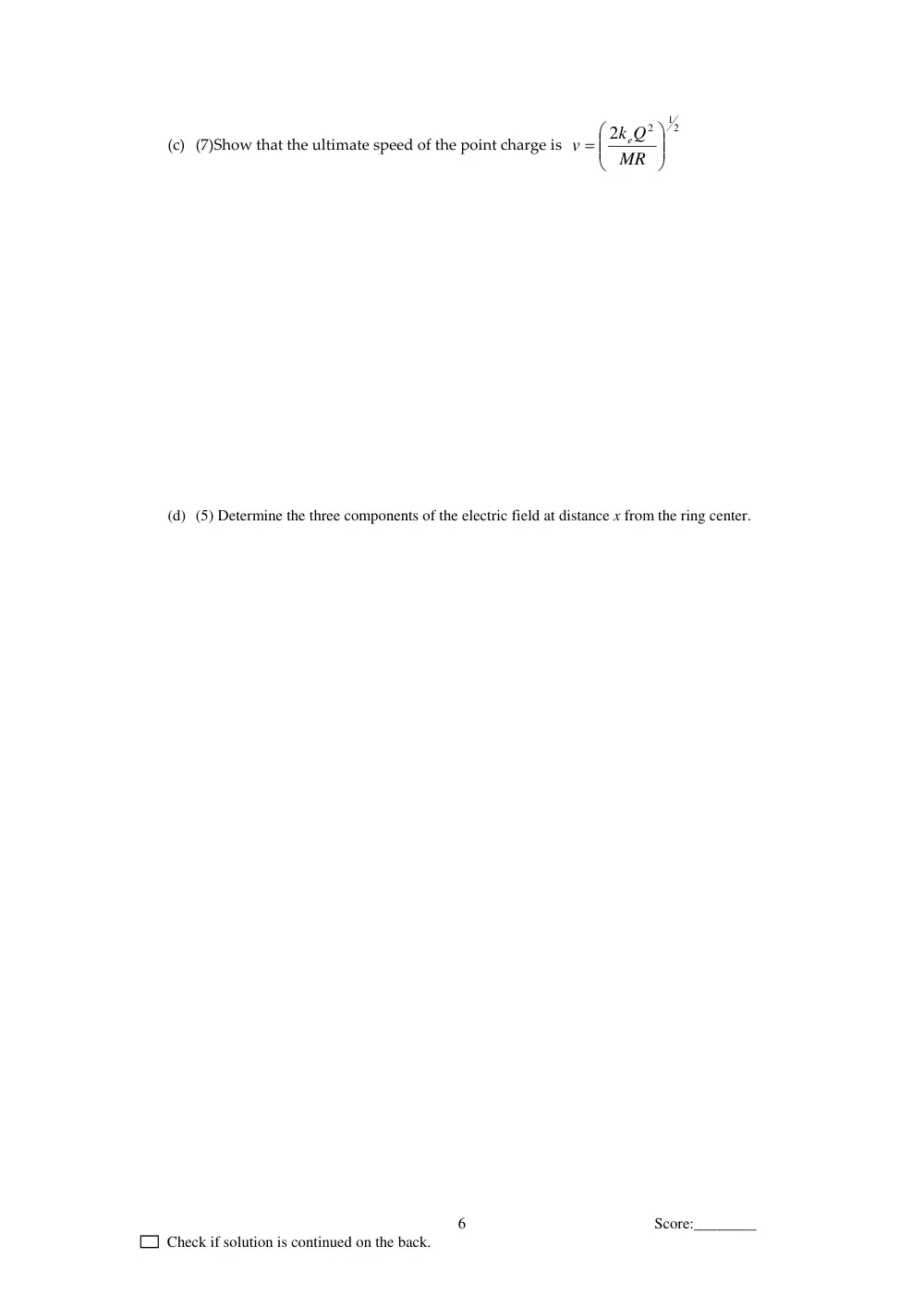
(c) (7)Show that the ultimate speed of the point charge is
12
2
2
MR
k Q
v
e
(d) (5) Determine the three components of the electric field at distance x from the ring center.
Score:________
Check if solution is continued on the back.
7
1. (20%) In 1911 Rutherford, Geiger and Marsden conducted an experiment in which they
had an alpha particle, having charge +2e and mass 6.64 × 10⁻²⁷ kg hits a gold sheet (+79e).
a) (7) An electric field E = 1 V/m is applied on the alpha particle. How long must E be
applied so that, starting from rest, the alpha particle reaches a velocity of v=107 m/s.
b) (7) Determine the analytical expression of the minimum distance the alpha particle can
get to the gold.
c) (6) Use the numerical values in order compare d it to the radius of an atom which is
about 10-9 m. What is d?
Score:________
Check if solution is continued on the back.
8
SCRATCH PAPER
Nothing on this page will be graded