
PHYS 211 Exam 1 with Solution, Fall 2011
American University of Beirut · Electricity and Magnetism · 7 pages · with solution


More PHYS 211 files
- Exam 2 · Fall 2017ExamView
- Exam 1 85% Solved · Fall 2016Exam · with solutionView
- Exam 2 Fall 1617 with Solution · Fall 2016Exam · with solutionView
- Exam 2 · Spring 2014ExamView
- Exam 1 · Fall 2014ExamView
- Exam 1 Quiz 1 Solution Fall 2014 · Fall 2014Exam · with solutionView
- Exam 2 Fall 2014 Quiz 2 Solution · Fall 2014Exam · with solutionView
- Exam 2 · Fall 2014ExamView
Show the text of this exam
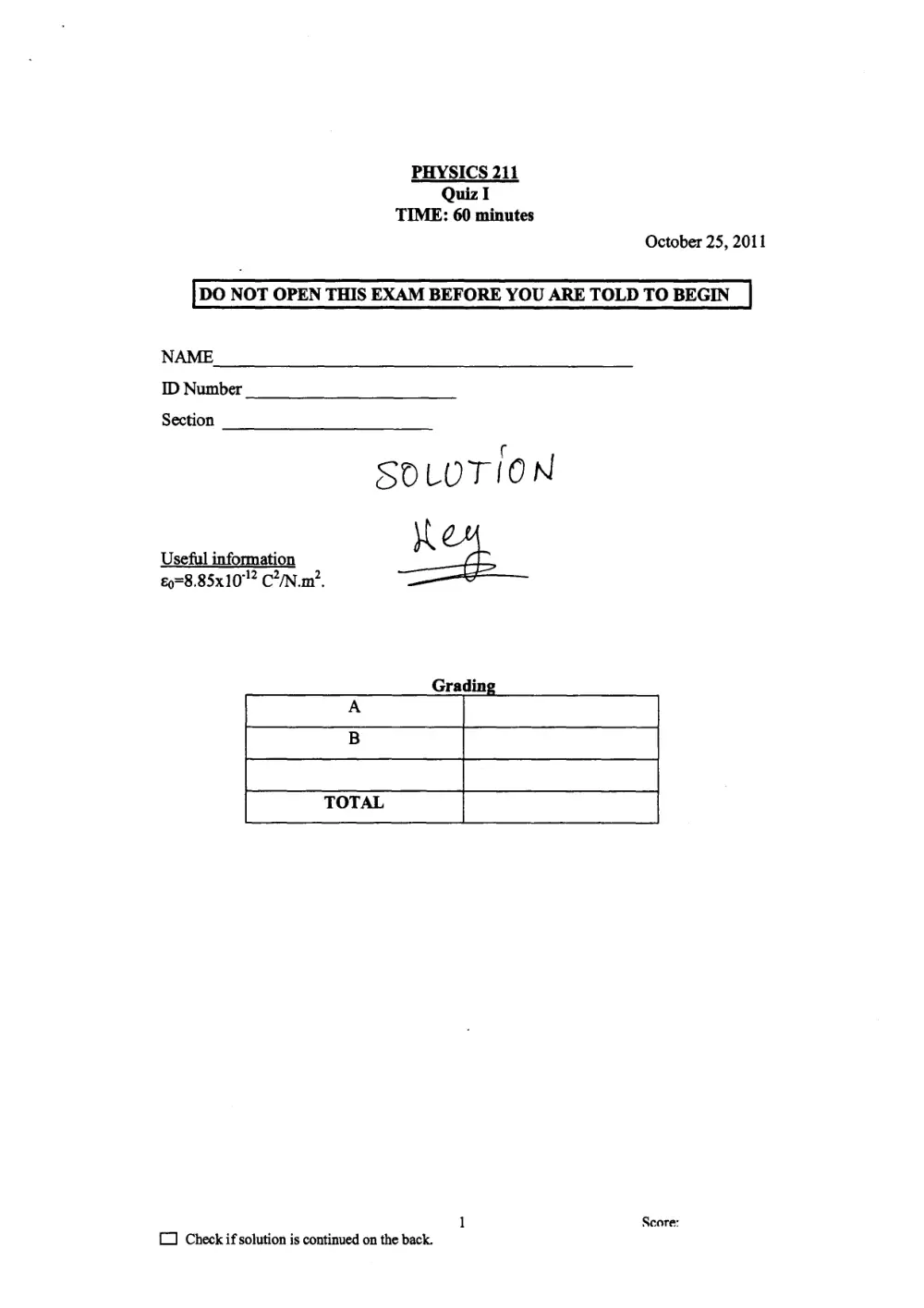
PEYSICS
2U
Qutu I
TIME:60 minutes
October
25,2011
DO NOT OPEN THIS EXAM BEFORE YOU ARE TOLD TO BEGIN
NAME
IDNumber
Section
EO L)Tio ru
Useful information
eo=8,85x10'12
c2lN.m2.
E
Check if solution is continued on the baclc
Score:
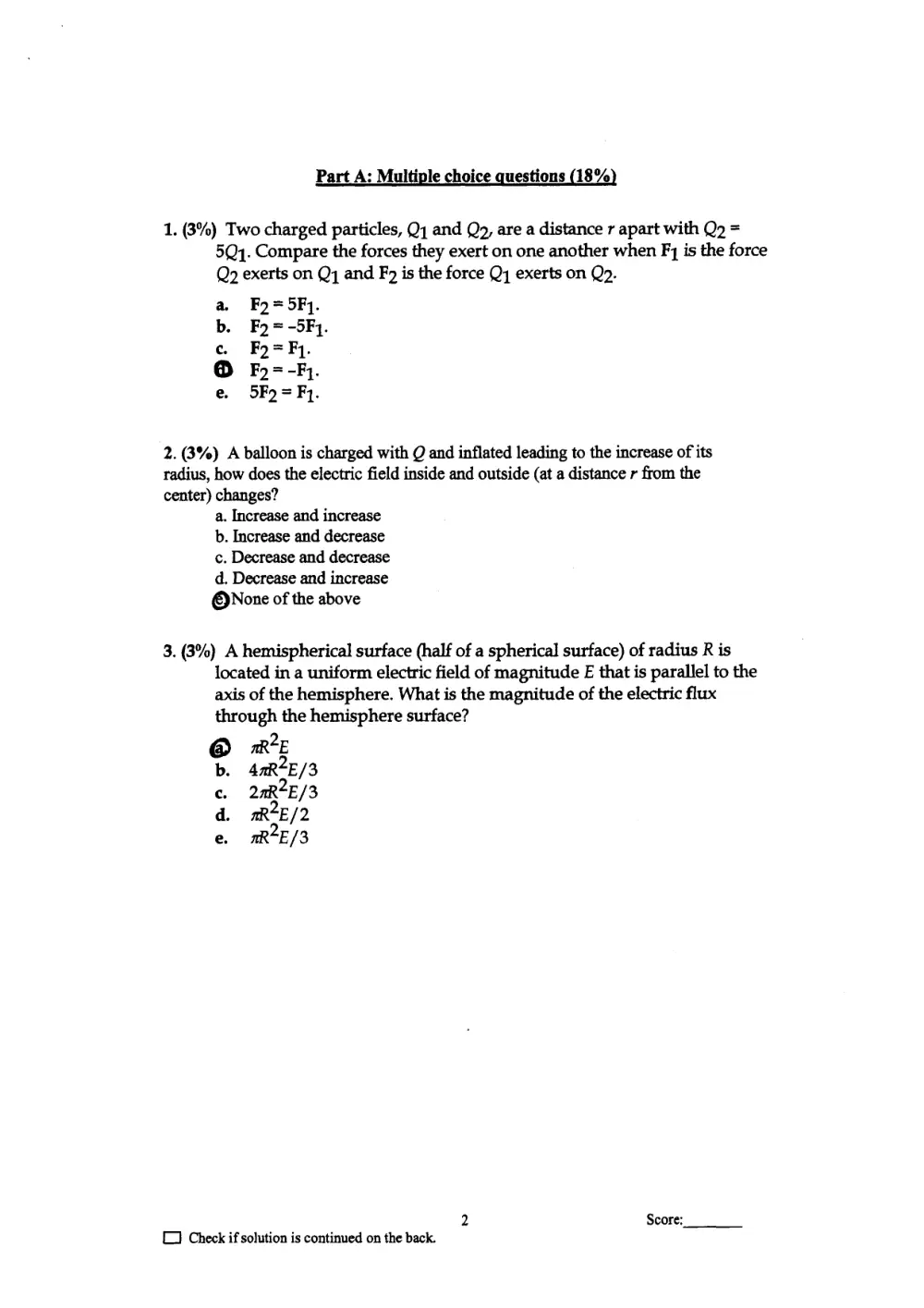
Part A: Multiple choice questions (18olo)
t. (3o/ol Two charged particles, Q1 and Q2, re a distance r apattwith Q2 =
5Q1. Compare the forces they exert on one another when F1 is the force
Q2 exerts on Q1 and F2 is the fotce Q1 exerts o^Q2.
a.
b.
c.o
e.
F2 = 5F1.
F2 = -5F1.
F2 = F1.
E2= -F1.
5F2 = F1.
2.Q%) A balloon is charged with Q and infln1s6 leading to the increase of its
radius, how does the electric field inside and outside (at a distance r from the
ce,nter) changes?
a. lncrease and increase
b. lncrease and decrease
c. Decrease and decrease
d. Decrease and increase
@None of the above
3. (3%l A hemispherical surface ftalf of a spherical surface) of radius R is
located in a uniform elecuic field of magniftrde E that is parallel to the
axis of the hemisphere. What is the magnitude of the electric flux
through the hemisphere surface?
@ d.'E
b. 41R'E/3
a
c.
21R'E/3
d.
,ft'E/2
e. ,rnzn/g
E
Chcck if solution is continued on the baclc
Scorc:
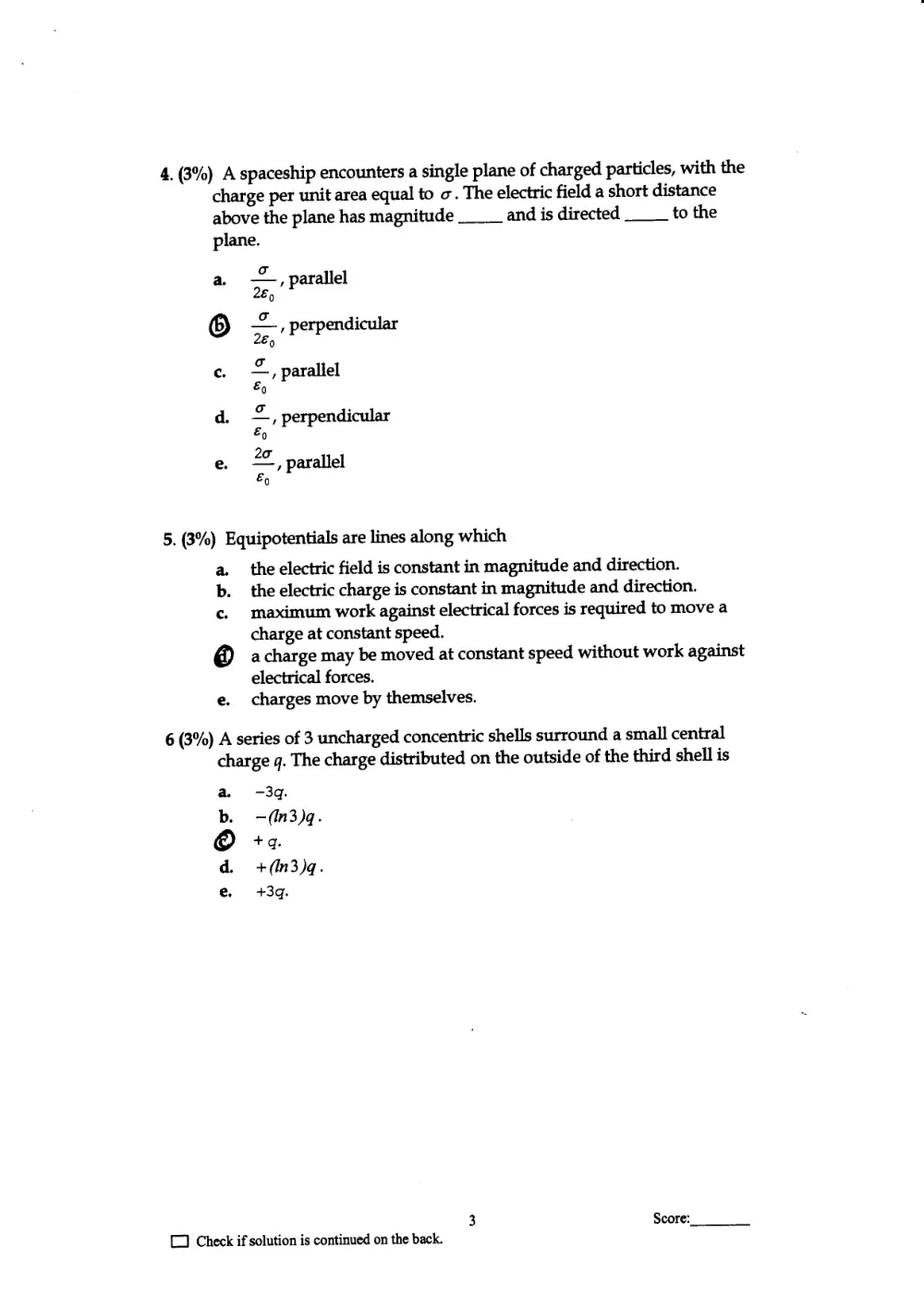
A. pr/"1 A spaceship encounters a single plane of charged particles, with the
'
charge per rurit area equal 6 o . The electric field a short distance
abov-e tile plane has magnitude -
and is directed
to the
plane.
o
a. fi'V*At"t
, r o
@ f
'v"w^dicular
o
c. i, fardtet
d.
g, p"tp"t dicular
6o
2o
e. fr, f*utt"t
5. (3%) Equipotentials are lines along which
a.
the electric field is constant in magnitude and direction.
b.
the electric charge is constant in magnitude and direction.
c.
maximum work against electrical forces is required to move a
charge at constant sPeed.
@
a chige may be mwed at constant speed withoutwork
against
electrical forces.
e.
charges move bY themselves.
6 (g%lA series of 3 uncharged concentric shells surround a small central
ct arge q. The ctrarge distriUuted on the outside of the third shell is
a.
-3q.
b.
-(tn3)q
@
+q'
d.
+(n3)q.
e.
+39.
El Cnect if solution is continued on the back
Score:
PartB- Problems
(82 %)
l. Q0%) A small, 2.00-9 plastic ball is suspended by a 20.O-cm-long
string in a
uniform electric field as shown in the Figure below. If the ball is in
equilibrium when the string makes a 15.0o angfe with the verticaf what is the
net dtarge on the ball?
E = 1.oo x toPi N/c
----------------+
+
20.0 cm
€>
1=
ru
tlal
-€
@
ry s,Tz# -
E
5.Z5xI0
E Check if solution is continued on the back.
Score:
&ou^'5 A"- ?ht Qu,/erA. V C
Wc ,*/rr/ //, Gar*,x-^
fu,
(o.s.)^f )"r/
4 yJr*,
cao'lr'2./ ^
fu, 7,r)r^ :e)
=) Ar3 f ,ro z E fro 3 afrzE(,rr)|
+#@
h
e Vt72t4'c4
omr1,c- al /1.
Q,,.r" :
*
a<..*/;V fr; Goro','> (.''(/ oL"e
r/,cts;]*w :wa
2.Q7%) Gauss taw
,.(ll%)
consider a hydrogen atom formed of one protou and one erectron assumed to
:tr*'tr"und at ";n";tG;;;;"
rr*, ari".ni,ilt.
,roni. nerd
at a
c. (to/o) What is the electric field at r>a?
4f ft )a ., Qartn's 4r*, 4/"Ua
l-
/-ra
b.(8%) What is the total flux across a,
x=aRi
_
- "' r'rar nux across a cube centered at the proton and with side
f"hll k
act?tb ^ eoL" *rrhrU dr, te pz,h,
f-,
,-t
4.s
4
z%.
4
m q";@.o)) ; o =d7 -/
El Cnect if solution is continue.d
on the back
5
Score:
3.Q5%) A thin rod exrends
arong the z-axis
from e = -d to z = d.The rod carries
a
l"rl{r:
charge g uniformly aiJtrituteo along its length ia *iu charge a*ritv
1,=e/2d.
(a)(12%) calculate the elechic potential at a point z> d alongthe z-axis.
7 ^ g- . ttl de /r"'rt
'rn n/r"mn/
r) tut. A*f
d/ *) dI " 2/O
Y/=l, U = h") #, u
?
(bx8%) what is the change in potential energy if an erecton moves fron z = 4d to z
V (e'3l\
= 3d2
El Cnectifsolutioniscontinuedonthebaclc
6
r
\
/'/+d
v(2,!,4 =!,.\% lrh
/a/ "d \
, )
x,1.207ft\a
= lo.2 U ?-
Tl. f7"rt-/,v/
uzu26/ aU- g
,_
=%))
Score:
(c)Q%) If the electon started out at rest at the point z = 4d, what is its velocity at z =
3d?
tx/c r'ne il"
AwuWEm A *'%
4
/>Ytf s- b('/ "A
fnytQz
onl">tff(*\
aq)e
0
f 3l_6_
=
b'*.
T
:- )Y =A J
b$
V /ou *|
eL -*ot/
lrt^
4 k^ d
6J1------1
L-- rl '
r \ r
t t 2 ^
X V
Eqt
- %
=
dbt
_u,))Jry
H,=
@1fV.) What is the electric field at aporntz > d?
W. /,ohz /'# ; )/'fr;+'/ P
il-
;;;:'J'- fe t/*'^rbh
-, (, E^
0Eu
E
Check if solution is conthued on the back'
Score: