
PHYS 211 Exam 2, Fall 2010
American University of Beirut · Electricity and Magnetism · 7 pages





More PHYS 211 files
- Exam 2 · Fall 2017ExamView
- Exam 1 85% Solved · Fall 2016Exam · with solutionView
- Exam 2 Fall 1617 with Solution · Fall 2016Exam · with solutionView
- Exam 2 Fall 2014 Quiz 2 Solution · Fall 2014Exam · with solutionView
- Exam 2 · Spring 2014ExamView
- Exam 1 · Fall 2014ExamView
- Exam 1 Quiz 1 Solution Fall 2014 · Fall 2014Exam · with solutionView
- Exam 2 · Fall 2014ExamView
Show the text of this exam
PHYSICS 211
Quiz II
TIME: 60 minutes
December 14, 2010
DO NOT OPEN THIS EXAM BEFORE YOU ARE TOLD TO BEGIN
NAME________________________________________________
ID Number ________________________
Useful information
0=8.85x10⁻¹² C2/N.m2.
Grading
Problem 1
Problem 2
Problem 3
TOTAL
Score:________
Check if solution is continued on the back.
1
Problems
1.(40%)
Consider a battery with a potential difference V connected to a cylindrical conductor
with length l and a cross-section A.
(a) (7%) Determine the velocity of one electron as a function of time assuming
that it makes no collisions.
(b) (5%) When collisions are taken into account, briefly describe the necessary
modifications that are to be undertaken for the velocity and time?
(c) (10%) Determine the relation between the current density j and the electric
field E
Score:________
Check if solution is continued on the back.
2
(d) (10%) Determine Ohm’s law, the relation between the current I and the
potential difference V
(e) (6%) Comment on the relationship obtained and the proportionality constants
between j and E and I and V.
(f) (7%) What happens if there were no collisions?
Score:________
Check if solution is continued on the back.
3
2. (20%)
(a) (10%) Demonstrate that if three resistors are connected in parallel, then the
expression of the equivalent capacitor is
1/Req = 1/R1 + 1/R2 + 1/R3
(b) (10%) Demonstrate that if three resistors are connected in series, then the
expression of the equivalent capacitor is
Req = R1 + R2 + R3
Score:________
Check if solution is continued on the back.
4
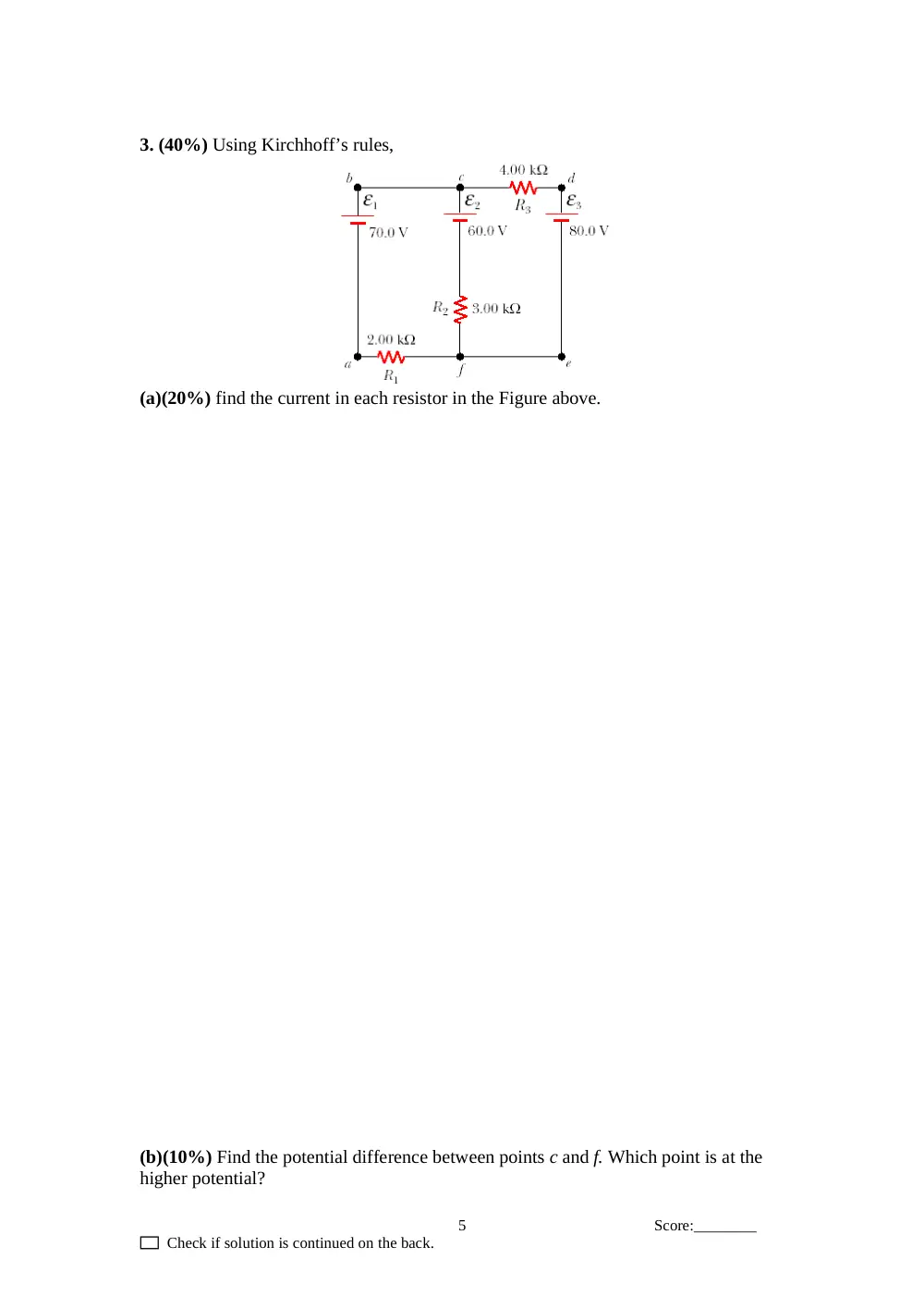
3. (40%) Using Kirchhoff’s rules,
(a)(20%) find the current in each resistor in the Figure above.
(b)(10%) Find the potential difference between points c and f. Which point is at the
higher potential?
Score:________
Check if solution is continued on the back.
5
(c) (10%) Re-determine the currents in the circuit long after (fully charged) including
a capacitor between R2 and E2
Score:________
Check if solution is continued on the back.
6
SCRATCH PAPER
Nothing on this page will be graded
Score:________
Check if solution is continued on the back.
7