
PHYS 211 Exam 2, Spring 2002
American University of Beirut · Electricity and Magnetism · 3 pages
More PHYS 211 files
- Exam 2 · Fall 2017ExamView
- Exam 1 85% Solved · Fall 2016Exam · with solutionView
- Exam 2 Fall 1617 with Solution · Fall 2016Exam · with solutionView
- Exam 2 Fall 2014 Quiz 2 Solution · Fall 2014Exam · with solutionView
- Exam 2 · Spring 2014ExamView
- Exam 1 · Fall 2014ExamView
- Exam 1 Quiz 1 Solution Fall 2014 · Fall 2014Exam · with solutionView
- Exam 2 · Fall 2014ExamView
Show the text of this exam
pT TT Naren a gine
tARELAIE AN ONY oF
LIBKARY |
OF BUIRUT i
Physics Department Physics 211 March 11, 2002
Quiz I Time: 1 hour
Name? ooo cceec cere
Remark: A correct answer without a solution is not counted
Given: ke = 1/(4e,) = 9x10° SI
Try to do this test in one hour once only.
1.
2.
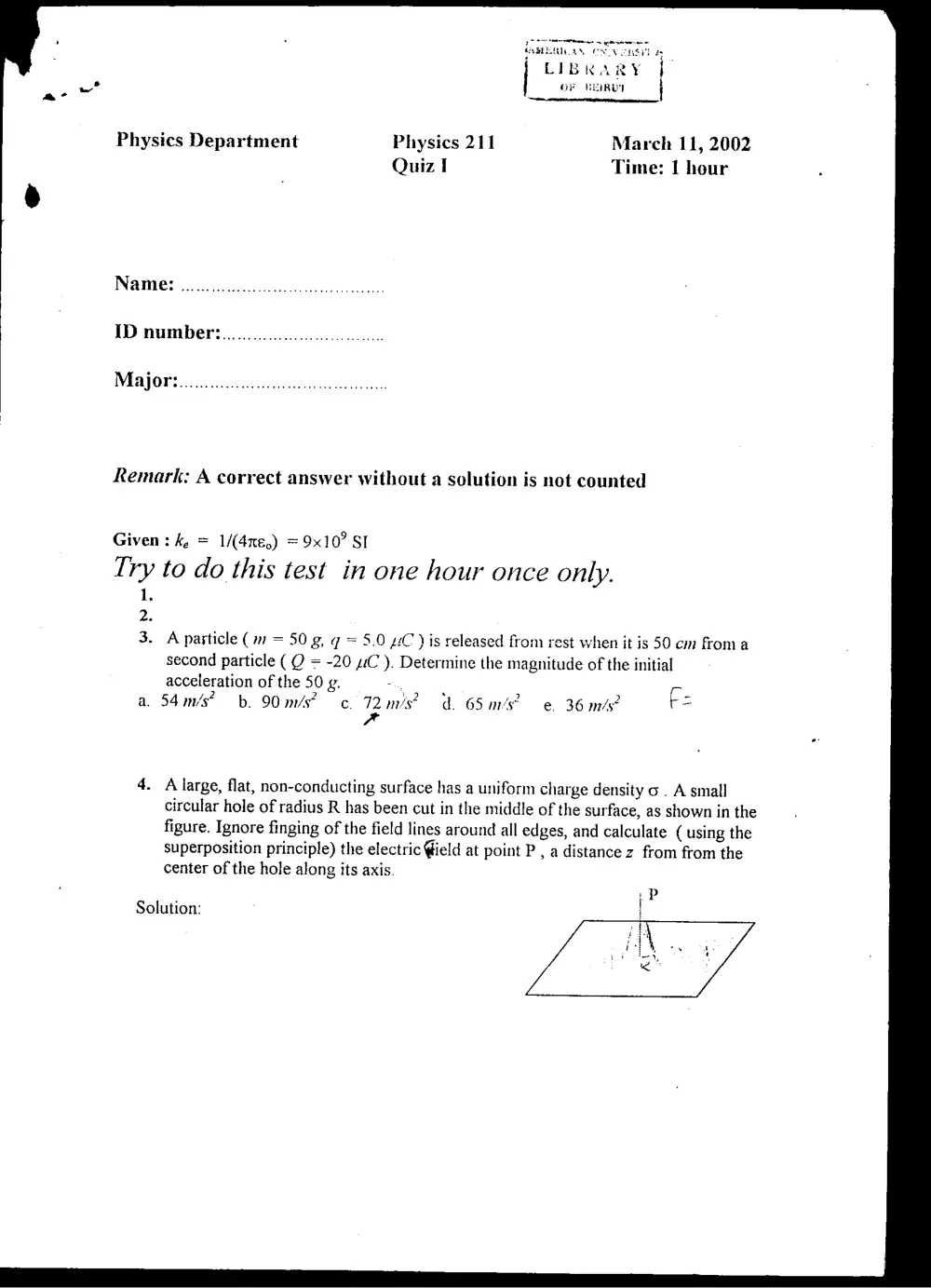
3. A particle (1 = 50 g, g = 5.0 4C ) is released from rest when it is 50 cm froma
second particle (Q = -20 wC ). Determine the magnitude of the initial
acceleration of the 50 g.
a. 54m/s? bb. 90 m/s? oc. T2 m/s? 65 ns? €. 36 m/s? Fs
x
4. A large, flat, non-conducting surface has a uniform charge density o . A small
circular hole of radius R has been cut in the middle of the surface, as shown in the
figure. Ignore finging of the field lines around all edges, and calculate (using the
superposition principle) the electric @ield at point P , a distance z from from the
center of the hole along its axis.
Pp
Solution: i
¢ panera ee
AMERICAN UNIVERSITA
LIBRARY
i 7
off
ee ce
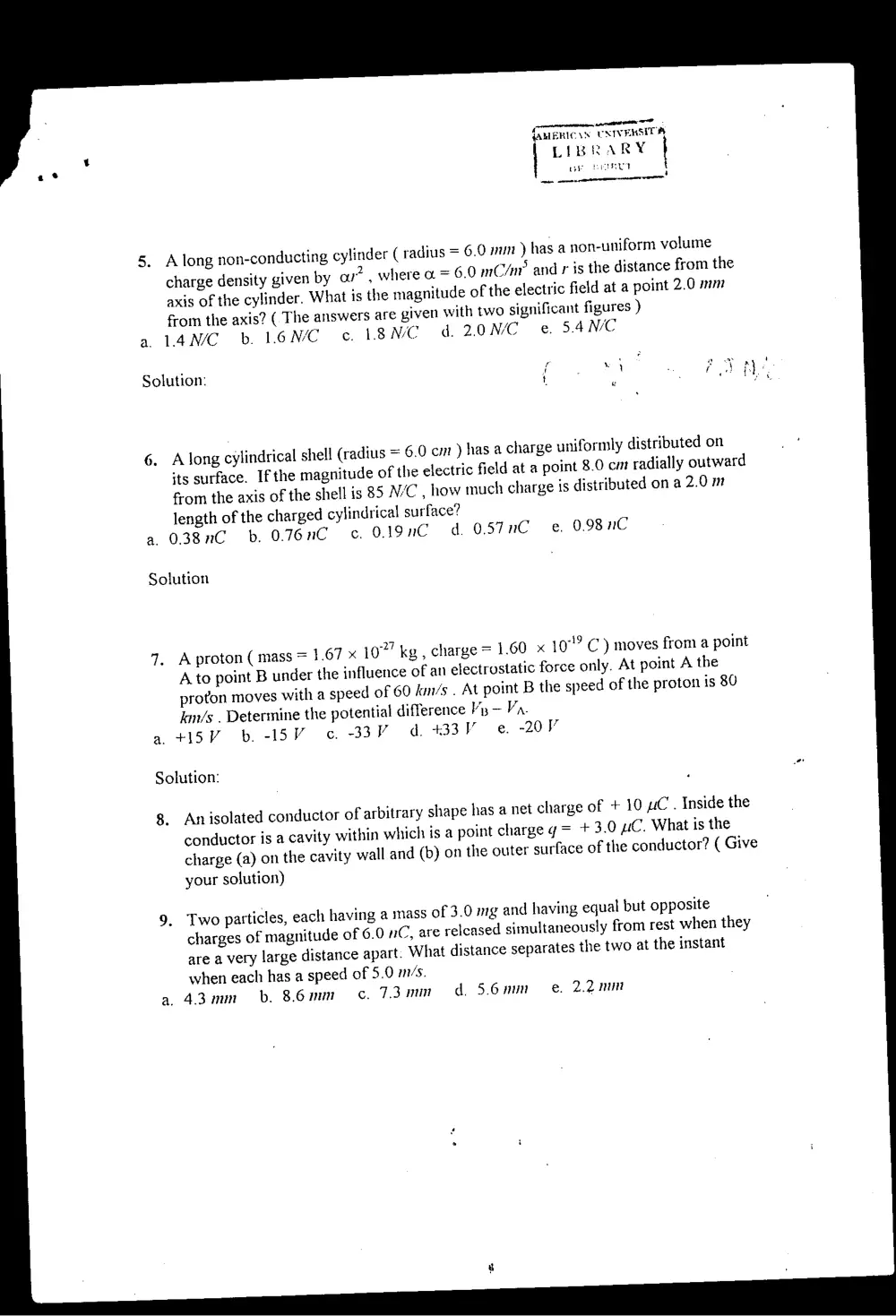
5. A long non-conducting cylinder ( radius = 6.0 mn ) has a non-uniform volume
charge density given by au? , where a = 6.0 mC/av and r is the distance from the
axis of the cylinder. What is the magnitude of the electric field at a point 2.0 sam
from the axis? ( The answers are given with two significant figures )
a 14NC b. LONC co. 18 NC d. 2.0N/C e. 54 NC
Solution:
6. A song cylindrical shell (radius = 6.0 cm ) has a charge uniformly distributed on
its surface. If the magnitude of the electric field at a point 8.0 cm radially outward
from the axis of the shell is 85 WC, how much charge is distributed on a 2.0 m
length of the charged cylindrical surface?
a. 038nC b. 0.76NC C. 019nC d. 0.57NC e. 0.98 nC
Solution
A proton ( mass = 1.67 x 10⁷’ kg , charge = 1.60 x 10⁷? C) moves from a point
A to point B under the influence of an electrostatic force only. At point A the
proton moves with a speed of 60 km/s . At point B the speed of the proton is 80
kin/s . Determine the potential difference 3 — Ya.
a +15V b. -15V 6. 33 d. 433 Ve. -20V
Solution:
8. An isolated conductor of arbitrary shape has a net charge of + 10 uC . Inside the
conductor is a cavity within which is a point charge g = + 3.0 uC. What is the
charge (a) on the cavity wall and (b) on the outer surface of the conductor? ( Give
your solution)
. Two particles, each having a mass of 3.0 mg and having equal but opposite
charges of magnitude of 6.0 nC, are released simultaneously from rest when they
are a very large distance apart: What distance separates the two at the instant
when each has a speed of 5.0 2s.
a. 43mm b. 8.6mm c. 7.3mm d. 56mm e. 2.2mm
an
{wena UN(WVERSIT
| LIBEARY |
OF PEIROE
teey ena een cneesaeremistieed
Solution;
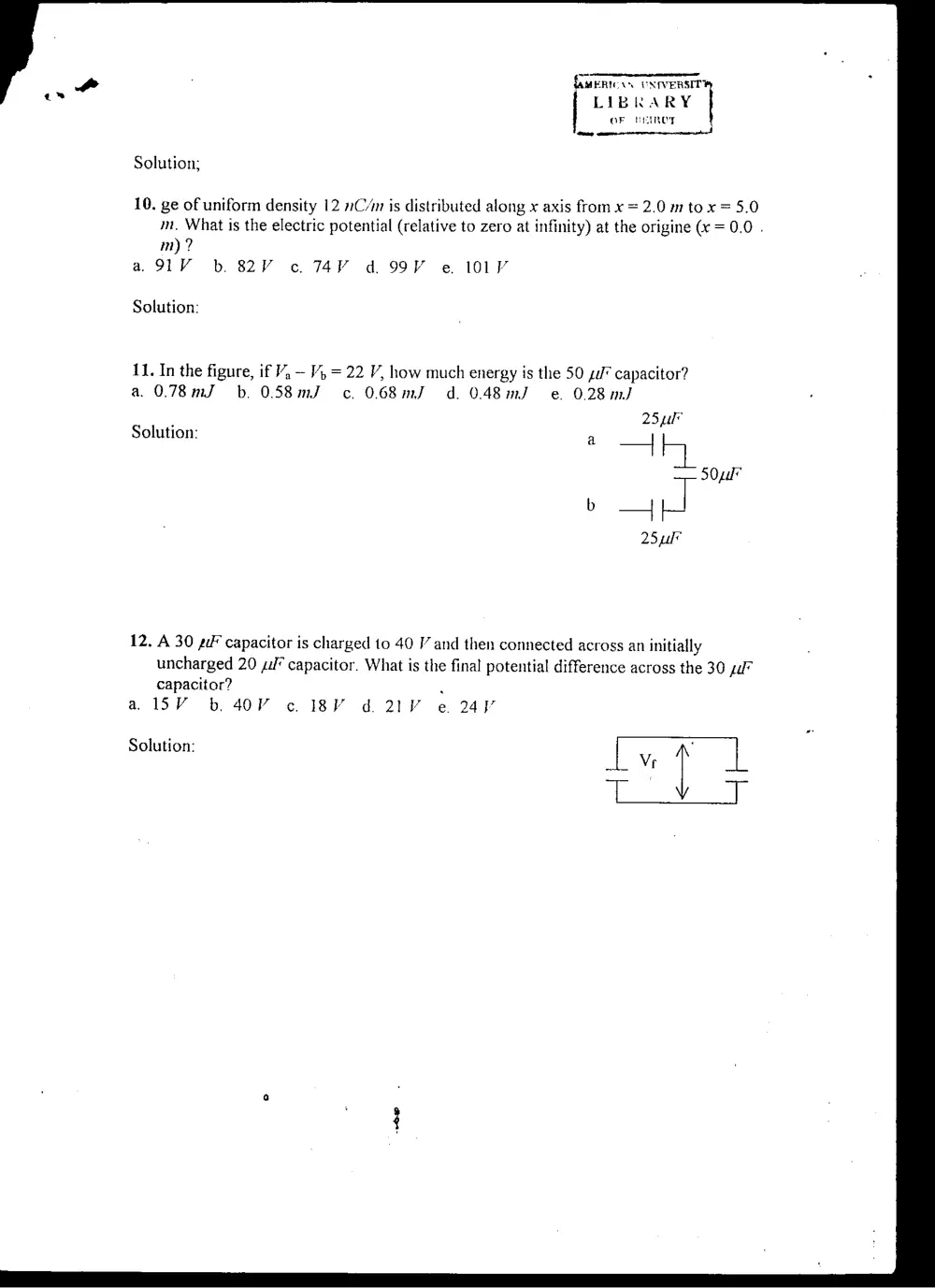
10. ge of uniform density 12 C/m is distributed along x axis from x = 2.0 m to x = 5.0
m. What is the electric potential (relative to zero at infinity) at the origine (x = 0.0 .
m)?
a 91V b. 82V ¢ 74V d 99F e LOL
Solution:
1]. In the figure, if / — V4, = 22 V, how much energy is the 50 s/* capacitor?
a. 0.78 ms b. O58m/ cc. 0.68ms d. 048mJ e. 0.28 mJ
25 ul
Solution: a
—— 50°
25 ule
12. A 30 gu capacitor is charged to 40 V and then connected across an initially
uncharged 20 u* capacitor. What is the final potential difference across the 30 Lu
capacitor? .
a 15V b. 40V ¢ 18 d. 21P e. 24V
Solution: Vt {
{ |
{|
VI