
PHYS 211 Exam 2, Spring 2007
American University of Beirut · Electricity and Magnetism · 5 pages
More PHYS 211 files
- Exam 2 · Fall 2017ExamView
- Exam 1 85% Solved · Fall 2016Exam · with solutionView
- Exam 2 Fall 1617 with Solution · Fall 2016Exam · with solutionView
- Exam 2 Fall 2014 Quiz 2 Solution · Fall 2014Exam · with solutionView
- Exam 2 · Spring 2014ExamView
- Exam 1 · Fall 2014ExamView
- Exam 1 Quiz 1 Solution Fall 2014 · Fall 2014Exam · with solutionView
- Exam 2 · Fall 2014ExamView
Show the text of this exam
PHYSICS 211
Quiz II
TIME: 50 minutes
April 16, 2008
Part A (30%)
Part B: Multiple choice questions ( 25%):
1. (5%) Gauss’s Law states that the net electric flux,
· dA, through any closed
surface is proportional to the charge enclosed:
· dA =
. The analogous
formula for magnetic fields is:
a.
· dA = 0.
b.
· dA =
.
c.
· dA =
.
d.
· dA =
.
e.
· dA = –
.
2. (5%) Which diagram correctly shows the magnetic field lines created by a circular
current loop in which current flows in the direction shown?
3. (5%) Equal charges, one at rest, the other having a velocity of 10
4 m/s, are
released in a uniform magnetic field. Which charge has the largest force
exerted on it by the magnetic field?
a.
The charge that is at rest.
b.
The charge that is moving, if its velocity is parallel to the magnetic field
direction when it is released.
c.
The charge that is moving if its velocity makes an angle of 45
o with the
direction of the magnetic field when it is released.
d.
The charge that is moving if its velocity is perpendicular to the
magnetic field direction when it is released.
e.
All the charges above experience equal forces when released in the same
magnetic field.
Score:________
Check if solution is continued on the back.
1
4. (5%) A deuteron is accelerated from rest through a 10-kV potential difference and
then moves perpendicularly to a uniform magnetic field with B = 1.6 T. What
is the radius of the resulting circular path? (deuteron: m = 3.3 10
–27 kg,
q = 1.6 10
–19 C)
a.
19 mm
b.
16 mm
c.
20.3 mm
d.
10 mm
e.
9.0 mm
5. (5%) At what rate is thermal energy generated in the 30- resistor?
a.
20 W
b.
27 W
c.
60 W
d.
13 W
e.
30 W
6. (5%) At t = 0 the switch S is closed with the capacitor uncharged. If C = 50 µF, =
20 V, and R = 4.0 k, what is the charge on the capacitor when I = 2.0 mA?
a.
360 µC
b.
480 µC
c.
240 µC
d.
600 µC
e.
400 µC
Score:________
Check if solution is continued on the back.
2
Part C- Problems (70 %)
1.a. Demonstrate that if 3 Resistors are set in parallel then the equivalent resistor is
given by
Using Ohm’s law we have DV=IR.
The current in the equivalent circuit should be the same as the total current in
the three loops leading to
Ieq=I1+I2+I3
Ieq=( DV1/R1) + ( DV2/R2) + ( DV3/R3) = ( DV/Req)
In parallel DV is the same leading to
DV1=DV2=DV3
This leads to
b.(8%) Demonstrate that if 3 resistors are set in series, then the equivalent resistor is
given by
Req = R1 + R2 + R3
In series we DV1 + DV2 + DV3 = DV whereas I is unchanged. Replacing DV1=IR1
We obtain
V=IReq= IR1+IR2+IR3 leading to Req = R1 + R2 + R3
2. Singly charged uranium-238 ions are accelerated through a potential difference of
2.00 kV and enter a uniform magnetic field of 1.20 T directed perpendicular to their
velocities (take proton mass to be 1.66 × 10⁻²⁷ kg and the electric charge = 1.6x10⁻¹⁹
C).
(a) Assuming energy is conserved, determine the velocity, and the radius of their
circular path.
so
(a)
(b) Repeat for uranium-235 ions and indicate how does the ratio of these path radii
depend on the accelerating voltage and on the magnitude of the magnetic field?
Score:________
Check if solution is continued on the back.
3
(b)
The ratios of the orbit radius for different ions are independent of
and
B.
3. Given the circuit below with 3 A of current running through the 4 Ω resistor as
indicated …
Determine …
a.
the current through each of the other resistors,
b. the voltage of the battery on the left
c.
the power delivered to the circuit by the battery on the right
a. Let's identify the currents through the resistors by the value of the resistor
(I1, I2, I3, I4) and the currents through the batteries by the side of the circuit on
which they lay (IL, IR). Start with the 2 Ω resistor. Apply the loop rule to the
circuit on the lower right.
20 V = I2(2 Ω) + (3 A)(4 Ω)
I2 = 4 A
Proceed to the 3 Ω resistor. Apply the junction rule to the junction in the center
of the circuit.
I2 = I3 + I4
4 A = I3 + 3 A
I3 = 1 A
The current through the 1 Ω resistor most certainly runs from right to left. If we
apply the loop rule to the top circuit, we'll have to run against that current. This
changes what is normally considered a potential drop into a potential increase.
(Kind of like skiing up a mountain instead of down.)
I1(1 Ω) = (4 A)(2 Ω) + (1 A)(3 Ω)
I1 = 11 A
Score:________
Check if solution is continued on the back.
4
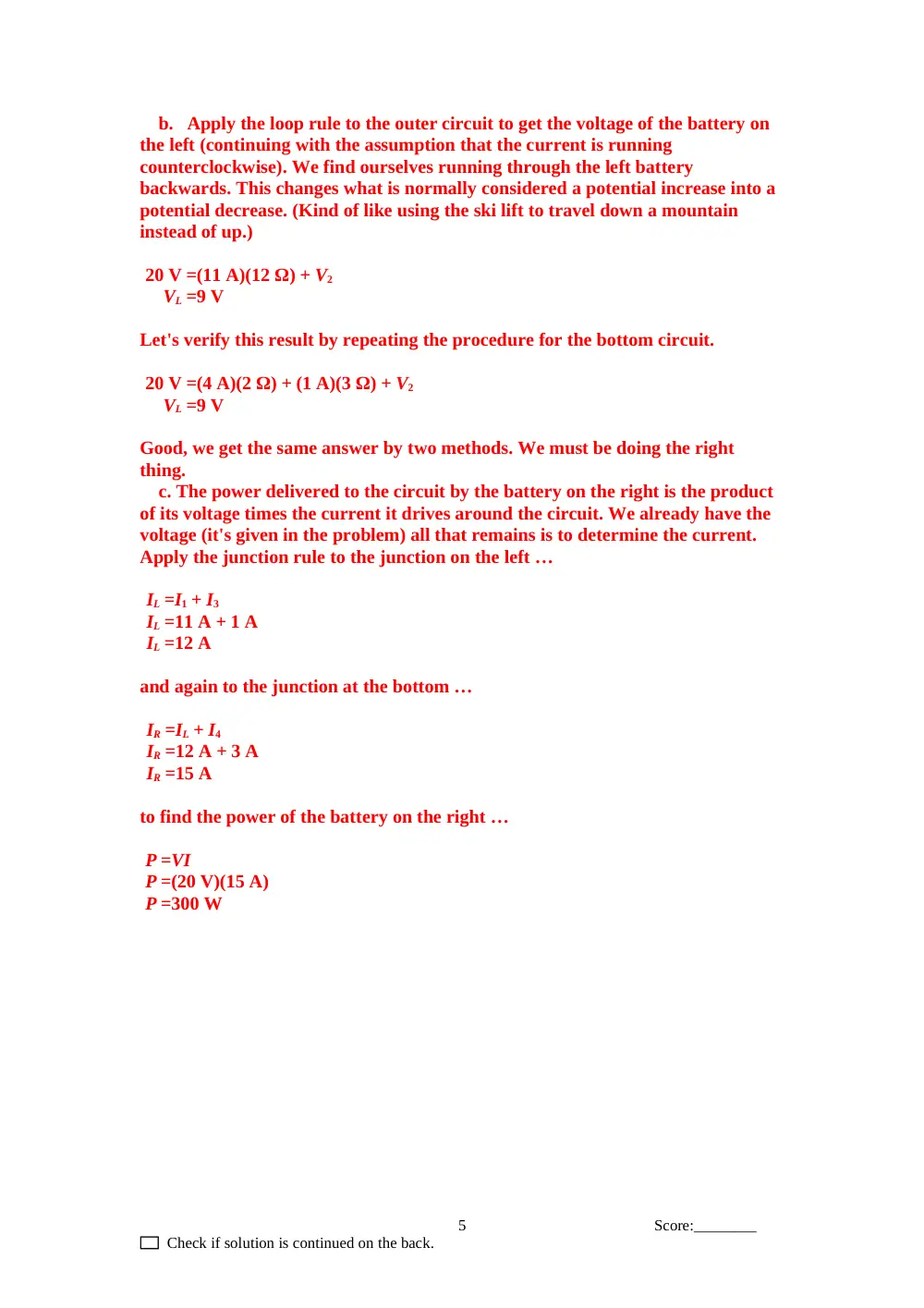
b. Apply the loop rule to the outer circuit to get the voltage of the battery on
the left (continuing with the assumption that the current is running
counterclockwise). We find ourselves running through the left battery
backwards. This changes what is normally considered a potential increase into a
potential decrease. (Kind of like using the ski lift to travel down a mountain
instead of up.)
20 V = (11 A)(12 Ω) + V2
VL = 9 V
Let's verify this result by repeating the procedure for the bottom circuit.
20 V = (4 A)(2 Ω) + (1 A)(3 Ω) + V2
VL = 9 V
Good, we get the same answer by two methods. We must be doing the right
thing.
c. The power delivered to the circuit by the battery on the right is the product
of its voltage times the current it drives around the circuit. We already have the
voltage (it's given in the problem) all that remains is to determine the current.
Apply the junction rule to the junction on the left …
IL = I1 + I3
IL = 11 A + 1 A
IL = 12 A
and again to the junction at the bottom …
IR = IL + I4
IR = 12 A + 3 A
IR = 15 A
to find the power of the battery on the right …
P = VI
P = (20 V)(15 A)
P = 300 W
Score:________
Check if solution is continued on the back.
5