
PHYS 211 Exam 2, Spring 2010
American University of Beirut · Electricity and Magnetism · 6 pages
More PHYS 211 files
- Exam 2 · Fall 2017ExamView
- Exam 1 85% Solved · Fall 2016Exam · with solutionView
- Exam 2 Fall 1617 with Solution · Fall 2016Exam · with solutionView
- Exam 2 Fall 2014 Quiz 2 Solution · Fall 2014Exam · with solutionView
- Exam 2 · Spring 2014ExamView
- Exam 1 · Fall 2014ExamView
- Exam 1 Quiz 1 Solution Fall 2014 · Fall 2014Exam · with solutionView
- Exam 2 · Fall 2014ExamView
Show the text of this exam
Lj} Cheek Uf @ilution be continued un the bavk
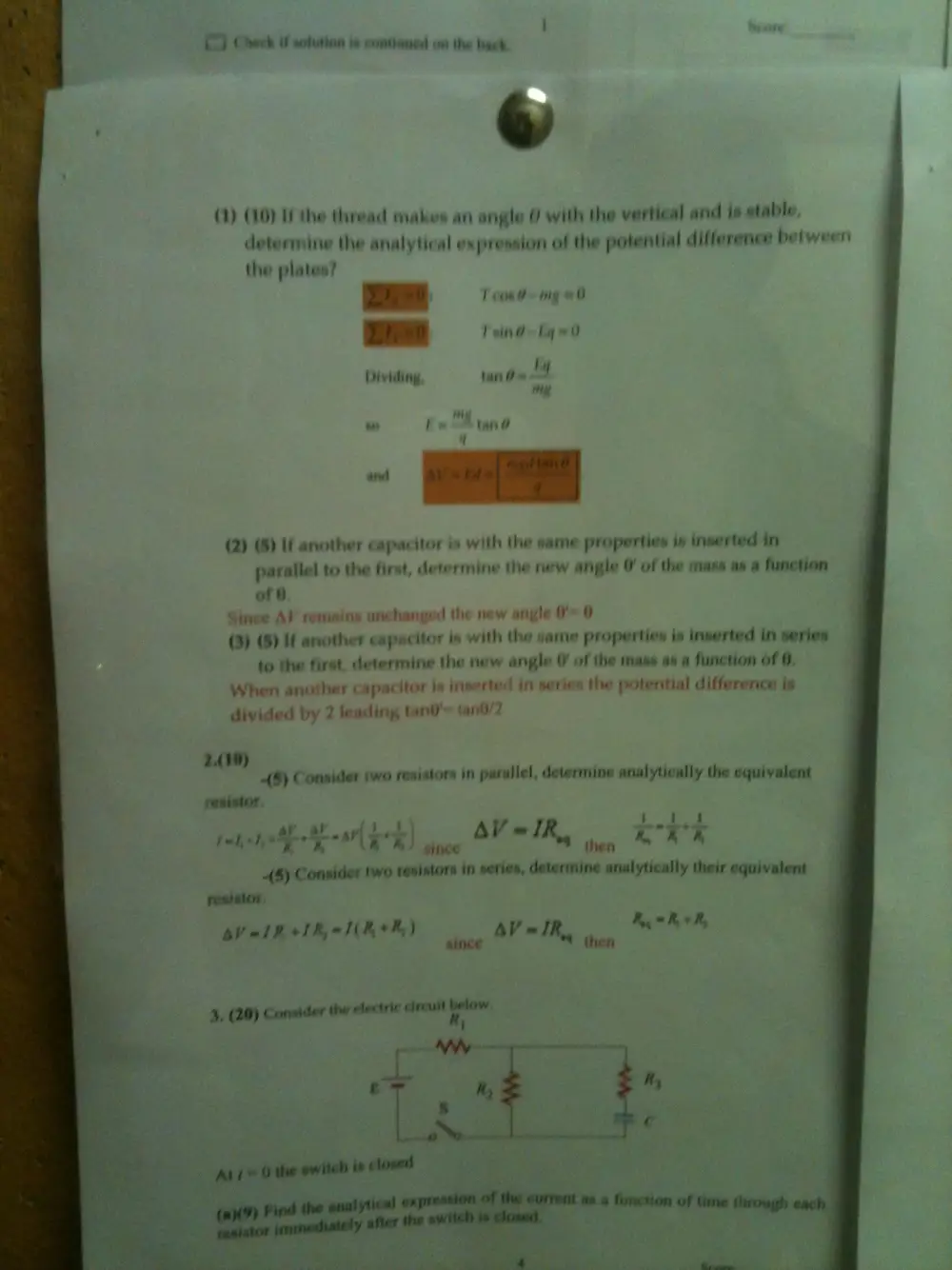
(1) (10) I the thread makes an angle 0 with the verte al and is stable,
determine the analytical expression of the potential difference between
the plates?
Tain@elqev
rae Teond= mg 20
ly
Dividing tan fe
nig
(2) (5) 1f another capacitor is with the same properties is inserted in
parallel to the first, determine the new angle & of the mass as 4 function
of 8
ince Al remains unchanged the new ingle Ow O
(3) (8) If another capacitor is with the same properties is inserted in series
to the first, determine the new angle 0 of the mass as a function of 0,
Wher another capacitor is inserted in series the potential difference is
divided by 2 leading tant’ tani/2
2419) .
(8) Consider two remstors in parallel, determine analytically the equivalent
femstor,
ae (At aE eav| node | AV =IR BS BP
lolol | \h°R) since then og Metis,
.f$) Consider two resistors in series, determine analytically their equivalent
FENIMOr,
OV aol l(heh) AV = IR Ayoh+h,
since “ then
4, (20) Consider the electric cireuit nas
MINS -
H {J Cheek if solution is continued on the back ; |
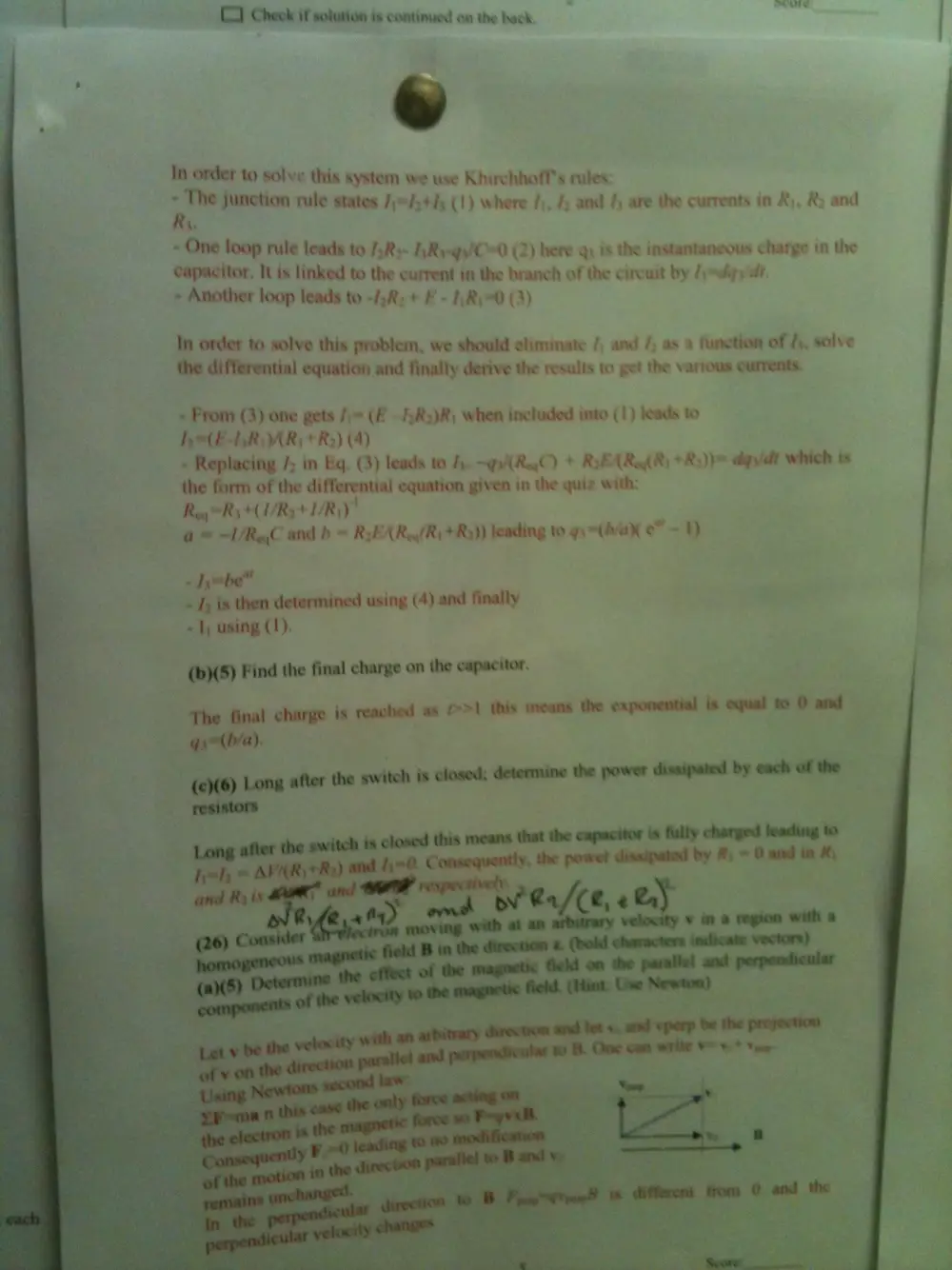
In order to Solve this system we use Khirchhoff's niles:
hd junction rule states Ay=J:+4; (1) where J), J and f; are the currents in 8), Ry and
-
» One loop rule leads to /,R»- hRyqy CoO (2) here gq; is the instantancous charge in the
capacitor. It is linked to the current in the branch of the circuit by /ysdey dt
» Another loop leads to -/,R, + EF « hRyO G)
In order to solve this problem, we should eliminate /\ and /; as a function of 4, solve
the differential equation and finally derive the results to get the various currents.
+ From (3) one gets /; (F -4:R2)R, when included into (1) leads to
Ty( EAR YAR) * Ra) (4)
« Replacing J; in Eq, (3) leads to fy. —gy/(Rog) + RoEAReg( Ry +R2))™ dgy/de which is
the form of the differential equation given in the quiz with:
Reg Ry (IPR TRY"
a ml /RegC and b = REA Re(Ry* Ry) Jeading to ayve(ay = 1)
- dyebe™
Jy is then determined using (4) and finally
sy using (1).
ee (b)(5) Find the final charge on the capacitor,
final charge is reached as ©>!1 this means the exponential is equal to @ and
7A.
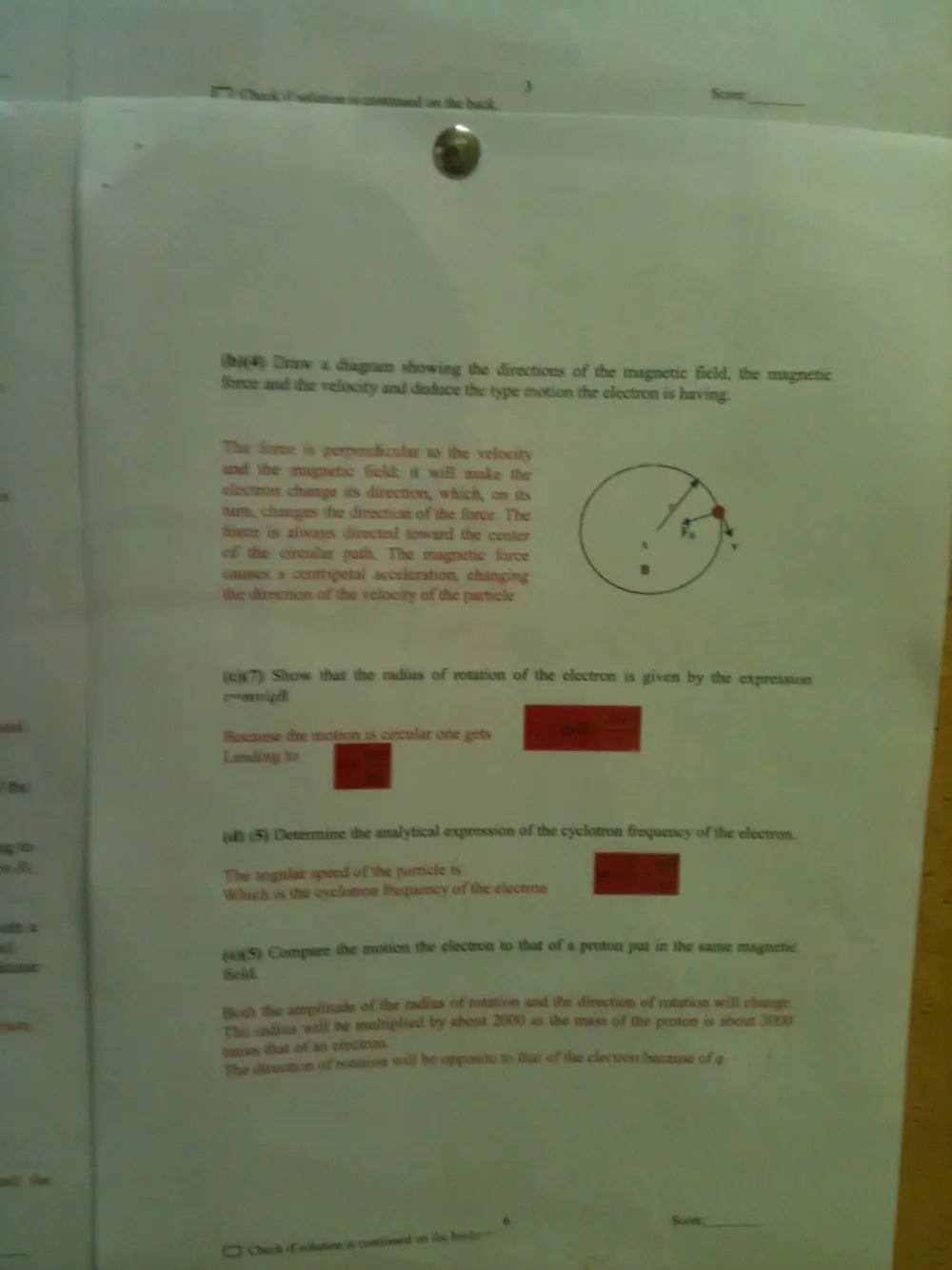
(HEH Oeww 2 diagram showing the directions of the magnetic field, the magnenc
Siros and the velocity and deduce the type motion the electron is having.
‘The fierce is perpendicular to the velocity
ane the magnetic field: it will make the
electron change its direction, which, on its
Sum, changes the direction of the force. The
farce is aways directed toward the center vil
af the anrcular path. The magnetic force
Gases. & Centmpetal acceleration, changing
the: direction of the veiocity of the particle
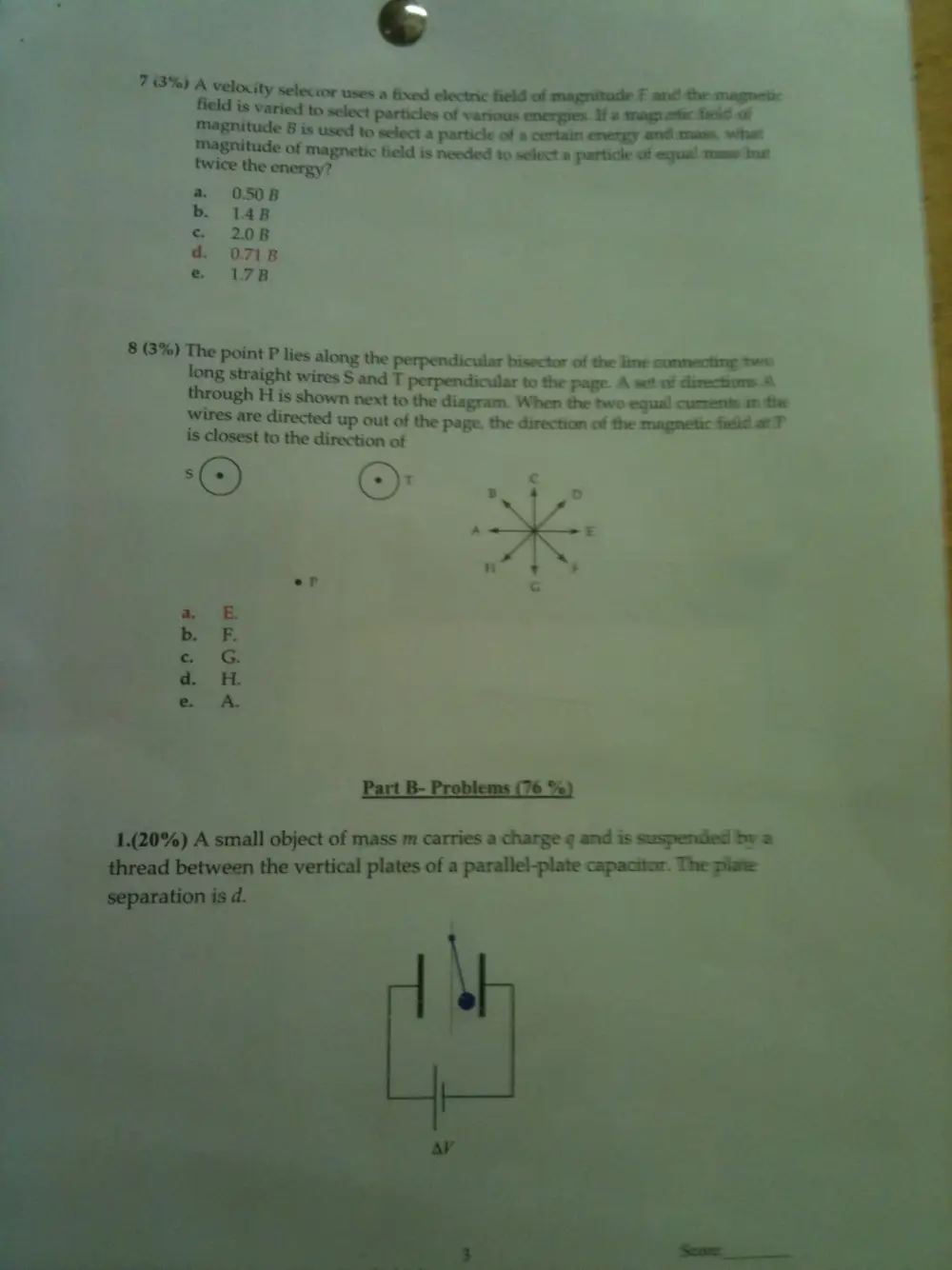
TBR) A velocity selecior uses a fixed electric field of magnitude F and the magrwetr
field is varied to select particles of various energies. I a magic fice of
Perpendicular to the page. A set.af directions
wires are directed up out of the page, the direction of the magnetic fisid at!P
is closest to the direction of
4£@ :
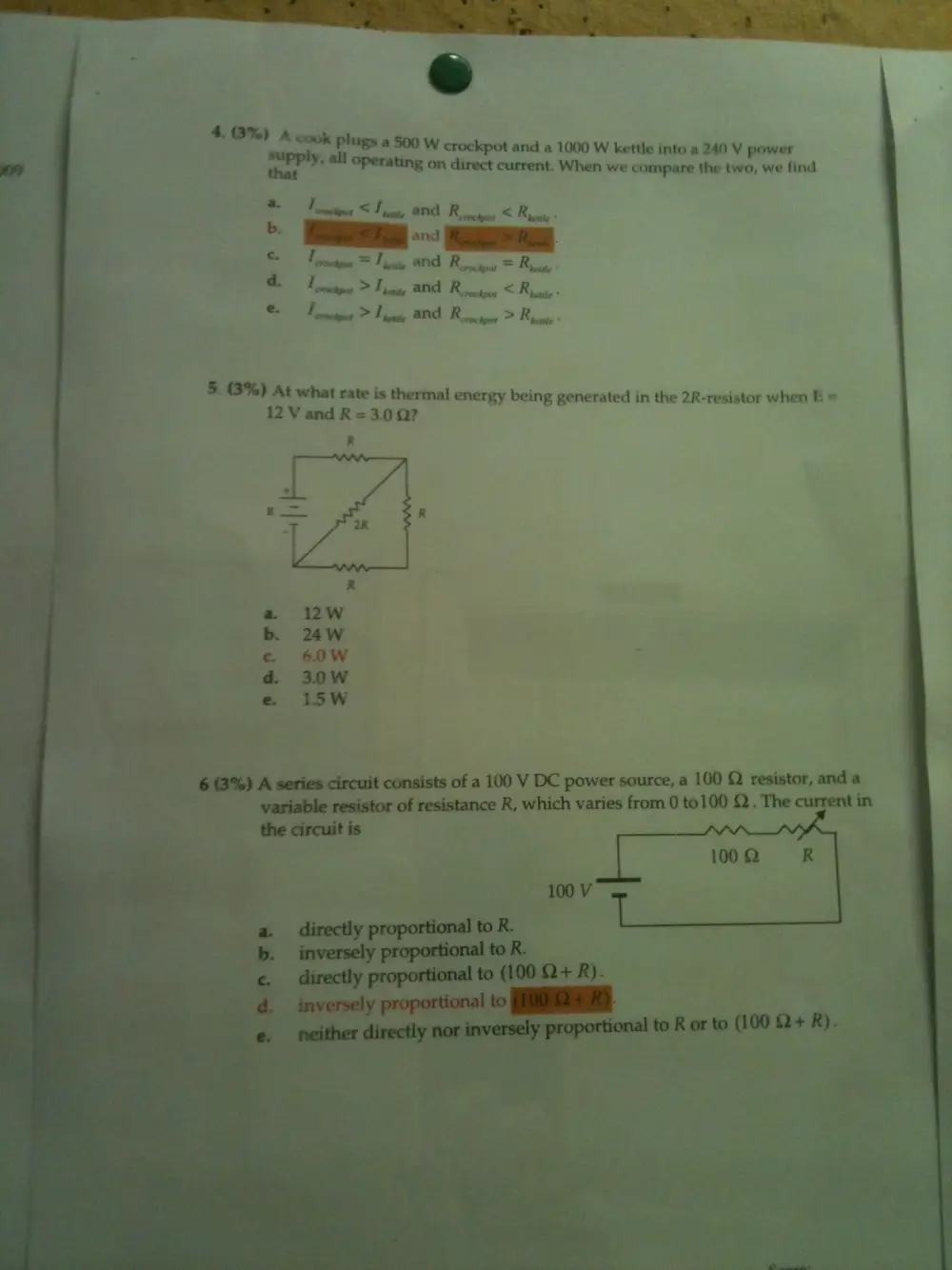
ie @%) soit Plugs a 500 W crockpot and a 1000 W kettle into a 240 V power
et operating on direct current. When we compare the two, we find
Forages <Nrete 808 Repcigss < R,
and
Fartoot = Tisasy 808 Roptgas = Rice
Frcs > H page O08 Ressctper < Recas
Tcini e tige HONE RK > Ry...
sae ee
5. (3%) At what rate is thermal energy being generated in the 2R-resistor when E =
12 V and R = 3.0.9?
onsists of a 100 V DC power source, a 100 Q resistor, and a
»sis R, which varies from 0 to100 Q. The
&
"i
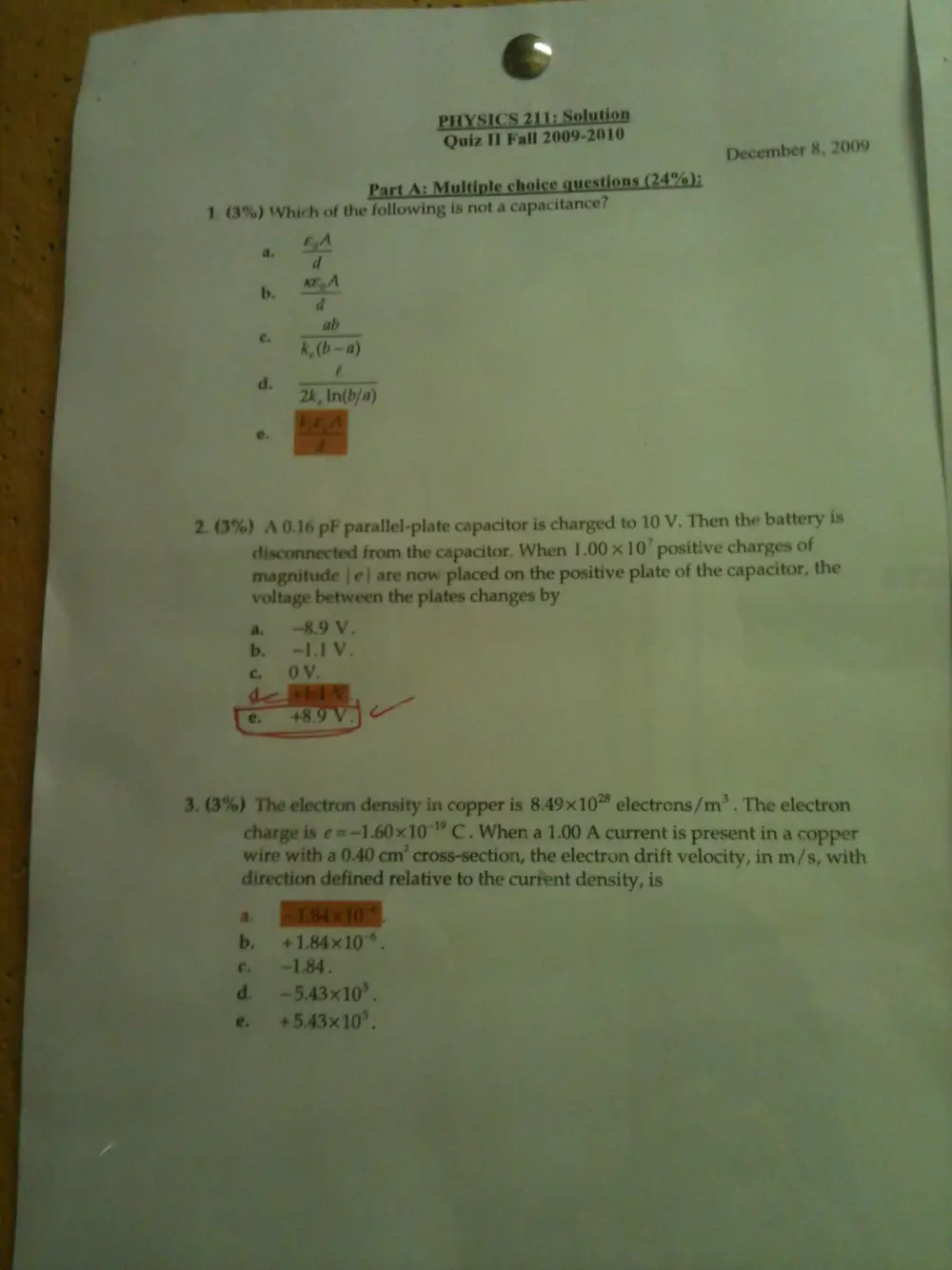
Quiz TI Fall 2009-2010
December 8, 2009
.
1. (8%) Which of the following is not a capacitance?
2. (8%) A 0.16 pF parallel-plate capacitor is charged to 10 V. Then the battery is
disconnected from the capacitor. When 1.00 x 10’ positive charges of
magnitude | e| are now placed on the positive plate of the capacitor, the
voltage between the plates changes by
a -8.9V.
& <1L1V.