
PHYS 211 Exam 2 with Solution, Fall 2011
American University of Beirut · Electricity and Magnetism · 7 pages · with solution


More PHYS 211 files
- Exam 2 · Fall 2017ExamView
- Exam 1 85% Solved · Fall 2016Exam · with solutionView
- Exam 2 Fall 1617 with Solution · Fall 2016Exam · with solutionView
- Exam 2 Fall 2014 Quiz 2 Solution · Fall 2014Exam · with solutionView
- Exam 2 · Spring 2014ExamView
- Exam 1 · Fall 2014ExamView
- Exam 1 Quiz 1 Solution Fall 2014 · Fall 2014Exam · with solutionView
- Exam 2 · Fall 2014ExamView
Show the text of this exam
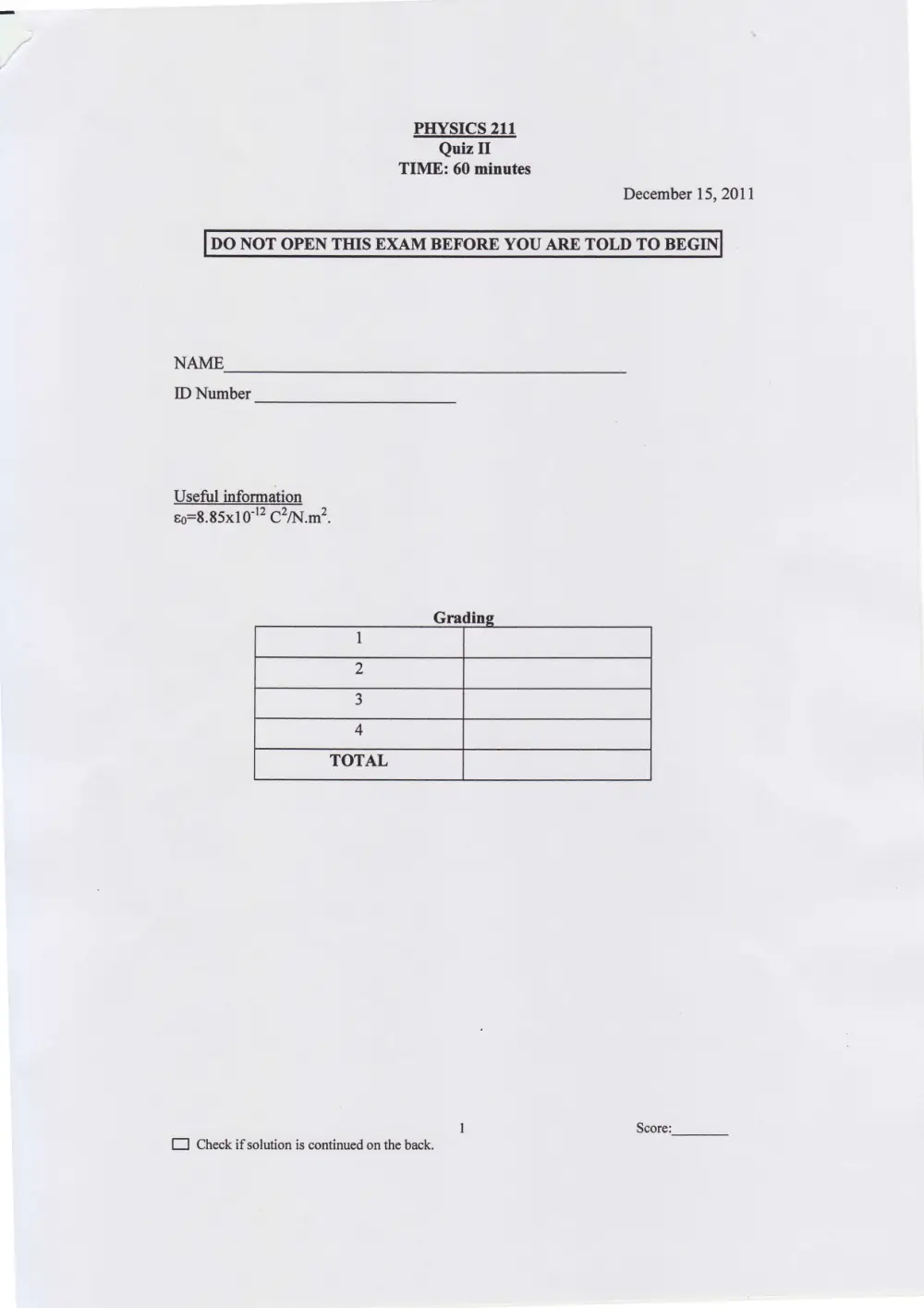
PHYSICS 211
Quiz n
TIME: 60 minutes
December l5,20ll
DO NOT OPEN THIS EXAM BEFORE YOU ARE TOLD TO
IDNumber
Useful infonnation
eo=8.
85x1 o-12 c2lN.m2.
E
Check if solution is continued on the back.
Score:
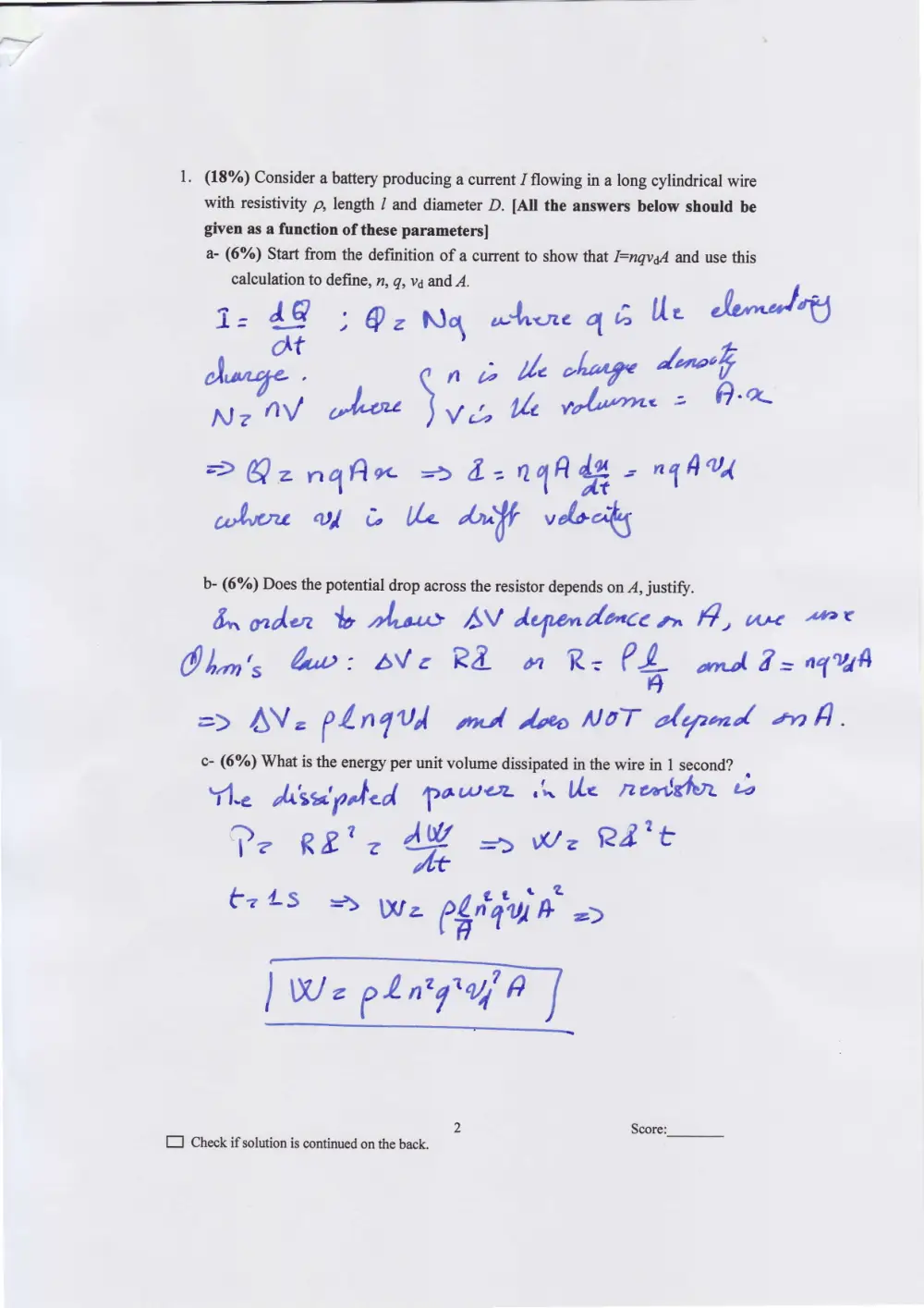
l. (18%) Consider abattery producing a current /flowing in a long cylindrical wire
with resistivity p,lengfh / and diameter D. [AIl the onswenr below should be
given as a function of these parametersl
a- (6%) Start from the definition of a current to show that l=nqv6A and use this
calculation to define, ft, e,vdandA.
dt
1.= A
)82 N1 ,,,ln*. al E II.. 'L*'J"V
fo nl*
b ,l-t
> AV lc'[ttnr/a'cc t- t4 , ^-,4 'J(*> v
c- (6%) What is the enerry per unit volnme dissipated in the wire in I second?
Y1* "l^s*iyJ.d
1)ouuL .'^ ilt n?'v{sf,u
z L
?.
R&? z #
-:+ vt/z fzL't
t" t-s =+ rva p$;ir, fr" =)
d$t,
c lt t- l/. rl*,r /*'fr
Nz nV J**
) u t Ut nol'L'n' 2 Q'*
+&.n1A*<
=+ E--rf
*s
"1Ant'q
,-I"u*
cttl A l/^ /t"'f
t/r";k
b- (60/0) Does the potential drop across the resistor depends on l, justifi.
0l-,"
4D: b{e ?3- ut R,= ?+ d^J?=n1urA
=) AV' f lnlUl
tr.t( fu6 AJIT efVr*"( /72 n .
E
Check if solution is continued on the back.
Score:_
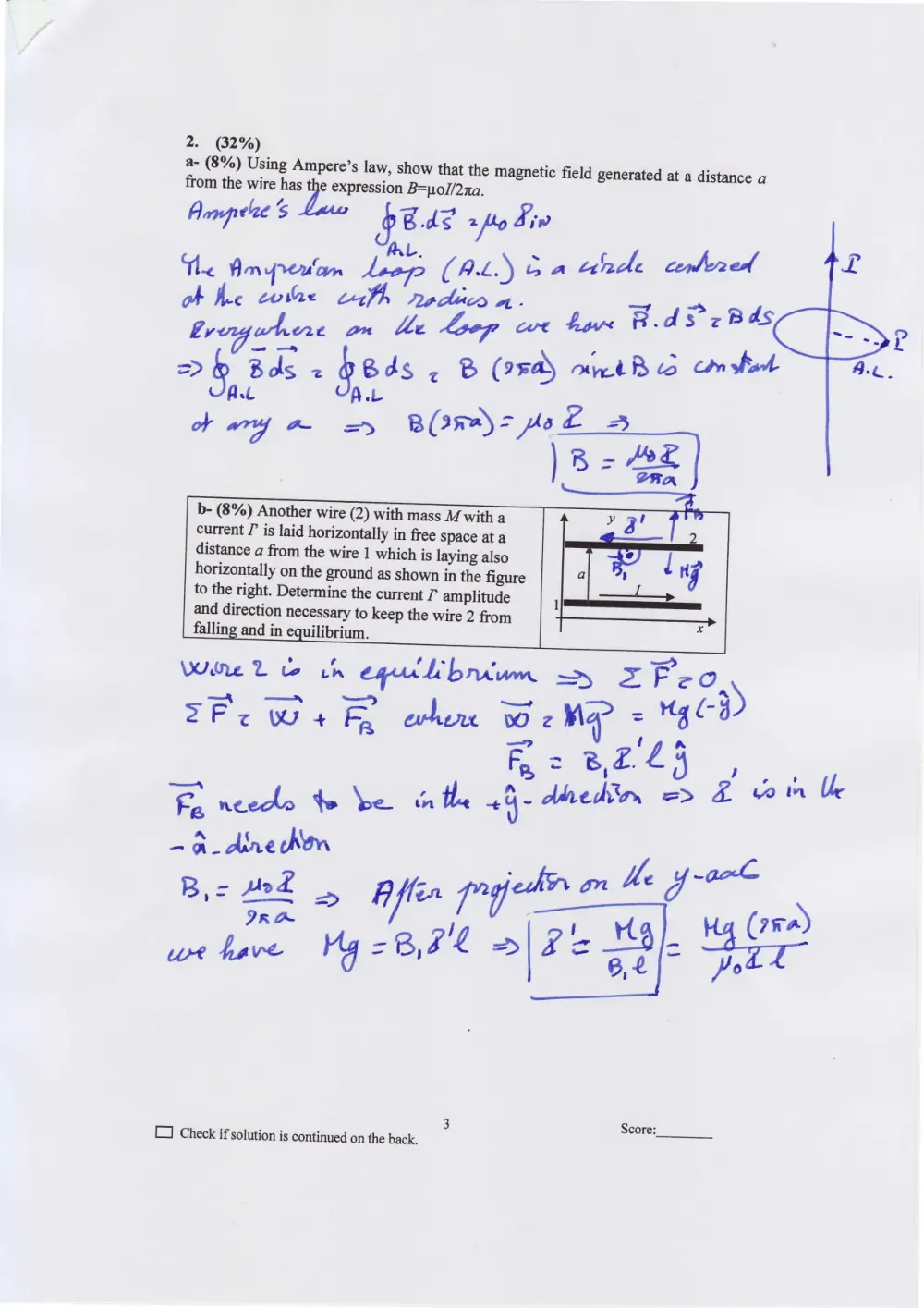
2. (s2%)
l- (8v:) u:ing Ampere's raw, show that the magnetic field generated
at a distance a
from the wire has tle expressionhpol/2i.
enycLu's -4,a', ,$6.U ,1+f;o
1l* flm"pottbn H
1n,.t.) i o crbc,l, arJL--l
o* Il*, Lrd. ,,r/A'*2;^
n.
-, ..a,
.
=>h"BE z $aas z B fotd o+',r}a ch'beL
On.t
dA.L
"rrya-:+
a(rr.):Va E :t
=M
7Ba,
)a
W.tru Z L ,'^, €4/*ll;b,ur^,rn
:i
Zf
-O \
rF. E* d sA,n'Yryltr
q ='i,Z.'l-j ,
E ncr*' $' !-
i^il^ *t: obbt'h'^ :> i
w tn tL
- a - Alnea[U^
B,t 4
2x*
u:e Ltv+
E] Ctrectifsolutioniscontinuedontheback. 3
n/^rilY
-aoC
and direction necessary
to keep the *ir" Z tom
current Jn is laid horizontally in free space at a
distance a from the wire I which i, f"yio! Jro
h.
"Lr*rUy_on the ground as shown io m-, ng_.
to the right. Determine the cunent.l"
"roptitoO,
Score:--
-
fr;::ffi:
at a distancey
from wire I is moving at a constant
u!g.rr, v inthe
a- (6%) Determine the distance it has to have with 0t?. t so as its
frajectoryisnotmodifiedwhenyca
a
tO
,
,,
?/ //' e ;
.r7zd *^d
"
/" A: oLhc /is-
7>
# *,ai'
u'-J
'A t *"ot /' d/>e b'4
d,wtJ"/ t" l'l' w =) zF +0 -t
c.
notmoving at all, justiS?
z:o
Ef Check if solution is continued on the back.
4
ry *',o *
;,,a*l*,
'leclron-elm-be placed to stay in equilibrium if it was
justiS?
b
ilr. *- a7t
)r,
"r/aze
or{"o" //, Q^ttf,
/"rr+
Score:
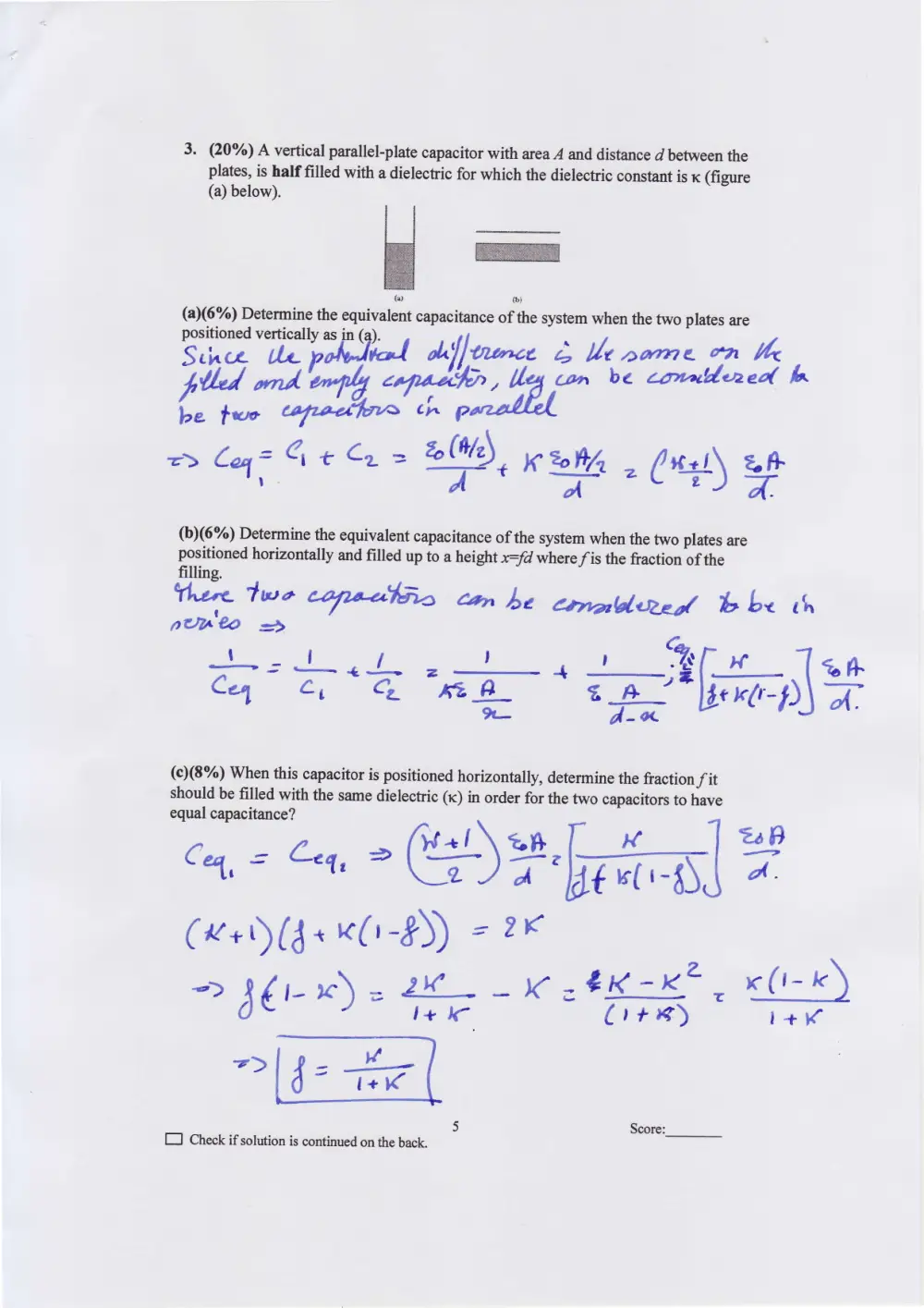
3. Q$o/o) A vertical parallel-plate capacitor with area A and distance d between the
plates, is half filled with a dielectic for which the dielectric constant is rc (figure
(a) below).
tl
t l
ffim
atK
ffi
(a)(6%)Determine
tn" "quiuadl capacitance
oiJn. ,yrt"- when the two plates
are
'j:'1"5""fr:r;fi8U a^lltno,cc
E /./, o*. ? /,/.
7{/t/ t/t/'@
, 4? f^
bc ra*'e'aluzed
he ftn
ry
cr Jz'{?u'rrl'
z) Coq= (t t cz = 4-
K&
z/q\
gS
fr
-rl
A
zL7)7
(b)(6%', Determine the equivalent capacitance
of the system when the two plates are
positioned horizontally and filled up to a heistrfdwhere/is
the fraction ofthe
filling.
tl,€^-'lwo
ca/rt*r/ya-
uv S,
oelvt24
+
h
.t
Lr t 0'-)
r,
Arr?tW.tZt
-t' x,3
A-o<
-l-*l-
cr
eL
?b(,etz4/
T'* %
rc
bL" tt
- = t
retl
,
=
-
8'.0.
91-
= 2(
.1t*
D)T
(c)(8%) When this capacitor is positioned horizontally, determine the fraction/it
should be filled with the same dielectoic (r) in order for the two capacitors to have
equal capacitance?
ca,,s
L.r, )e$},,ffi
T
(ant)fd - vc(, &)
tl
l+K
6=
z)
EI Check if solution is continued on the back
Score:
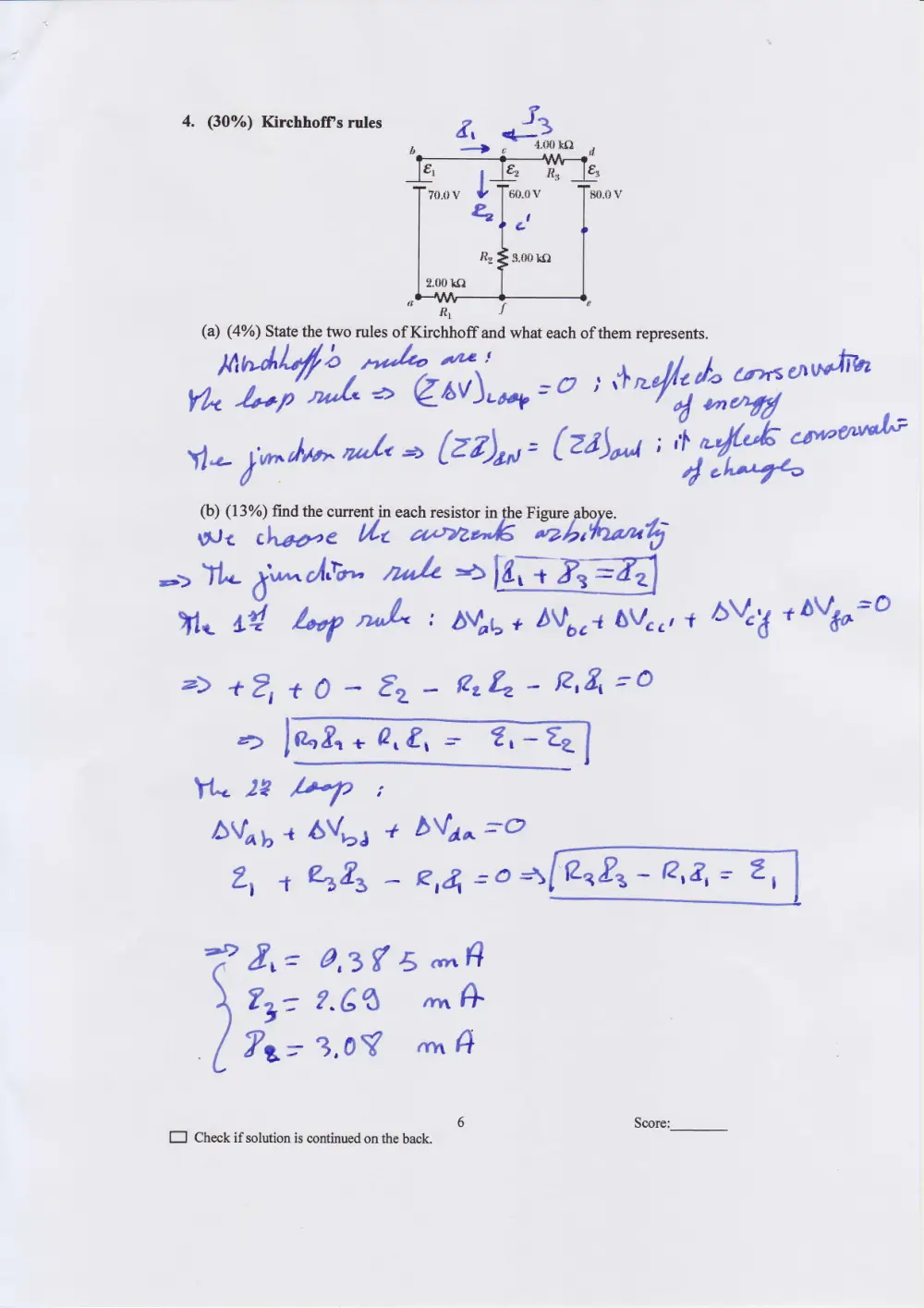
4. Q0%\ Kirchhoffs rules
G'
-r
-l
t \ l
(a) (4%) State the two rules of Kirchhoffand what each of them represents.
,fffin*rffi),, * = o ; i oo/c
t^ffi-
ylu- ir^rl,wao./,
o (zZ)rn=
Gd)*t t'!o;yfus"'"I*
(b) (13%) find the cunent jn each resistor in the Fieure aboye.
w.
chztne ilt
alrtn"k
"D6;fu/rr/C
:> TL 21r*.'J,V-'
nt/' =>Vrtry4
U
11. Li
bf
""'/^ : b\V+ blJ'or+
0V..' + 6Y'6*bV6o=o
z) +2,
+
tL 24
bVah
2l
? 3,=
\ 77=
( 7t=
t 0
Zz
t?, L.
f?,8, = o
I
ry'
{ 6V,rr + b{on =o
t 44
P,4:o ={
0,3 ( s ,,^fl
?.G1 ' #
3.0V ,n ff
E
Check ifsolution is continued on the back.
Score:
ftfi"l?ffi*l;
potential
difference
berween
points
c ndfwhich point is ar the
Nl. -- Vc - V : blrc, * oY rd
z) vf ; ++i* ,Hfr'" =-6a'zv
(c)Q%) Find the potential b,etween
points e andf
,t'+ce ,?& c/*rn*-l
;
,h L/'rrc.n
( */
/
z5 bV"6 - o
(e) (5y0 compare the power dissipated to the power generated and comment.
7L< fln u, A o8srVol"1 bA l*
));A-
;
?,= P.8' . *ag<:l&/ z o, zq6 oo{.
?=?ot'.
?{.h6 rnn\o
?. - ?6 rm\I/'
(*trnrnt'nq
ll"
t"^du^'^ */r^
/"
u',na/
d
"l
il, ztffi? r" d^h, ol€*
:> 2f ,r"A o'h a'^ d 6e'Lu26lcr'
,&^
7t D il"
"h t/ ^{/ a/ da < a'#4blb''
:u) A ?rr=+&,bv,z+&2,
=26.q5
7, .= +f,qa\45
= EzZ+ .= 915.2
?r, .' + Sr AVo '-2.2, = t g4-r'
-D C\**rfr/
7dr,u* : ?r = z/,2 W
Err*nlA
1
-, ?, t 2h2 W
dr>e N
El ctrect if solution is continued on the back.
7
score: