
PHYS 216 Exam 2, Fall 2016
American University of Beirut · Mathematical Methods for Physics · 2 pages · Dr. Ali Chamseddine
More PHYS 216 files
- Exam 1 · Fall 2017ExamView
- Exam 1 · Fall 2017ExamView
- Exam 1 Solution · Fall 2017Exam · with solutionView
- Exam 1 Solution · Fall 2017Exam · with solutionView
- Exam 2 · Fall 2016ExamView
- Exam 2 Solutions · Fall 2016Exam · with solutionView
- Exam 2 Solutions · Fall 2016Exam · with solutionView
- Exam 2 · Fall 2014ExamView
Show the text of this exam
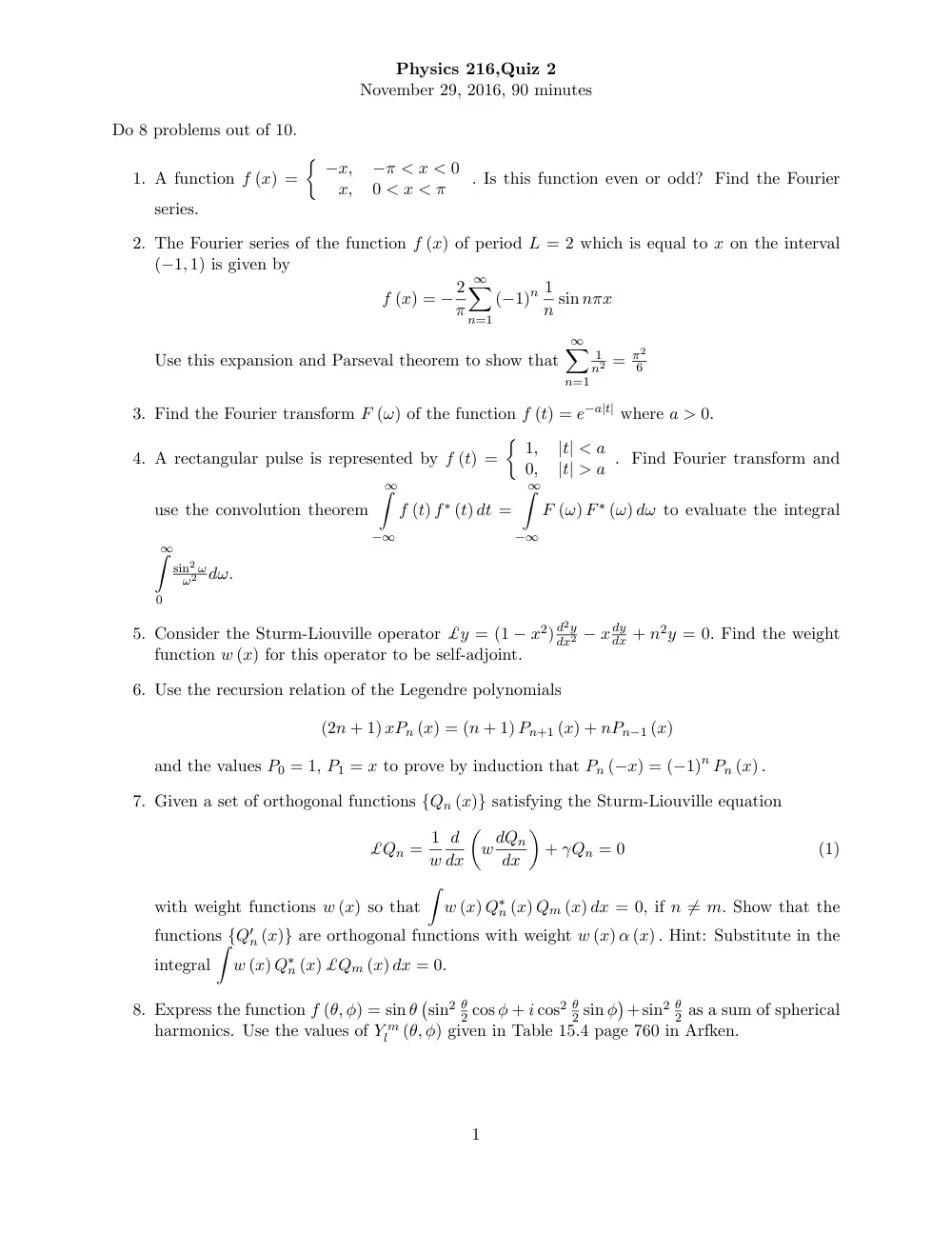
Physics 216,Quiz 2
November 29, 2016, 90 minutes
Do 8 problems out of 10.
1. A function f (x) =
� −x,
−π < x < 0
x,
0 < x < π
. Is this function even or odd? Find the Fourier
series.
2. The Fourier series of the function f (x) of period L = 2 which is equal to x on the interval
(−1, 1) is given by
f (x) = − 2
π
∞
�
n=1
(−1)n 1
n sin nπx
Use this expansion and Parseval theorem to show that
∞
�
n=1
1
n2 = π2
6
3. Find the Fourier transform F (ω) of the function f (t) = e−a|t| where a > 0.
4. A rectangular pulse is represented by f (t) =
� 1,
|t| < a
0,
|t| > a . Find Fourier transform and
use the convolution theorem
∞
�
−∞
f (t) f∗ (t) dt =
∞
�
−∞
F (ω) F ∗ (ω) dω to evaluate the integral
∞
�
0
sin2 ω
ω2 dω.
5. Consider the Sturm-Liouville operator £y = (1 − x2) d2y
dx2 − x dy
dx + n2y = 0. Find the weight
function w (x) for this operator to be self-adjoint.
6. Use the recursion relation of the Legendre polynomials
(2n + 1) xPn (x) = (n + 1) Pn+1 (x) + nPn−1 (x)
and the values P0 = 1, P1 = x to prove by induction that Pn (−x) = (−1)n Pn (x) .
7. Given a set of orthogonal functions {Qn (x)} satisfying the Sturm-Liouville equation
£Qn = 1
w
d
dx
�
wdQn
dx
�
+ γQn = 0
(1)
with weight functions w (x) so that
�
w (x) Q∗
n (x) Qm (x) dx = 0, if n ̸= m. Show that the
functions {Q′
n (x)} are orthogonal functions with weight w (x) α (x) . Hint: Substitute in the
integral
�
w (x) Q∗
n (x) £Qm (x) dx = 0.
8. Express the function f (θ, φ) = sin θ
�
sin2 θ
2 cos φ + i cos2 θ
2 sin φ
�
+sin2 θ
2 as a sum of spherical
harmonics. Use the values of Y m
l
(θ, φ) given in Table 15.4 page 760 in Arfken.
1
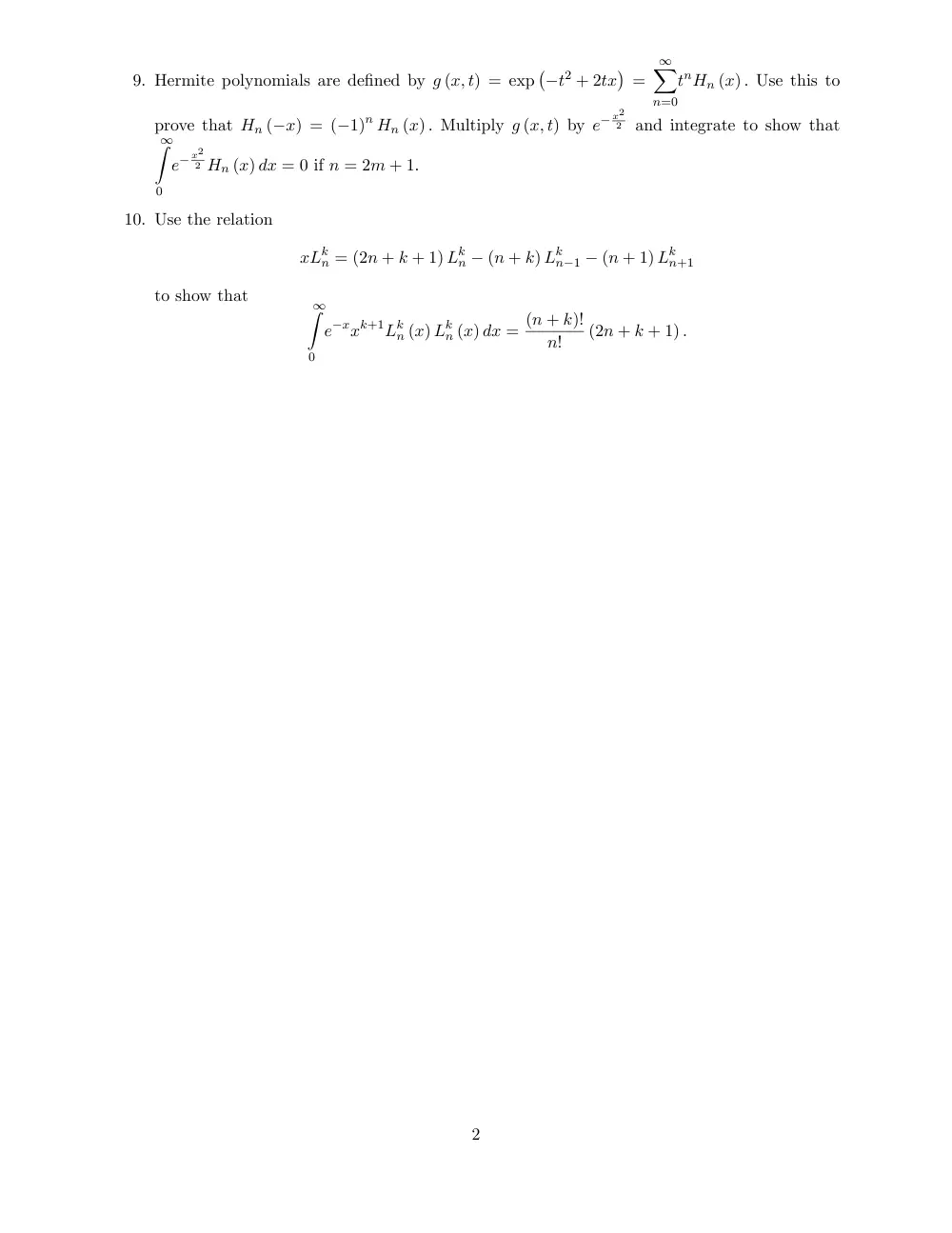
9. Hermite polynomials are defined by g (x, t) = exp
�
−t2 + 2tx
�
=
∞
�
n=0
tnHn (x) . Use this to
prove that Hn (−x) = (−1)n Hn (x) . Multiply g (x, t) by e− x2
2
and integrate to show that
∞
�
0
e− x2
2 Hn (x) dx = 0 if n = 2m + 1.
10. Use the relation
xLk
n = (2n + k + 1) Lk
n − (n + k) Lk
n−1 − (n + 1) Lk
n+1
to show that
∞
�
0
e−xxk+1Lk
n (x) Lk
n (x) dx = (n + k)!
n!
(2n + k + 1) .
2