
PHYS 216 Exam 2, Fall 2016
American University of Beirut · Mathematical Methods for Physics · 1 page · Dr. Ali Chamseddine
Stuck on a question? A tutor can walk you through it.
More PHYS 216 files
- Exam 1 · Fall 2017ExamView
- Exam 1 · Fall 2017ExamView
- Exam 1 Solution · Fall 2017Exam · with solutionView
- Exam 1 Solution · Fall 2017Exam · with solutionView
- Exam 2 · Fall 2016ExamView
- Exam 2 Solutions · Fall 2016Exam · with solutionView
- Exam 2 Solutions · Fall 2016Exam · with solutionView
- Exam 2 · Fall 2014ExamView
Show the text of this exam
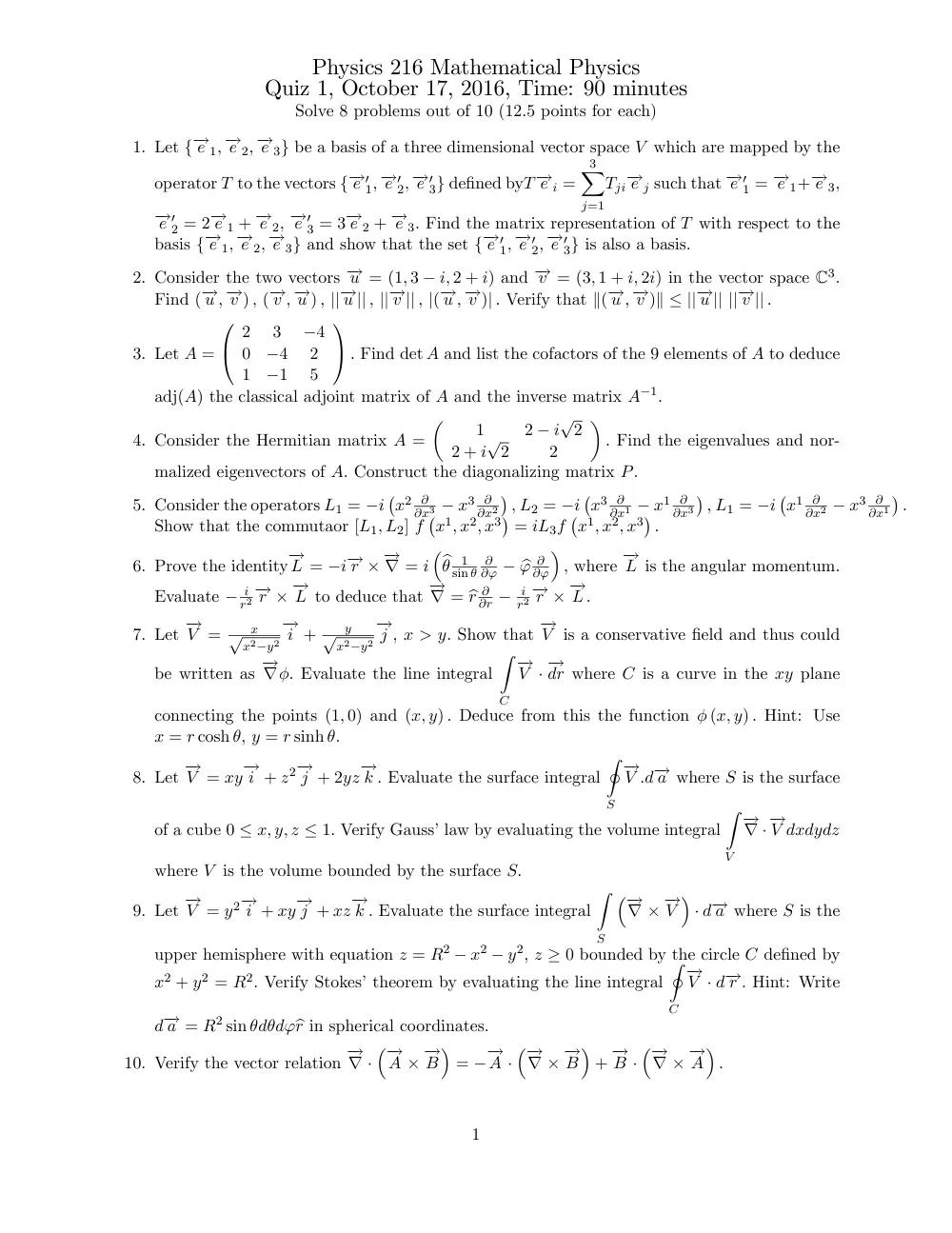
Physics 216 Mathematical Physics
Quiz 1, October 17, 2016, Time: 90 minutes
Solve 8 problems out of 10 (12.5 points for each)
1. Let {−→e 1, −→e 2, −→e 3} be a basis of a three dimensional vector space V which are mapped by the
operator T to the vectors {−→e ′
1, −→e ′
2, −→e ′
3} defined byT−→e i =
3
�
j=1
Tji−→e j such that −→e ′
1 = −→e 1+−→e 3,
−→e ′
2 = 2−→e 1 + −→e 2, −→e ′
3 = 3−→e 2 + −→e 3. Find the matrix representation of T with respect to the
basis {−→e 1, −→e 2, −→e 3} and show that the set {−→e ′
1, −→e ′
2, −→e ′
3} is also a basis.
2. Consider the two vectors −→u = (1, 3 − i, 2 + i) and −→v = (3, 1 + i, 2i) in the vector space C3.
Find (−→u , −→v ) , (−→v , −→u ) , ||−→u || , ||−→v || , |(−→u , −→v )| . Verify that ∥(−→u , −→v )∥ ≤ ||−→u || ||−→v || .
3. Let A =
2
3
−4
0
−4
2
1
−1
5
. Find det A and list the cofactors of the 9 elements of A to deduce
adj(A) the classical adjoint matrix of A and the inverse matrix A−1.
4. Consider the Hermitian matrix A =
�
1
2 − i
√
2
2 + i
√
2
2
�
. Find the eigenvalues and nor-
malized eigenvectors of A. Construct the diagonalizing matrix P.
5. Consider the operators L1 = −i
�
x2 ∂
∂x3 − x3 ∂
∂x2
�
, L2 = −i
�
x3 ∂
∂x1 − x1 ∂
∂x3
�
, L1 = −i
�
x1 ∂
∂x2 − x3 ∂
∂x1
�
.
Show that the commutaor [L1, L2] f
�
x1, x2, x3�
= iL3f
�
x1, x2, x3�
.
6. Prove the identity−→
L = −i−→r × −→
∇ = i
�
�θ
1
sin θ
∂
∂ϕ − �ϕ ∂
∂ϕ
�
, where −→
L is the angular momentum.
Evaluate − i
r2 −→r × −→
L to deduce that −→
∇ = �r ∂
∂r − i
r2 −→r × −→
L .
7. Let −→
V =
x
√
x2−y2
−→i +
y
√
x2−y2
−→j , x > y. Show that −→
V is a conservative field and thus could
be written as −→
∇φ. Evaluate the line integral
�
C
−→
V · −→
dr where C is a curve in the xy plane
connecting the points (1, 0) and (x, y) . Deduce from this the function φ (x, y) . Hint: Use
x = r cosh θ, y = r sinh θ.
8. Let −→
V = xy−→i + z2−→j + 2yz−→k . Evaluate the surface integral
�
S
−→
V .d−→a where S is the surface
of a cube 0 ≤ x, y, z ≤ 1. Verify Gauss’ law by evaluating the volume integral
�
V
−→
∇ ·−→
V dxdydz
where V is the volume bounded by the surface S.
9. Let −→
V = y2−→i + xy−→j + xz−→k . Evaluate the surface integral
�
S
�−→
∇ × −→
V
�
· d−→a where S is the
upper hemisphere with equation z = R2 − x2 − y2, z ≥ 0 bounded by the circle C defined by
x2 + y2 = R2. Verify Stokes’ theorem by evaluating the line integral
�
C
−→
V · d−→r . Hint: Write
d−→a = R2 sin θdθdϕ�r in spherical coordinates.
10. Verify the vector relation −→
∇ ·
�−→
A × −→
B
�
= −−→
A ·
�−→
∇ × −→
B
�
+ −→
B ·
�−→
∇ × −→
A
�
.
1