
PHYS 216 Final, Fall 2013
American University of Beirut · Mathematical Methods for Physics · 2 pages · Dr. Ali Chamseddine

More PHYS 216 files
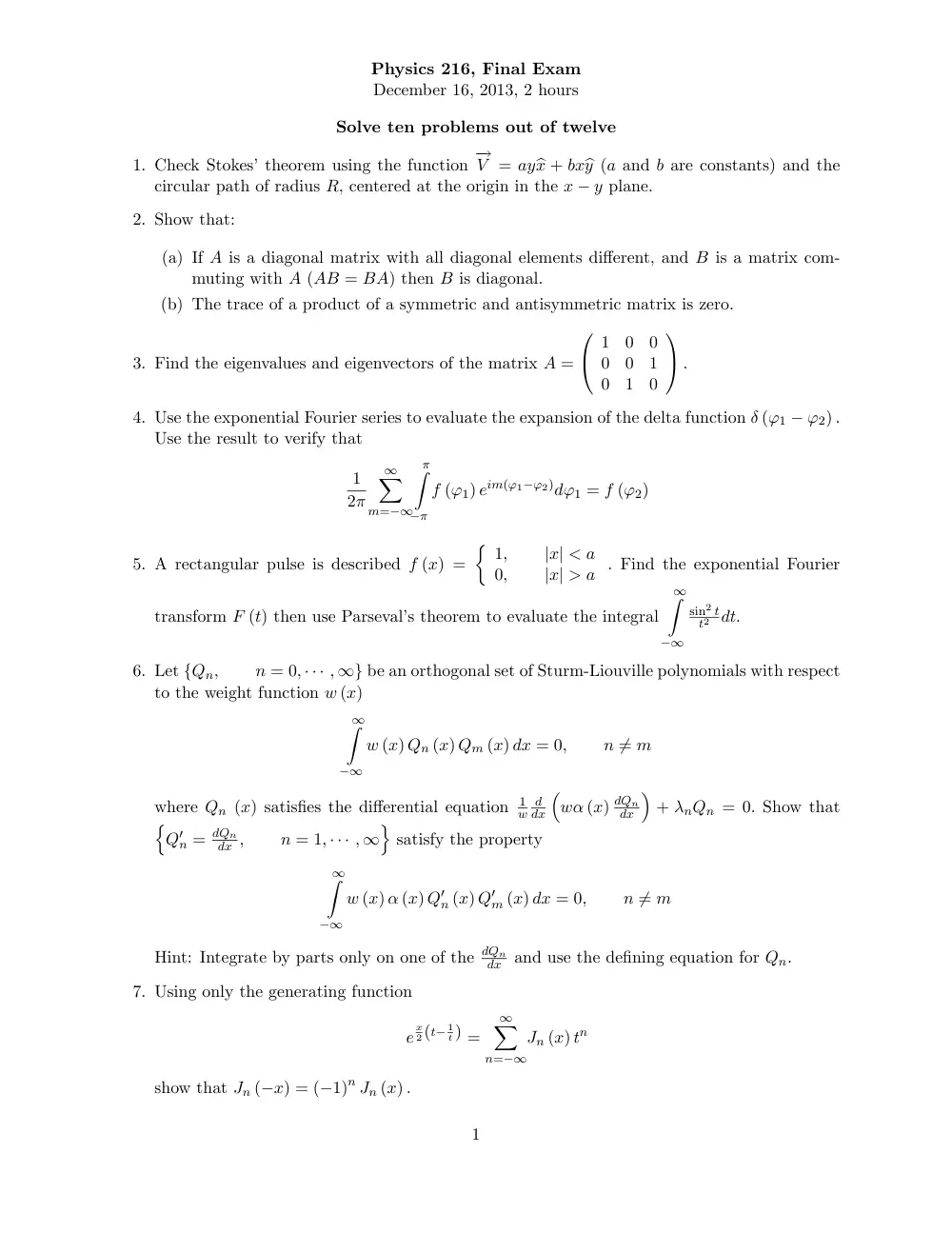
Show the text of this final exam
Physics 216, Final Exam
December 16, 2013, 2 hours
Solve ten problems out of twelve
1. Check Stokes’ theorem using the function −→
V = ay�x + bx�y (a and b are constants) and the
circular path of radius R, centered at the origin in the x − y plane.
2. Show that:
(a) If A is a diagonal matrix with all diagonal elements different, and B is a matrix com-
muting with A (AB = BA) then B is diagonal.
(b) The trace of a product of a symmetric and antisymmetric matrix is zero.
3. Find the eigenvalues and eigenvectors of the matrix A =
1
0
0
0
0
1
0
1
0
.
4. Use the exponential Fourier series to evaluate the expansion of the delta function δ (ϕ1 − ϕ2) .
Use the result to verify that
1
2π
∞
�
m=−∞
π
�
−π
f (ϕ1) eim(ϕ1−ϕ2)dϕ1 = f (ϕ2)
5. A rectangular pulse is described f (x) =
� 1,
|x| < a
0,
|x| > a . Find the exponential Fourier
transform F (t) then use Parseval’s theorem to evaluate the integral
∞
�
−∞
sin2 t
t2 dt.
6. Let {Qn,
n = 0, · · · , ∞} be an orthogonal set of Sturm-Liouville polynomials with respect
to the weight function w (x)
∞
�
−∞
w (x) Qn (x) Qm (x) dx = 0,
n ̸= m
where Qn (x) satisfies the differential equation
1
w
d
dx
�
wα (x) dQn
dx
�
+ λnQn = 0. Show that
�
Q′
n = dQn
dx ,
n = 1, · · · , ∞
�
satisfy the property
∞
�
−∞
w (x) α (x) Q′
n (x) Q′
m (x) dx = 0,
n ̸= m
Hint: Integrate by parts only on one of the dQn
dx and use the defining equation for Qn.
7. Using only the generating function
e
x
2(t− 1
t) =
∞
�
n=−∞
Jn (x) tn
show that Jn (−x) = (−1)n Jn (x) .
1
8. The quantum mechanical angular momentum operator is given by −→
L = i−→r × −→
∇. Show that
L± = Lx ± iLy = ±e±iϕ
� ∂
∂θ ± i cot θ ∂
∂ϕ
�
9. Consider the Hermite differential operator 2H = − d2
dx2 + x2 and the raising and lowering
operators a± =
1
√
2
�
x ∓ d
dx
�
. Show that [a−, a+] = 1, and [N, a±] = ±a± where N = a+a−.
Express H in terms of N. Let ψn (x) be the eigenstate satisfying Nψn (x) = nψn (x) . Deduce
that ψn (x) is an eigenstate of H with eigenvalue
�
n + 1
2
�
, i.e. Hψn (x) =
�
n + 1
2
�
ψn (x).
10. Find the Laurent series expansion of the function f (z) =
1
(z−1)(z−2) in the annulus 1 < |z| < 2
by direct expansion.
(Hint: first express f (z) in terms of
1
z−1 and
1
z−2 and use power
series expansion in region of validity). Verify the coefficients a0 and a−1 using the formula
an =
1
2πi
�
C
f(z)
zn+1 dz where f (z) =
∞
�
n=−∞
anzn.
11. Find the residue at z = −i of the function
1
z4−1. Find the integral
�
C
1
z4−1dz where C is a
circle of radius 1
2 centered at z = −i.
12. Using contour integration evaluate the definite integral
2π
�
0
1
3+2 cos θdθ.
2