
PHYS 217 Final, Fall 1995
American University of Beirut · Mechanics · 4 pages

More PHYS 217 files
Show the text of this final exam
<a coe eee
: La .o basins As : MIN a fag
a an LIBRARY
8 ; ;
. LZ OF BEIT
7
AUB Physics 217 Jan. 29, 1996
Physics Department Final Exam Time: 2 hours
Name: :
4
ID. No: :
General infromation :
(1) No make up of this exam without legal reason
(2) Try to work out all questions, unless you are given a choice
@) The time given above cannot be exceeded.
(4) The exam will have a total grade of 200
Content Grade
1. Particle in a central field
2. Rotation ee
3. Collisions
4. Oscillation of rigid bodies
5. Pendulum with Lagrangian
6. Particle on a wire with Lagrangian
(This problem has a bonus)
Total :
Physics 217 1 Jan. 29, 1996
Final Exam
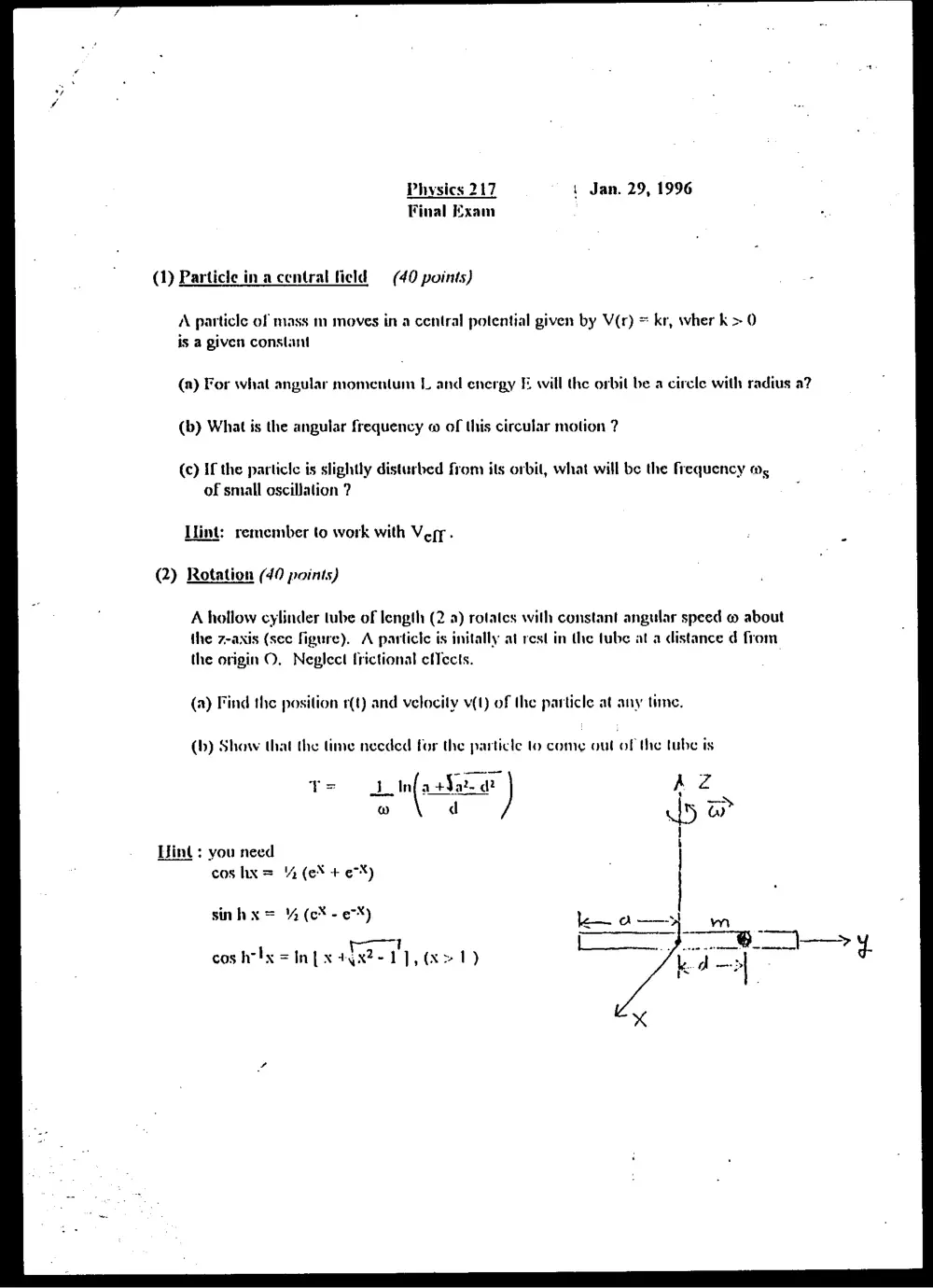
(1) Particle ina central field (40 points)
A particle of mass m moves ina central potential given by V(r) = kr, wher k > 0
is a given constant
(a) For what angular momentum L and energy EF. will the orbil be a circle with radius a?
(b) What is the angular frequency « of this circular motion ?
(c) If the particle is slightly disturbed from its orbil, what will be the frequency m,
of small oscillation ?
Hint: remember to work with Very .
(2) Rotation (40 points)
A hollow cylinder tube of length (2 a) rotates with constant angular speed @ about
the z-axis (sec figure). A particle is initally at rest in the tube ata distance d from
the origin O. Neglect frictional effects.
(a) Find the position r(t) and velocity v(t) of the particle at any time.
(b) Show that the time needed for the particle to come out of the tube is
T= 4. (a Vara
oy) d
Lint: you need
cos hx = % (eX + e7X)
sinh x = % (eX - eX)
a
cos holy = In[ x 4yx?-1],(x>1)
Physics 217 Jan 1996
Final Exam
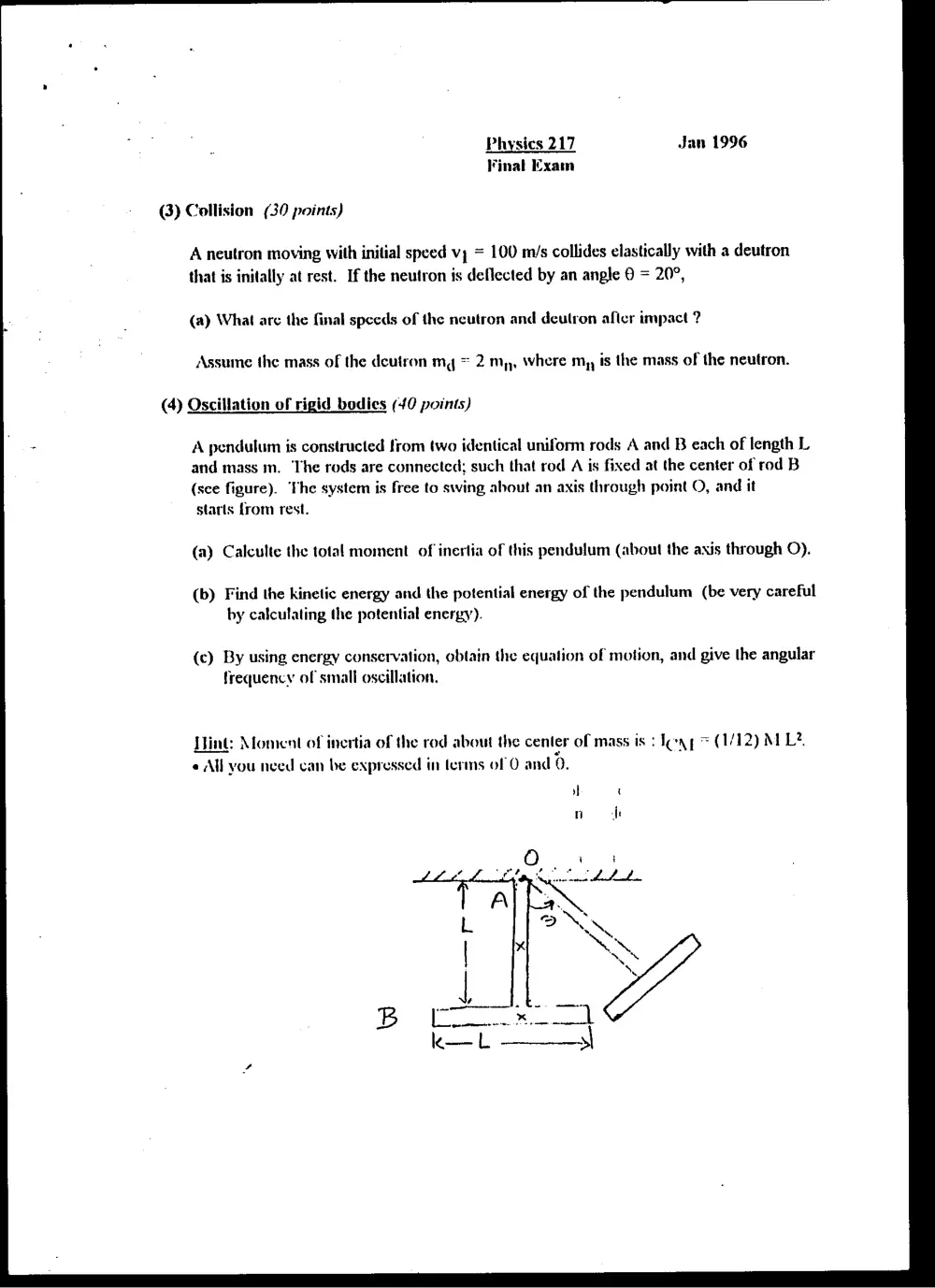
(3) Collision (30 points)
A neutron moving with initial speed vy = 100 m/s collides elastically with a deutron
that is initally at rest. If the neutron is deflected by an angle 6 = 20°,
(a) What are the final speeds of the neutron and deutron afler impact ?
Assume the mass of the deutron mg = 2 my, where my is the mass of the neutron.
(4) Oscillation of rigid bodies (40 points)
A pendulum is constructed from two identical uniform rods A and B each of length L
and mass m. The rods are connected; such that rod A is fixed at the center of rod B
(sce figure). The system is free to swing about an axis through point O, and it
starts from rest.
(a) Calculte the total moment of inertia of this pendulum (about the axis through O).
(b) Find the kinetic energy and the potential energy of the pendulum (be very careful
by calculating the potential energy).
(c) By using energy conservation, obtain the equation of motion, and give the angular
frequency of small oscillation,
[int: Moment of inertia of the rod about the center of mass is : Teng = (1/12) ML
¢ All you need can be expressed in terms of O and 0,
Physics 217 Jan. 1996
“inal Exam
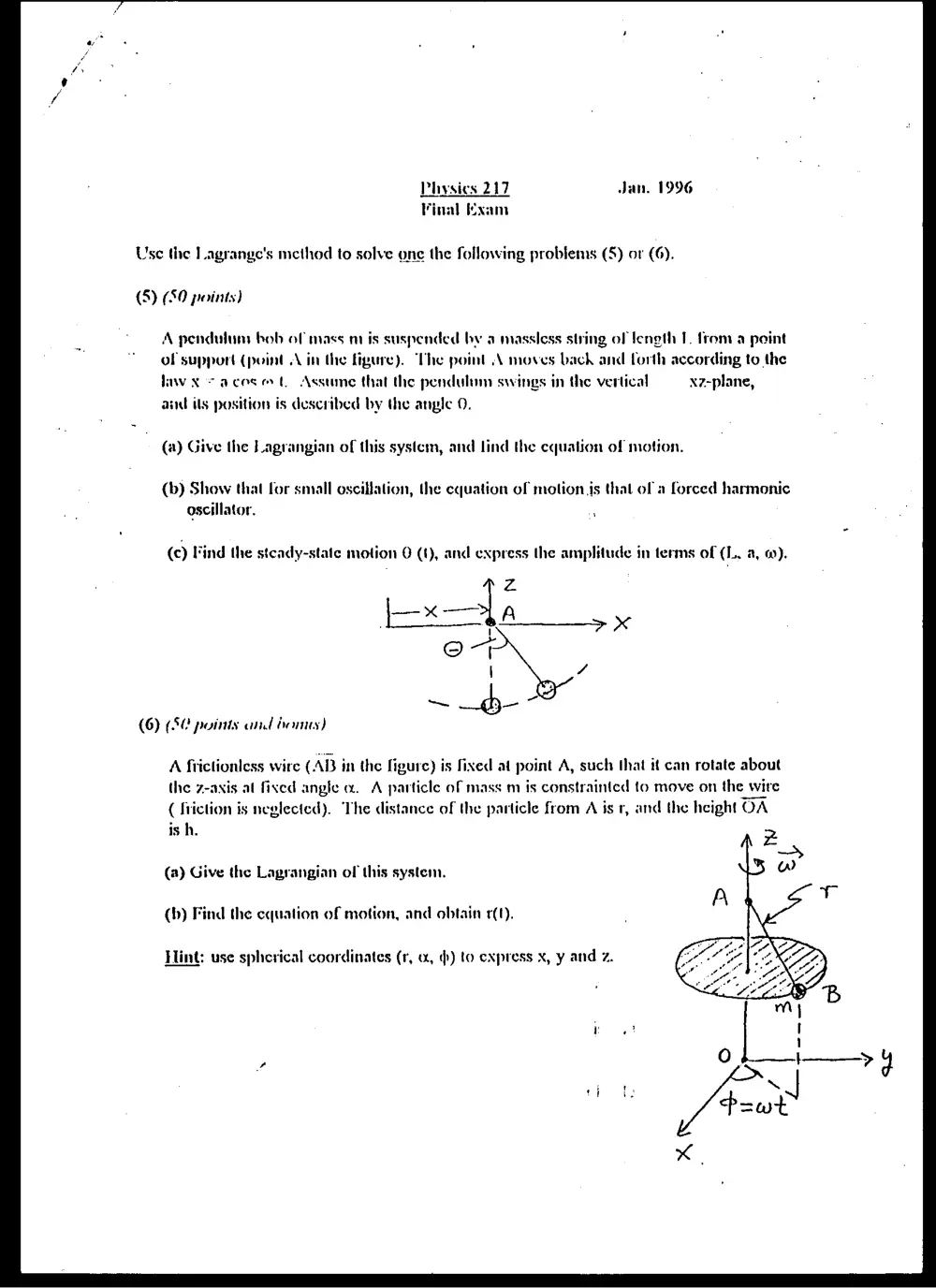
Use the Lagrange's method to solve one the following problems (8) or (6).
(8) ($0 points)
A pendulum bob of mass ntis suspended by a massless string of length 1. from a point
of support (point Ain the figure). The point A moves back and forth according to the
Jaw x = acest Assume that the pendulum swings in the vertical xz-plane,
aint ils position is described by the angle 0.
(a) Give the Lagrangian of this system, and lind the equation of motion.
(b) Show that for small oscillation, the equation of motion js that of a forced harmonic
oscillator. ,
(c) Find the steady-state motion 0 (4), and express the amplitude in terms of (L. a, 0).
Zz
Ext ><
(6) (80 points and domes)
A frictionless wire (AB in the figure) is fixed at point A, such that it can rotate about
the z-axis al fixed angle a. A particle of mass m is constrainted to move on the wire
( fiiction is neglected). ‘The distance of the particle from A is r, and the height OA
is h.
(a) Give the Lagrangian of this system.
(b) Find the cquation of motion, and obtain r(t),
Hint: use spherical coordinates (r, o, sb) to express x, y and z.