
PHYS 217 Final, Fall 2007
American University of Beirut · Mechanics · 1 page
Stuck on a question? A tutor can walk you through it.
More PHYS 217 files
Show the text of this final exam
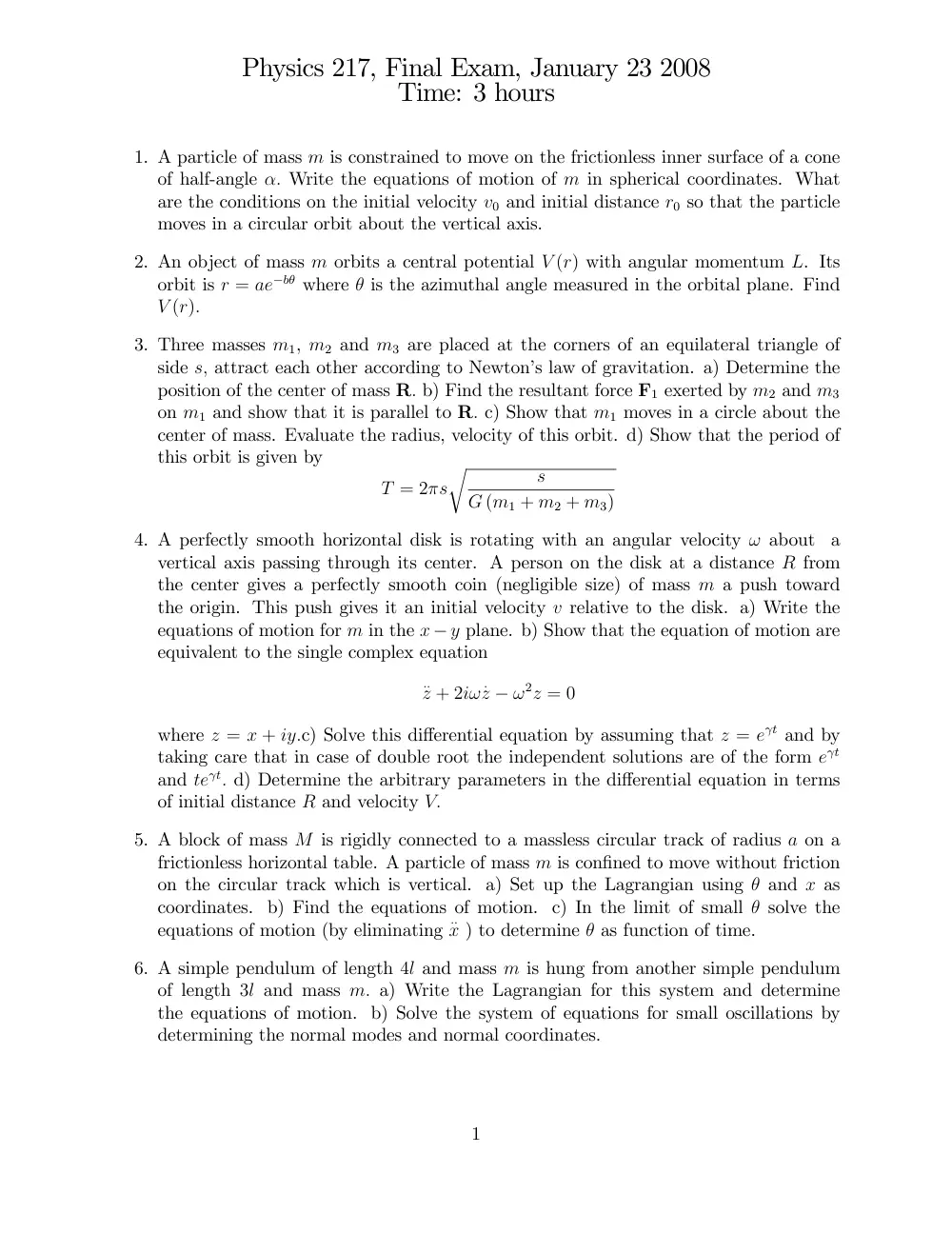
Physics 217, Final Exam, January 23 2008
Time: 3 hours
1. A particle of mass m is constrained to move on the frictionless inner surface of a cone
of half-angle �: Write the equations of motion of m in spherical coordinates. What
are the conditions on the initial velocity v0 and initial distance r0 so that the particle
moves in a circular orbit about the vertical axis.
2. An object of mass m orbits a central potential V (r) with angular momentum L. Its
orbit is r = ae�b� where � is the azimuthal angle measured in the orbital plane. Find
V (r):
3. Three masses m1, m2 and m3 are placed at the corners of an equilateral triangle of
side s; attract each other according to Newton’s law of gravitation. a) Determine the
position of the center of mass R: b) Find the resultant force F1 exerted by m2 and m3
on m1 and show that it is parallel to R: c) Show that m1 moves in a circle about the
center of mass. Evaluate the radius, velocity of this orbit. d) Show that the period of
this orbit is given by
T = 2�s
r
s
G (m1 + m2 + m3)
4. A perfectly smooth horizontal disk is rotating with an angular velocity ! about
a
vertical axis passing through its center. A person on the disk at a distance R from
the center gives a perfectly smooth coin (negligible size) of mass m a push toward
the origin. This push gives it an initial velocity v relative to the disk. a) Write the
equations of motion for m in the x � y plane. b) Show that the equation of motion are
equivalent to the single complex equation
::z + 2i!
:z � !2z = 0
where z = x + iy:c) Solve this di¤erential equation by assuming that z = e�t and by
taking care that in case of double root the independent solutions are of the form e�t
and te�t: d) Determine the arbitrary parameters in the di¤erential equation in terms
of initial distance R and velocity V:
5. A block of mass M is rigidly connected to a massless circular track of radius a on a
frictionless horizontal table. A particle of mass m is con…ned to move without friction
on the circular track which is vertical. a) Set up the Lagrangian using � and x as
coordinates. b) Find the equations of motion. c) In the limit of small � solve the
equations of motion (by eliminating
::x ) to determine � as function of time.
6. A simple pendulum of length 4l and mass m is hung from another simple pendulum
of length 3l and mass m: a) Write the Lagrangian for this system and determine
the equations of motion. b) Solve the system of equations for small oscillations by
determining the normal modes and normal coordinates.
1