
PSPA 213 Final, Fall 2007
American University of Beirut · Survey of International Relations · 4 pages
More PSPA 213 files
Show the text of this final exam
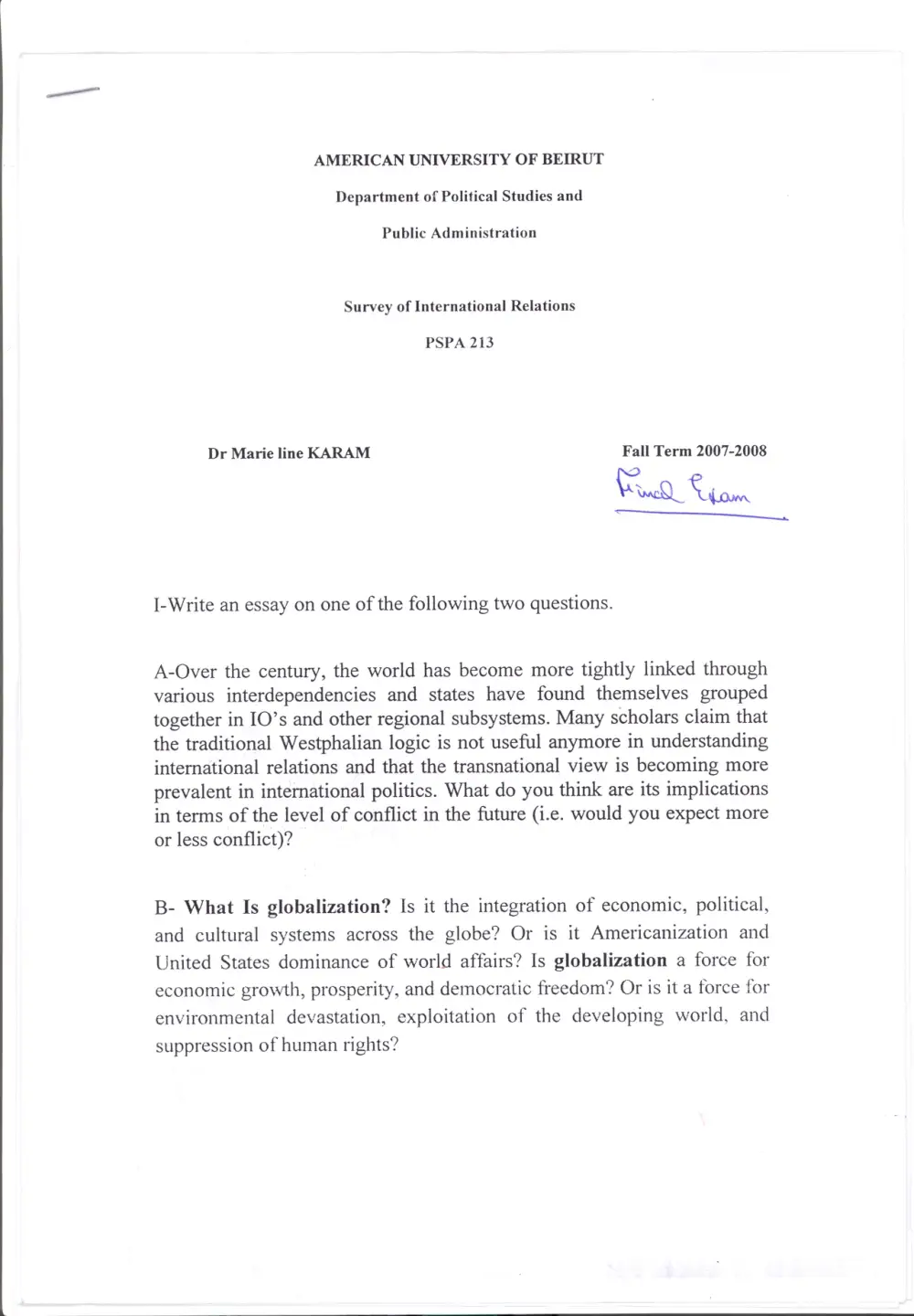
AMERICAN UNIVERSITY OF BEIRUT
Department of Political Studies and
Public Administration
Survey of International Relations
PSPA 213
Dr Marie line KARAM Fall Term 2007-2008
ieee Som
I-Write an essay on one of the following two questions.
A-Over the century, the world has become more tightly linked through
various interdependencies and states have found themselves grouped
together in IO’s and other regional subsystems. Many scholars claim that
the traditional Westphalian logic is not useful anymore in understanding
international relations and that the transnational view is becoming more
prevalent in international politics. What do you think are its implications
in terms of the level of conflict in the future (i.e. would you expect more
or less conflict)?
B- What Is globalization? Is it the integration of economic, political,
and cultural systems across the globe? Or is it Americanization and
United States dominance of world affairs? Is globalization a force for
economic growth, prosperity, and democratic freedom? Or is it a force for
environmental devastation, exploitation of the developing world, and
suppression of human rights?
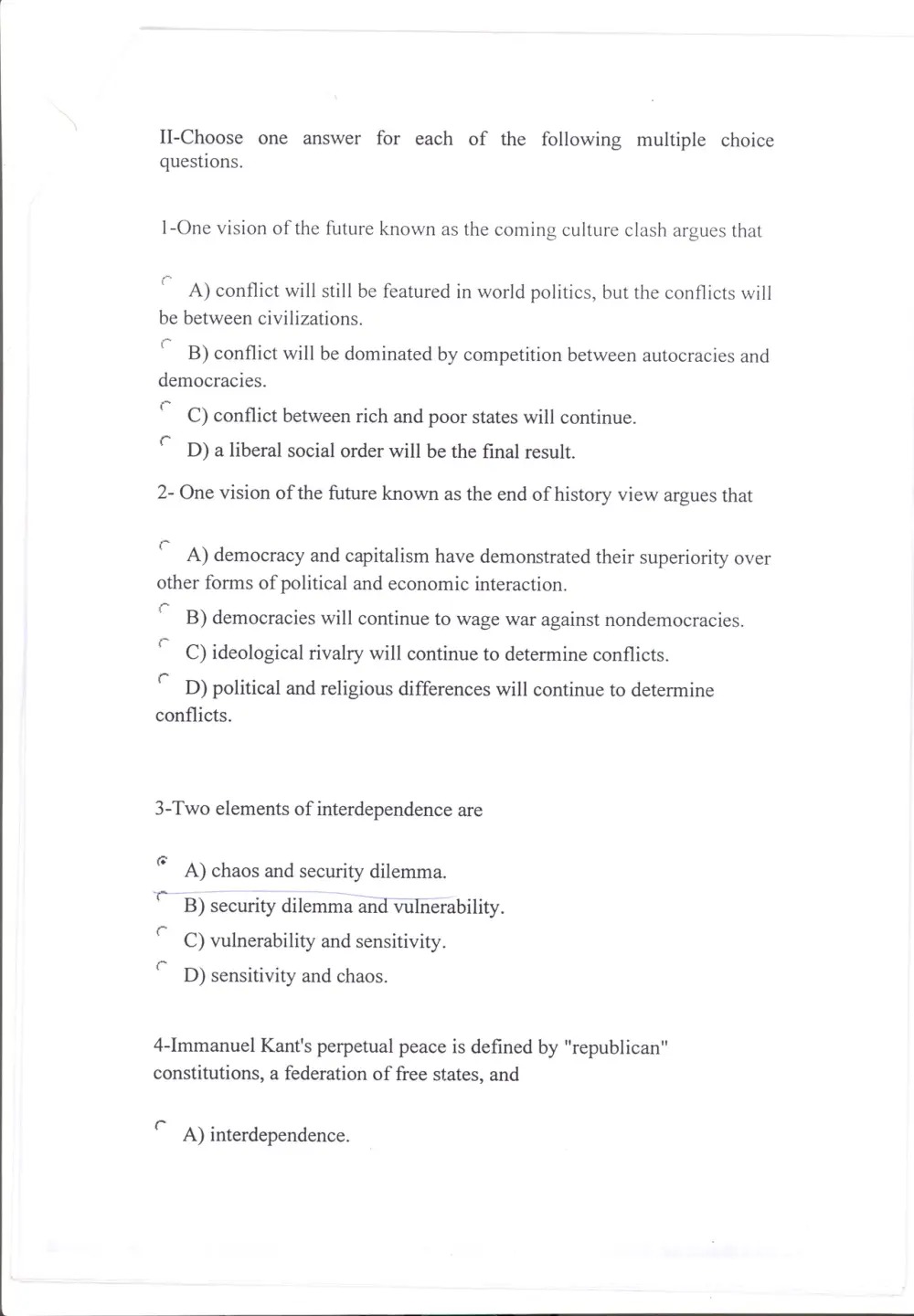
II-Choose one answer for each of the following multiple choice
questions.
1-One vision of the future known as the coming culture clash argues that
© A) conflict will still be featured in world politics, but the conflicts will
be between civilizations.
B) conflict will be dominated by competition between autocracies and
democracies.
C) conflict between rich and poor states will continue.
D) a liberal social order will be the final result.
2- One vision of the future known as the end of history view argues that
° A) democracy and capitalism have demonstrated their superiority over
other forms of political and economic interaction.
Cc . . . . .
B) democracies will continue to wage war against nondemocracies.
C) ideological rivalry will continue to determine conflicts.
. D) political and religious differences will continue to determine
conflicts.
3-Two elements of interdependence are
A) chaos and security dilemma.
B) security dilemma and vulnerability.
C) vulnerability and sensitivity.
D) sensitivity and chaos.
4-Immanuel Kant's perpetual peace is defined by "republican"
constitutions, a federation of free states, and
A) interdependence.
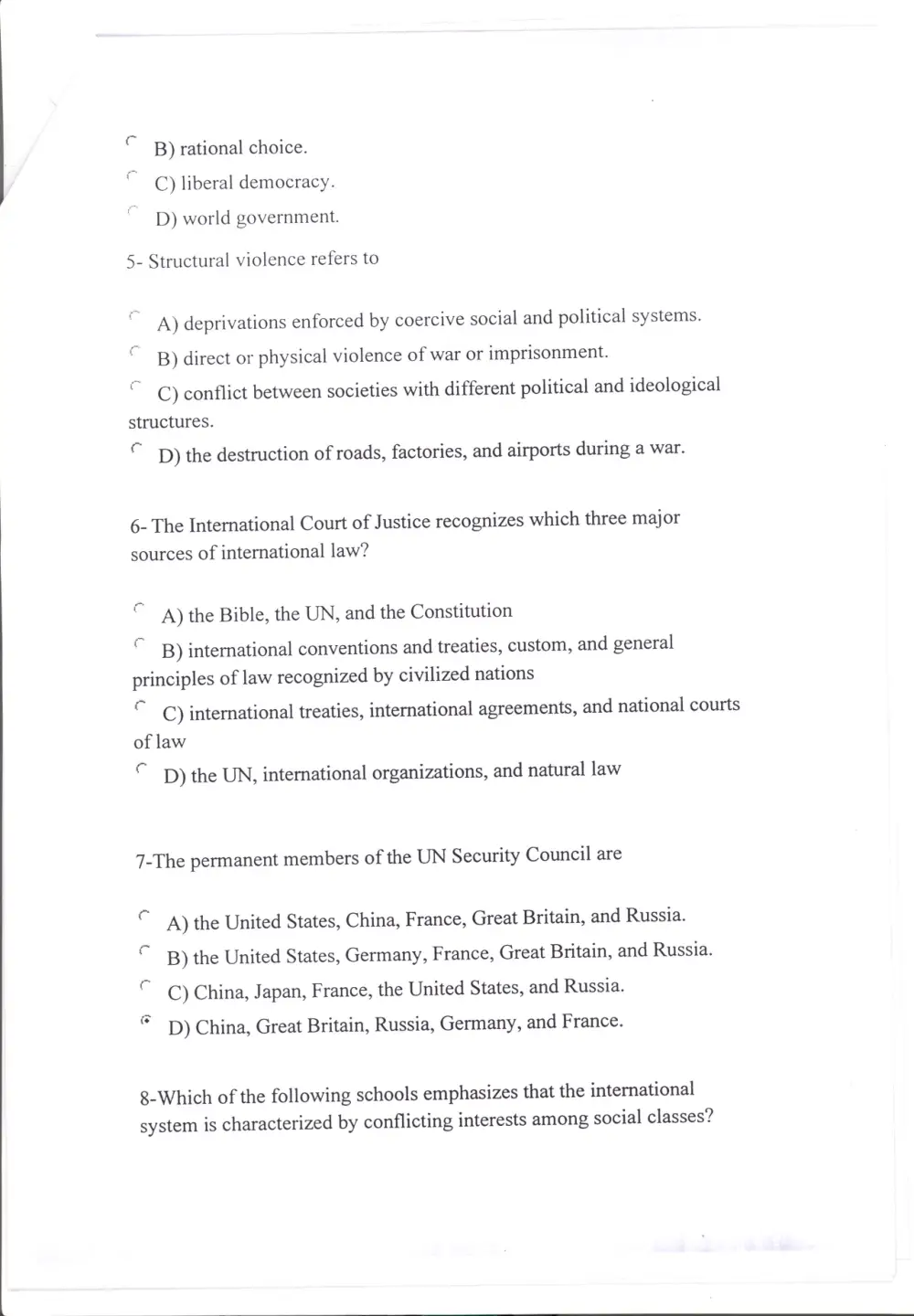
B) rational choice.
C) liberal democracy.
D) world government.
5- Structural violence refers to
A) deprivations enforced by coercive social and political systems.
Cc . : . . .
“ B) direct or physical violence of war or imprisonment.
C) conflict between societies with different political and ideological
structures.
° D) the destruction of roads, factories, and airports during a war.
6- The International Court of Justice recognizes which three major
sources of international law?
. A) the Bible, the UN, and the Constitution
B) international conventions and treaties, custom, and general
principles of law recognized by civilized nations
C) international treaties, international agreements, and national courts
of law
° D) the UN, international organizations, and natural law
7-The permanent members of the UN Security Council are
7 A) the United States, China, France, Great Britain, and Russia.
- B) the United States, Germany, France, Great Britain, and Russia.
i. C) China, Japan, France, the United States, and Russia.
° D) China, Great Britain, Russia, Germany, and France.
8-Which of the following schools emphasizes that the international
system is characterized by conflicting interests among social classes?
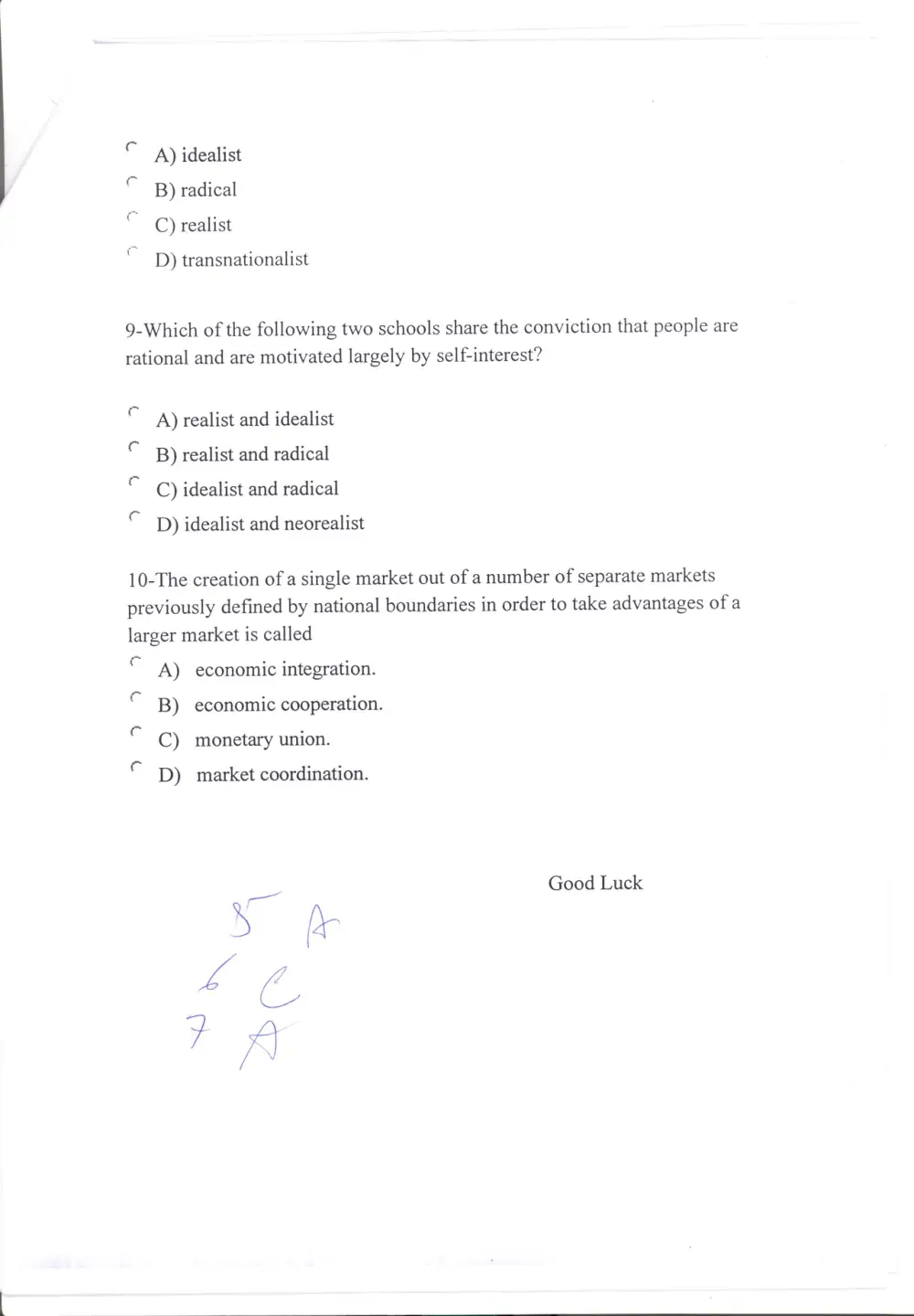
A) idealist
B) radical
“ C) realist
c
¢
D) transnationalist
9-Which of the following two schools share the conviction that people are
rational and are motivated largely by self-interest?
A) realist and idealist
B) realist and radical
C) idealist and radical
D) idealist and neorealist
10-The creation of a single market out of a number of separate markets
previously defined by national boundaries in order to take advantages ofa
larger market is called
c _ ;
A) economic integration.
c : .
B) economic cooperation.
. C) monetary union.
. D) market coordination.
ot Good Luck
Sh
Le
7 f