
SOAN 201 Notes Topic 2, Fall 2012
American University of Beirut · Introduction to Sociology · 4 pages
More SOAN 201 files
- Notes Chapter 2 · Fall 2013NotesView
- Notes Topic 3 · Fall 2012NotesView
- Notes Summary of Articles · Fall 2011NotesView
- Notes Very Useful · Spring 2011NotesView
- Useful File Reading Material · Spring 2016FileView
- Useful File Reading Material · Spring 2016FileView
- Useful File Reading Material · Spring 2016FileView
- Useful File Reading Material · Spring 2016FileView
Show the text of this notes
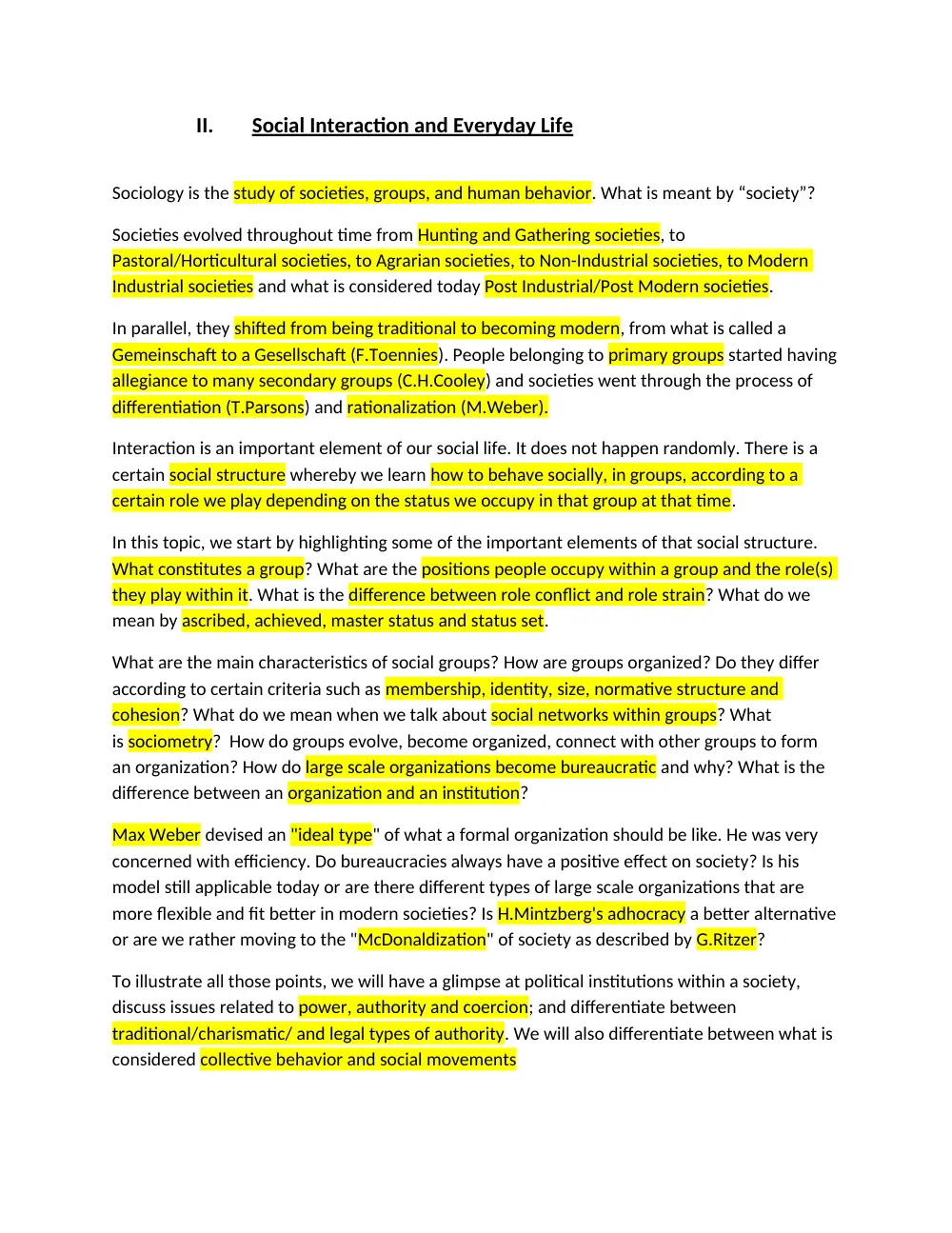
II.
Social Interaction and Everyday Life
Sociology is the study of societies, groups, and human behavior. What is meant by “society”?
Societies evolved throughout time from Hunting and Gathering societies, to
Pastoral/Horticultural societies, to Agrarian societies, to Non-Industrial societies, to Modern
Industrial societies and what is considered today Post Industrial/Post Modern societies.
In parallel, they shifted from being traditional to becoming modern, from what is called a
Gemeinschaft to a Gesellschaft (F.Toennies). People belonging to primary groups started having
allegiance to many secondary groups (C.H.Cooley) and societies went through the process of
differentiation (T.Parsons) and rationalization (M.Weber).
Interaction is an important element of our social life. It does not happen randomly. There is a
certain social structure whereby we learn how to behave socially, in groups, according to a
certain role we play depending on the status we occupy in that group at that time.
In this topic, we start by highlighting some of the important elements of that social structure.
What constitutes a group? What are the positions people occupy within a group and the role(s)
they play within it. What is the difference between role conflict and role strain? What do we
mean by ascribed, achieved, master status and status set.
What are the main characteristics of social groups? How are groups organized? Do they differ
according to certain criteria such as membership, identity, size, normative structure and
cohesion? What do we mean when we talk about social networks within groups? What
is sociometry? How do groups evolve, become organized, connect with other groups to form
an organization? How do large scale organizations become bureaucratic and why? What is the
difference between an organization and an institution?
Max Weber devised an "ideal type" of what a formal organization should be like. He was very
concerned with efficiency. Do bureaucracies always have a positive effect on society? Is his
model still applicable today or are there different types of large scale organizations that are
more flexible and fit better in modern societies? Is H.Mintzberg's adhocracy a better alternative
or are we rather moving to the "McDonaldization" of society as described by G.Ritzer?
To illustrate all those points, we will have a glimpse at political institutions within a society,
discuss issues related to power, authority and coercion; and differentiate between
traditional/charismatic/ and legal types of authority. We will also differentiate between what is
considered collective behavior and social movements
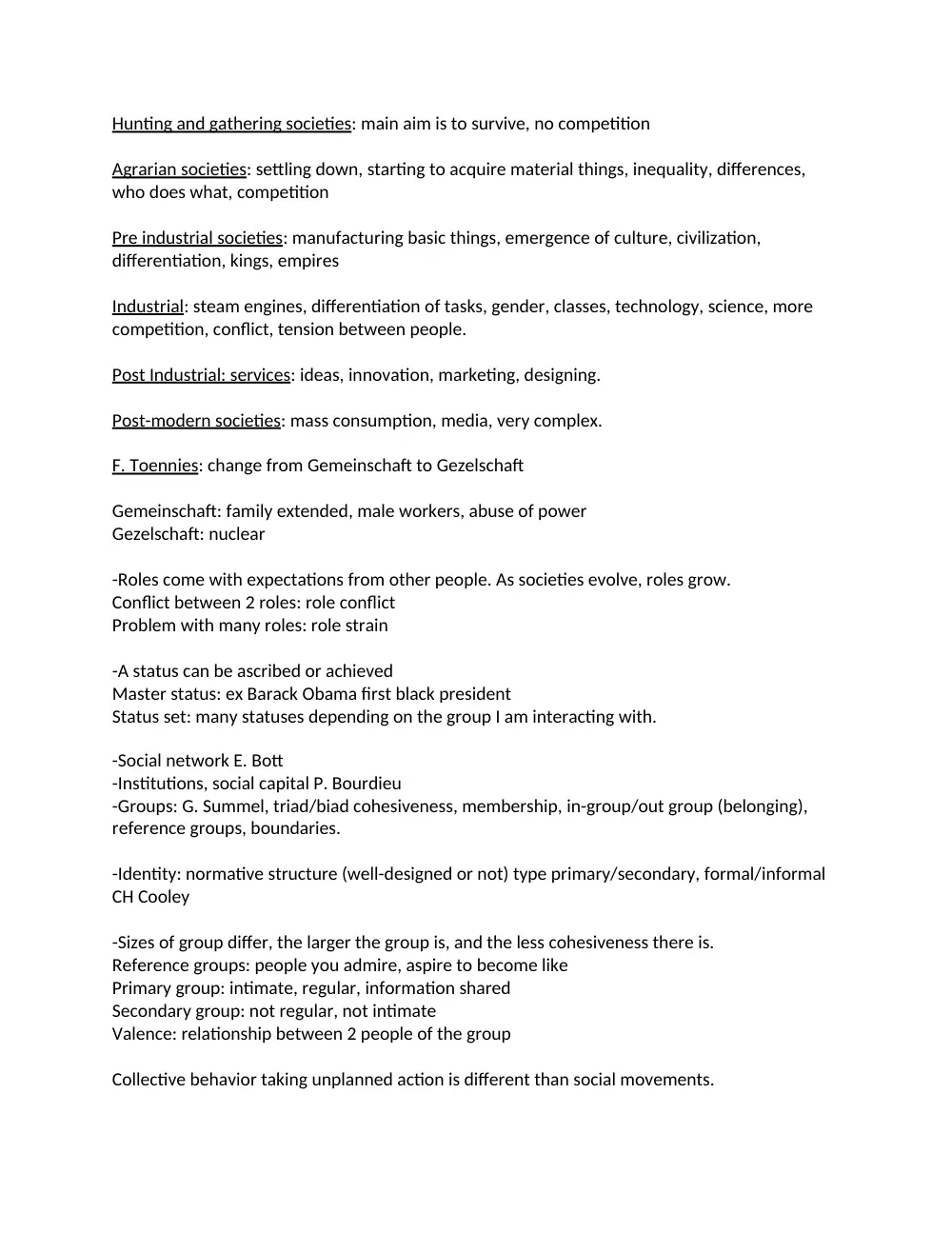
Hunting and gathering societies: main aim is to survive, no competition
Agrarian societies: settling down, starting to acquire material things, inequality, differences,
who does what, competition
Pre industrial societies: manufacturing basic things, emergence of culture, civilization,
differentiation, kings, empires
Industrial: steam engines, differentiation of tasks, gender, classes, technology, science, more
competition, conflict, tension between people.
Post Industrial: services: ideas, innovation, marketing, designing.
Post-modern societies: mass consumption, media, very complex.
F. Toennies: change from Gemeinschaft to Gezelschaft
Gemeinschaft: family extended, male workers, abuse of power
Gezelschaft: nuclear
-Roles come with expectations from other people. As societies evolve, roles grow.
Conflict between 2 roles: role conflict
Problem with many roles: role strain
-A status can be ascribed or achieved
Master status: ex Barack Obama first black president
Status set: many statuses depending on the group I am interacting with.
-Social network E. Bott
-Institutions, social capital P. Bourdieu
-Groups: G. Summel, triad/biad cohesiveness, membership, in-group/out group (belonging),
reference groups, boundaries.
-Identity: normative structure (well-designed or not) type primary/secondary, formal/informal
CH Cooley
-Sizes of group differ, the larger the group is, and the less cohesiveness there is.
Reference groups: people you admire, aspire to become like
Primary group: intimate, regular, information shared
Secondary group: not regular, not intimate
Valence: relationship between 2 people of the group
Collective behavior taking unplanned action is different than social movements.
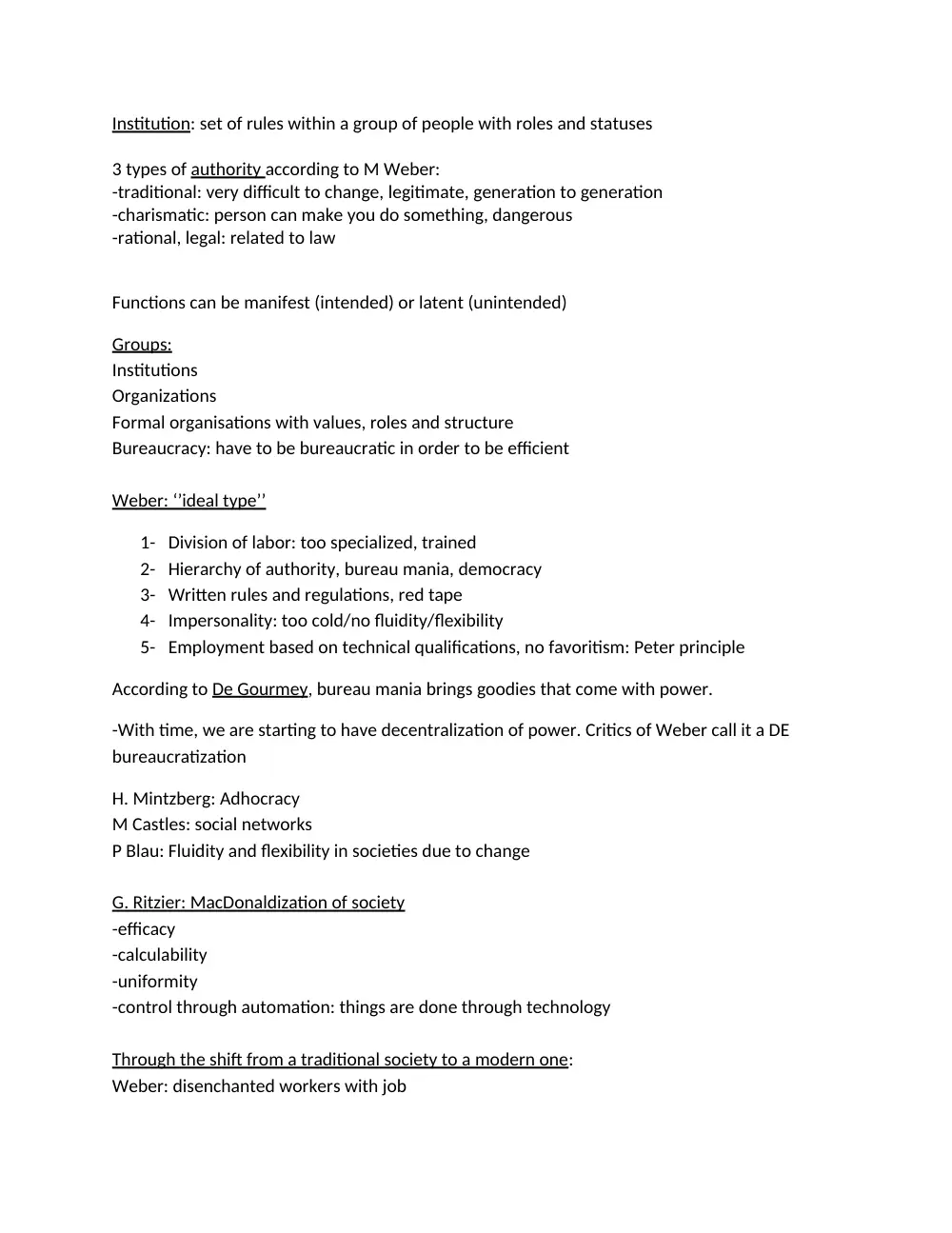
Institution: set of rules within a group of people with roles and statuses
3 types of authority according to M Weber:
-traditional: very difficult to change, legitimate, generation to generation
-charismatic: person can make you do something, dangerous
-rational, legal: related to law
Functions can be manifest (intended) or latent (unintended)
Groups:
Institutions
Organizations
Formal organisations with values, roles and structure
Bureaucracy: have to be bureaucratic in order to be efficient
Weber: ‘’ideal type’’
1- Division of labor: too specialized, trained
2- Hierarchy of authority, bureau mania, democracy
3- Written rules and regulations, red tape
4- Impersonality: too cold/no fluidity/flexibility
5- Employment based on technical qualifications, no favoritism: Peter principle
According to De Gourmey, bureau mania brings goodies that come with power.
-With time, we are starting to have decentralization of power. Critics of Weber call it a DE
bureaucratization
H. Mintzberg: Adhocracy
M Castles: social networks
P Blau: Fluidity and flexibility in societies due to change
G. Ritzier: MacDonaldization of society
-efficacy
-calculability
-uniformity
-control through automation: things are done through technology
Through the shift from a traditional society to a modern one:
Weber: disenchanted workers with job
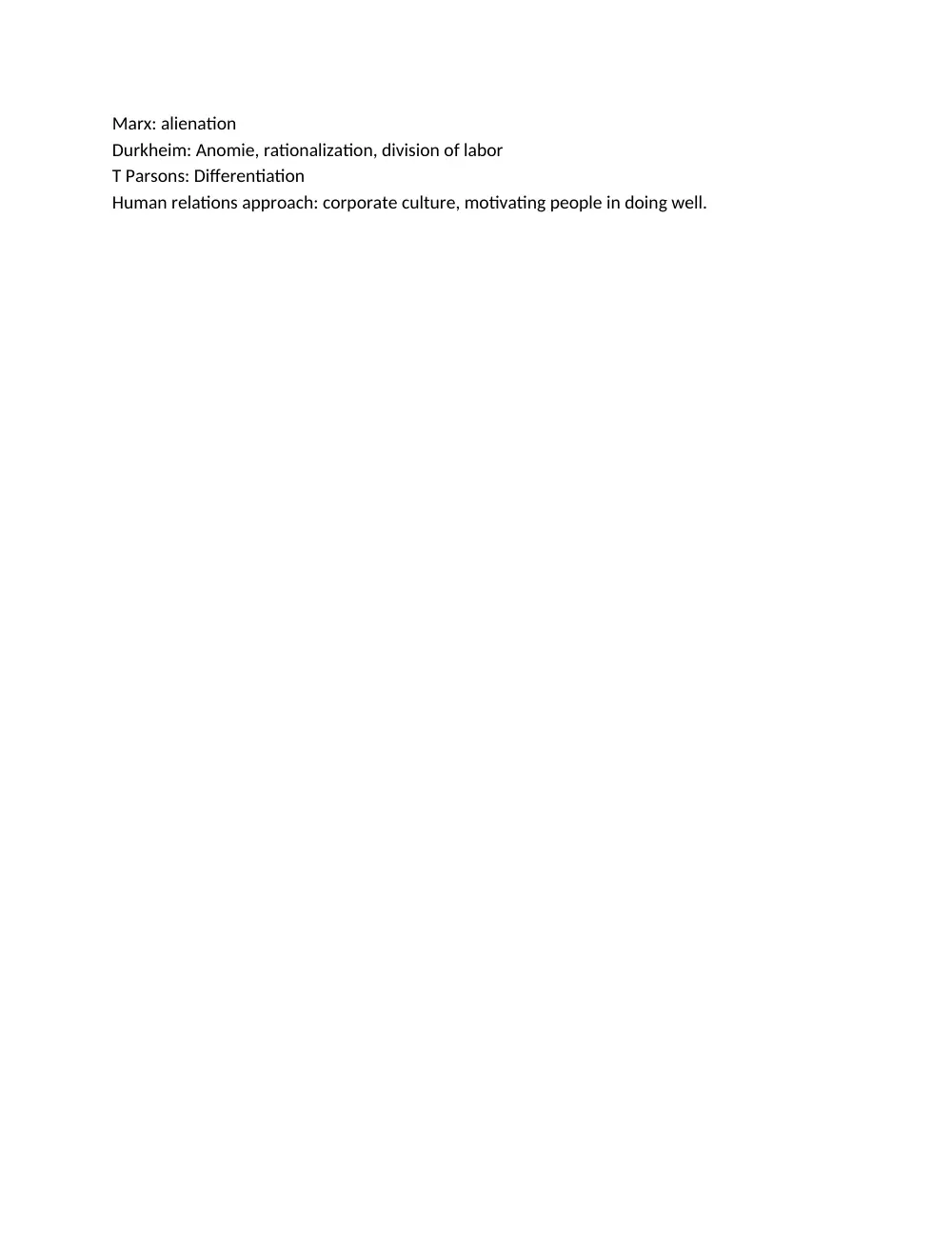
Marx: alienation
Durkheim: Anomie, rationalization, division of labor
T Parsons: Differentiation
Human relations approach: corporate culture, motivating people in doing well.