
SOAN 201 Notes Topic 3, Fall 2012
American University of Beirut · Introduction to Sociology · 4 pages

More SOAN 201 files
- Notes Chapter 2 · Fall 2013NotesView
- Notes Topic 2 · Fall 2012NotesView
- Notes Summary of Articles · Fall 2011NotesView
- Notes Very Useful · Spring 2011NotesView
- Useful File Reading Material · Spring 2016FileView
- Useful File Reading Material · Spring 2016FileView
- Useful File Reading Material · Spring 2016FileView
- Useful File Reading Material · Spring 2016FileView
Show the text of this notes
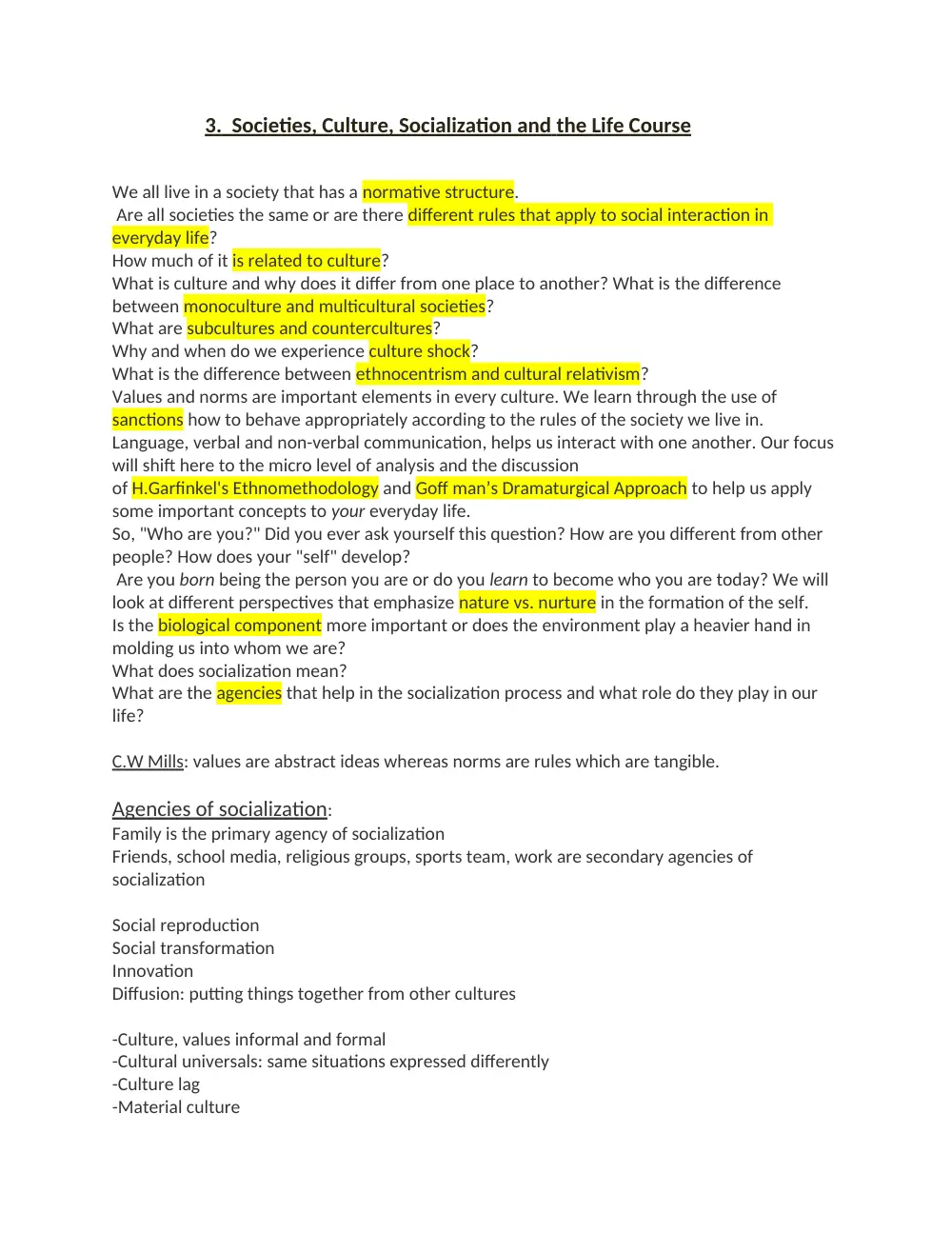
3. Societies, Culture, Socialization and
the Life Course
We all live in a society that has a normative structure.
Are all societies the same or are there different rules that apply to social interaction in
everyday life?
How much of it is related to culture?
What is culture and why does it differ from one place to another? What is the difference
between monoculture and multicultural societies?
What are subcultures and countercultures?
Why and when do we experience culture shock?
What is the difference between ethnocentrism and cultural relativism?
Values and norms are important elements in every culture. We learn through the use of
sanctions how to behave appropriately according to the rules of the society we live in.
Language, verbal and non-verbal communication, helps us interact with one another. Our focus
will shift here to the micro level of analysis and the discussion
of H.Garfinkel's Ethnomethodology and Goff man’s Dramaturgical Approach to help us apply
some important concepts to your everyday life.
So, "Who are you?" Did you ever ask yourself this question? How are you different from other
people? How does your "self" develop?
Are you born being the person you are or do you learn to become who you are today? We will
look at different perspectives that emphasize nature vs. nurture in the formation of the self.
Is the biological component more important or does the environment play a heavier hand in
molding us into whom we are?
What does socialization mean?
What are the agencies that help in the socialization process and what role do they play in our
life?
C.W Mills: values are abstract ideas whereas norms are rules which are tangible.
Agencies of socialization:
Family is the primary agency of socialization
Friends, school media, religious groups, sports team, work are secondary agencies of
socialization
Social reproduction
Social transformation
Innovation
Diffusion: putting things together from other cultures
-Culture, values informal and formal
-Cultural universals: same situations expressed differently
-Culture lag
-Material culture
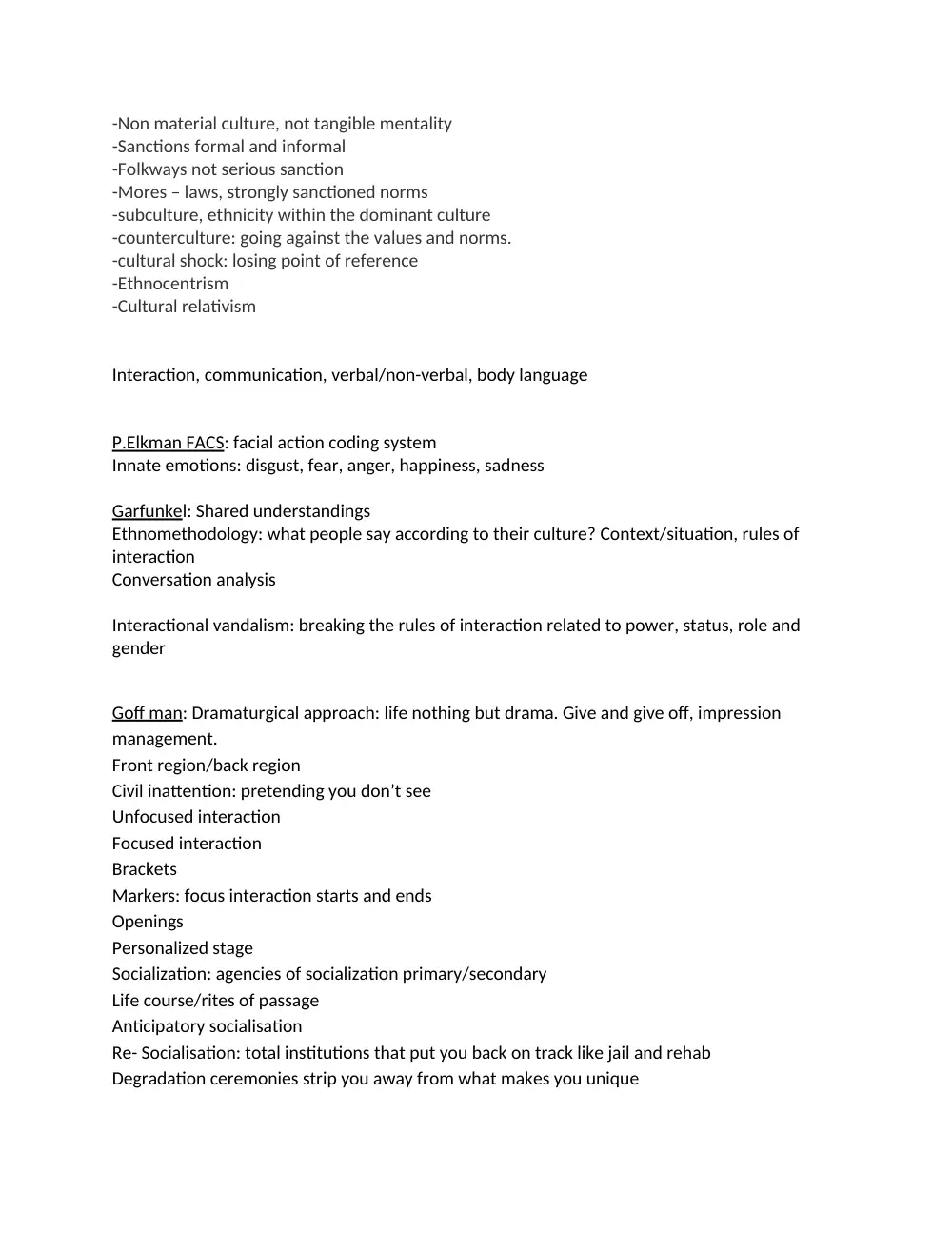
-Non material culture, not tangible mentality
-Sanctions formal and informal
-Folkways not serious sanction
-Mores – laws, strongly sanctioned norms
-subculture, ethnicity within the dominant culture
-counterculture: going against the values and norms.
-cultural shock: losing point of reference
-Ethnocentrism
-Cultural relativism
Interaction, communication, verbal/non-verbal, body language
P.Elkman FACS: facial action coding system
Innate emotions: disgust, fear, anger, happiness, sadness
Garfunkel: Shared understandings
Ethnomethodology: what people say according to their culture? Context/situation, rules of
interaction
Conversation analysis
Interactional vandalism: breaking the rules of interaction related to power, status, role and
gender
Goff man: Dramaturgical approach: life nothing but drama. Give and give off, impression
management.
Front region/back region
Civil inattention: pretending you don’t see
Unfocused interaction
Focused interaction
Brackets
Markers: focus interaction starts and ends
Openings
Personalized stage
Socialization: agencies of socialization primary/secondary
Life course/rites of passage
Anticipatory socialisation
Re- Socialisation: total institutions that put you back on track like jail and rehab
Degradation ceremonies strip you away from what makes you unique
Artie Hoch child: accommodating the people I have interaction with
Territories of the self
1- Personal space: claim, claimant, counter claimant
2- Stall: space temporarily claimed
3- Use space: territory immediately around individual
4- The turn: order to which a claimant receives something
5- Stealth: skin that covers body, clothes over skin
6- Information preserve: set of facts about oneself
7- Conversational preserve: control over who can summon one
8- Possession territory: set of objects identified with the self and arranged around the
body
The self
Nature vs. Nurture: am I born the way I am or am I just a product of society?
Freud:
Id-self centered
Superego, others centered
Ego, social self-balances between biological instinct and what society wants you to be.
Piaget: Cognitive Theory Development
1- Sensorimotor stage 0-2
2- Pre operational stage 2-7
3- Concrete operational stage 7-11
4- Formal operational stage 11-15
Behaviorists:
Pavlov: conditioning
Watson: Little Albert
Skinner: Isolation to avoid failure
Kohlberg: Moral Development Theory
1- Pre-conventional, self-formed morality (reward/punishment) 0-9
2- Conventional, others focused morality (obligations/expectations)
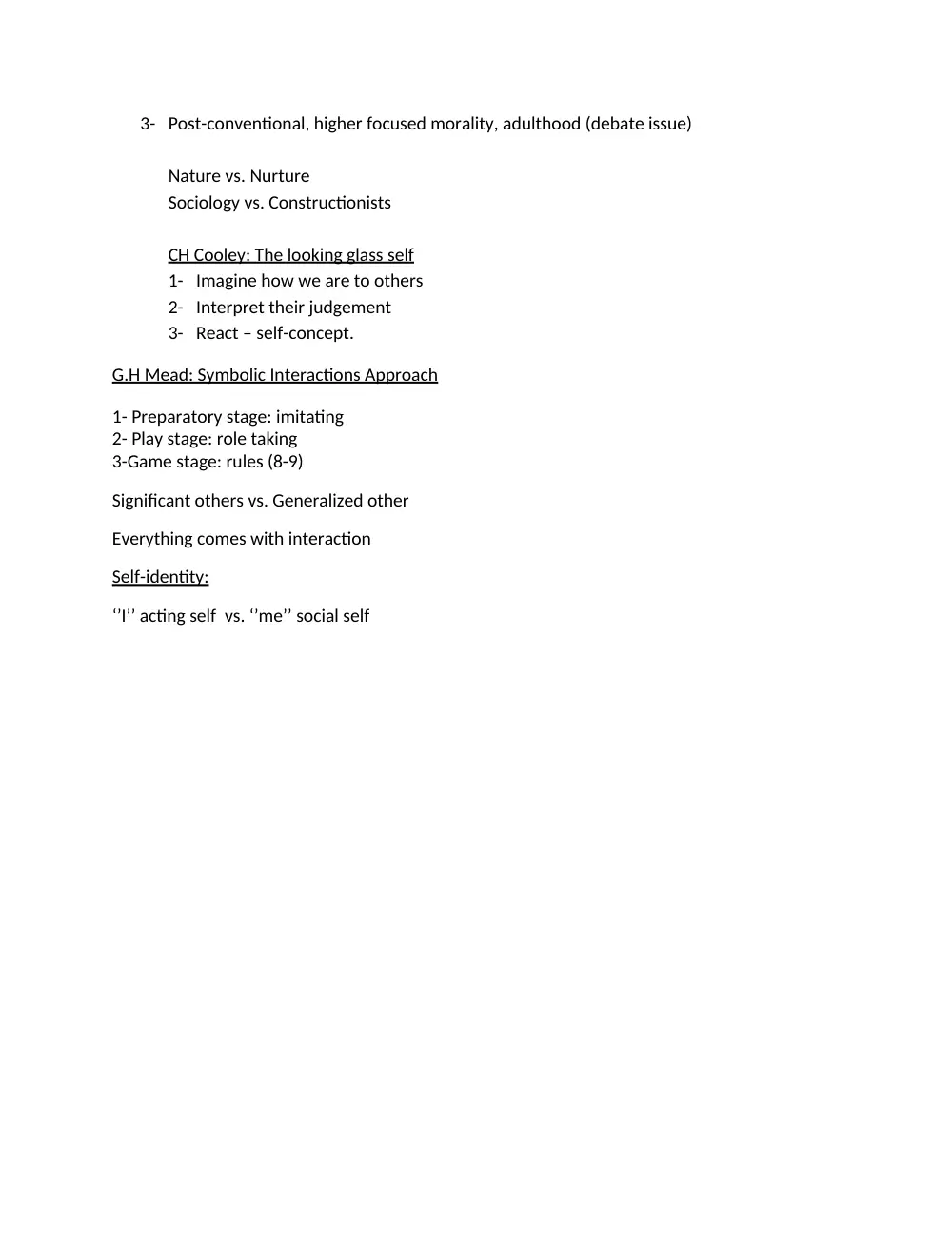
3- Post-conventional, higher focused morality, adulthood (debate issue)
Nature vs. Nurture
Sociology vs. Constructionists
CH Cooley: The looking glass self
1- Imagine how we are to others
2- Interpret their judgement
3- React – self-concept.
G.H Mead: Symbolic Interactions Approach
1- Preparatory stage: imitating
2- Play stage: role taking
3-Game stage: rules (8-9)
Significant others vs. Generalized other
Everything comes with interaction
Self-identity:
‘’I’’ acting self vs. ‘’me’’ social self