
STAT 230 Exam 2 Solution, Fall 2009
American University of Beirut · Introduction to Probability and Random Variables · 2 pages · with solution
More STAT 230 files
- Exam 1 · Summer 2016ExamView
- Exam 2 Solution · Fall 2016Exam · with solutionView
- Exam 2 Solution · Fall 2016Exam · with solutionView
- Exam 1 · Summer 2016ExamView
- Midterm with Answers · Summer 2015Exam · with solutionView
- Midterm Summer 2015 · Summer 2015ExamView
- Exam 1 · Summer 2013ExamView
- Exam 1 With Solution · Summer 2013Exam · with solutionView
Show the text of this exam
American University of Beirut
STAT 230
Introduction to Probability and Random Variables
Fall 2009-2010
quiz # 2 - solution
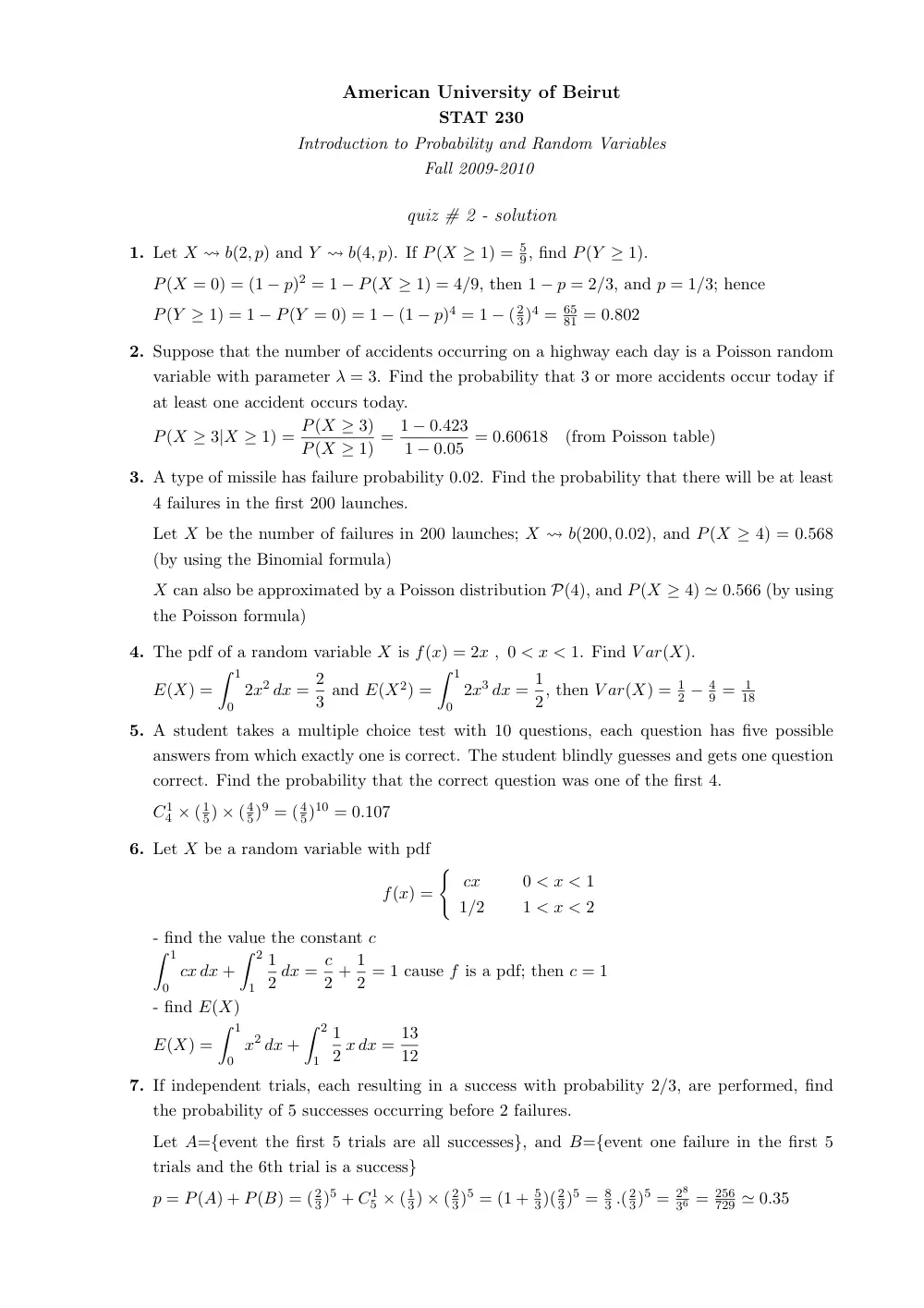
1. Let X ⇝ b(2, p) and Y ⇝ b(4, p). If P(X ≥ 1) = 5
9, find P(Y ≥ 1).
P(X = 0) = (1 − p)2 = 1 − P(X ≥ 1) = 4/9, then 1 − p = 2/3, and p = 1/3; hence
P(Y ≥ 1) = 1 − P(Y = 0) = 1 − (1 − p)4 = 1 − ( 2
3)4 = 65
81 = 0.802
2. Suppose that the number of accidents occurring on a highway each day is a Poisson random
variable with parameter λ = 3. Find the probability that 3 or more accidents occur today if
at least one accident occurs today.
P(X ≥ 3|X ≥ 1) = P(X ≥ 3)
P(X ≥ 1) = 1 − 0.423
1 − 0.05 = 0.60618
(from Poisson table)
3. A type of missile has failure probability 0.02. Find the probability that there will be at least
4 failures in the first 200 launches.
Let X be the number of failures in 200 launches; X ⇝ b(200, 0.02), and P(X ≥ 4) = 0.568
(by using the Binomial formula)
X can also be approximated by a Poisson distribution P(4), and P(X ≥ 4) ≃ 0.566 (by using
the Poisson formula)
4. The pdf of a random variable X is f(x) = 2x , 0 < x < 1. Find V ar(X).
E(X) =
∫ 1
0
2x2 dx = 2
3 and E(X2) =
∫ 1
0
2x3 dx = 1
2, then V ar(X) = 1
2 − 4
9 = 1
18
5. A student takes a multiple choice test with 10 questions, each question has five possible
answers from which exactly one is correct. The student blindly guesses and gets one question
correct. Find the probability that the correct question was one of the first 4.
C1
4 × ( 1
5) × ( 4
5)9 = ( 4
5)10 = 0.107
6. Let X be a random variable with pdf
f(x) =
{
cx
0 < x < 1
1/2
1 < x < 2
- find the value the constant c
∫ 1
0
cx dx +
∫ 2
1
1
2 dx = c
2 + 1
2 = 1 cause f is a pdf; then c = 1
- find E(X)
E(X) =
∫ 1
0
x2 dx +
∫ 2
1
1
2 x dx = 13
12
7. If independent trials, each resulting in a success with probability 2/3, are performed, find
the probability of 5 successes occurring before 2 failures.
Let A={event the first 5 trials are all successes}, and B={event one failure in the first 5
trials and the 6th trial is a success}
p = P(A) + P(B) = ( 2
3)5 + C1
5 × ( 1
3) × ( 2
3)5 = (1 + 5
3)( 2
3)5 = 8
3 .( 2
3)5 = 28
36 = 256
729 ≃ 0.35
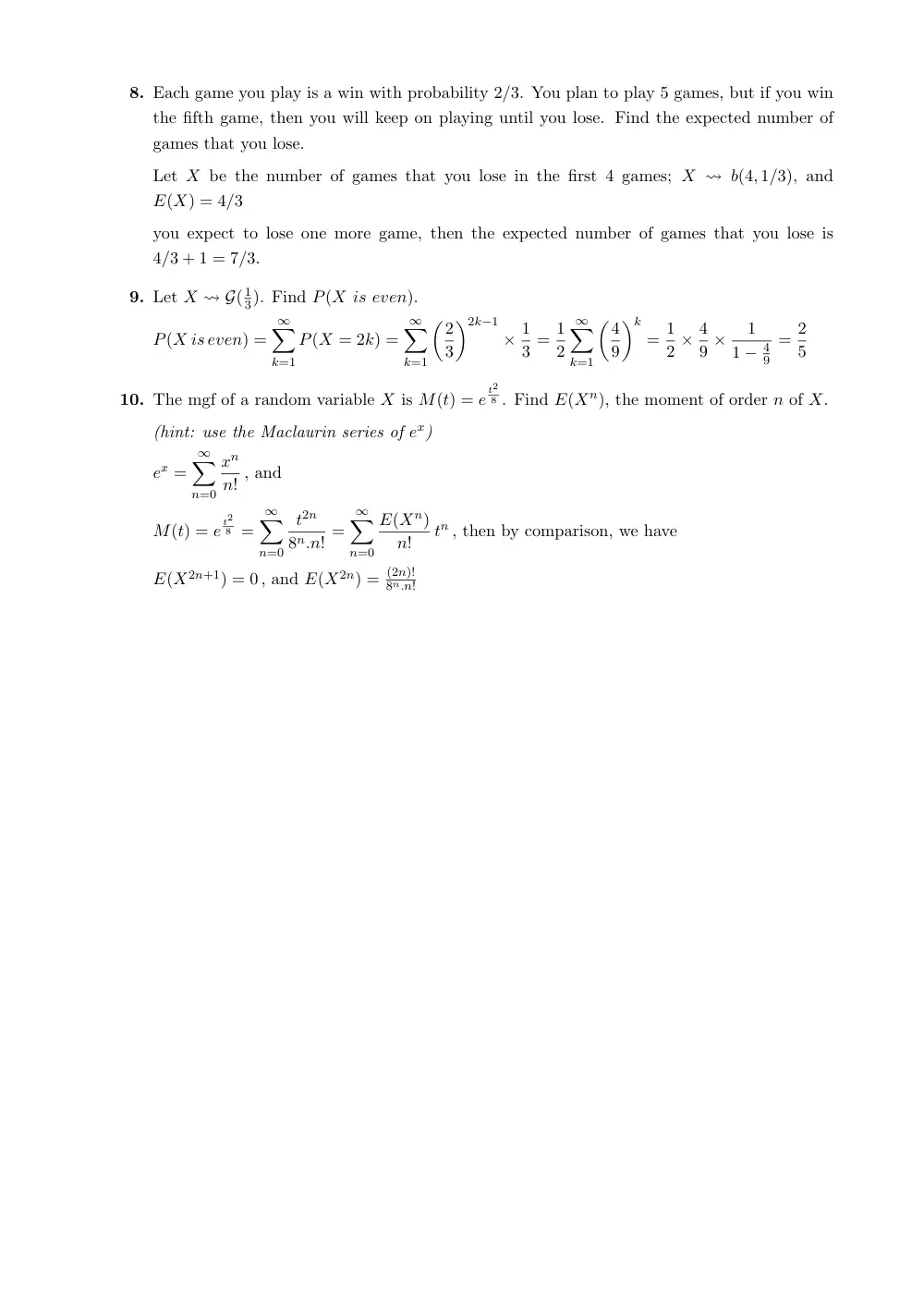
8. Each game you play is a win with probability 2/3. You plan to play 5 games, but if you win
the fifth game, then you will keep on playing until you lose. Find the expected number of
games that you lose.
Let X be the number of games that you lose in the first 4 games; X ⇝ b(4, 1/3), and
E(X) = 4/3
you expect to lose one more game, then the expected number of games that you lose is
4/3 + 1 = 7/3.
9. Let X ⇝ G( 1
3). Find P(X is even).
P(X is even) =
∞
∑
k=1
P(X = 2k) =
∞
∑
k=1
(2
3
)2k−1
× 1
3 = 1
2
∞
∑
k=1
(4
9
)k
= 1
2 × 4
9 ×
1
1 − 4
9
= 2
5
10. The mgf of a random variable X is M(t) = e
t2
8 . Find E(Xn), the moment of order n of X.
(hint: use the Maclaurin series of ex)
ex =
∞
∑
n=0
xn
n! , and
M(t) = e
t2
8 =
∞
∑
n=0
t2n
8n.n! =
∞
∑
n=0
E(Xn)
n!
tn , then by comparison, we have
E(X2n+1) = 0 , and E(X2n) = (2n)!
8n.n!