
STAT 230 Exam 2 Solution, Fall 2016
American University of Beirut · Introduction to Probability and Random Variables · 6 pages · with solution


More STAT 230 files
- Exam 1 · Summer 2016ExamView
- Exam 2 Solution · Fall 2016Exam · with solutionView
- Exam 1 · Summer 2016ExamView
- Midterm Summer 2015 · Summer 2015ExamView
- Midterm with Answers · Summer 2015Exam · with solutionView
- Exam 1 · Summer 2013ExamView
- Exam 1 With Solution · Summer 2013Exam · with solutionView
- Midterm With Solution · Summer 2013Exam · with solutionView
Show the text of this exam
STAT 230. Fall 2016-T2
Multiple Choice Questions Five (5) points are assigned to each correct an-
swer. No penalty for wrong answers. You may select more than one answer. If
you decide to do, you must distribute the points among the selected answers.
Indicate in the empty box beside the answer the (integer) number of points you
wish to allocate to that answer.
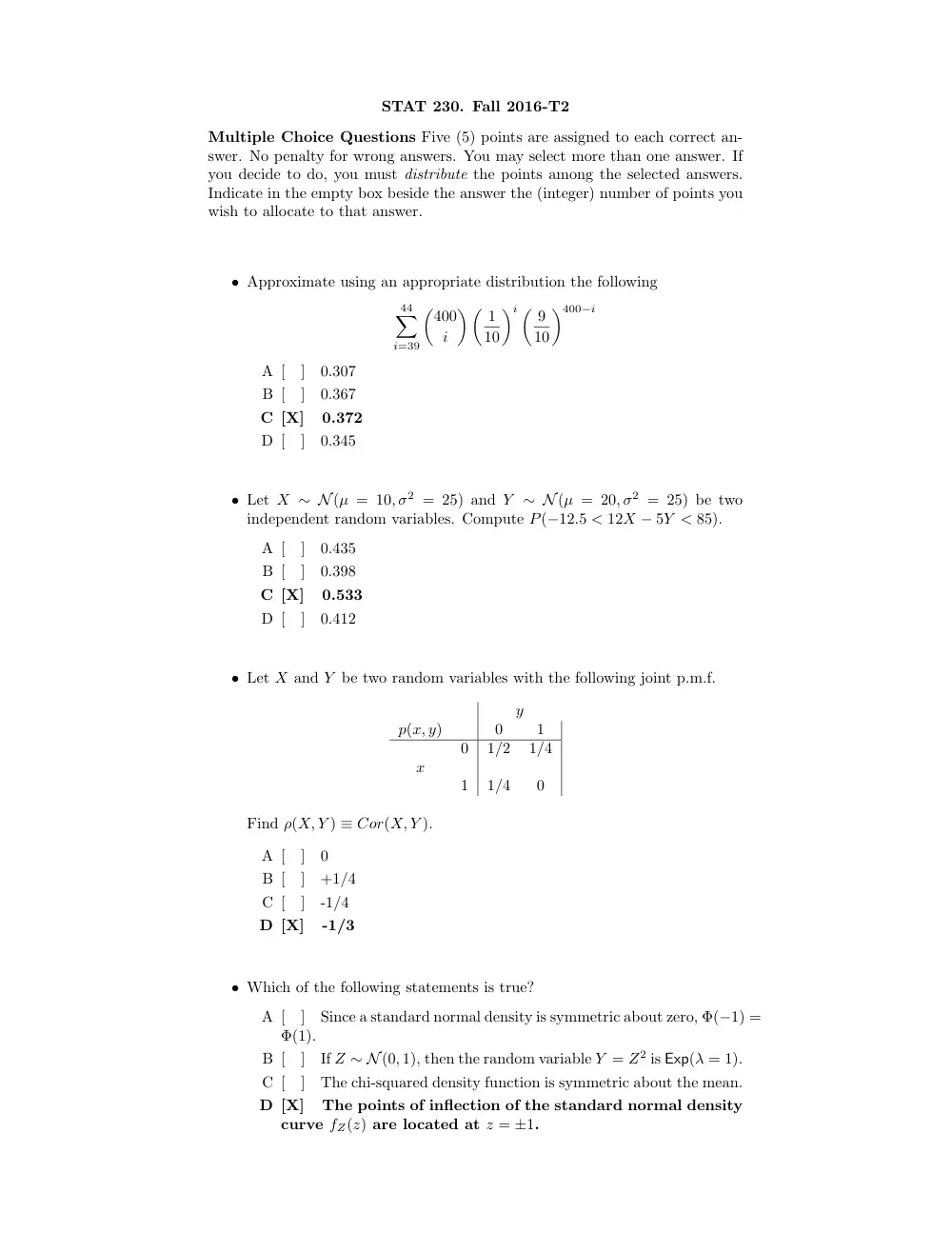
• Approximate using an appropriate distribution the following
44
�
i=39
�400
i
� � 1
10
�i � 9
10
�400−i
A [
]
0.307
B [
]
0.367
C [X]
0.372
D [
]
0.345
• Let X ∼ N(µ = 10, σ2 = 25) and Y ∼ N(µ = 20, σ2 = 25) be two
independent random variables. Compute P(−12.5 < 12X − 5Y < 85).
A [
]
0.435
B [
]
0.398
C [X]
0.533
D [
]
0.412
• Let X and Y be two random variables with the following joint p.m.f.
y
p(x, y)
0
1
x
0
1/2
1/4
1
1/4
0
Find ρ(X, Y ) ≡ Cor(X, Y ).
A [
]
0
B [
]
+1/4
C [
]
-1/4
D [X]
-1/3
• Which of the following statements is true?
A [
]
Since a standard normal density is symmetric about zero, Φ(−1) =
Φ(1).
B [
]
If Z ∼ N(0, 1), then the random variable Y = Z2 is Exp(λ = 1).
C [
]
The chi-squared density function is symmetric about the mean.
D [X]
The points of inflection of the standard normal density
curve fZ(z) are located at z = ±1.
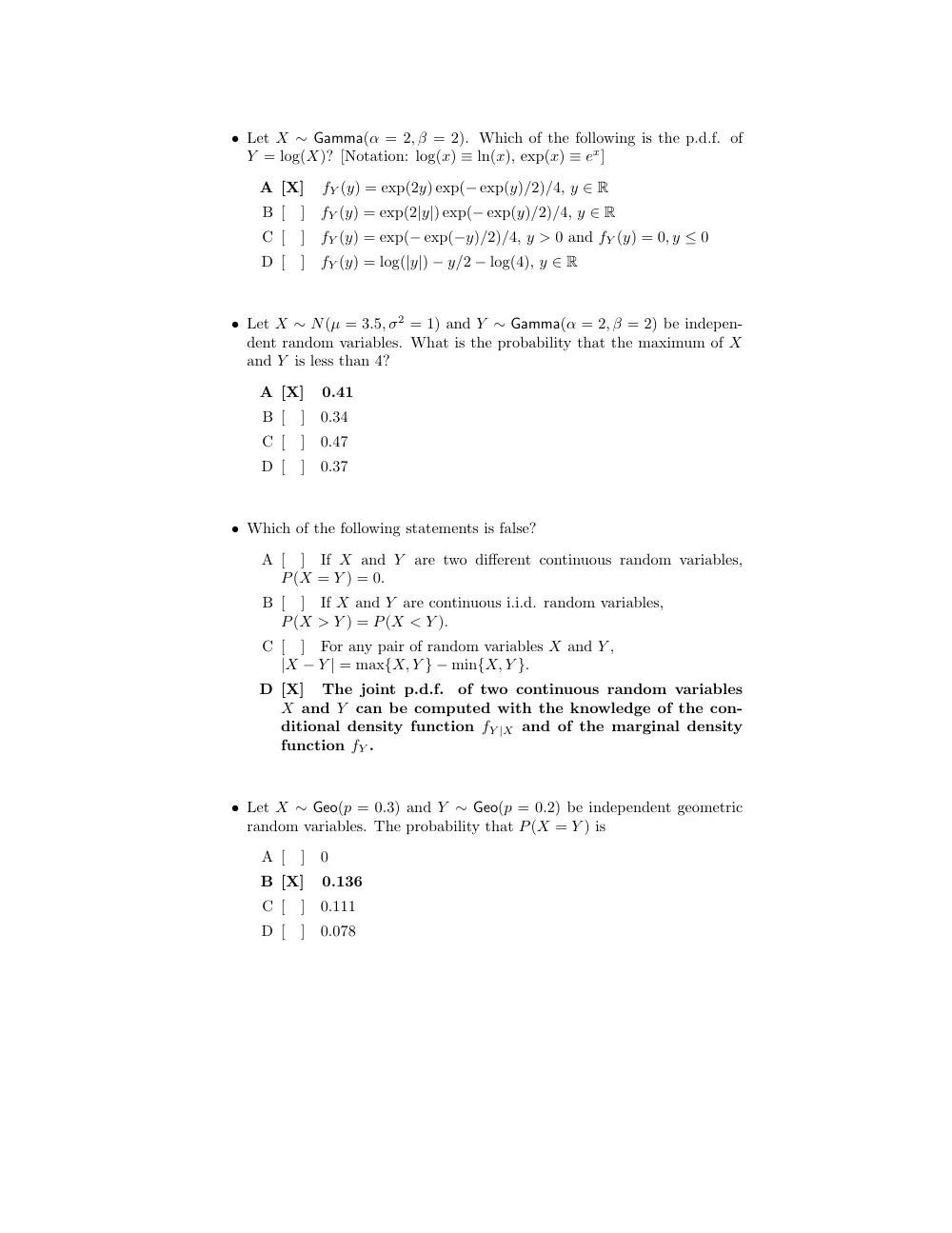
• Let X ∼ Gamma(α = 2, β = 2). Which of the following is the p.d.f. of
Y = log(X)? [Notation: log(x) ≡ ln(x), exp(x) ≡ ex]
A [X]
fY (y) = exp(2y) exp(− exp(y)/2)/4, y ∈ R
B [
]
fY (y) = exp(2|y|) exp(− exp(y)/2)/4, y ∈ R
C [
]
fY (y) = exp(− exp(−y)/2)/4, y > 0 and fY (y) = 0, y ≤ 0
D [
]
fY (y) = log(|y|) − y/2 − log(4), y ∈ R
• Let X ∼ N(µ = 3.5, σ2 = 1) and Y ∼ Gamma(α = 2, β = 2) be indepen-
dent random variables. What is the probability that the maximum of X
and Y is less than 4?
A [X]
0.41
B [
]
0.34
C [
]
0.47
D [
]
0.37
• Which of the following statements is false?
A [
]
If X and Y are two different continuous random variables,
P(X = Y ) = 0.
B [
]
If X and Y are continuous i.i.d. random variables,
P(X > Y ) = P(X < Y ).
C [
]
For any pair of random variables X and Y ,
|X − Y | = max{X, Y } − min{X, Y }.
D [X]
The joint p.d.f.
of two continuous random variables
X and Y can be computed with the knowledge of the con-
ditional density function fY |X and of the marginal density
function fY .
• Let X ∼ Geo(p = 0.3) and Y ∼ Geo(p = 0.2) be independent geometric
random variables. The probability that P(X = Y ) is
A [
]
0
B [X]
0.136
C [
]
0.111
D [
]
0.078
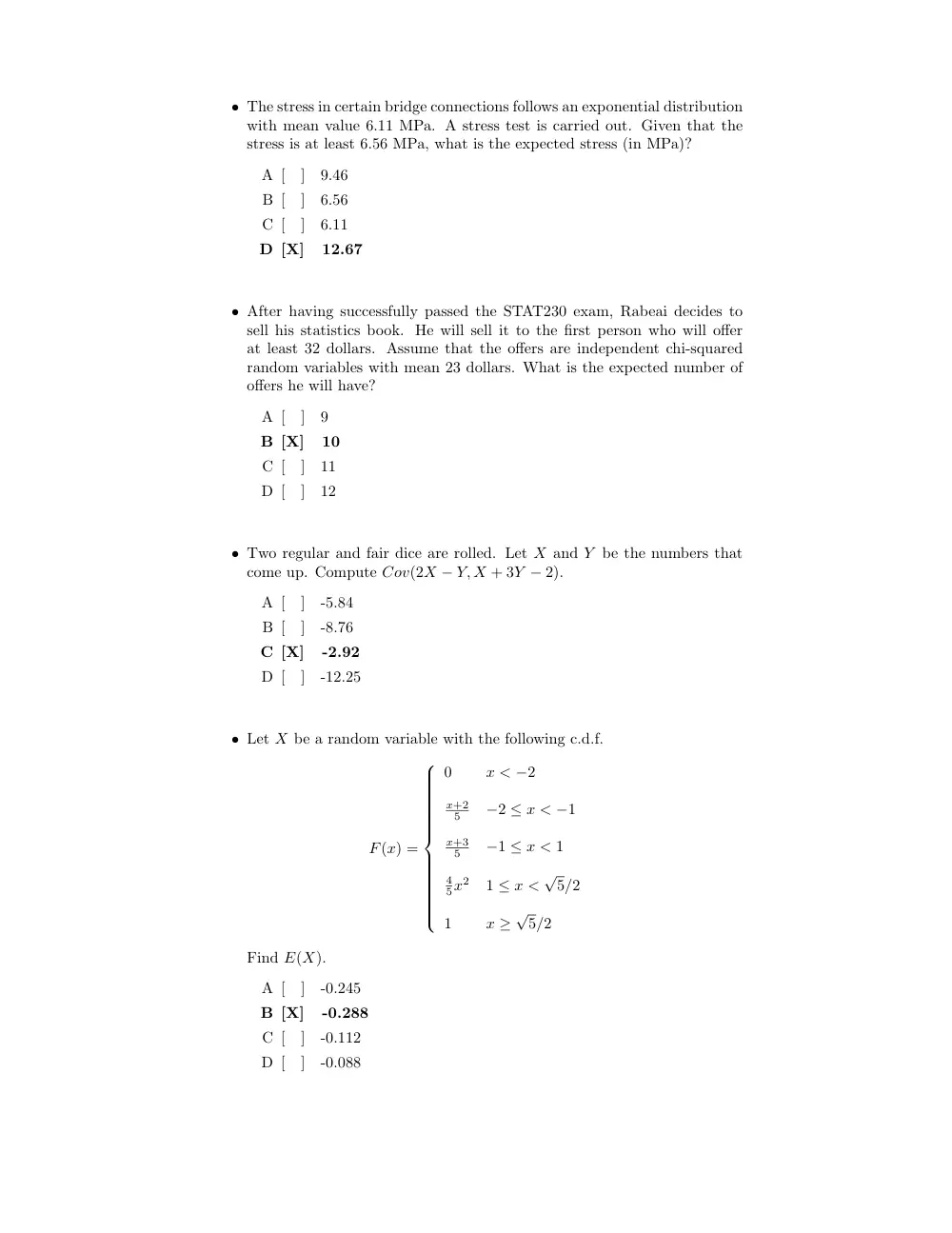
• The stress in certain bridge connections follows an exponential distribution
with mean value 6.11 MPa. A stress test is carried out. Given that the
stress is at least 6.56 MPa, what is the expected stress (in MPa)?
A [
]
9.46
B [
]
6.56
C [
]
6.11
D [X]
12.67
• After having successfully passed the STAT230 exam, Rabeai decides to
sell his statistics book. He will sell it to the first person who will offer
at least 32 dollars. Assume that the offers are independent chi-squared
random variables with mean 23 dollars. What is the expected number of
offers he will have?
A [
]
9
B [X]
10
C [
]
11
D [
]
12
• Two regular and fair dice are rolled. Let X and Y be the numbers that
come up. Compute Cov(2X − Y, X + 3Y − 2).
A [
]
-5.84
B [
]
-8.76
C [X]
-2.92
D [
]
-12.25
• Let X be a random variable with the following c.d.f.
F(x) =
0
x < −2
x+2
5
−2 ≤ x < −1
x+3
5
−1 ≤ x < 1
4
5x2
1 ≤ x <
√
5/2
1
x ≥
√
5/2
Find E(X).
A [
]
-0.245
B [X]
-0.288
C [
]
-0.112
D [
]
-0.088
• Let X ∼ N(µ = 50, σ2 = 25). Find the probability that X exceeds 52 by
at least one standard deviation.
A [
]
0.0937
B [
]
0.0832
C [X]
0.0808
D [
]
0.0793
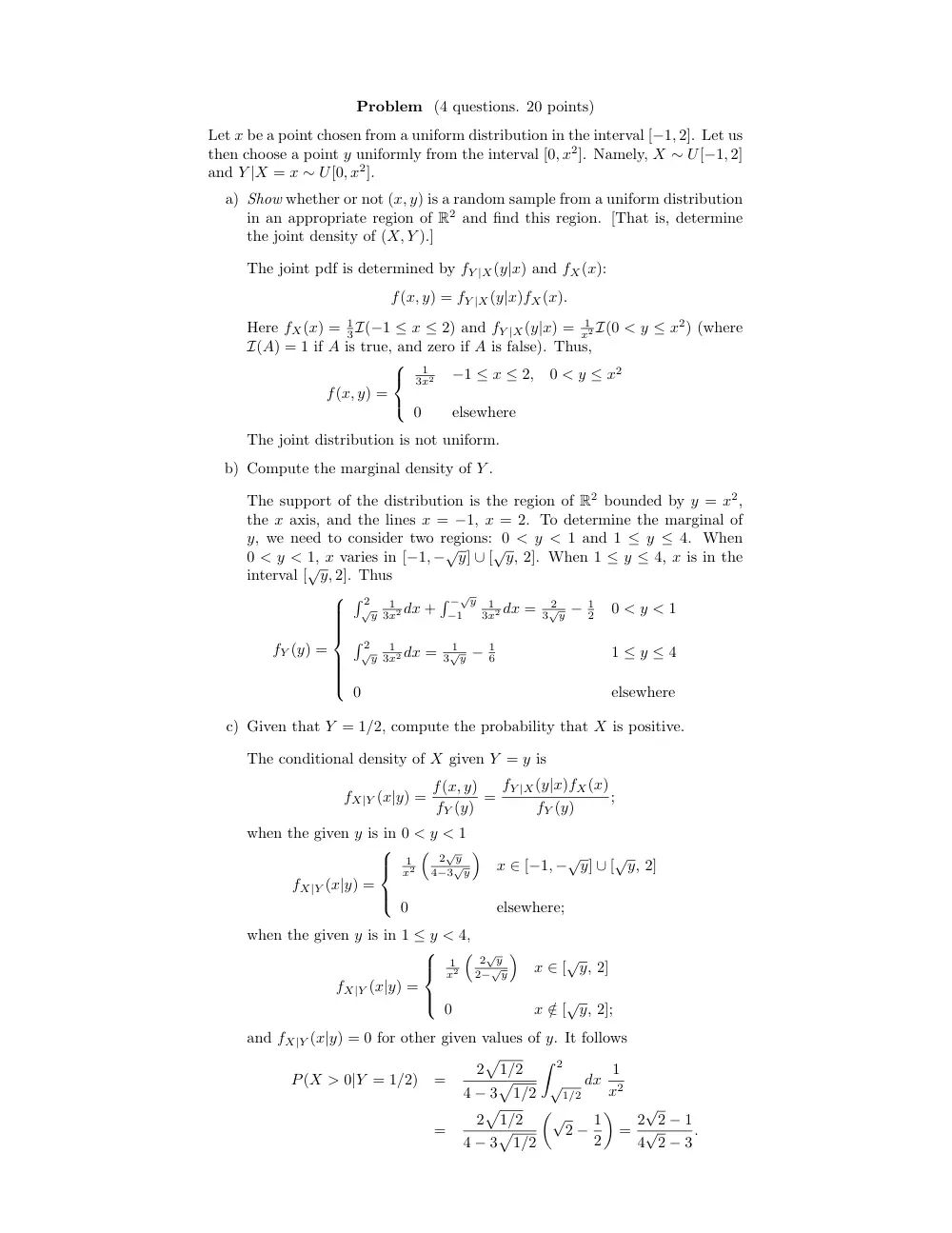
Problem (4 questions. 20 points)
Let x be a point chosen from a uniform distribution in the interval [−1, 2]. Let us
then choose a point y uniformly from the interval [0, x2]. Namely, X ∼ U[−1, 2]
and Y |X = x ∼ U[0, x2].
a) Show whether or not (x, y) is a random sample from a uniform distribution
in an appropriate region of R2 and find this region. [That is, determine
the joint density of (X, Y ).]
The joint pdf is determined by fY |X(y|x) and fX(x):
f(x, y) = fY |X(y|x)fX(x).
Here fX(x) = 1
3I(−1 ≤ x ≤ 2) and fY |X(y|x) =
1
x2 I(0 < y ≤ x2) (where
I(A) = 1 if A is true, and zero if A is false). Thus,
f(x, y) =
1
3x2
−1 ≤ x ≤ 2,
0 < y ≤ x2
0
elsewhere
The joint distribution is not uniform.
b) Compute the marginal density of Y .
The support of the distribution is the region of R2 bounded by y = x2,
the x axis, and the lines x = −1, x = 2. To determine the marginal of
y, we need to consider two regions: 0 < y < 1 and 1 ≤ y ≤ 4. When
0 < y < 1, x varies in [−1, −√y] ∪ [√y, 2]. When 1 ≤ y ≤ 4, x is in the
interval [√y, 2]. Thus
fY (y) =
� 2
√y
1
3x2 dx +
� −√y
−1
1
3x2 dx =
2
3√y − 1
2
0 < y < 1
� 2
√y
1
3x2 dx =
1
3√y − 1
6
1 ≤ y ≤ 4
0
elsewhere
c) Given that Y = 1/2, compute the probability that X is positive.
The conditional density of X given Y = y is
fX|Y (x|y) = f(x, y)
fY (y) = fY |X(y|x)fX(x)
fY (y)
;
when the given y is in 0 < y < 1
fX|Y (x|y) =
1
x2
�
2√y
4−3√y
�
x ∈ [−1, −√y] ∪ [√y, 2]
0
elsewhere;
when the given y is in 1 ≤ y < 4,
fX|Y (x|y) =
1
x2
�
2√y
2−√y
�
x ∈ [√y, 2]
0
x /∈ [√y, 2];
and fX|Y (x|y) = 0 for other given values of y. It follows
P(X > 0|Y = 1/2)
=
2
�
1/2
4 − 3
�
1/2
� 2
√
1/2
dx 1
x2
=
2
�
1/2
4 − 3
�
1/2
�√
2 − 1
2
�
= 2
√
2 − 1
4
√
2 − 3.
d) Knowing that Y is equal to 3, compute the expected value of X.
Using the conditional pdf obtained above,
E(X|Y = 3)
=
2
√
3
2 −
√
3
� 2
√
3
dx x · 1
x2
=
2
√
3
2 −
√
3 log
� 2
√
3
�
.
Problem (3 questions. 15 points)
Buses of the Poisson Company arrive at a bus stop according to a Poisson
process with a rate of 1 bus every ten minutes. Tarek arrives at the bus stop at
a random time.
a) What is the probability that he has to wait more than 10 minutes to take
the next Poisson Company bus?
The time between two consecutive events in a Poisson process is an ex-
ponential random variable, with parameter λ equal to the rate of the
process. Thus λ = 1/10 (using here and in the following minutes as units
of time). Let T be the time Tarek will wait until the next Poisson bus.
By the memoryless property of the exponential, T is exponential as well:
T ∼ Exp(λ = 1/10). Hence
P(T > 10) = e−10/10 = e−1.
b) A second bus company, Punctual, serves the same route. A Punctual bus
arrives at the bus stop exactly every 10 minutes. What is the probability
that exactly two Poisson buses arrive between two consecutive buses of
Punctual?
The time interval between two consecutive Punctual buses is fixed and
equal to ∆t = 10. The number N(∆t) of events in a time interval ∆t is a
Poisson r.v. with mean λ∆t.
P(N(∆t) = 2) = e−λ∆t (λ∆t)2
2!
= e−1
2 .
c) At his arrival, Tarek decides to get on the bus that will come first. What
is the probability that he will board a Poisson bus, assuming bus arrivals
are independent?
Tarek arrives at a random instant. The time Y to the next Punctual bus
is thus a U[0, 10] random variable. He will end up taking the Poisson bus,
if the Poisson bus arrives before the Punctual bus: namely, T < Y , with
T as in a). T and Y are independent random variables, thus the joint pdf
is the product of the two marginal pdf’s.
P(T < Y )
=
�
dt dyfT (t)fY (y) =
� 10
0
1
10dy
� y
0
dt λe−λt
=
1 −
1
10λ +
1
10λe−λ10
=
e−1.