
STAT 230 Midterm With Solution, Summer 2013
American University of Beirut · Introduction to Probability and Random Variables · 12 pages · Dr. Todd Kuffner · with solution



Showing the first 10 of 12 pages. Download the PDF to see all of it.
More STAT 230 files
- Exam 1 · Summer 2016ExamView
- Exam 2 Solution · Fall 2016Exam · with solutionView
- Exam 2 Solution · Fall 2016Exam · with solutionView
- Exam 1 · Summer 2016ExamView
- Midterm with Answers · Summer 2015Exam · with solutionView
- Midterm Summer 2015 · Summer 2015ExamView
- Exam 1 · Summer 2013ExamView
- Exam 1 With Solution · Summer 2013Exam · with solutionView
Show the text of this exam
American University of Beirut
Stat 230 Summer 2013
Midterm Exam
Name:
ID Number:
Rules
1. No questions.
2. No talking.
3. No looking at someone else’s exam or any other action which could be construed as
cheating.
4. No mobile phones.
5. No calculators.
6. There is no need to simplify solutions for which a calculator is needed (such as
�n
k
�
or
�). However, you are expected to integrate and differentiate where needed.
Failure to comply with Rules 1-5 will result in a score of zero for the exam and
your immediate dismissal from the room. There will be no warnings.
Some Possibly Useful Formulae
Geometric(p): f(i) = (1 − p)i−1p,
i = 1, 2, . . .
Binomial(n, p): f(i) =
�n
i
�
pi(1 − p)n−i,
i = 0, 1, . . . , n
Poisson(λ): f(i) = λie−λ
i!
,
i = 0, 1, 2, . . .
NegBin(r, p): f(n) =
�n−1
r−1
�
pr(1 − p)n−r,
n = r, r + 1, . . .
HypGeo(N, n, k): f(i) = (k
i)(N−k
n−i)
(N
n)
,
max{0, n − (N − k)} ≤ i ≤ min{n, k}
Uniform: f(x; a, b) =
1
b−a, a < x < b
Normal: f(x; µ, σ) =
1
√
2πσ exp
�
− (x−µ)2
2σ2
�
, −∞ < x < ∞
Gamma: f(x; α, β) = xα−1e−x/β
βαΓ(α) , x, α, β > 0
Beta: f(x; α, β) = xα−1(1−x)β−1
B(α,β)
, 0 < x < 1, α, β > 0
Lognormal: f(x; µ, σ) =
1
√
2πσx exp
�
−
1
2σ2[ln(x) − µ]2�
, x ≥ 0
Weibull: f(x; α, β) = αβxβ−1e−αxβ, x, α, β > 0
Section One (12 points)
1. (12 points) For the following questions, circle TRUE or FALSE. No work need be
shown. Each correct answer will be awarded +2 points and each incorrect answer will
be penalized −2 points. Blank answers will be marked as zero.
T
F
It is possible that P(A) = P(B) = 0.6 and that A and B are mutually
exclusive.
Solution: False. If they were mutually exclusive, then
P(A ∪ B) = P(A) + P(B) = 1.2
T
F
For 3 events A, B and C, P(A ∪ (B′ ∪ C′)′) = P(A ∪ (B ∩ C))
Solution: True (by DeMorgan’s Laws).
T
F
Suppose there is a pile of 157 socks on your bedroom floor; 19 of them are
clean and the remainder are dirty. Your curious mother bravely reaches
into the pile and grabs 22 socks. Let X be a random variable denoting
the number of clean socks she is holding; then X has a hypergeometric
distribution.
Solution: False, 22 > 19.
T
F
For a normal random variable X with mean 6 and variance 9,
P(3 < X < 9) > 0.7.
Solution: False , it is P(−1 < Z < 1) = .8413 − .1587 = .6826.
T
F
Mutually exclusive events can be independent, but independent events
cannot be mutually exclusive.
Solution: False, they are just different things...
T
F
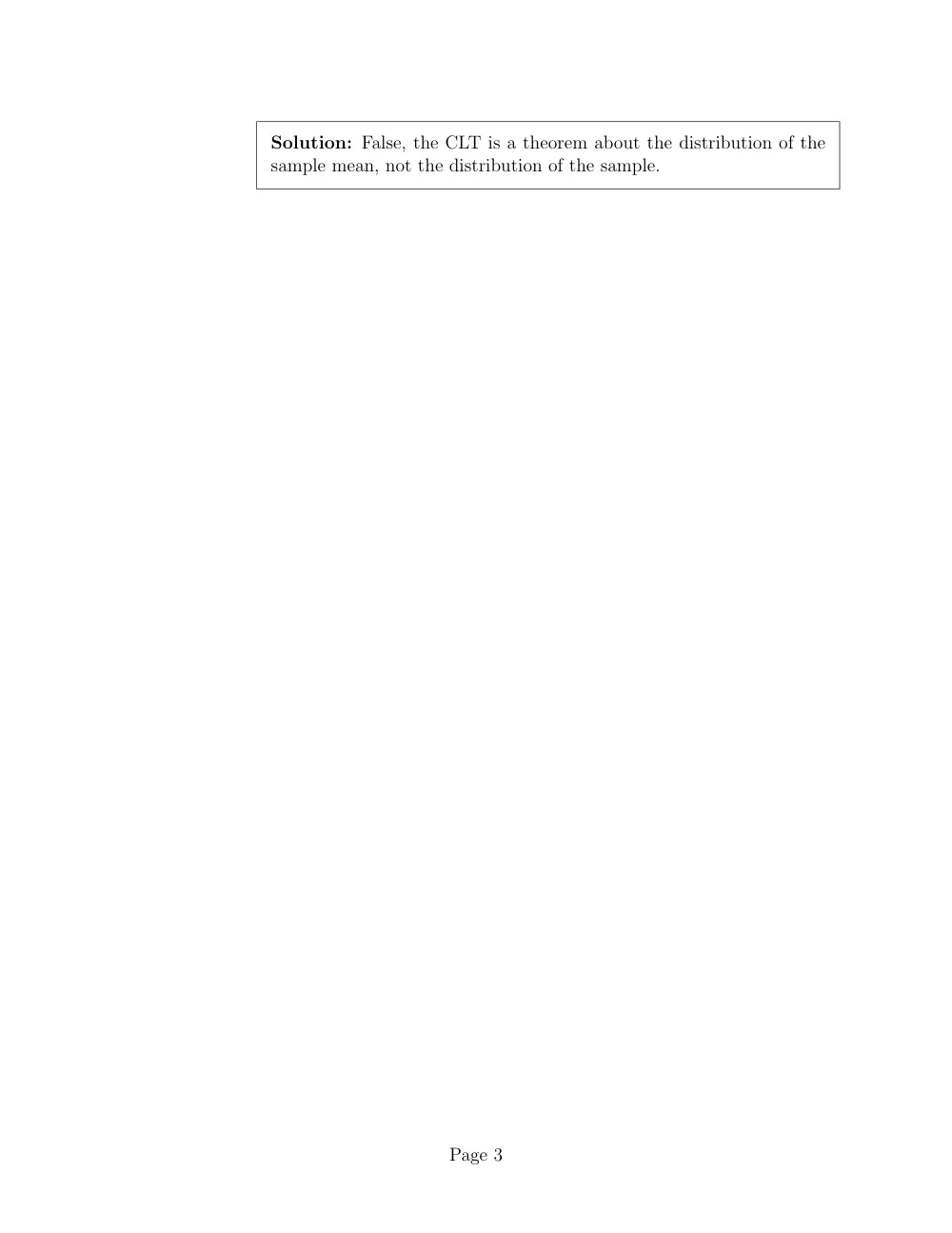
The Central Limit Theorem states that as the sample size tends to infinity,
then regardless of the distribution in the population, the distribution of
the random sample will be approximately standard normal.
Page 2
Solution: False, the CLT is a theorem about the distribution of the
sample mean, not the distribution of the sample.
Page 3
Section Two (48 points)
Answer the questions in the spaces provided. If you run out of room for an answer,
continue on the back of the page. Show clearly all work and make sure your
final answer is clearly indicated.
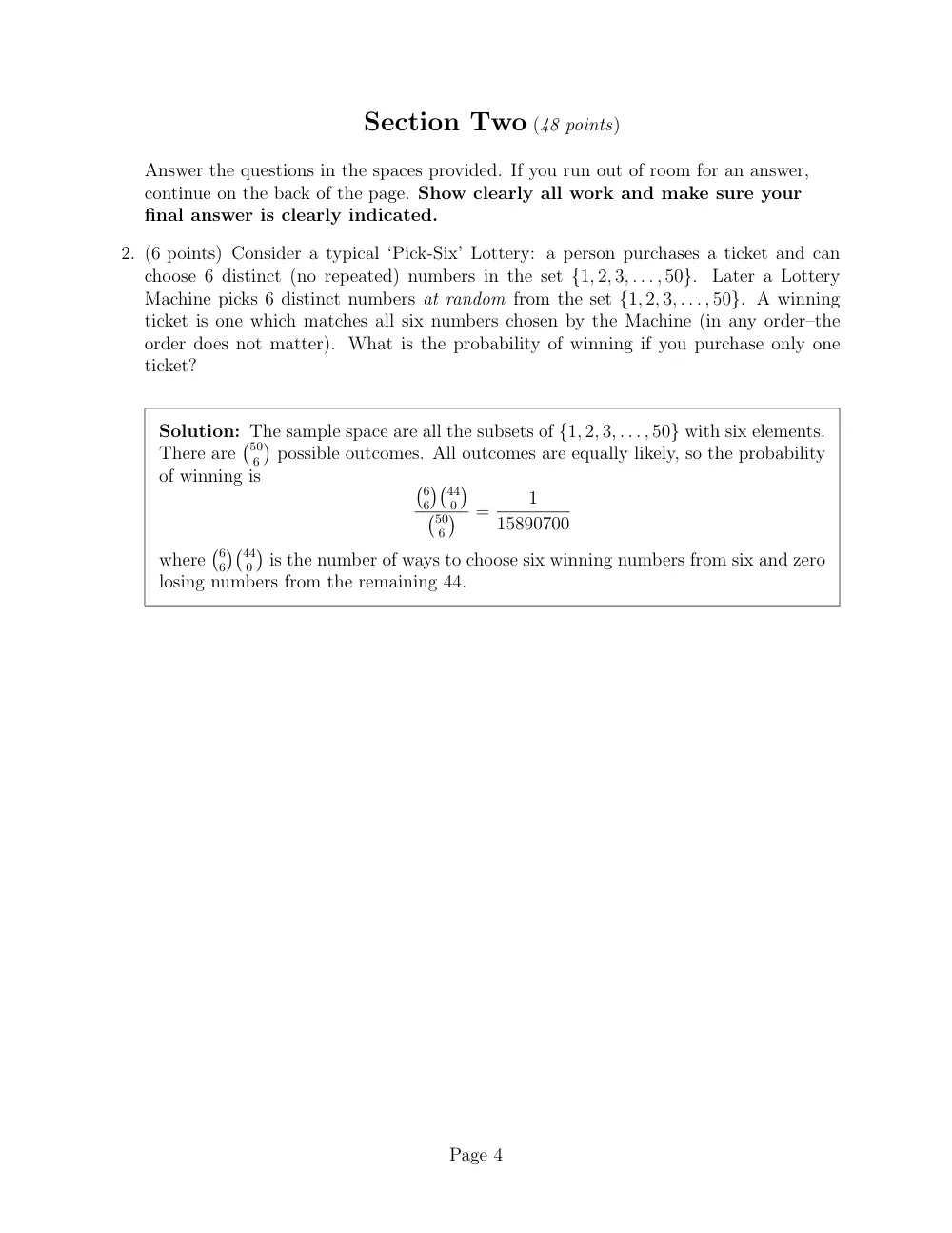
2. (6 points) Consider a typical ‘Pick-Six’ Lottery: a person purchases a ticket and can
choose 6 distinct (no repeated) numbers in the set {1, 2, 3, . . . , 50}. Later a Lottery
Machine picks 6 distinct numbers at random from the set {1, 2, 3, . . . , 50}. A winning
ticket is one which matches all six numbers chosen by the Machine (in any order–the
order does not matter). What is the probability of winning if you purchase only one
ticket?
Solution: The sample space are all the subsets of {1, 2, 3, . . . , 50} with six elements.
There are
�50
6
�
possible outcomes. All outcomes are equally likely, so the probability
of winning is
�6
6
��44
0
�
�50
6
�
=
1
15890700
where
�6
6
��44
0
�
is the number of ways to choose six winning numbers from six and zero
losing numbers from the remaining 44.
Page 4
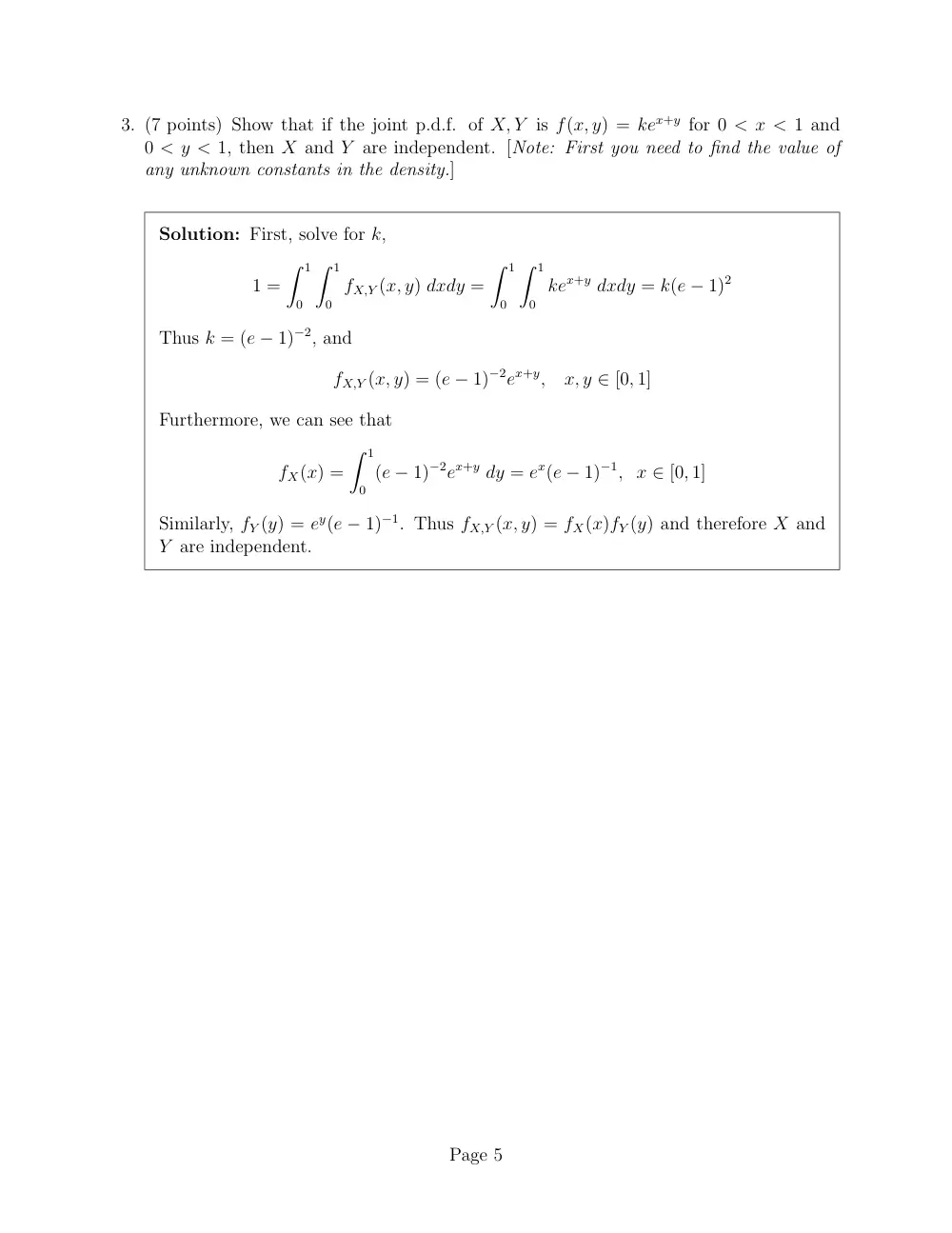
3. (7 points) Show that if the joint p.d.f. of X, Y is f(x, y) = kex+y for 0 < x < 1 and
0 < y < 1, then X and Y are independent. [Note: First you need to find the value of
any unknown constants in the density.]
Solution: First, solve for k,
1 =
� 1
0
� 1
0
fX,Y (x, y) dxdy =
� 1
0
� 1
0
kex+y dxdy = k(e − 1)2
Thus k = (e − 1)−2, and
fX,Y (x, y) = (e − 1)−2ex+y,
x, y ∈ [0, 1]
Furthermore, we can see that
fX(x) =
� 1
0
(e − 1)−2ex+y dy = ex(e − 1)−1, x ∈ [0, 1]
Similarly, fY (y) = ey(e − 1)−1. Thus fX,Y (x, y) = fX(x)fY (y) and therefore X and
Y are independent.
Page 5
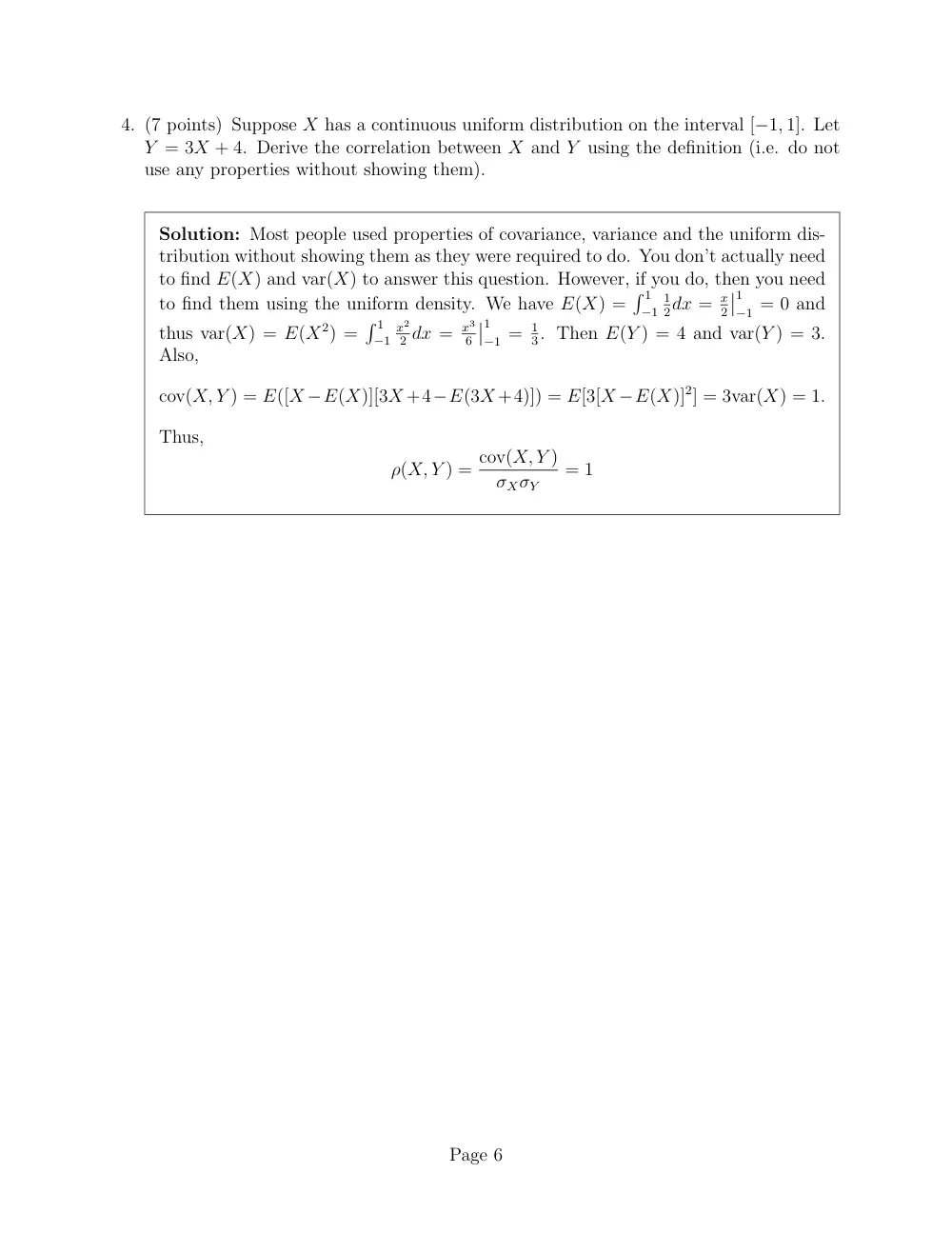
4. (7 points) Suppose X has a continuous uniform distribution on the interval [−1, 1]. Let
Y = 3X + 4. Derive the correlation between X and Y using the definition (i.e. do not
use any properties without showing them).
Solution: Most people used properties of covariance, variance and the uniform dis-
tribution without showing them as they were required to do. You don’t actually need
to find E(X) and var(X) to answer this question. However, if you do, then you need
to find them using the uniform density. We have E(X) =
� 1
−1
1
2dx = x
2
��1
−1 = 0 and
thus var(X) = E(X2) =
� 1
−1
x2
2 dx = x3
6
��1
−1 = 1
3. Then E(Y ) = 4 and var(Y ) = 3.
Also,
cov(X, Y ) = E([X −E(X)][3X +4−E(3X +4)]) = E[3[X −E(X)]2] = 3var(X) = 1.
Thus,
ρ(X, Y ) = cov(X, Y )
σXσY
= 1
Page 6
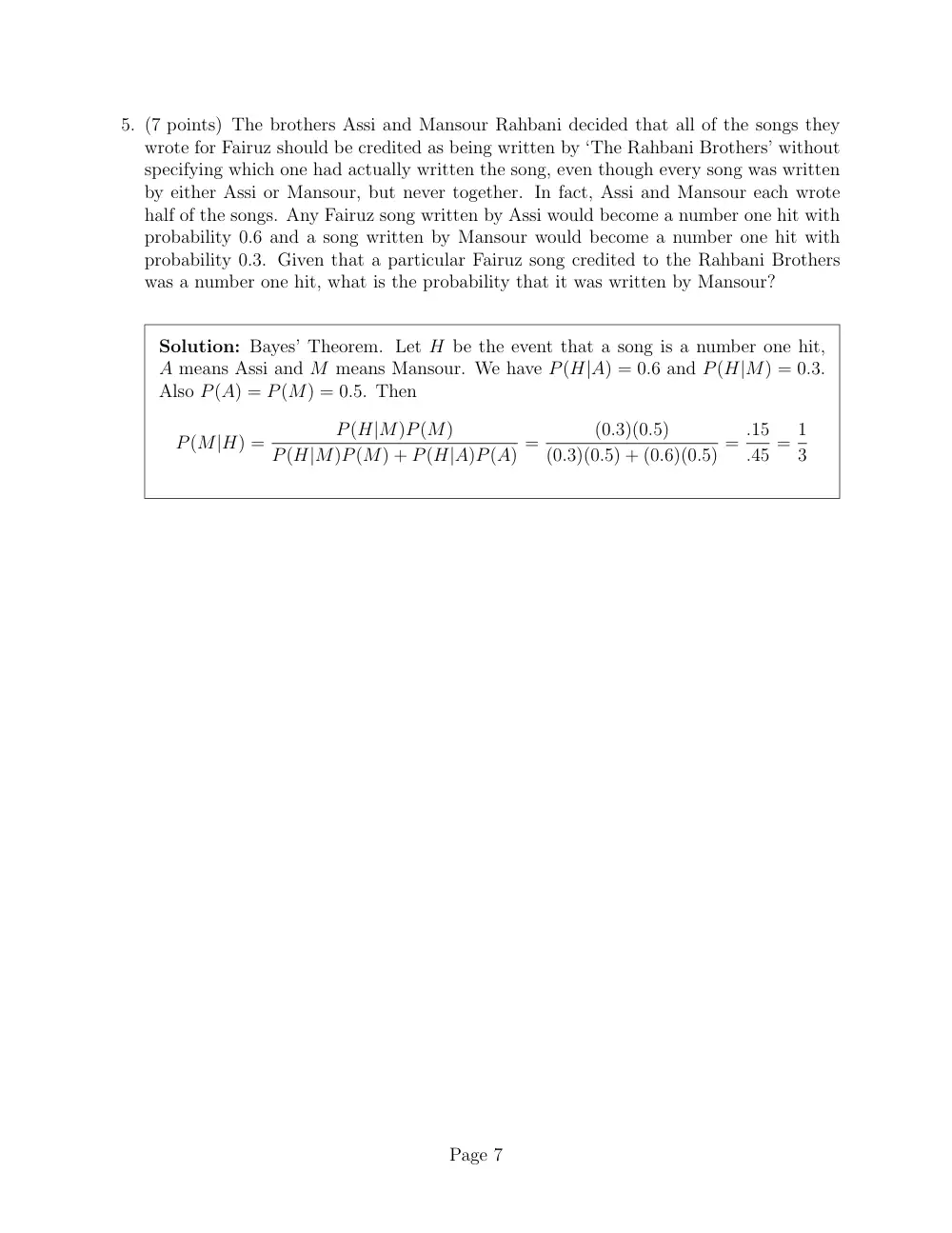
5. (7 points) The brothers Assi and Mansour Rahbani decided that all of the songs they
wrote for Fairuz should be credited as being written by ‘The Rahbani Brothers’ without
specifying which one had actually written the song, even though every song was written
by either Assi or Mansour, but never together. In fact, Assi and Mansour each wrote
half of the songs. Any Fairuz song written by Assi would become a number one hit with
probability 0.6 and a song written by Mansour would become a number one hit with
probability 0.3. Given that a particular Fairuz song credited to the Rahbani Brothers
was a number one hit, what is the probability that it was written by Mansour?
Solution: Bayes’ Theorem. Let H be the event that a song is a number one hit,
A means Assi and M means Mansour. We have P(H|A) = 0.6 and P(H|M) = 0.3.
Also P(A) = P(M) = 0.5. Then
P(M|H) =
P(H|M)P(M)
P(H|M)P(M) + P(H|A)P(A) =
(0.3)(0.5)
(0.3)(0.5) + (0.6)(0.5) = .15
.45 = 1
3
Page 7
6. (7 points) On any given day, independently of what happens on any other day, a bird
poops on my car with fixed probability 0.9. Consider the probability that in the next
1000 days, I will be able to enjoy at least 50 but no more than 150 days without a
bird pooping on my car. Give 3 different answers to this question: (a) the exact answer,
(b) an approximation using a discrete distribution and (c) an approximation using a
continuous distribution. Make sure to clearly define the distributions and parameters
you are using.
Solution: This is a binomial problem with n = 1000 and p = 0.1. We have
P(50 ≤ Xbin ≤ 150) =
150
�
k=50
�1000
k
�
(0.1)k(0.9)1000−k
For the Poisson approximation, let λ = np = 100. Then
P(50 ≤ Xbin ≤ 150) ≈
150
�
k=50
100ke−100
k!
and the normal approximation uses the continuity correction, so
P(50 ≤ Xbin ≤ 150) ≈ P(49.5 − 100
√
90
< Z < 150.5 − 100
√
90
)
Page 8
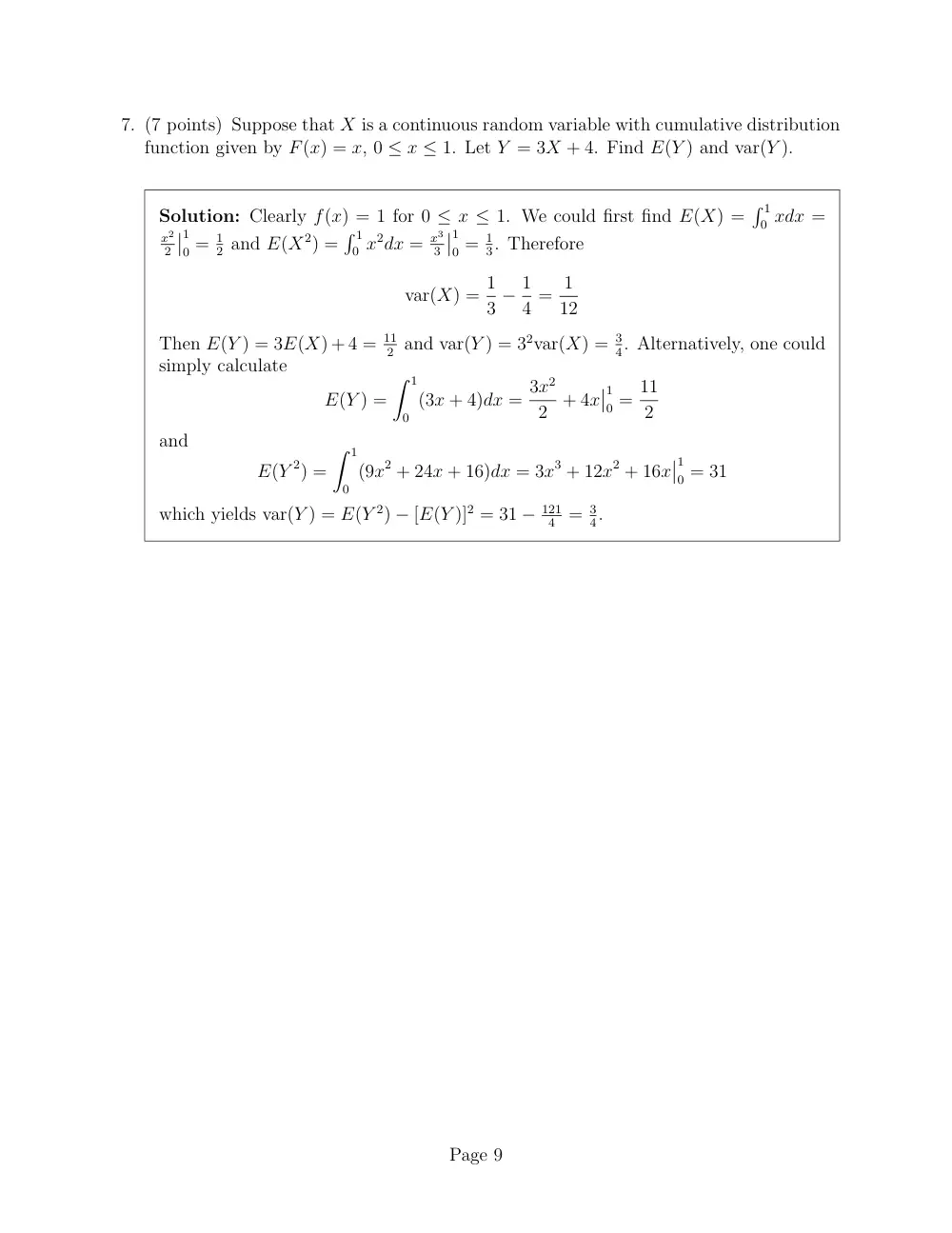
7. (7 points) Suppose that X is a continuous random variable with cumulative distribution
function given by F(x) = x, 0 ≤ x ≤ 1. Let Y = 3X + 4. Find E(Y ) and var(Y ).
Solution: Clearly f(x) = 1 for 0 ≤ x ≤ 1. We could first find E(X) =
� 1
0 xdx =
x2
2
��1
0 = 1
2 and E(X2) =
� 1
0 x2dx = x3
3
��1
0 = 1
3. Therefore
var(X) = 1
3 − 1
4 = 1
12
Then E(Y ) = 3E(X) + 4 = 11
2 and var(Y ) = 32var(X) = 3
4. Alternatively, one could
simply calculate
E(Y ) =
� 1
0
(3x + 4)dx = 3x2
2 + 4x
��1
0 = 11
2
and
E(Y 2) =
� 1
0
(9x2 + 24x + 16)dx = 3x3 + 12x2 + 16x
��1
0 = 31
which yields var(Y ) = E(Y 2) − [E(Y )]2 = 31 − 121
4 = 3
4.
Page 9
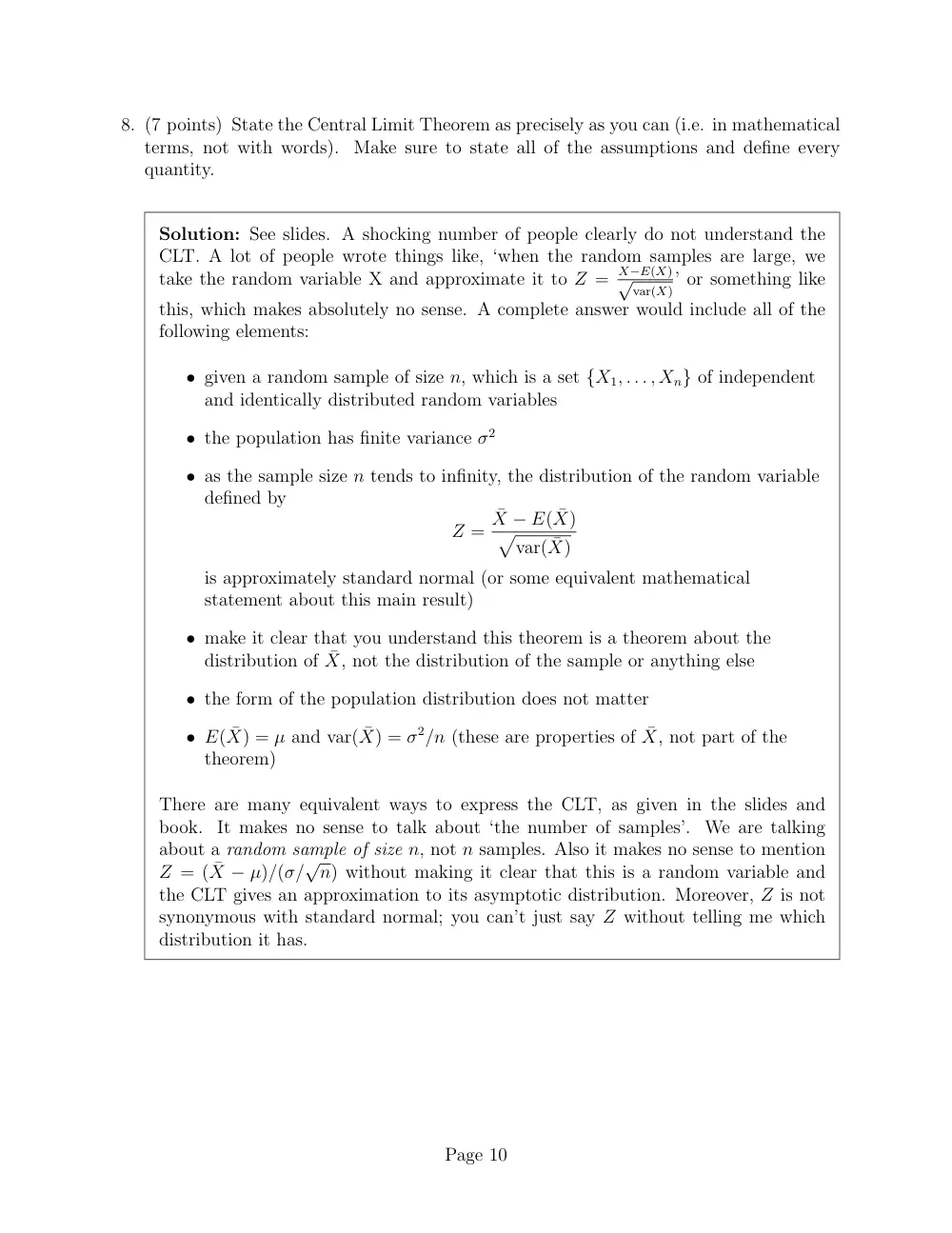
8. (7 points) State the Central Limit Theorem as precisely as you can (i.e. in mathematical
terms, not with words). Make sure to state all of the assumptions and define every
quantity.
Solution: See slides. A shocking number of people clearly do not understand the
CLT. A lot of people wrote things like, ‘when the random samples are large, we
take the random variable X and approximate it to Z = X−E(X)
√
var(X)’ or something like
this, which makes absolutely no sense. A complete answer would include all of the
following elements:
• given a random sample of size n, which is a set {X1, . . . , Xn} of independent
and identically distributed random variables
• the population has finite variance σ2
• as the sample size n tends to infinity, the distribution of the random variable
defined by
Z =
¯X − E( ¯X)
�
var( ¯X)
is approximately standard normal (or some equivalent mathematical
statement about this main result)
• make it clear that you understand this theorem is a theorem about the
distribution of ¯X, not the distribution of the sample or anything else
• the form of the population distribution does not matter
• E( ¯X) = µ and var( ¯X) = σ2/n (these are properties of ¯X, not part of the
theorem)
There are many equivalent ways to express the CLT, as given in the slides and
book. It makes no sense to talk about ‘the number of samples’. We are talking
about a random sample of size n, not n samples. Also it makes no sense to mention
Z = ( ¯X − µ)/(σ/√n) without making it clear that this is a random variable and
the CLT gives an approximation to its asymptotic distribution. Moreover, Z is not
synonymous with standard normal; you can’t just say Z without telling me which
distribution it has.
Page 10
Bonus Question (worth 4 points, but not counted at all unless all other
questions in Section 2 are answered)
9. Explain why the normal distribution with mean µ and variance σ2, which has posi-
tive probability over all intervals from (−∞, ∞), may still be appropriate to model the
distribution of a random variable which, in reality, can take only positive values.
Solution: No partial credit. A graph would be helpful in answering this question.
If µ >> 0 and σ2 is small relative to the mean, then almost all of the area under
the normal density will be over positive values. We know that more than 99% of
the values of a normal random variable are within 3 standard deviations of its mean.
Thus, while a normal random variable will always take negative values with positive
probability, this probability can be negligibly small for large positive values of µ
and small relative values of σ2. Thus the normal distribution could in principle still
be a good approximation to the distribution of a random variable which only takes
positive values.
Page 11
Bonus Question (worth 4 points, but not counted at all unless all other
questions in Section 2 are answered)
10. Let X represent a random variable having the same distribution as the population and
suppose that the distribution is normal with mean 2 and unknown variance σ2. Further
suppose we have a very small random sample from this population. Determine which is
greater, P(1 < X < 3) or P(1 < ¯X < 3).
Solution: No partial credit.
Here we know that ¯X is normal without the CLT
because it is a sum of iid normal random variables. In fact we are told that we
have a ‘very small’ random sample, so the CLT would not apply here. Thus P(1 <
X < 3) = P( 1−2
σ
< Z < 3−2
σ ). Also P(1 < ¯X < 3) = P( 1−2
σ/√n < Z <
3−2
σ/√n). If
n > 1, the interval for ¯X contains a higher concentration of the density, because
var( ¯X) < var(X) and therefore P(1 < ¯X < 3) > P(1 < X < 3). If n = 1, they are
the same.
Page 12