
STAT 230 Final with Solution, Fall 2009
American University of Beirut · Introduction to Probability and Random Variables · 3 pages · with solution
More STAT 230 files
- Final · Summer 2010Final examView
- Final with Solution · Summer 2010Final exam · with solutionView
- Final · Fall 2010Final examView
- Final · Summer 2010Final examView
- Final with Answers · Fall 2009Final exam · with solutionView
- Final · Fall 2009Final examView
- Final with Solution · Summer 2009Final exam · with solutionView
- Final with Solution · Spring 2009Final exam · with solutionView
Show the text of this final exam
American University of Beirut
STAT 230
Introduction to Probability and Random Variables
Fall 2009-2010
Final Exam - solution
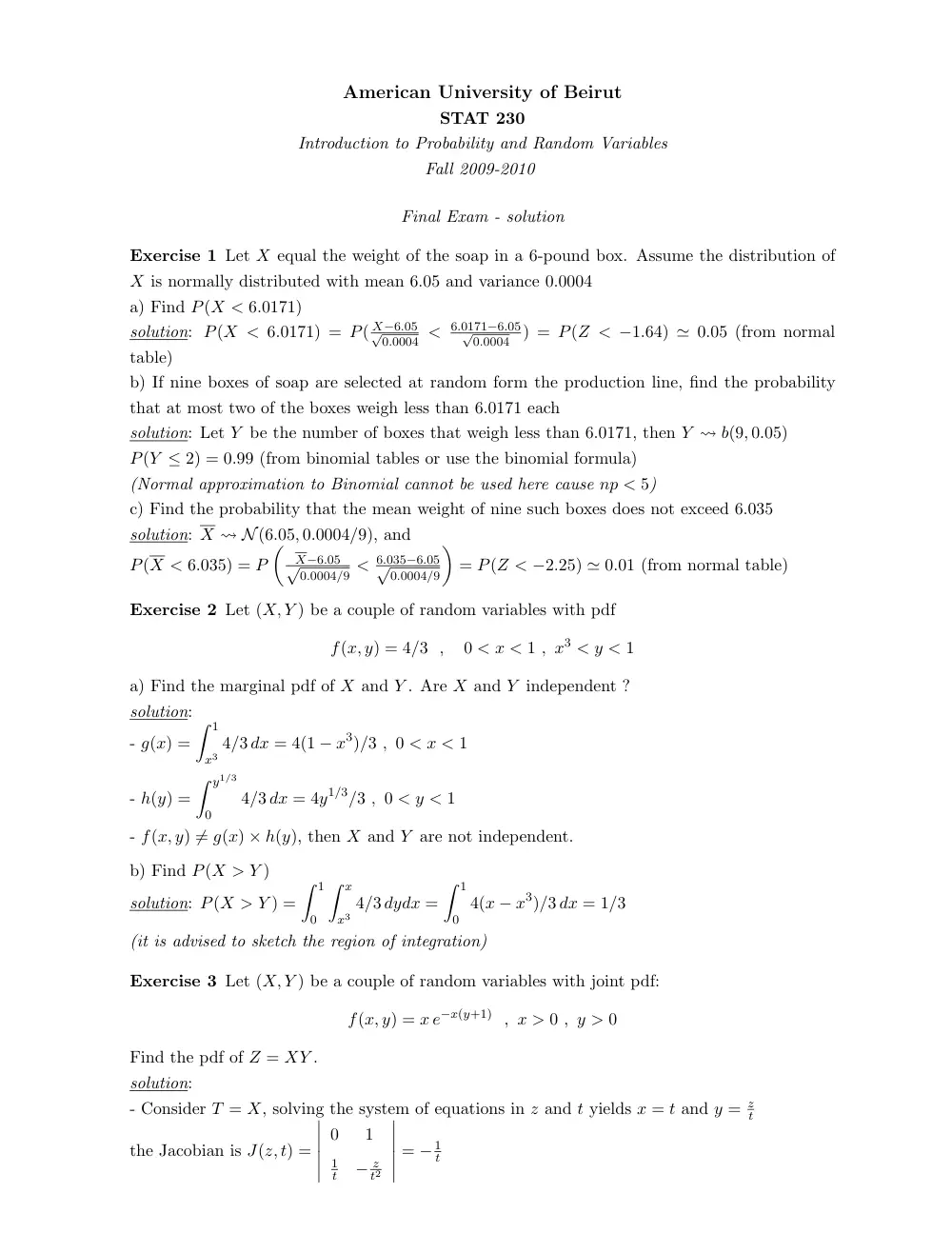
Exercise 1 Let X equal the weight of the soap in a 6-pound box. Assume the distribution of
X is normally distributed with mean 6.05 and variance 0.0004
a) Find P(X < 6.0171)
solution: P(X < 6.0171) = P( X−6.05
√
0.0004 < 6.0171−6.05
√
0.0004 ) = P(Z < −1.64) ≃ 0.05 (from normal
table)
b) If nine boxes of soap are selected at random form the production line, find the probability
that at most two of the boxes weigh less than 6.0171 each
solution: Let Y be the number of boxes that weigh less than 6.0171, then Y ⇝ b(9, 0.05)
P(Y ≤ 2) = 0.99 (from binomial tables or use the binomial formula)
(Normal approximation to Binomial cannot be used here cause np < 5)
c) Find the probability that the mean weight of nine such boxes does not exceed 6.035
solution: X ⇝ N(6.05, 0.0004/9), and
P(X < 6.035) = P
�
X−6.05
√
0.0004/9 < 6.035−6.05
√
0.0004/9
�
= P(Z < −2.25) ≃ 0.01 (from normal table)
Exercise 2 Let (X, Y ) be a couple of random variables with pdf
f(x, y) = 4/3 ,
0 < x < 1 , x3 < y < 1
a) Find the marginal pdf of X and Y . Are X and Y independent ?
solution:
- g(x) =
� 1
x3 4/3 dx = 4(1 − x3)/3 , 0 < x < 1
- h(y) =
� y1/3
0
4/3 dx = 4y1/3/3 , 0 < y < 1
- f(x, y) ̸= g(x) × h(y), then X and Y are not independent.
b) Find P(X > Y )
solution: P(X > Y ) =
� 1
0
� x
x3 4/3 dydx =
� 1
0
4(x − x3)/3 dx = 1/3
(it is advised to sketch the region of integration)
Exercise 3 Let (X, Y ) be a couple of random variables with joint pdf:
f(x, y) = x e−x(y+1) , x > 0 , y > 0
Find the pdf of Z = XY .
solution:
- Consider T = X, solving the system of equations in z and t yields x = t and y = z
t
the Jacobian is J(z, t) =
������
0
1
1
t
− z
t2
������
= −1
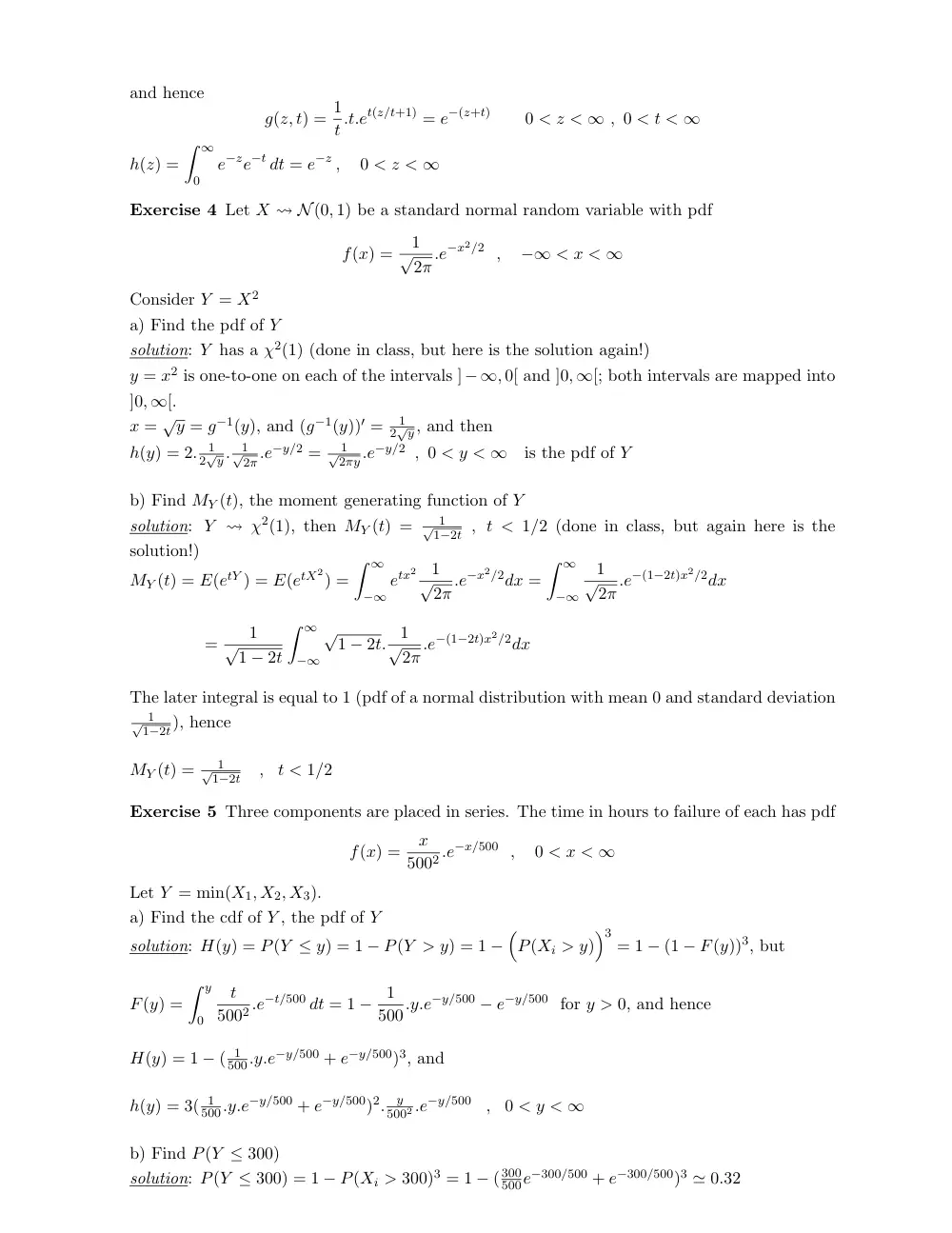
t
and hence
g(z, t) = 1
t .t.et(z/t+1) = e−(z+t)
0 < z < ∞ , 0 < t < ∞
h(z) =
� ∞
0
e−ze−t dt = e−z ,
0 < z < ∞
Exercise 4 Let X ⇝ N(0, 1) be a standard normal random variable with pdf
f(x) =
1
√
2π.e−x2/2 ,
−∞ < x < ∞
Consider Y = X2
a) Find the pdf of Y
solution: Y has a χ2(1) (done in class, but here is the solution again!)
y = x2 is one-to-one on each of the intervals ]−∞, 0[ and ]0, ∞[; both intervals are mapped into
]0, ∞[.
x = √y = g−1(y), and (g−1(y))′ =
1
2√y, and then
h(y) = 2.
1
2√y.
1
√
2π.e−y/2 =
1
√2πy.e−y/2 , 0 < y < ∞
is the pdf of Y
b) Find MY (t), the moment generating function of Y
solution: Y ⇝ χ2(1), then MY (t) =
1
√1−2t , t < 1/2 (done in class, but again here is the
solution!)
MY (t) = E(etY ) = E(etX2) =
� ∞
−∞
etx2
1
√
2π.e−x2/2dx =
� ∞
−∞
1
√
2π.e−(1−2t)x2/2dx
=
1
√1 − 2t
� ∞
−∞
√
1 − 2t.
1
√
2π.e−(1−2t)x2/2dx
The later integral is equal to 1 (pdf of a normal distribution with mean 0 and standard deviation
1
√1−2t), hence
MY (t) =
1
√1−2t
,
t < 1/2
Exercise 5 Three components are placed in series. The time in hours to failure of each has pdf
f(x) =
x
5002 .e−x/500 ,
0 < x < ∞
Let Y = min(X1, X2, X3).
a) Find the cdf of Y , the pdf of Y
solution: H(y) = P(Y ≤ y) = 1 − P(Y > y) = 1 −
�
P(Xi > y)
�3
= 1 − (1 − F(y))3, but
F(y) =
� y
0
t
5002 .e−t/500 dt = 1 −
1
500.y.e−y/500 − e−y/500 for y > 0, and hence
H(y) = 1 − ( 1
500.y.e−y/500 + e−y/500)3, and
h(y) = 3( 1
500.y.e−y/500 + e−y/500)2.
y
5002 .e−y/500
,
0 < y < ∞
b) Find P(Y ≤ 300)
solution: P(Y ≤ 300) = 1 − P(Xi > 300)3 = 1 − (300
500e−300/500 + e−300/500)3 ≃ 0.32
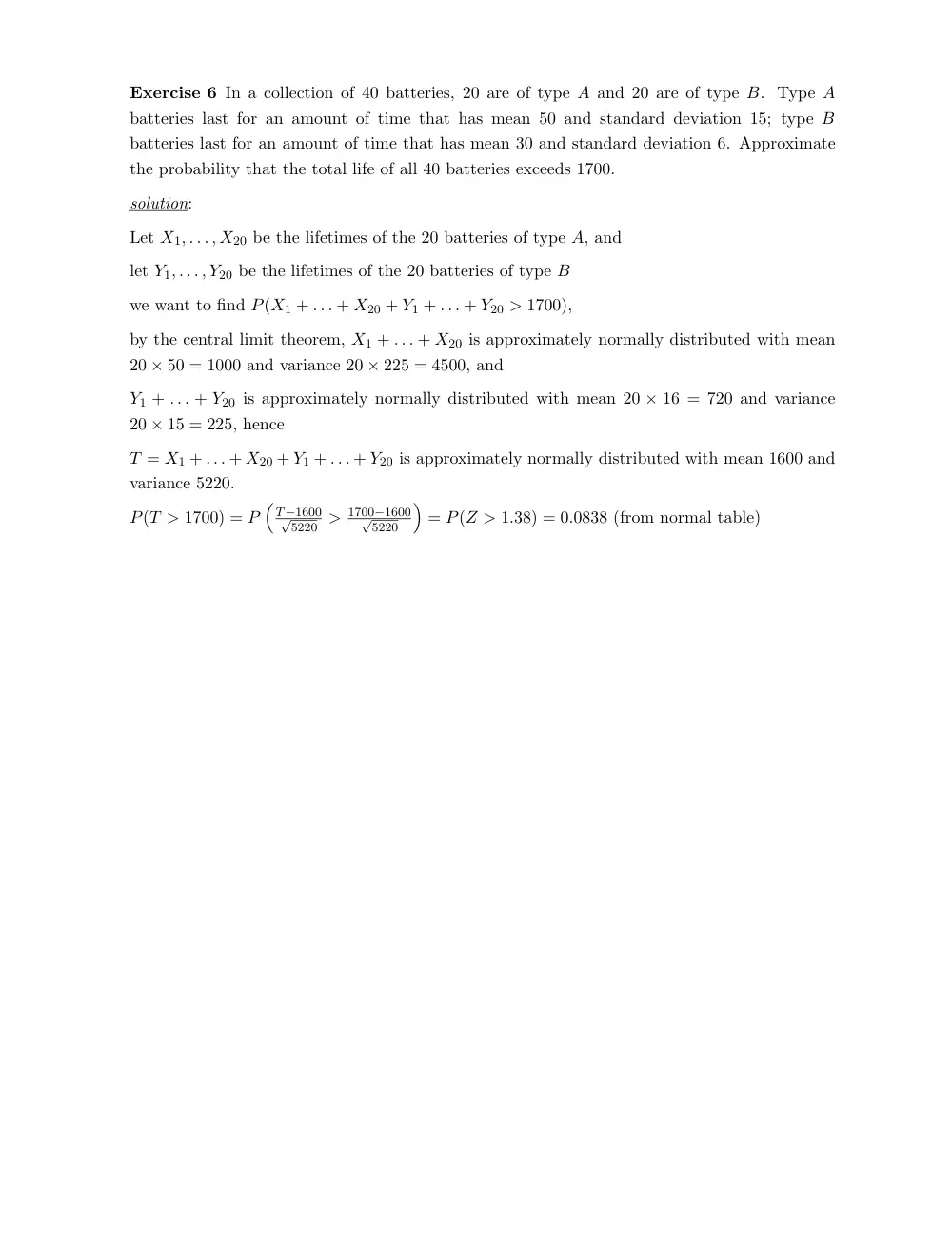
Exercise 6 In a collection of 40 batteries, 20 are of type A and 20 are of type B. Type A
batteries last for an amount of time that has mean 50 and standard deviation 15; type B
batteries last for an amount of time that has mean 30 and standard deviation 6. Approximate
the probability that the total life of all 40 batteries exceeds 1700.
solution:
Let X1, . . . , X20 be the lifetimes of the 20 batteries of type A, and
let Y1, . . . , Y20 be the lifetimes of the 20 batteries of type B
we want to find P(X1 + . . . + X20 + Y1 + . . . + Y20 > 1700),
by the central limit theorem, X1 + . . . + X20 is approximately normally distributed with mean
20 × 50 = 1000 and variance 20 × 225 = 4500, and
Y1 + . . . + Y20 is approximately normally distributed with mean 20 × 16 = 720 and variance
20 × 15 = 225, hence
T = X1 + . . . + X20 + Y1 + . . . + Y20 is approximately normally distributed with mean 1600 and
variance 5220.
P(T > 1700) = P
�
T−1600
√
5220 > 1700−1600
√
5220
�
= P(Z > 1.38) = 0.0838 (from normal table)