
STAT 230 Final with Solution, Summer 2010
American University of Beirut · Introduction to Probability and Random Variables · 17 pages · with solution



Showing the first 10 of 17 pages. Download the PDF to see all of it.
More STAT 230 files
- Final · Summer 2010Final examView
- Final · Fall 2010Final examView
- Final · Summer 2010Final examView
- Final with Answers · Fall 2009Final exam · with solutionView
- Final with Solution · Summer 2009Final exam · with solutionView
- Final · Fall 2009Final examView
- Final with Solution · Spring 2009Final exam · with solutionView
- Final with Solution · Fall 2009Final exam · with solutionView
Show the text of this final exam
Final solution, Summer 2010
Exercise
Lori just bought a new set of 4 tires for her car. The life of each
tire is normally distributed with a mean of 45000 miles and a
standard deviation of 3200 miles. Find the probability that all 4
tires will last at least 46000 miles. Assume the life of each of these
tires is independent of the lives of other tires.
Solution
The probability that one tire lives more than 46000 miles is 0.377,
and the probability that all 4 tires live more than 46000 each is
(0.377)4 = 0.02 .
Exercise
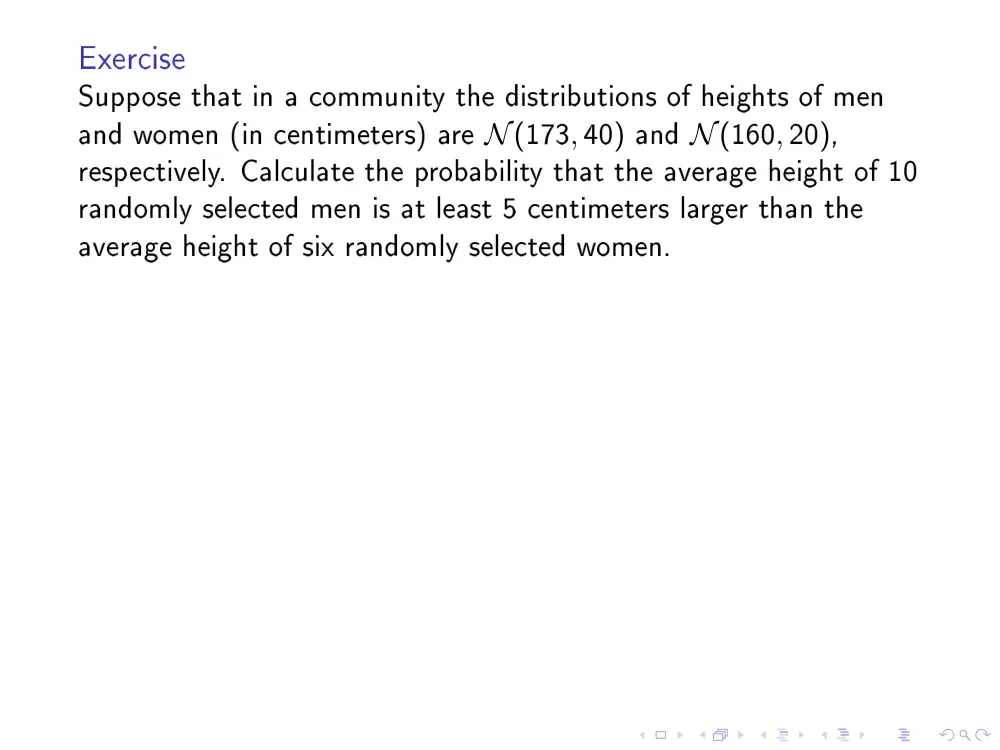
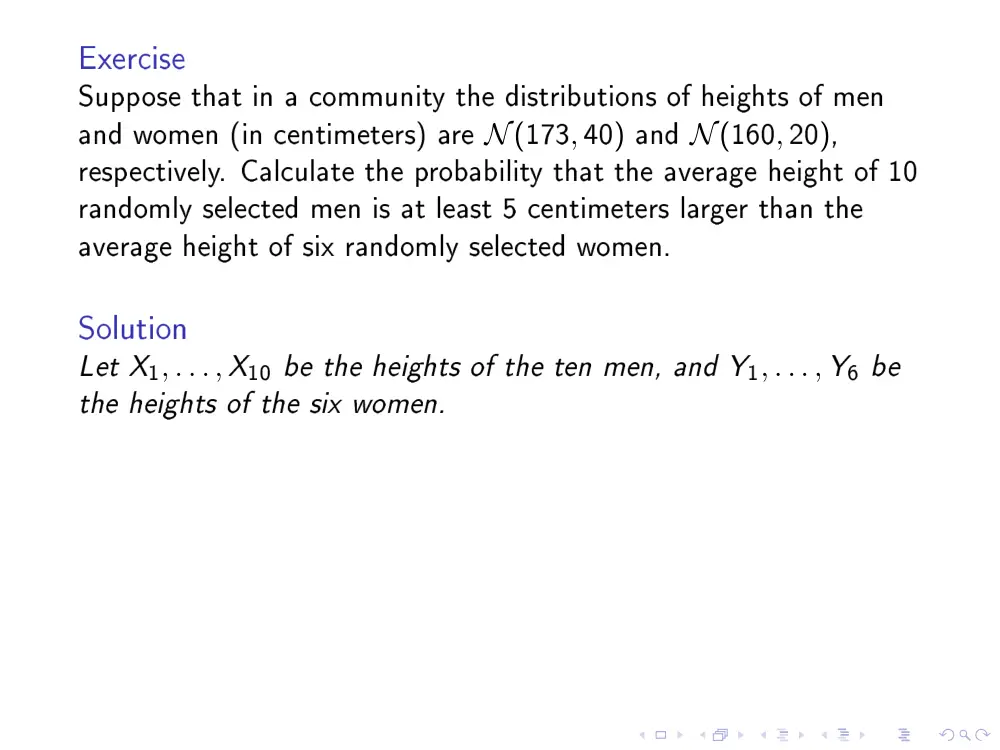
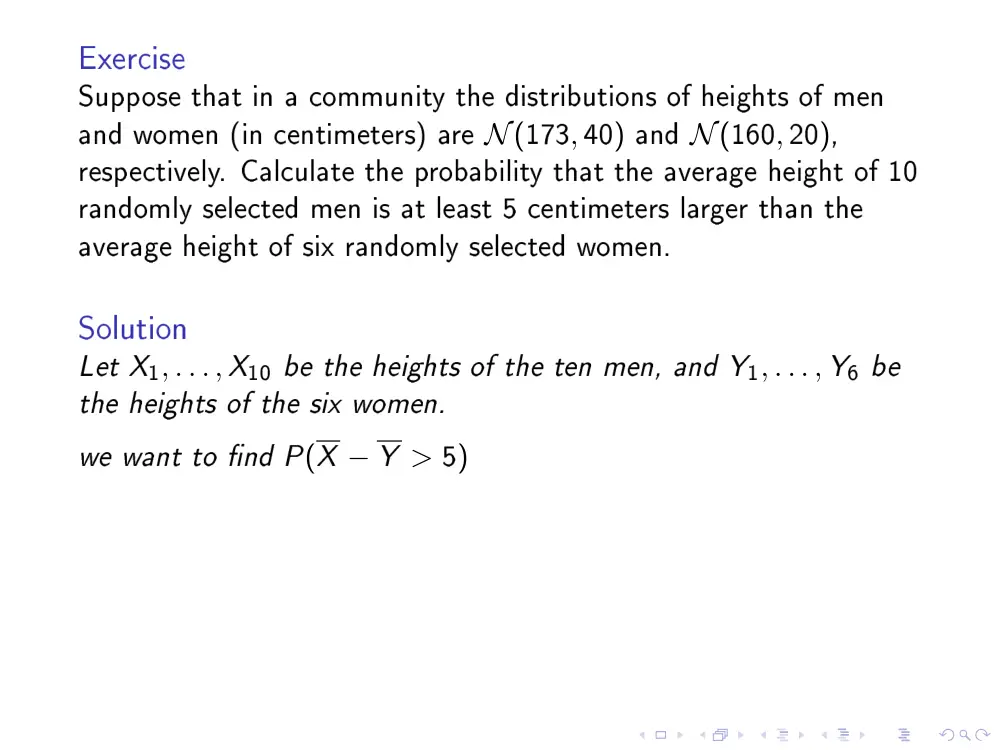
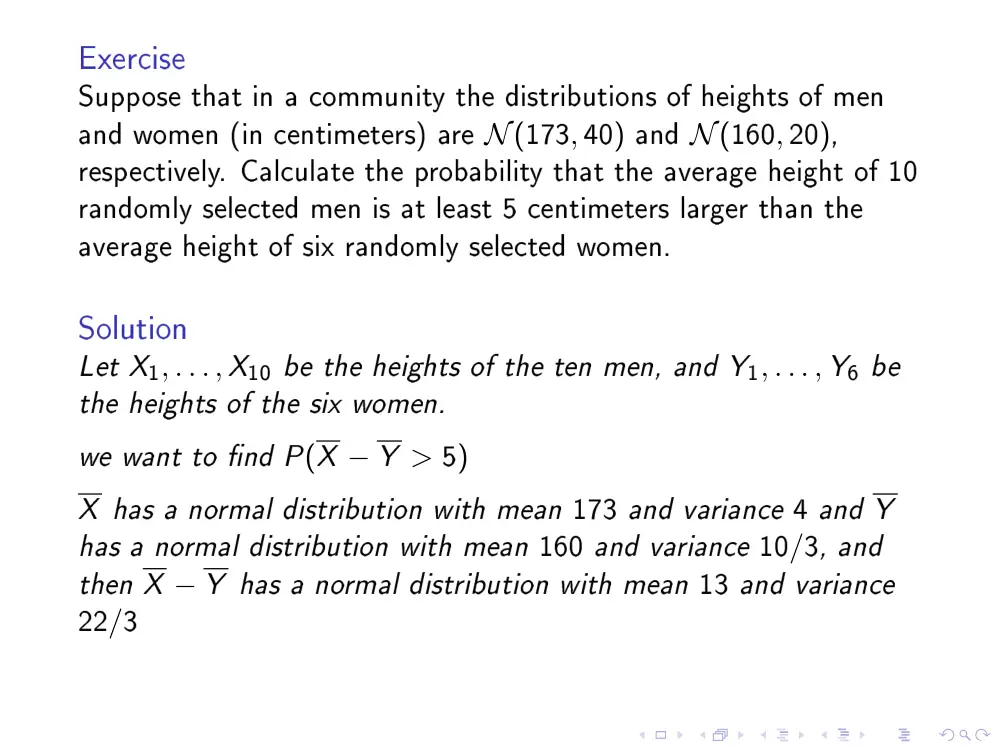
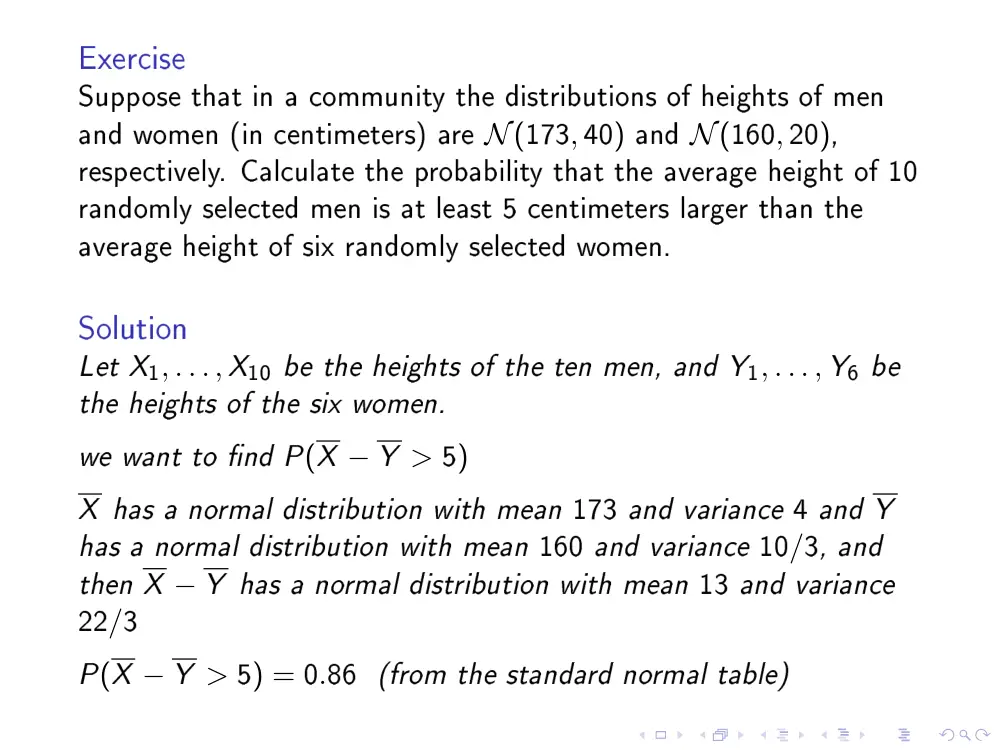
Suppose that in a community the distributions of heights of men
and women (in centimeters) are N(173, 40) and N(160, 20),
respectively. Calculate the probability that the average height of 10
randomly selected men is at least 5 centimeters larger than the
average height of six randomly selected women.
Solution
Let X1, . . . , X10 be the heights of the ten men, and Y1, . . . , Y6 be
the heights of the six women.
we want to
nd P(X − Y > 5)
X has a normal distribution with mean 173 and variance 4 and Y
has a normal distribution with mean 160 and variance 10/3, and
then X − Y has a normal distribution with mean 13 and variance
22/3
P(X − Y > 5) = 0.86 (from the standard normal table)
Exercise
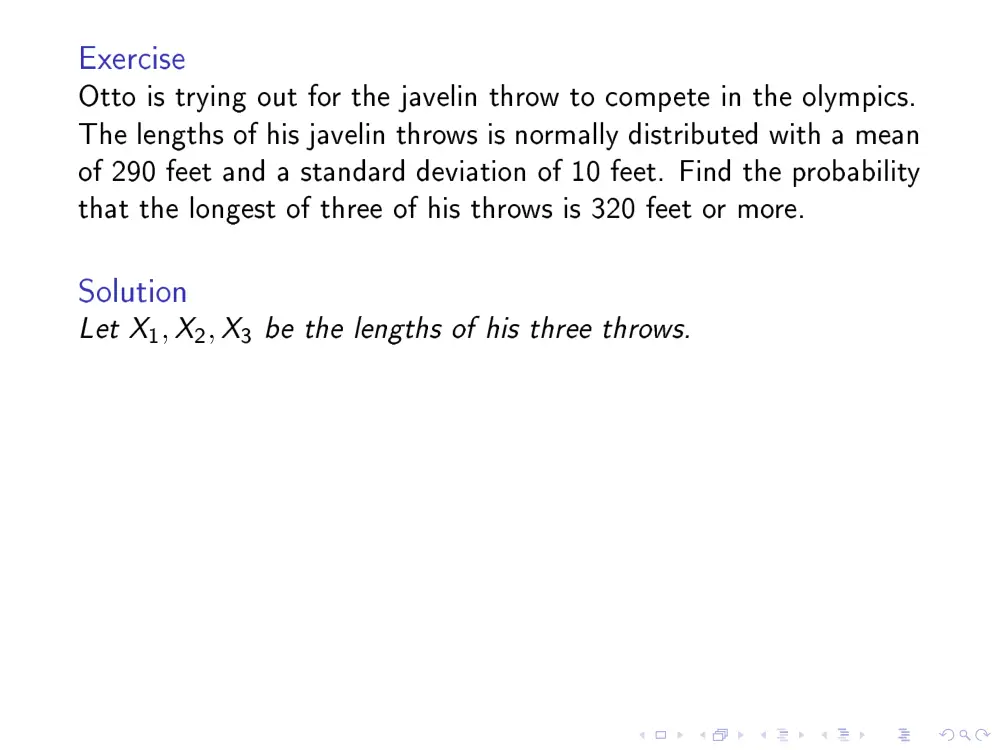
Otto is trying out for the javelin throw to compete in the olympics.
The lengths of his javelin throws is normally distributed with a mean
of 290 feet and a standard deviation of 10 feet. Find the probability
that the longest of three of his throws is 320 feet or more.
Exercise
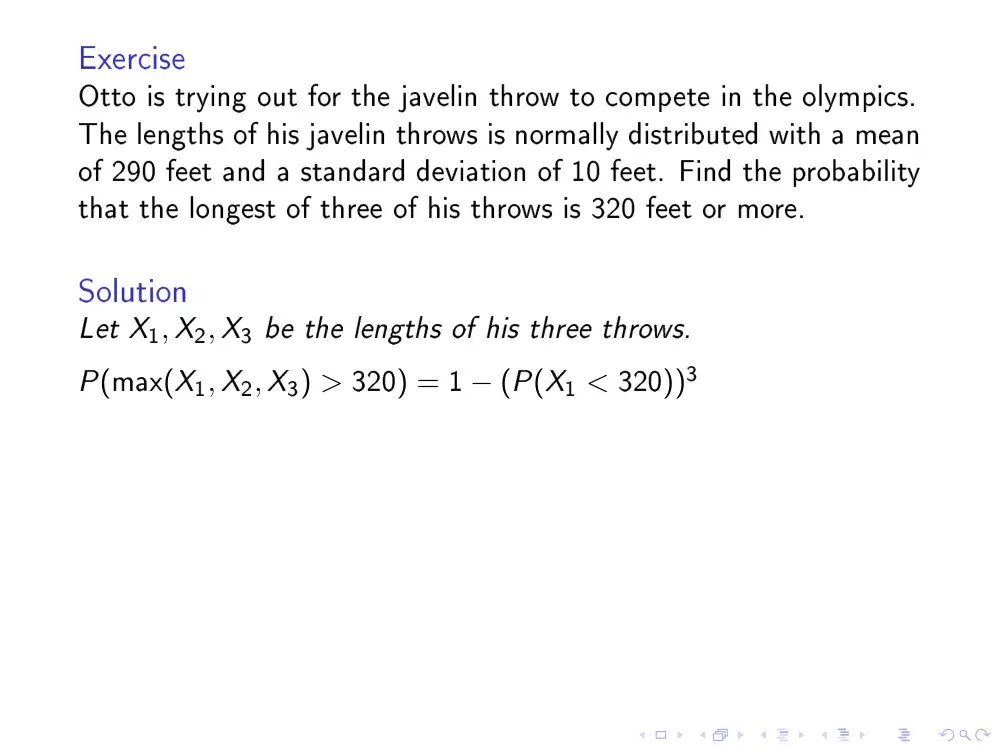
Otto is trying out for the javelin throw to compete in the olympics.
The lengths of his javelin throws is normally distributed with a mean
of 290 feet and a standard deviation of 10 feet. Find the probability
that the longest of three of his throws is 320 feet or more.
Solution
Let X1, X2, X3 be the lengths of his three throws.
P(max(X1, X2, X3) > 320) = 1 − (P(X1 < 320))3
= 1 − (P(Z < 3))3 = 1 − (0.998)3 = 0.004 .
Exercise
he time it takes for a student to
nish an aptitude test (in hours)
has the pdf
f (x) = 6(x − 1)(2 − x) , 1 < x < 2
Approximate the probability that the average length of time it takes
for a random sample of 15 students to complete the test is less
than 1 hour and 25 minutes.
Exercise
he time it takes for a student to
nish an aptitude test (in hours)
has the pdf
f (x) = 6(x − 1)(2 − x) , 1 < x < 2
Approximate the probability that the average length of time it takes
for a random sample of 15 students to complete the test is less
than 1 hour and 25 minutes.
Solution
Let X1, . . . , X15 be the exam time of the 15 students.
we want to
nd P(X < 1.42) (time in hours!!)
E(X1) = 3/2 and Var(X1) = 1/20
by the central limit theorem, X−3/2
1/
√
300 has an approximate standard
normal distribution
P(X < 1.42) ≃ P(Z < −1.38) = 0.083