
STAT 230 Lecture Chapter 2, Fall 2011
American University of Beirut · Introduction to Probability and Random Variables · 90 pages






Showing the first 10 of 90 pages. Download the PDF to see all of it.
More STAT 230 files
- Syllabus · Spring 2020LabView
- Lecture 4- Chapter 2.4 · Spring 2019LabView
- Lecture 4- Examples About Chapters 2.4 · Spring 2019LabView
- Lecture 2- Chapters 2.1 & 2.2 · Spring 2019LabView
- Lecture 1- Chapter 1 · Spring 2019LabView
- Lecture 3- Chapters 2.1, 2.2 & 2.4 · Spring 2019LabView
- Syllabus · Spring 2016LabView
- Lecture Chapter 1.1 · Summer 2015LabView
Show the text of this lab
Copyright © 2010 Pearson Addison-Wesley. All rights reserved.
Chapter 2
Probability
Copyright © 2010 Pearson Addison-Wesley. All rights reserved.
Section 2.1
Sample Space
Copyright © 2010 Pearson Addison-Wesley. All rights reserved.
2 - 3
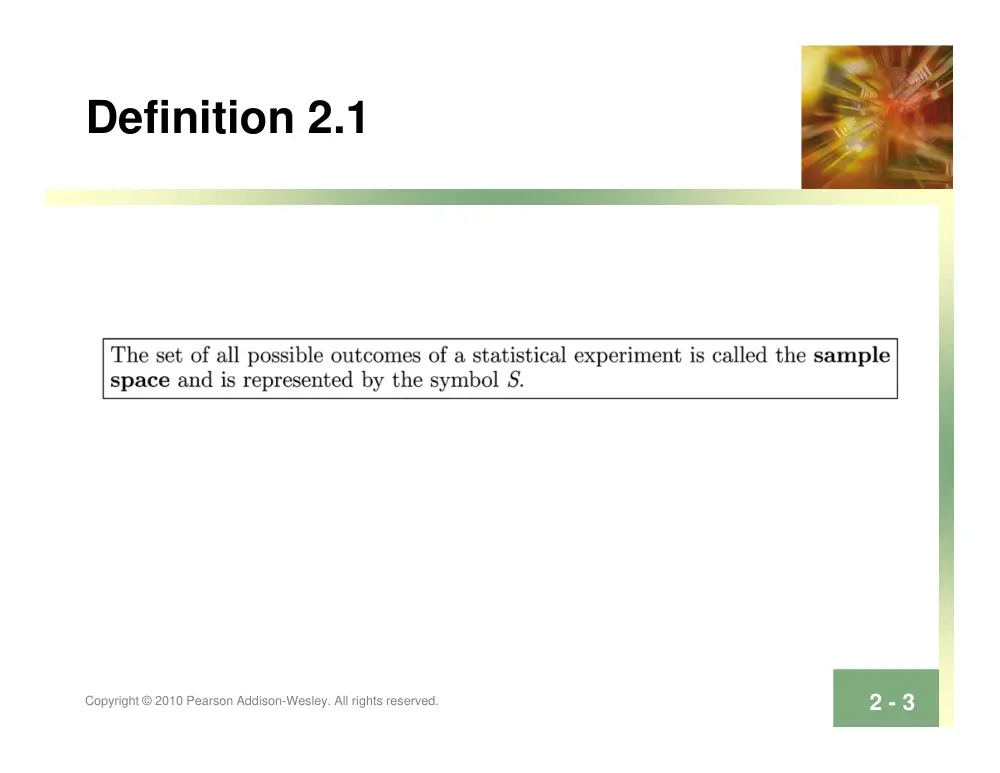
Definition 2.1
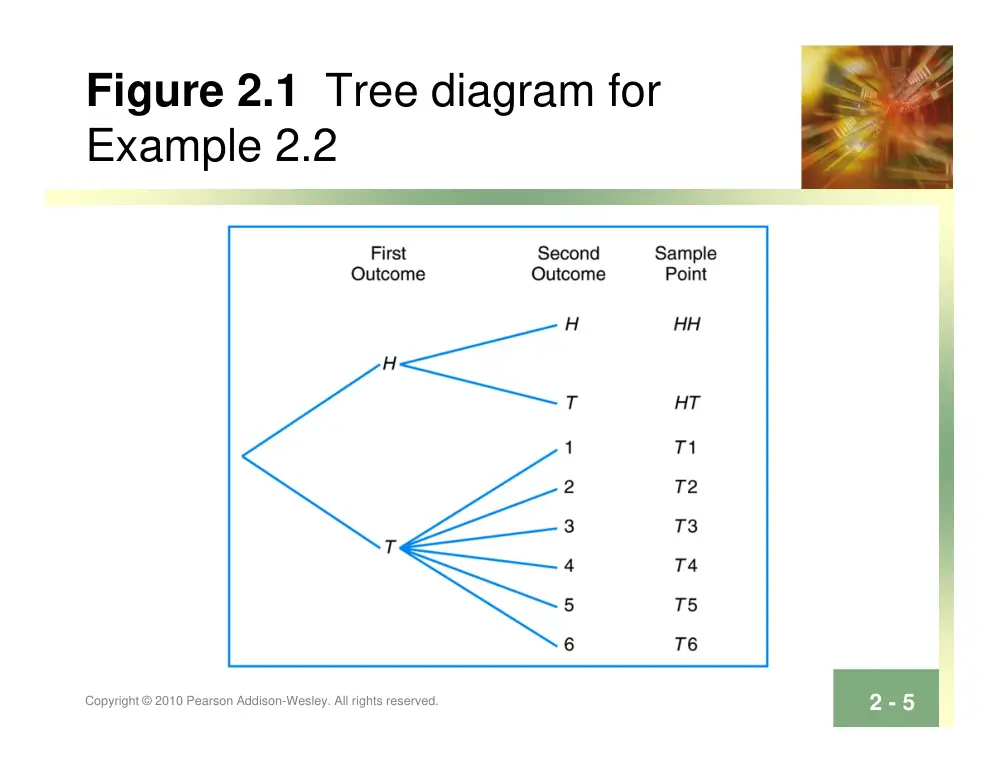
Example 2.2
An experiment consists of
• Flipping a coin, then
• Flip it again if the first one is heads, or
• Toss a die if the first toss is a tail
List the sample space
Copyright © 2010 Pearson Addison-Wesley. All rights reserved.
2 - 4
Copyright © 2010 Pearson Addison-Wesley. All rights reserved.
2 - 5
Figure 2.1 Tree diagram for
Example 2.2
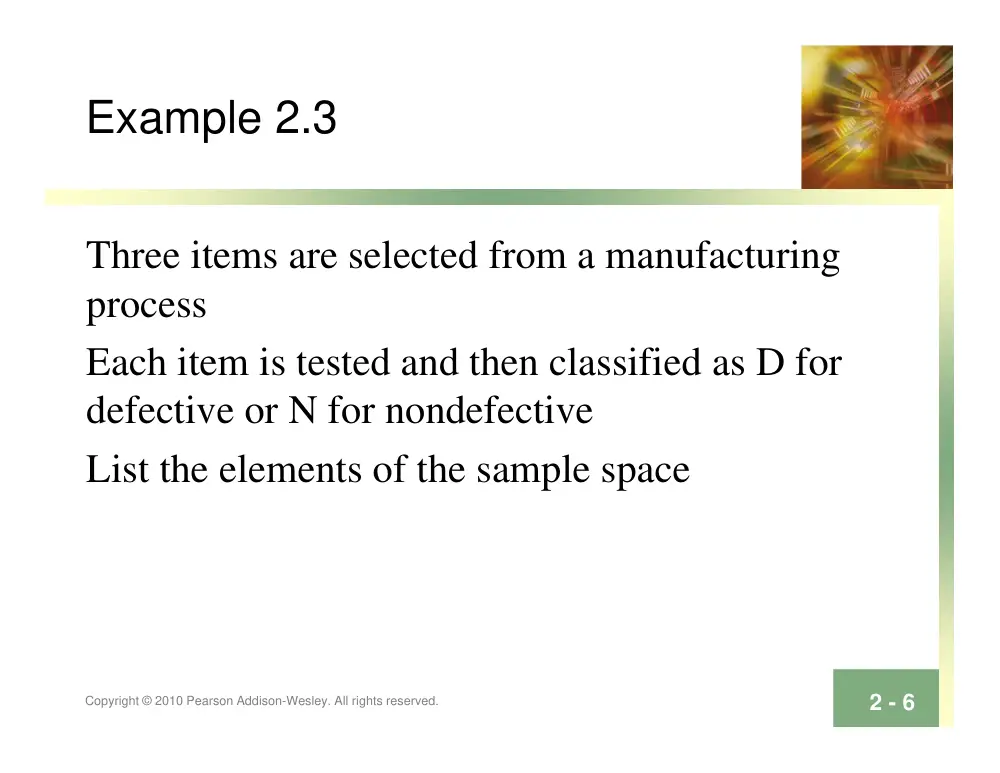
Example 2.3
Three items are selected from a manufacturing
process
Each item is tested and then classified as D for
defective or N for nondefective
List the elements of the sample space
Copyright © 2010 Pearson Addison-Wesley. All rights reserved.
2 - 6
Copyright © 2010 Pearson Addison-Wesley. All rights reserved.
2 - 7
Figure 2.2 Tree Diagram for
Example 2.3
Copyright © 2010 Pearson Addison-Wesley. All rights reserved.
Section 2.2
Events
Copyright © 2010 Pearson Addison-Wesley. All rights reserved.
2 - 9
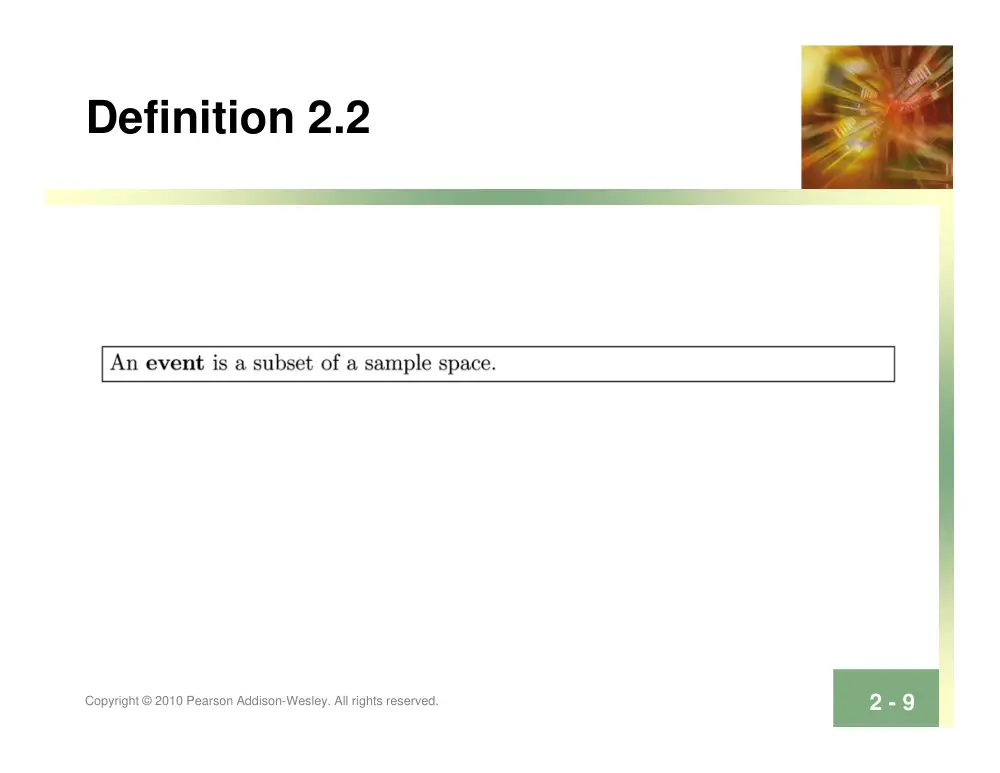
Definition 2.2
Copyright © 2010 Pearson Addison-Wesley. All rights reserved.
2 - 10
Definition 2.3
Copyright © 2010 Pearson Addison-Wesley. All rights reserved.
2 - 11
Definition 2.4
Copyright © 2010 Pearson Addison-Wesley. All rights reserved.
2 - 12
Definition 2.5
Copyright © 2010 Pearson Addison-Wesley. All rights reserved.
2 - 13
Definition 2.6
Copyright © 2010 Pearson Addison-Wesley. All rights reserved.
2 - 14
Figure 2.3 Events represented by
various regions
Copyright © 2010 Pearson Addison-Wesley. All rights reserved.
2 - 15
Figure 2.4 Events of the sample
space S
Copyright © 2010 Pearson Addison-Wesley. All rights reserved.
2 - 16
Figure 2.5 Venn diagram for
Exercises 2.19 and 2.20
Copyright © 2010 Pearson Addison-Wesley. All rights reserved.
Section 2.3
Counting Sample
Points
Copyright © 2010 Pearson Addison-Wesley. All rights reserved.
2 - 18
Rule 2.1
Example 2.14
• A developer of a a new subdivision offers
prospective home buyers a choice of Tudor,
rustic, colonial, and traditional exterior styling in
ranch, two-story, and split level floor plans.
• How many different choices does a buyer have?
Copyright © 2010 Pearson Addison-Wesley. All rights reserved.
2 - 19
Copyright © 2010 Pearson Addison-Wesley. All rights reserved.
2 - 20
Figure 2.6 Tree diagram for
Example 2.14
Copyright © 2010 Pearson Addison-Wesley. All rights reserved.
2 - 21
Rule 2.2
Copyright © 2010 Pearson Addison-Wesley. All rights reserved.
2 - 22
Definition 2.7
Copyright © 2010 Pearson Addison-Wesley. All rights reserved.
2 - 23
Definition 2.8
Copyright © 2010 Pearson Addison-Wesley. All rights reserved.
2 - 24
Theorem 2.1
Copyright © 2010 Pearson Addison-Wesley. All rights reserved.
2 - 25
Theorem 2.2
Copyright © 2010 Pearson Addison-Wesley. All rights reserved.
2 - 26
Theorem 2.3
Copyright © 2010 Pearson Addison-Wesley. All rights reserved.
2 - 27
Theorem 2.4
Copyright © 2010 Pearson Addison-Wesley. All rights reserved.
2 - 28
Theorem 2.5
Copyright © 2010 Pearson Addison-Wesley. All rights reserved.
2 - 29
Theorem 2.6
Exercise 2.36
a) How many digit numbers can be formed from
the digits 0, 1, 2, 3, 4, 5, and 6 if each digit can be
used only once?
b) How many of these are odd numbers?
c) How many are greater than 330?
Copyright © 2010 Pearson Addison-Wesley. All rights reserved.
2 - 30
Exercise 2.43
• In how many ways can 5 different trees be
planted in a circle?
Copyright © 2010 Pearson Addison-Wesley. All rights reserved.
2 - 31
Exercise 2.45
How many distinct permutations can be made
from the letters of the word:
• OPEN
• BOOK?
• INFINITY?
Copyright © 2010 Pearson Addison-Wesley. All rights reserved.
2 - 32
Exercise 2.46
• In how many ways can 3 oaks, 4 pines, and 2
maples be arranged along a property line if one
does not distinguish among trees of the same
kind?
Copyright © 2010 Pearson Addison-Wesley. All rights reserved.
2 - 33
Exercise 2.47
• How many ways are there to select 3 candidates
from 8 equally qualified recent graduates for
openings in an accounting firm?
Copyright © 2010 Pearson Addison-Wesley. All rights reserved.
2 - 34
Exercise 2.48
• How many ways are there hat no two students
will have the same birth date in a class of size
60?
Copyright © 2010 Pearson Addison-Wesley. All rights reserved.
2 - 35
Copyright © 2010 Pearson Addison-Wesley. All rights reserved.
Section 2.4
Probability of an
Event
Interpretations of Probability
Subjective probability: assigning a value based on
one’s belief of how likely a certain event (that can
not be repeated)
• What is the chance that Joe will marry Zoe?
• What is the chance that the current government
will stay until the end of its full term?
Copyright © 2010 Pearson Addison-Wesley. All rights reserved.
2 - 37
Interpretations of Probability
Frequentist’s probability:
• Repeat an experiment a large number N of times
• Let n(A) be the number of times that event A
was observed
• the chance of A is approximately n(A)/N
The law of large numbers says:
lim n(A)/N = P[A]
Copyright © 2010 Pearson Addison-Wesley. All rights reserved.
2 - 38
Copyright © 2010 Pearson Addison-Wesley. All rights reserved.
2 - 39
Definition 2.9
Copyright © 2010 Pearson Addison-Wesley. All rights reserved.
2 - 40
Rule 2.3
Example 2.28
• In a poker hand (i.e. five cards taken out of a
deck of 52 cards), find the probability of holding
2 aces and 3 jacks?
Copyright © 2010 Pearson Addison-Wesley. All rights reserved.
2 - 41
Example 2.28
• The number of ways we can choose 2 aces is 4C2
• The number of ways we can choose 3 jacks is
4C3
• The number of ways we can choose 3 jacks is
52C5
• Hence the required answer is
4C2*4C3 /52C5
Copyright © 2010 Pearson Addison-Wesley. All rights reserved.
2 - 42
Exercise
• In a poker hand, find the probability of holding
at least 2 aces?
Copyright © 2010 Pearson Addison-Wesley. All rights reserved.
2 - 43
Copyright © 2010 Pearson Addison-Wesley. All rights reserved.
Section 2.5
Additive Rules
Copyright © 2010 Pearson Addison-Wesley. All rights reserved.
2 - 45
Theorem 2.7
Copyright © 2010 Pearson Addison-Wesley. All rights reserved.
2 - 46
Figure 2.7 Additive rule of
probability
Copyright © 2010 Pearson Addison-Wesley. All rights reserved.
2 - 47
Corollary 2.1
Copyright © 2010 Pearson Addison-Wesley. All rights reserved.
2 - 48
Corollary 2.2
Copyright © 2010 Pearson Addison-Wesley. All rights reserved.
2 - 49
Corollary 2.3
Copyright © 2010 Pearson Addison-Wesley. All rights reserved.
2 - 50
Theorem 2.8
Copyright © 2010 Pearson Addison-Wesley. All rights reserved.
2 - 51
Theorem 2.9
Exercise 2.52
• In a senior class of 500 students, 210 smoke,
258 drink alcoholic beverages, 216 eat between
meals, 122 smoke and drink, 83 eat between
meals and drink, 97 smoke and eat between
meals. 52engage in all of these bad health
practices.
Find the probability that a randomly chosen
senior student:
Copyright © 2010 Pearson Addison-Wesley. All rights reserved.
2 - 52
Exercise 2.52
•
In a senior class of 500 students, 210 smoke, 258 drink alcoholic beverages,
216 eat between meals, 122 smoke and drink, 83 eat between meals and drink,
97 smoke and eat between meals. 52engage in all of these bad health
practices.
Find the probability that a randomly chosen senior student:
a) Smokes but does not drink
b) Eats between meals and drinks but does not
smoke
c) Neither smokes nor eats between meals
Copyright © 2010 Pearson Addison-Wesley. All rights reserved.
2 - 53
Copyright © 2010 Pearson Addison-Wesley. All rights reserved.
Section 2.6
Conditional
Probability,
Independence,
and the Product
Rule
Copyright © 2010 Pearson Addison-Wesley. All rights reserved.
2 - 3
Definition 2.10
Explanation of Def. 2.10
• Knowing that A is given, we know that the outcome
that was observed must be in A
• It follows that the new “reduced” sample space is A
(any outcome outside A becomes impossible)
• Then for B to occur, the outcome must be in both A and
B
• The division by P(A) must be done so that
P(A|A) = 1
Copyright © 2010 Pearson Addison-Wesley. All rights reserved.
2 - 4
Copyright © 2010 Pearson Addison-Wesley. All rights reserved.
2 - 5
Table 2.1 Categorization of the
Adults in a Small Town
Copyright © 2010 Pearson Addison-Wesley. All rights reserved.
2 - 6
Definition 2.11
Copyright © 2010 Pearson Addison-Wesley. All rights reserved.
2 - 7
Theorem 2.10
Example 2.37
• One bag contains 4 white balls and 3 black balls,
and a second bag contains 3 white balls and 5
black balls. One ball is drawn from the first ball
and placed unseen in the second bag. What is the
probability that a ball now drawn from the
second bag is black?
Copyright © 2010 Pearson Addison-Wesley. All rights reserved.
2 - 8