
STAT 230 Syllabus, Fall 2013
American University of Beirut · Introduction to Probability and Random Variables · 3 pages

More STAT 230 files
- Syllabus · Spring 2020LabView
- Lecture 4- Chapter 2.4 · Spring 2019LabView
- Lecture 4- Examples About Chapters 2.4 · Spring 2019LabView
- Lecture 2- Chapters 2.1 & 2.2 · Spring 2019LabView
- Lecture 1- Chapter 1 · Spring 2019LabView
- Lecture 3- Chapters 2.1, 2.2 & 2.4 · Spring 2019LabView
- Syllabus · Spring 2016LabView
- Lecture Chapter 1.1 · Summer 2015LabView
Show the text of this lab
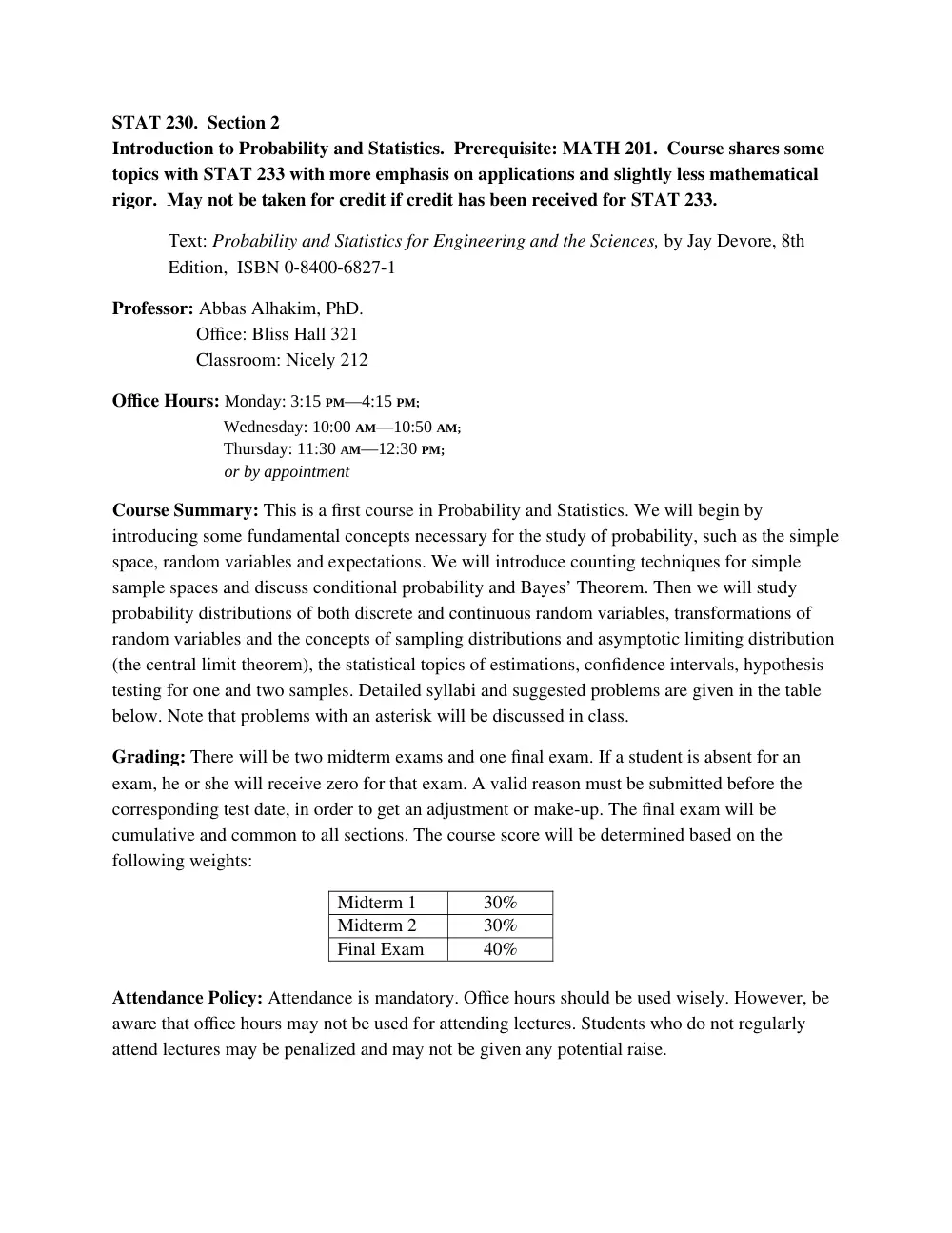
STAT 230. Section 2
Introduction to Probability and Statistics. Prerequisite: MATH 201. Course shares some
topics with STAT 233 with more emphasis on applications and slightly less mathematical
rigor. May not be taken for credit if credit has been received for STAT 233.
Text: Probability and Statistics for Engineering and the Sciences, by Jay Devore, 8th
Edition, ISBN 0-8400-6827-1
Professor: Abbas Alhakim, PhD.
Office: Bliss Hall 321
Classroom: Nicely 212
Office Hours: Monday: 3:15 PM—4:15 PM;
Wednesday: 10:00 AM—10:50 AM;
Thursday: 11:30 AM—12:30 PM;
or by appointment
Course Summary: This is a first course in Probability and Statistics. We will begin by
introducing some fundamental concepts necessary for the study of probability, such as the simple
space, random variables and expectations. We will introduce counting techniques for simple
sample spaces and discuss conditional probability and Bayes’ Theorem. Then we will study
probability distributions of both discrete and continuous random variables, transformations of
random variables and the concepts of sampling distributions and asymptotic limiting distribution
(the central limit theorem), the statistical topics of estimations, confidence intervals, hypothesis
testing for one and two samples. Detailed syllabi and suggested problems are given in the table
below. Note that problems with an asterisk will be discussed in class.
Grading: There will be two midterm exams and one final exam. If a student is absent for an
exam, he or she will receive zero for that exam. A valid reason must be submitted before the
corresponding test date, in order to get an adjustment or make-up. The final exam will be
cumulative and common to all sections. The course score will be determined based on the
following weights:
Midterm 1
30%
Midterm 2
30%
Final Exam
40%
Attendance Policy: Attendance is mandatory. Office hours should be used wisely. However, be
aware that office hours may not be used for attending lectures. Students who do not regularly
attend lectures may be penalized and may not be given any potential raise.
Detailed (tentative) Syllabi: only sections that are listed below are covered during the semester.
Recommended problems are given next to each section. Problems with an asterisk next to them
will be discussed in class. Note the dates of the exams, specific time and location of each exam
will be announced by the instructor.
Week Section(s) Topics (recommended problems)
1
1.1
Basics, samples etc.
1.2
Summarizing data; graphic representations (11*, 22*)
1.3
Measures of location/central tendency (33*, 44*)
2
1.4
Measures of variability (46, 49, 52*, 58*, 61)
2.1
Sample space and events (2*, 3*, 5, 6, 9*)
2.2
Axioms and properties of probability (11, 12, 13*, 15*, 16, 17, 18*, 19,
20, 21, 24*, 26)
2.3
Counting techniques (29*, 31*, 32, 33, 35, 42*, 43, 44)
3
2.4
Conditional probability (45*, 46*, 47, 50, 51*, 54, 55, 56, 57, 59, 60, 61,
62, 63*, 67*)
2.5
Independence of events (70, 71*, 73*, 74*, 77, 78, 80, 83*, 86, 87)
3.1
Random variables (1—10)
4
3.2
Discrete probability distributions (12, 13, 15, 17, 21, 23, 24)
3.3
Expected values (29--35, 36, 39, 40, 41, 44, 45)
3.4
Binomial random variable (47, 49, 50, 55, 56, 57)
3.5
Hypergeometric and negative binomial distributions ( 68, 70, 73, 75, 76,
77)
3.6
The Poisson distribution and the Poisson process (80, , 81, 82, 83, 84, 86,
87, 88, 91, 92, 93)
Exam 1 (Oct. 1) Chapters 1 – 3
5
4.1
Probability density functions(1,2,3,4,9,10)
4.2
Cumulative distribution functions (11, 12, 13, 17, 19, 23, 24, 27)
4.3
The normal distribution(28--31, 34, 36, 37, 39, 40, 43, 53)
6
4.4
the exponential and gamma distribution(59, 60, 61, 63--66, 68—71)
5.1
Jointly distributed random variables(1,2,3,6,9,10,12,15,17)
5.2
Expected Values, Covariance and Correlation(22--24, 26--29, 31—35)
7
5.3
Statistics and their distributions(37, 38, 40, 43)
5.4
The distribution of the sample mean(46 , 47, 49, 50, 51, 52, 53, 56*)
8
5.5
The distribution of a linear combination (58, 59, 60, 61, 63)
6.1
Point Estimation( 1,2,3,4,8,15)
9
6.2
Methods of Point Estimation (21, 22a)
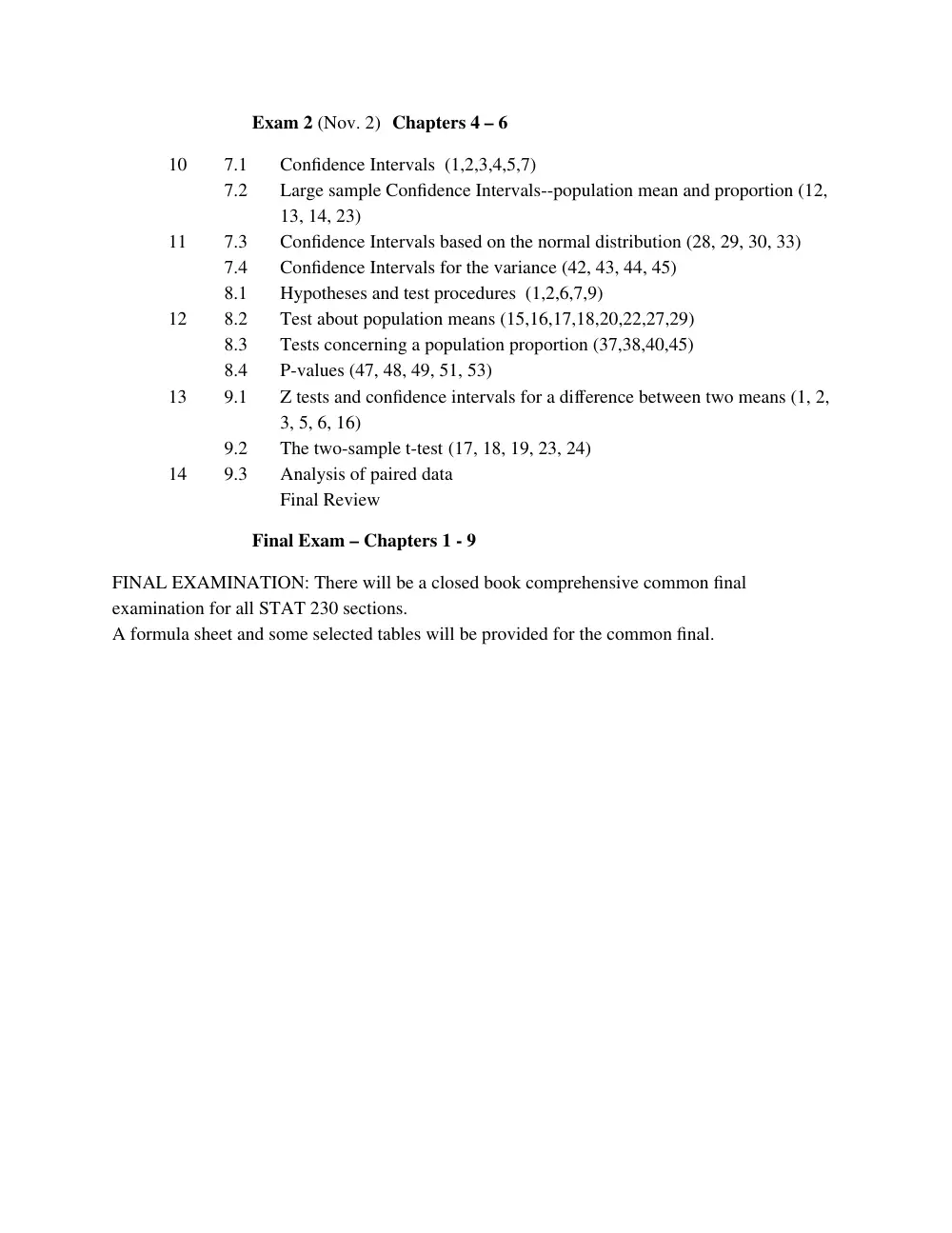
Exam 2 (Nov. 2) Chapters 4 – 6
10
7.1
Confidence Intervals (1,2,3,4,5,7)
7.2
Large sample Confidence Intervals--population mean and proportion (12,
13, 14, 23)
11
7.3
Confidence Intervals based on the normal distribution (28, 29, 30, 33)
7.4
Confidence Intervals for the variance (42, 43, 44, 45)
8.1
Hypotheses and test procedures (1,2,6,7,9)
12
8.2
Test about population means (15,16,17,18,20,22,27,29)
8.3
Tests concerning a population proportion (37,38,40,45)
8.4
P-values (47, 48, 49, 51, 53)
13
9.1
Z tests and confidence intervals for a difference between two means (1, 2,
3, 5, 6, 16)
9.2
The two-sample t-test (17, 18, 19, 23, 24)
14
9.3
Analysis of paired data
Final Review
Final Exam – Chapters 1 - 9
FINAL EXAMINATION: There will be a closed book comprehensive common final
examination for all STAT 230 sections.
A formula sheet and some selected tables will be provided for the common final.