
COE 212 Final, Spring 2013
Lebanese American University · Engineering Programming · 15 pages · Dr. George Sakr

Showing the first 10 of 15 pages. Download the PDF to see all of it.
More COE 212 files
- Final · Fall 2016Final examView
- Exam Final Exam · Fall 2015Final examView
- Final Exam · Spring 2013Final examView
- Problems Final · Spring 2013Final examView
- Final · Spring 2013Final examView
- Final + Solutions · Spring 2012Final exam · with solutionView
- Final · Fall 2012Final examView
- Final Exam · Fall 2012Final examView
Show the text of this final exam
COE 211/COE 212 – Computer
Programming/Engineering Programming
Welcome to
The Comprehensive Final Exam
Monday June 04 2012
Instructor: Dr.Wissam F. Fawaz
Dr. Georges Sakr
Name: _______________________
Student ID: ________________
Instructions:
1. This exam is Closed Book. Please do not forget to write your
name and ID on the first page.
2. You have exactly 150 minutes to complete the eight required
problems.
3. Read each problem carefully. If something appears
ambiguous, please write your assumptions.
4. Do not get bogged-down on any one problem, you will have
to work fast to complete this exam.
5. Put your answers in the space provided only. No other spaces
will be graded or even looked at.
Good Luck!!
1
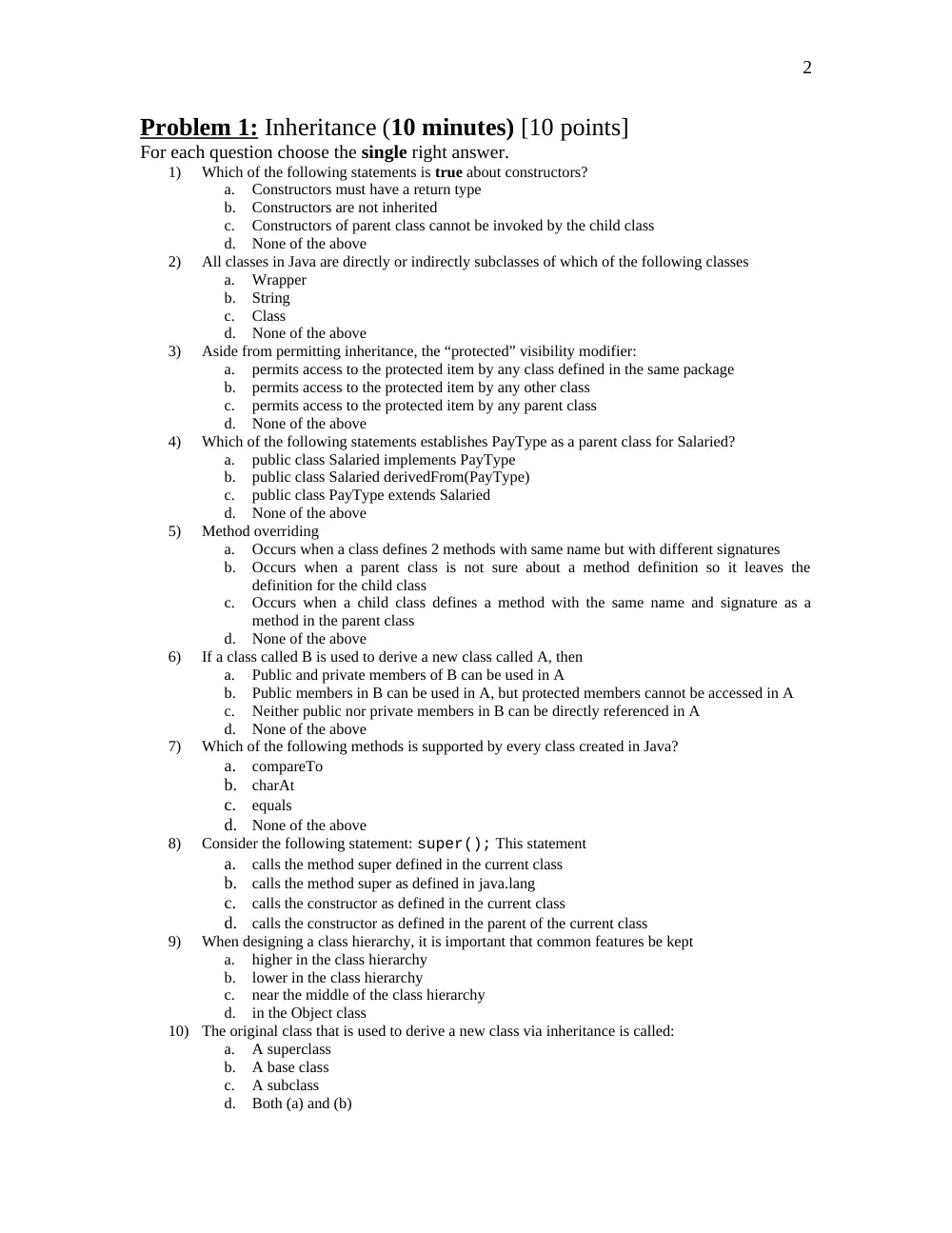
Problem 1: Inheritance (10 minutes) [10 points]
For each question choose the single right answer.
1)
Which of the following statements is true about constructors?
a.
Constructors must have a return type
b.
Constructors are not inherited
c.
Constructors of parent class cannot be invoked by the child class
d.
None of the above
2)
All classes in Java are directly or indirectly subclasses of which of the following classes
a.
Wrapper
b.
String
c.
Class
d.
None of the above
3)
Aside from permitting inheritance, the “protected” visibility modifier:
a.
permits access to the protected item by any class defined in the same package
b.
permits access to the protected item by any other class
c.
permits access to the protected item by any parent class
d.
None of the above
4)
Which of the following statements establishes PayType as a parent class for Salaried?
a.
public class Salaried implements PayType
b.
public class Salaried derivedFrom(PayType)
c.
public class PayType extends Salaried
d.
None of the above
5)
Method overriding
a.
Occurs when a class defines 2 methods with same name but with different signatures
b.
Occurs when a parent class is not sure about a method definition so it leaves the
definition for the child class
c.
Occurs when a child class defines a method with the same name and signature as a
method in the parent class
d.
None of the above
6)
If a class called B is used to derive a new class called A, then
a.
Public and private members of B can be used in A
b.
Public members in B can be used in A, but protected members cannot be accessed in A
c.
Neither public nor private members in B can be directly referenced in A
d.
None of the above
7)
Which of the following methods is supported by every class created in Java?
a.
compareTo
b.
charAt
c.
equals
d.
None of the above
8)
Consider the following statement: super(); This statement
a.
calls the method super defined in the current class
b.
calls the method super as defined in java.lang
c.
calls the constructor as defined in the current class
d.
calls the constructor as defined in the parent of the current class
9)
When designing a class hierarchy, it is important that common features be kept
a.
higher in the class hierarchy
b.
lower in the class hierarchy
c.
near the middle of the class hierarchy
d.
in the Object class
10)
The original class that is used to derive a new class via inheritance is called:
a.
A superclass
b.
A base class
c.
A subclass
d.
Both (a) and (b)
2
Problem 2: Arrays (15 minutes) [11 points]
For each question choose the single right answer.
1)
Which of the following statements prints the third command line argument out?
a.
System.out.println(args[3]);
b. System.out.println(args[2]);
c.
System.out.println(args[1]);
d.
None of the above
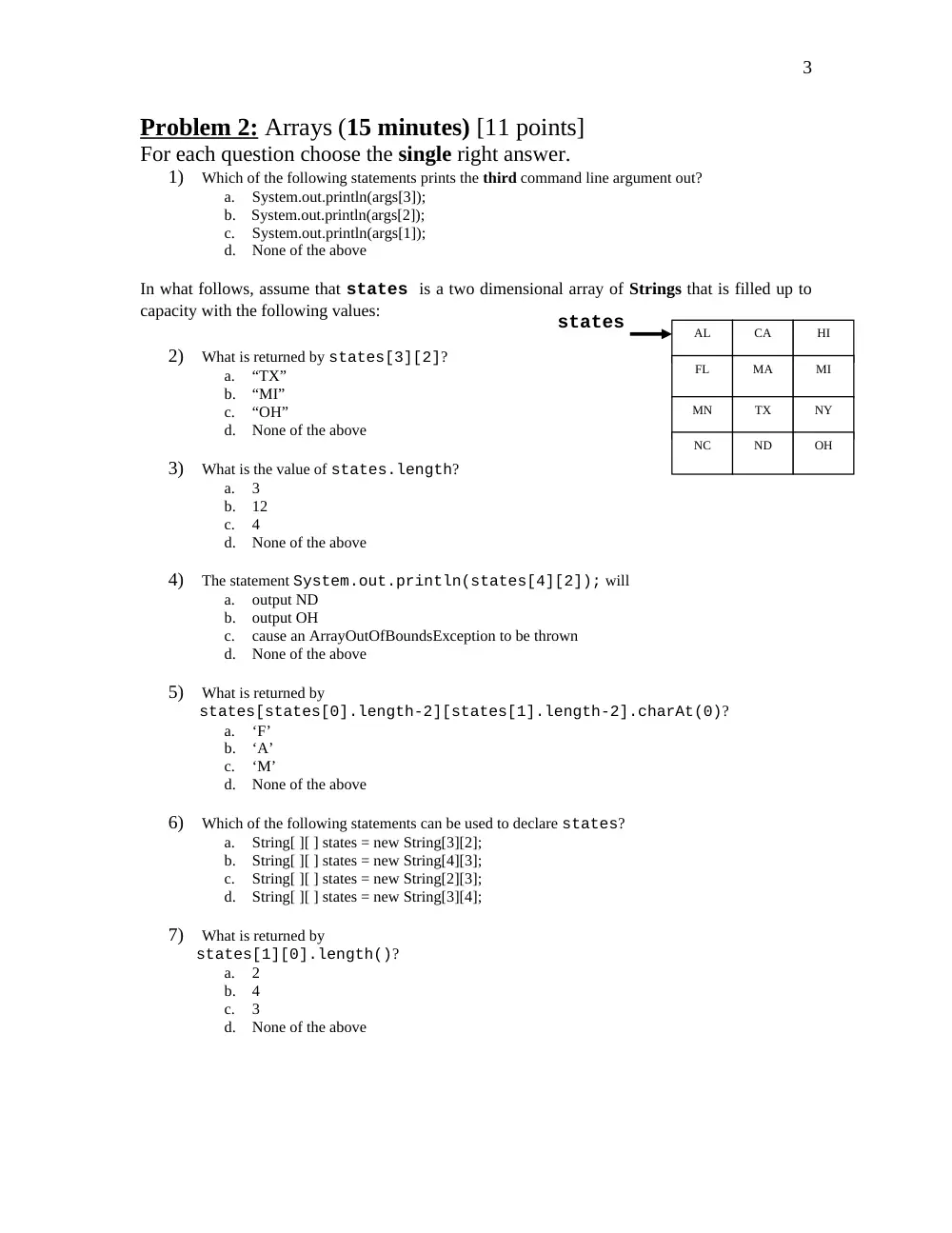
In what follows, assume that states is a two dimensional array of Strings that is filled up to
capacity with the following values:
2)
What is returned by states[3][2]?
a.
“TX”
b.
“MI”
c.
“OH”
d.
None of the above
3)
What is the value of states.length?
a.
3
b.
12
c.
4
d.
None of the above
4)
The statement System.out.println(states[4][2]); will
a.
output ND
b.
output OH
c.
cause an ArrayOutOfBoundsException to be thrown
d.
None of the above
5)
What is returned by
states[states[0].length-2][states[1].length-2].charAt(0)?
a.
‘F’
b.
‘A’
c.
‘M’
d.
None of the above
6)
Which of the following statements can be used to declare states?
a.
String[ ][ ] states = new String[3][2];
b.
String[ ][ ] states = new String[4][3];
c.
String[ ][ ] states = new String[2][3];
d.
String[ ][ ] states = new String[3][4];
7)
What is returned by
states[1][0].length()?
a.
2
b.
4
c.
3
d.
None of the above
3
states
AL
CA
HI
FL
MA
MI
MN
TX
NY
NC
ND
OH
int[] zip = new int[4];
zip[0] = 7;
zip[1] = 1;
zip[2] = 4;
int j = zip[1];
System.out.println(zip[j+1]+zip[3]);
int[] data = {0, 3, 7, 9, 12, 14};
System.out.println(data[data[1]]);
int[] arr = new int[5];
int j = 2;
arr[0] = 4;
arr[1] = 5;
arr[2] = 6;
arr[3] = 7;
int j = arr[j];
System.out.println(arr[(int)Math.floor((j+1)/2.0)]);
ArrayList players = new ArrayList();
players.add(“Messi”); players.add(“Ronaldo”);
int location = players.indexOf(“Messi”);
players.add(location, “Rooney”);
players.add(“Zidane”);
players.remove(1);
System.out.println(players.get(2));
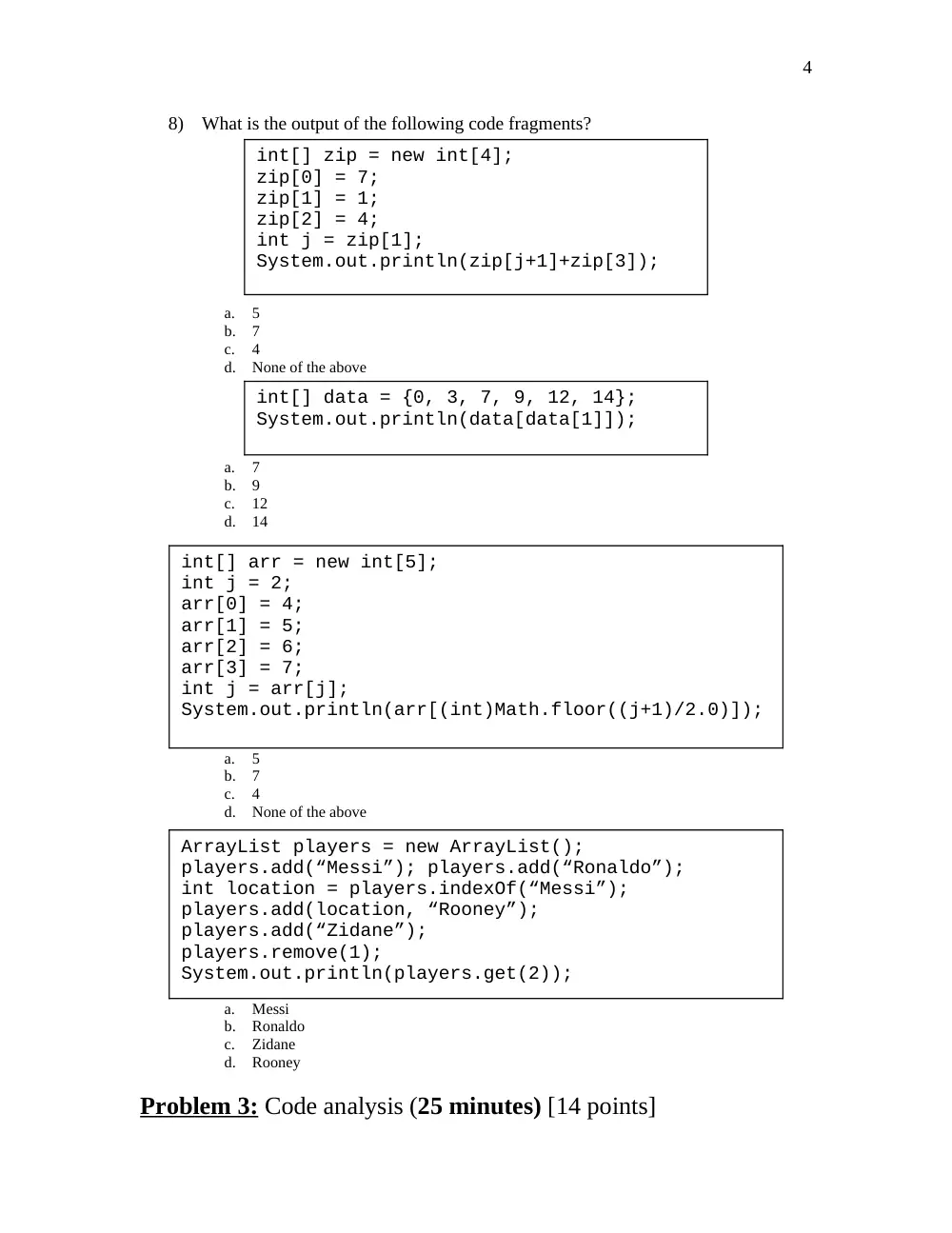
8)
What is the output of the following code fragments?
a.
5
b.
7
c.
4
d.
None of the above
a.
7
b.
9
c.
12
d.
14
a.
5
b.
7
c.
4
d.
None of the above
a.
Messi
b.
Ronaldo
c.
Zidane
d.
Rooney
Problem 3: Code analysis (25 minutes) [14 points]
4
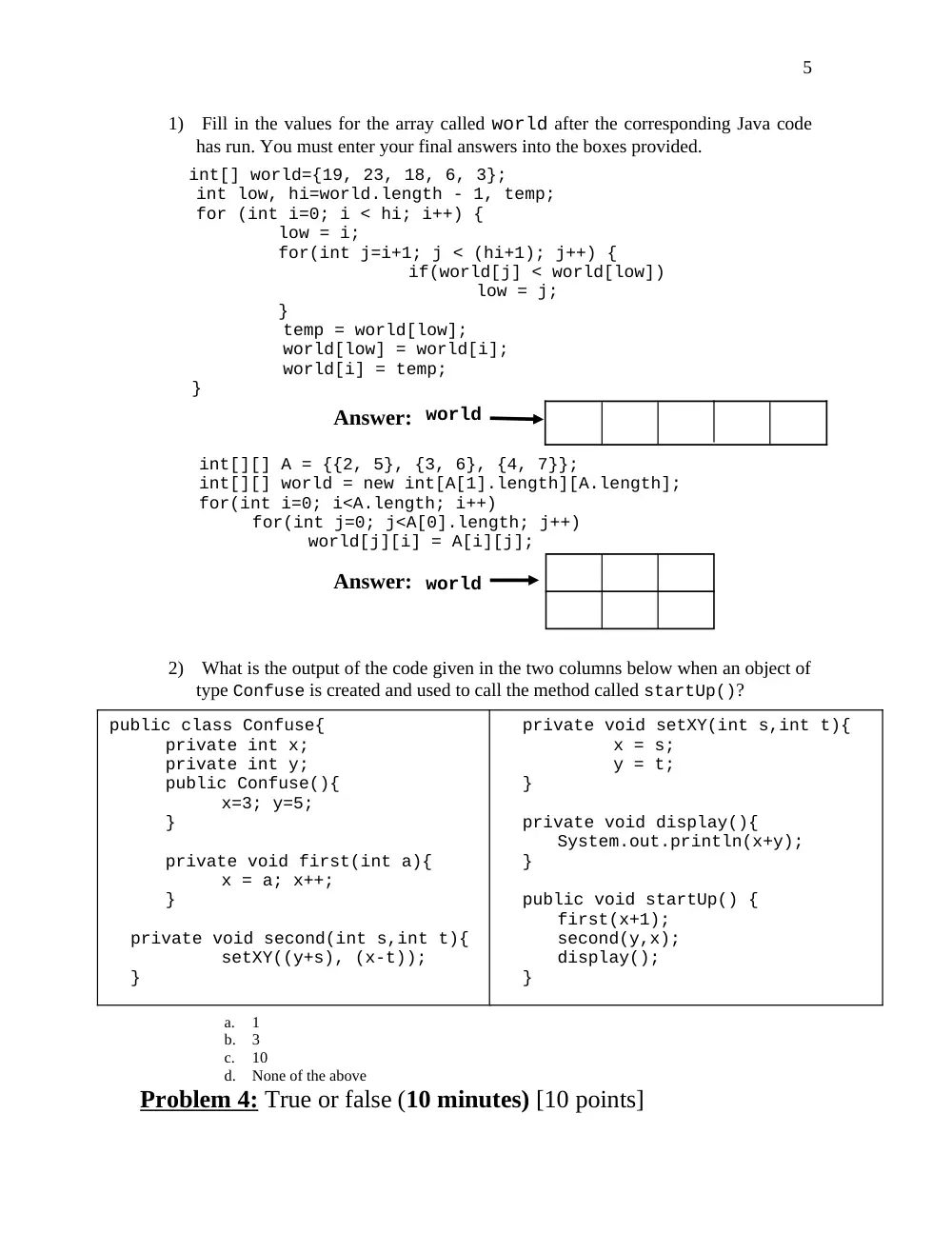
1)
Fill in the values for the array called world after the corresponding Java code
has run. You must enter your final answers into the boxes provided.
int[] world={19, 23, 18, 6, 3};
int low, hi=world.length - 1, temp;
for (int i=0; i < hi; i++) {
low = i;
for(int j=i+1; j < (hi+1); j++) {
if(world[j] < world[low])
low = j;
}
temp = world[low];
world[low] = world[i];
world[i] = temp;
}
int[][] A = {{2, 5}, {3, 6}, {4, 7}};
int[][] world = new int[A[1].length][A.length];
for(int i=0; i<A.length; i++)
for(int j=0; j<A[0].length; j++)
world[j][i] = A[i][j];
2)
What is the output of the code given in the two columns below when an object of
type Confuse is created and used to call the method called startUp()?
a.
1
b.
3
c.
10
d.
None of the above
Problem 4: True or false (10 minutes) [10 points]
5
world
Answer:
Answer: world
public class Confuse{
private int x;
private int y;
public Confuse(){
x=3; y=5;
}
private void first(int a){
x = a; x++;
}
private void second(int s,int t){
setXY((y+s), (x-t));
}
private void setXY(int s,int t){
x = s;
y = t;
}
private void display(){
System.out.println(x+y);
}
public void startUp() {
first(x+1);
second(y,x);
display();
}
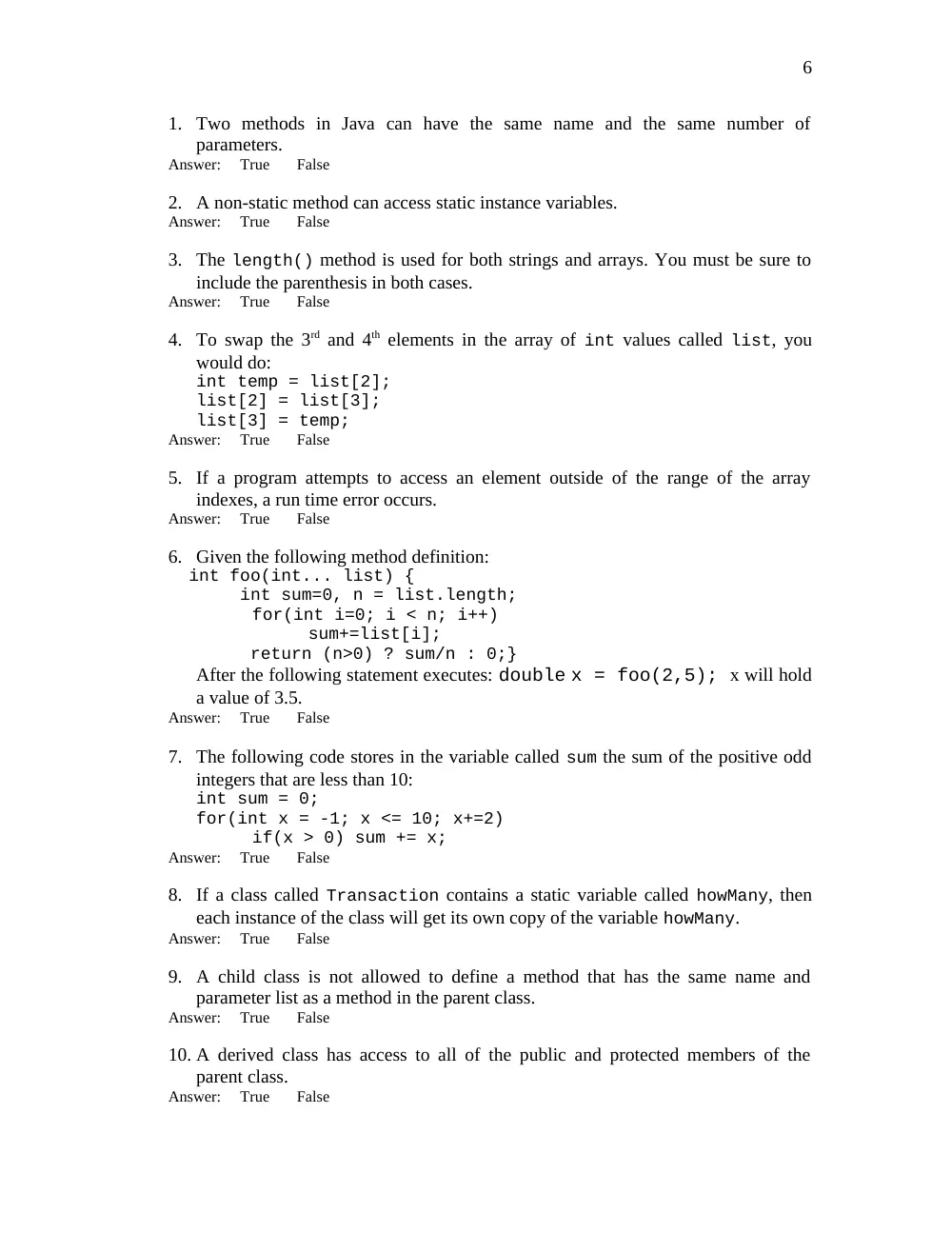
1. Two methods in Java can have the same name and the same number of
parameters.
Answer: True False
2. A non-static method can access static instance variables.
Answer: True False
3. The length() method is used for both strings and arrays. You must be sure to
include the parenthesis in both cases.
Answer: True False
4. To swap the 3rd and 4th elements in the array of int values called list, you
would do:
int temp = list[2];
list[2] = list[3];
list[3] = temp;
Answer: True False
5. If a program attempts to access an element outside of the range of the array
indexes, a run time error occurs.
Answer: True False
6. Given the following method definition:
int foo(int... list) {
int sum=0, n = list.length;
for(int i=0; i < n; i++)
sum+=list[i];
return (n>0) ? sum/n : 0;}
After the following statement executes: double x = foo(2,5); x will hold
a value of 3.5.
Answer: True False
7. The following code stores in the variable called sum the sum of the positive odd
integers that are less than 10:
int sum = 0;
for(int x = -1; x <= 10; x+=2)
if(x > 0) sum += x;
Answer: True False
8. If a class called Transaction contains a static variable called howMany, then
each instance of the class will get its own copy of the variable howMany.
Answer: True False
9. A child class is not allowed to define a method that has the same name and
parameter list as a method in the parent class.
Answer: True False
10. A derived class has access to all of the public and protected members of the
parent class.
Answer: True False
6
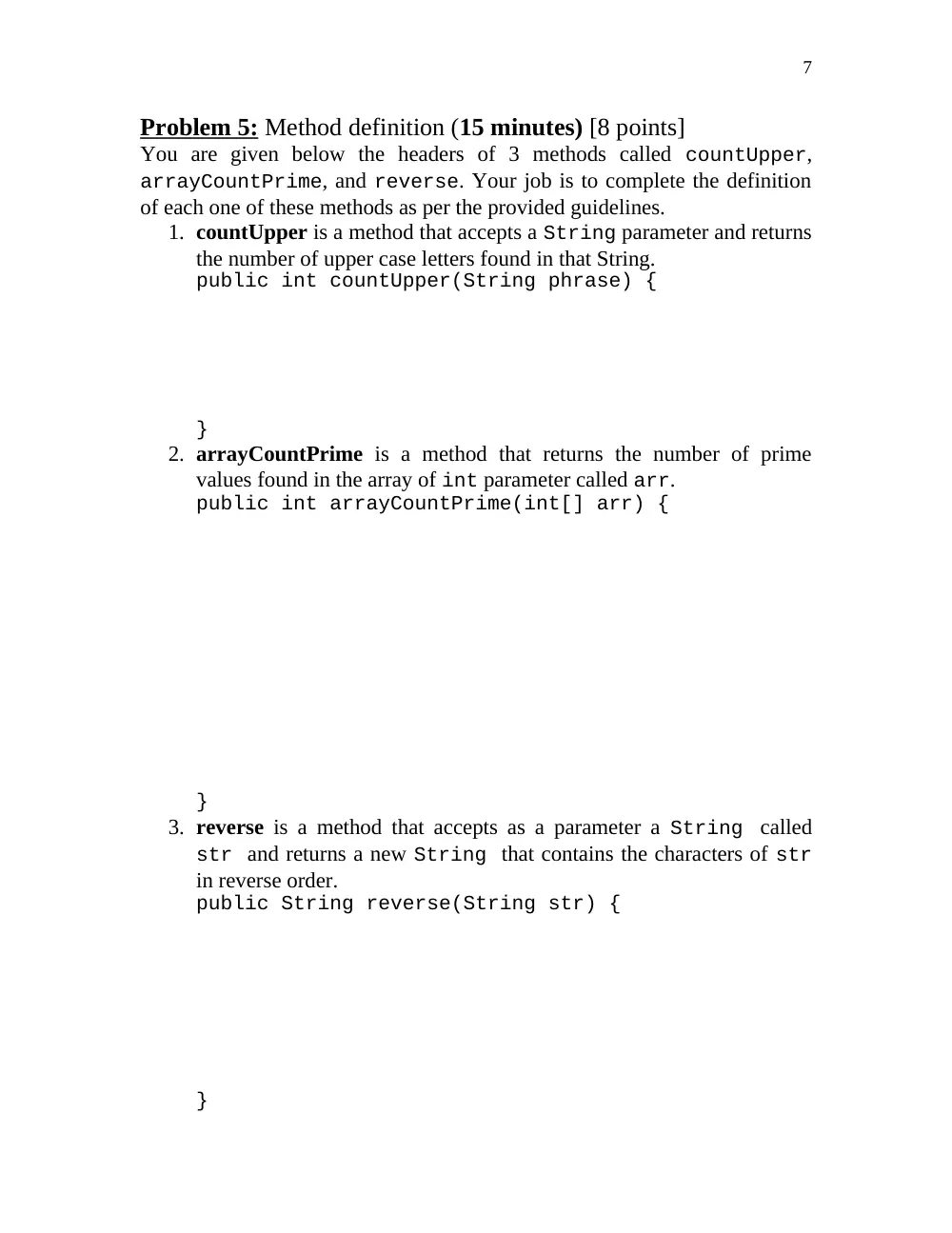
Problem 5: Method definition (15 minutes) [8 points]
You are given below the headers of 3 methods called countUpper,
arrayCountPrime, and reverse. Your job is to complete the definition
of each one of these methods as per the provided guidelines.
1. countUpper is a method that accepts a String parameter and returns
the number of upper case letters found in that String.
public int countUpper(String phrase) {
}
2. arrayCountPrime is a method that returns the number of prime
values found in the array of int parameter called arr.
public int arrayCountPrime(int[] arr) {
}
3. reverse is a method that accepts as a parameter a String called
str and returns a new String that contains the characters of str
in reverse order.
public String reverse(String str) {
}
7
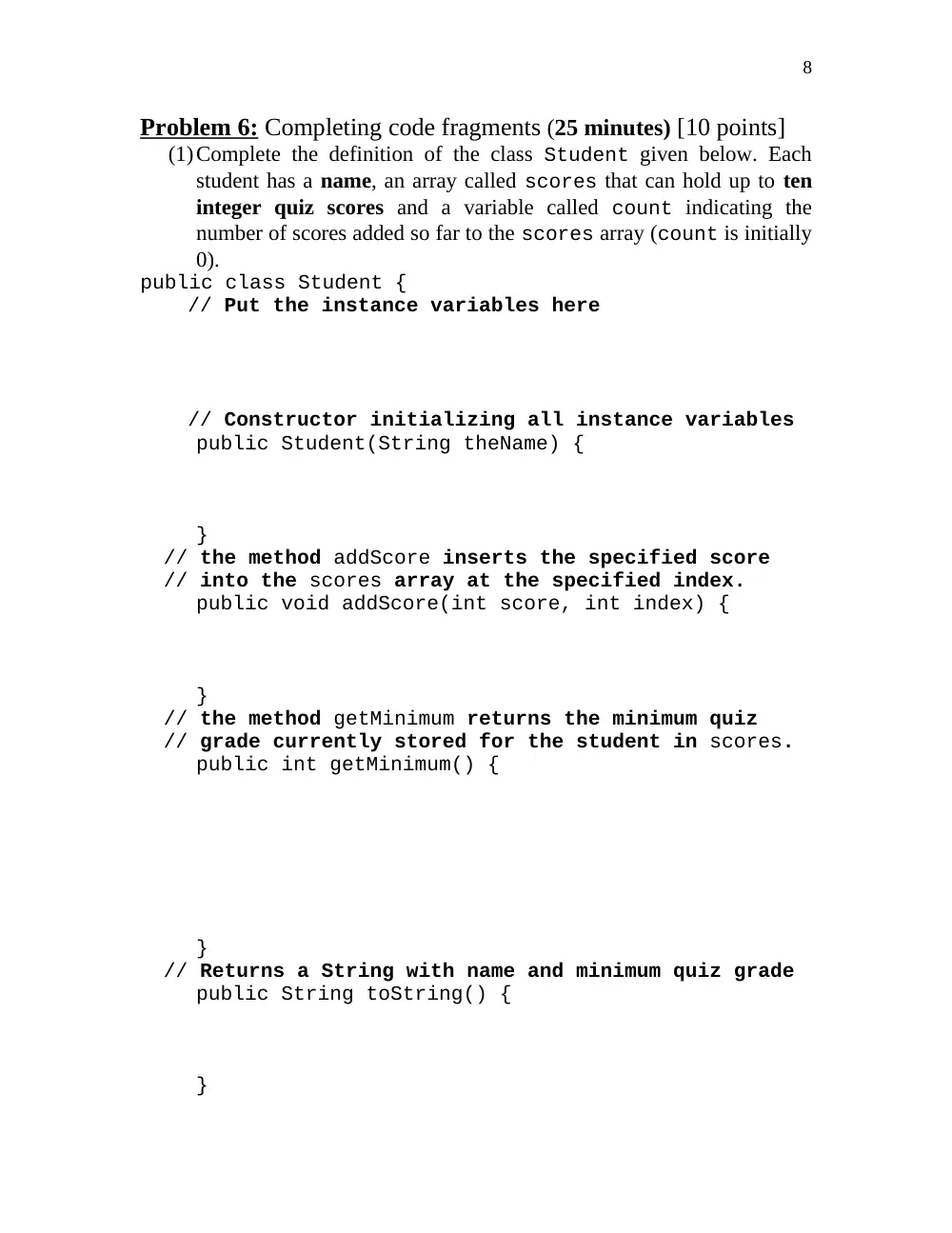
Problem 6: Completing code fragments (25 minutes) [10 points]
(1)Complete the definition of the class Student given below. Each
student has a name, an array called scores that can hold up to ten
integer quiz scores and a variable called count indicating the
number of scores added so far to the scores array (count is initially
0).
public class Student {
// Put the instance variables here
// Constructor initializing all instance variables
public Student(String theName) {
}
// the method addScore inserts the specified score
// into the scores array at the specified index.
public void addScore(int score, int index) {
}
// the method getMinimum returns the minimum quiz
// grade currently stored for the student in scores.
public int getMinimum() {
}
// Returns a String with name and minimum quiz grade
public String toString() {
}
8
}// end Student
Problem 6 continued:
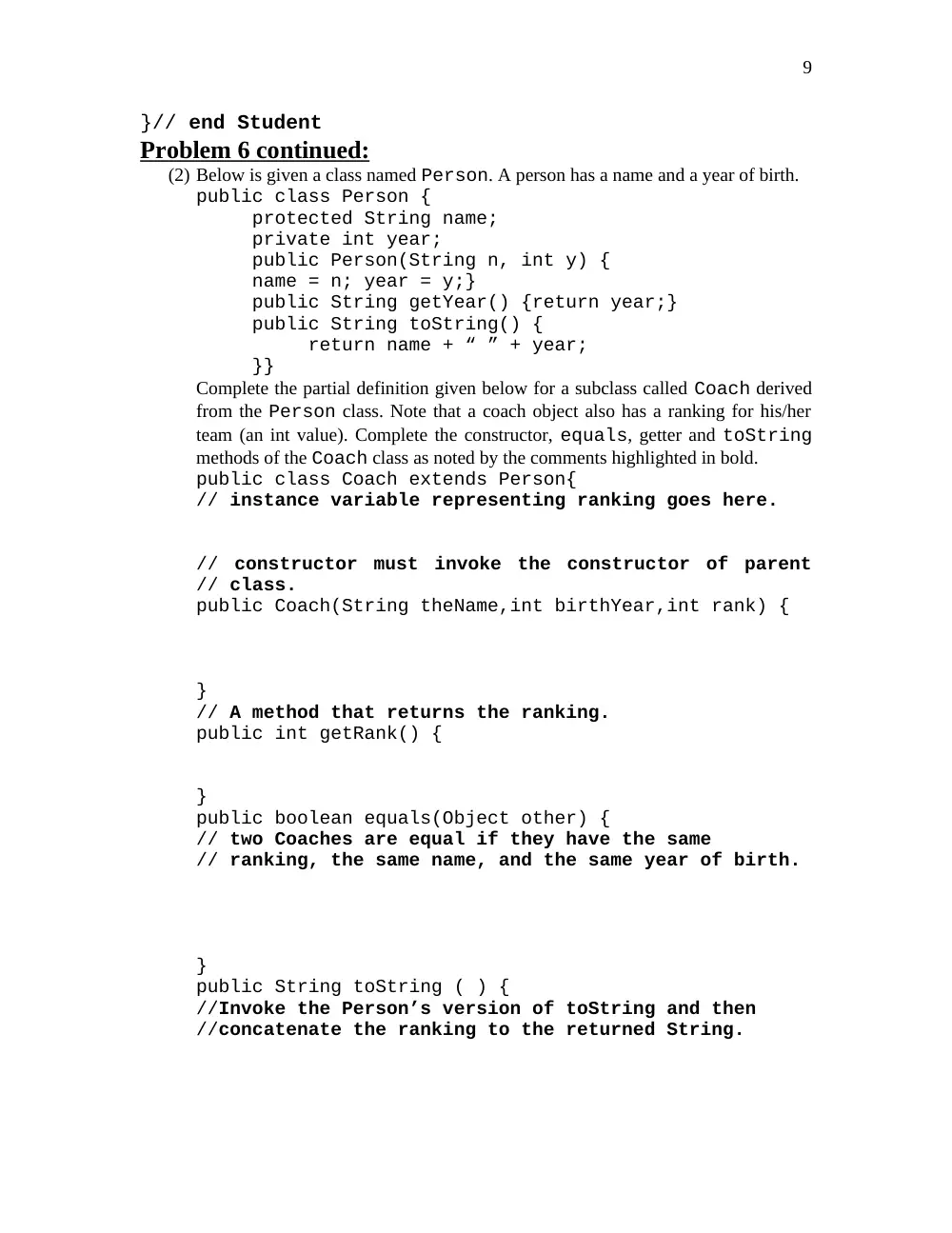
(2) Below is given a class named Person. A person has a name and a year of birth.
public class Person {
protected String name;
private int year;
public Person(String n, int y) {
name = n; year = y;}
public String getYear() {return year;}
public String toString() {
return name + “ ” + year;
}}
Complete the partial definition given below for a subclass called Coach derived
from the Person class. Note that a coach object also has a ranking for his/her
team (an int value). Complete the constructor, equals, getter and toString
methods of the Coach class as noted by the comments highlighted in bold.
public class Coach extends Person{
// instance variable representing ranking goes here.
// constructor must invoke the constructor of parent
// class.
public Coach(String theName,int birthYear,int rank) {
}
// A method that returns the ranking.
public int getRank() {
}
public boolean equals(Object other) {
// two Coaches are equal if they have the same
// ranking, the same name, and the same year of birth.
}
public String toString ( ) {
//Invoke the Person’s version of toString and then
//concatenate the ranking to the returned String.
9
}}
10
Problem 7: Writing code segments (15 minutes) [7 points]
Write each of the Java code segments requested below.
Example: write a one-line statement declaring a string storing your name.
Answer: String name = “wissam”;
a) Write a one-line statement that defines the header of a method called
average accepting a one-dimensional array of integers.
b) Write a one-line statement declaring, creating, and initializing the
following two-dimensional array of temperatures:
c) Write one or more Java statements to print each of the values stored
in the array temps (from part (b)) on a separate line.
d) Write one or more Java statements to print the smallest number
found in the array temps (from part (b)).
e) Write a code segment to define a method called avgMatrix that
receives a two-dimensional array of int values and returns their
average.
11
Problem 8: Coding (35 minutes) [30 points]
1. Write a Java program that reads ten integers from the user. Your code should
compute their average and should output how many of the input numbers are
strictly greater than the computed average.
12
2. Write a Java program that loads 200 random integers between 0 and 99 and then
sorts the elements of the array in an ascending order before displaying the sorted
version of the array on the screen.
13
3. Write a Java program called binaryToDecimal that reads from the user a string
consisting of a sequence of ‘0’ and ‘1’ characters. The obtained string is a binary
representation of a decimal (base-10) integer number. Display on the screen the
decimal integer value corresponding to that input string. Recall that the binary
number system is also called the base-2 number system and has only two digits to
represent values, namely ‘0’ and ‘1’. So, for example, 1100 which is a binary
number
is
equivalent
to
12
in
decimal
since:
(1100)2=1*23+1*22+0*21+0*20=(12)10
Sample output:
Enter a binary value: 110
The integer corresponding to “110” is: 6
14
4. Consider a three-dimensional array of the form
Write a Java program which finds the transpose of A denoted by AT. Note that AT can be
derived from A by interchanging the rows and columns of A. That is, the rows of A
become the columns of AT and the columns of A become the rows of AT.
Note that the program should read the values of a, b, c, d, e, f, g, h, and i from the user
and then display the entries of AT in a table format with 3 rows and 3 columns.
15