
COE 212 Final, Spring 2013
Lebanese American University · Engineering Programming · 14 pages · Dr. George Sakr

Showing the first 10 of 14 pages. Download the PDF to see all of it.
More COE 212 files
- Final · Fall 2016Final examView
- Exam Final Exam · Fall 2015Final examView
- Final Exam · Spring 2013Final examView
- Problems Final · Spring 2013Final examView
- Final · Spring 2013Final examView
- Final + Solutions · Spring 2012Final exam · with solutionView
- Final · Fall 2012Final examView
- Final Exam · Fall 2012Final examView
Show the text of this final exam
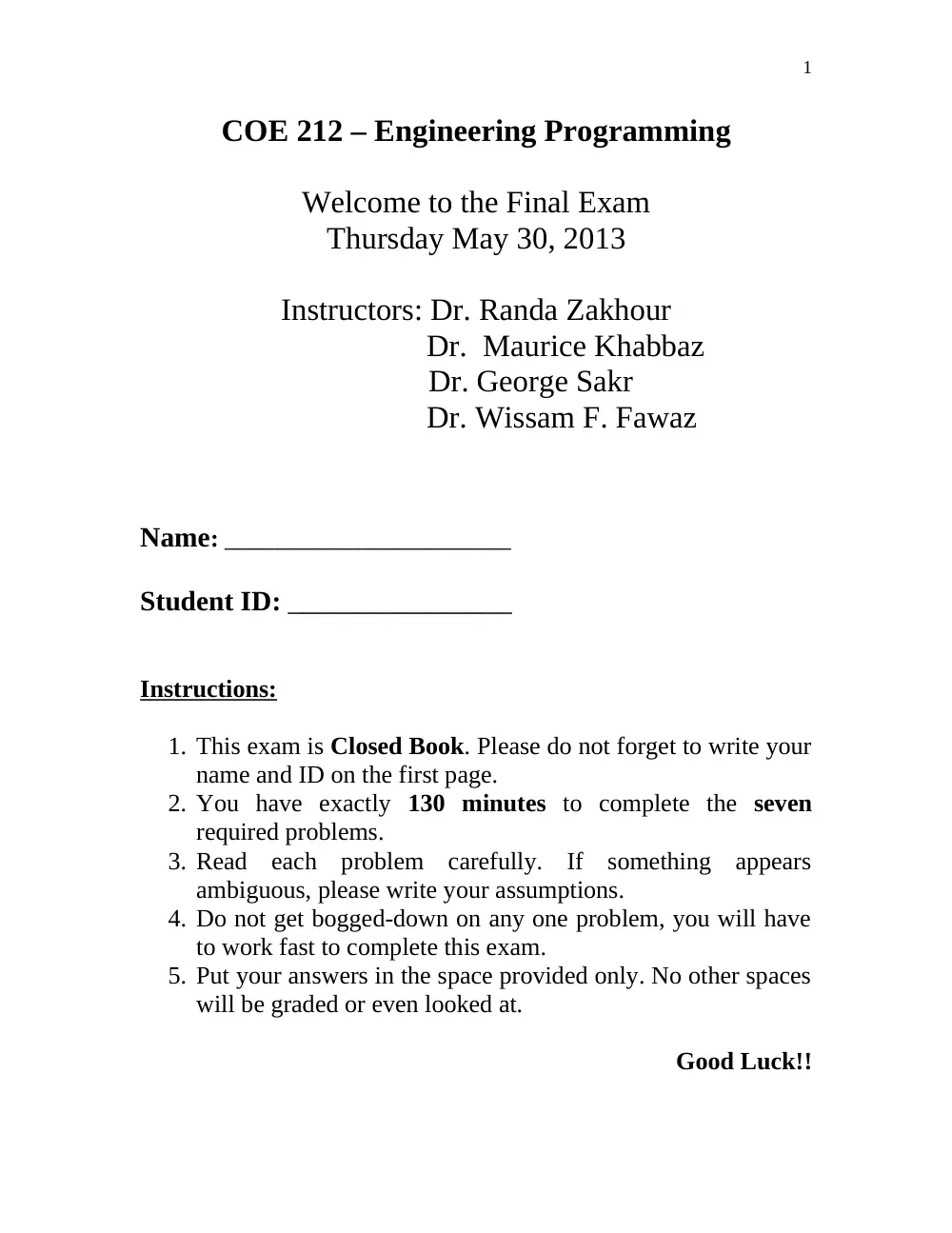
COE 212 – Engineering Programming
Welcome to the Final Exam
Thursday May 30, 2013
Instructors: Dr. Randa Zakhour
Dr. Maurice Khabbaz
Dr. George Sakr
Dr. Wissam F. Fawaz
Name: _______________________
Student ID: ________________
Instructions:
1. This exam is Closed Book. Please do not forget to write your
name and ID on the first page.
2. You have exactly 130 minutes to complete the seven
required problems.
3. Read each problem carefully. If something appears
ambiguous, please write your assumptions.
4. Do not get bogged-down on any one problem, you will have
to work fast to complete this exam.
5. Put your answers in the space provided only. No other spaces
will be graded or even looked at.
Good Luck!!
1
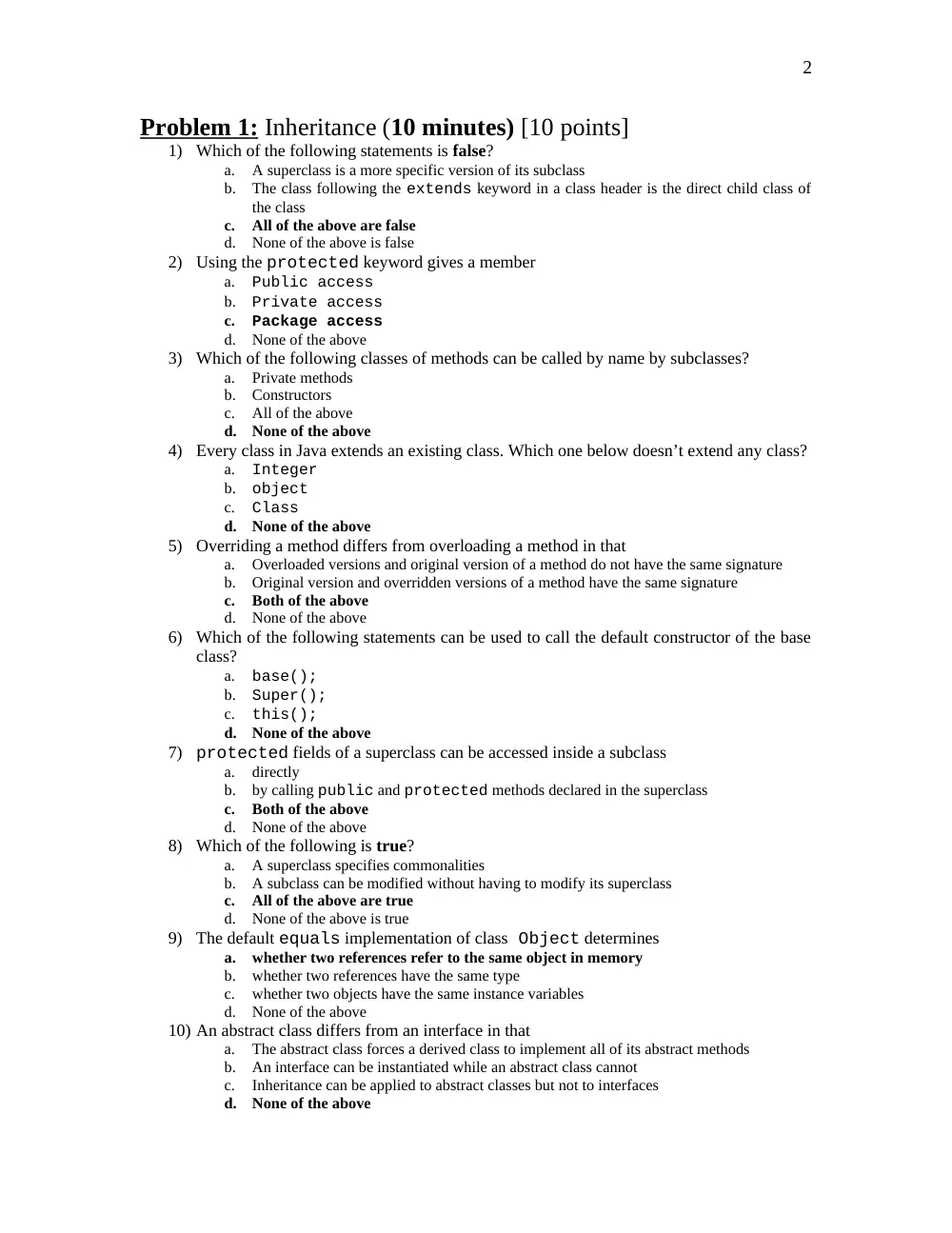
Problem 1: Inheritance (10 minutes) [10 points]
1)
Which of the following statements is false?
a.
A superclass is a more specific version of its subclass
b.
The class following the extends keyword in a class header is the direct child class of
the class
c.
All of the above are false
d.
None of the above is false
2)
Using the protected keyword gives a member
a.
Public access
b.
Private access
c.
Package access
d.
None of the above
3)
Which of the following classes of methods can be called by name by subclasses?
a.
Private methods
b.
Constructors
c.
All of the above
d.
None of the above
4)
Every class in Java extends an existing class. Which one below doesn’t extend any class?
a.
Integer
b.
object
c.
Class
d.
None of the above
5)
Overriding a method differs from overloading a method in that
a.
Overloaded versions and original version of a method do not have the same signature
b.
Original version and overridden versions of a method have the same signature
c.
Both of the above
d.
None of the above
6)
Which of the following statements can be used to call the default constructor of the base
class?
a.
base();
b.
Super();
c.
this();
d.
None of the above
7)
protected fields of a superclass can be accessed inside a subclass
a.
directly
b.
by calling public and protected methods declared in the superclass
c.
Both of the above
d.
None of the above
8)
Which of the following is true?
a.
A superclass specifies commonalities
b.
A subclass can be modified without having to modify its superclass
c.
All of the above are true
d.
None of the above is true
9)
The default equals implementation of class Object determines
a.
whether two references refer to the same object in memory
b.
whether two references have the same type
c.
whether two objects have the same instance variables
d.
None of the above
10) An abstract class differs from an interface in that
a.
The abstract class forces a derived class to implement all of its abstract methods
b.
An interface can be instantiated while an abstract class cannot
c.
Inheritance can be applied to abstract classes but not to interfaces
d.
None of the above
2
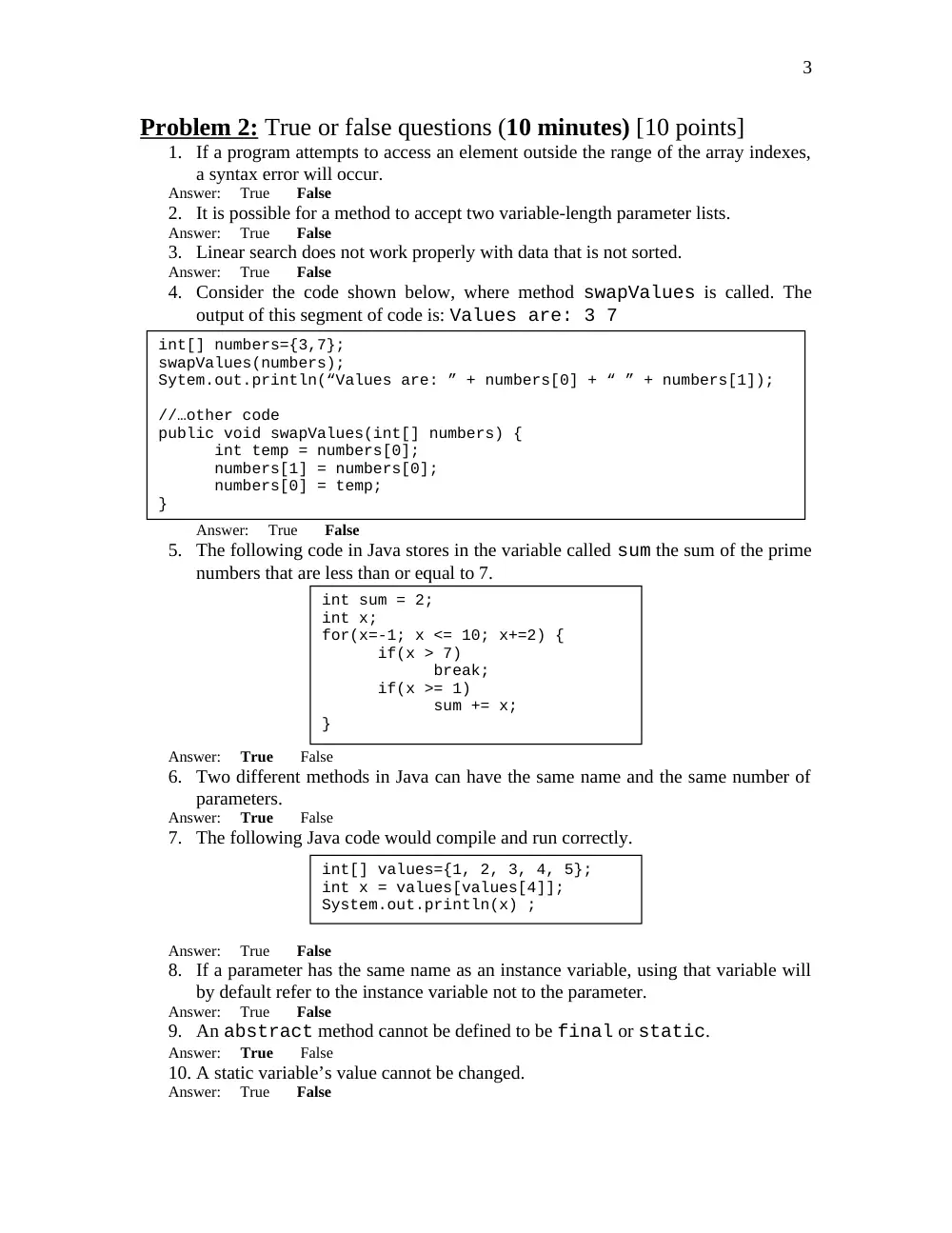
Problem 2: True or false questions (10 minutes) [10 points]
1. If a program attempts to access an element outside the range of the array indexes,
a syntax error will occur.
Answer: True False
2. It is possible for a method to accept two variable-length parameter lists.
Answer: True False
3. Linear search does not work properly with data that is not sorted.
Answer: True False
4. Consider the code shown below, where method swapValues is called. The
output of this segment of code is: Values are: 3 7
Answer: True False
5. The following code in Java stores in the variable called sum the sum of the prime
numbers that are less than or equal to 7.
Answer: True False
6. Two different methods in Java can have the same name and the same number of
parameters.
Answer: True False
7. The following Java code would compile and run correctly.
Answer: True False
8. If a parameter has the same name as an instance variable, using that variable will
by default refer to the instance variable not to the parameter.
Answer: True False
9. An abstract method cannot be defined to be final or static.
Answer: True False
10. A static variable’s value cannot be changed.
Answer: True False
int[] numbers={3,7};
swapValues(numbers);
Sytem.out.println(“Values are: ” + numbers[0] + “ ” + numbers[1]);
//…other code
public void swapValues(int[] numbers) {
int temp = numbers[0];
numbers[1] = numbers[0];
numbers[0] = temp;
}
int sum = 2;
int x;
for(x=-1; x <= 10; x+=2) {
if(x > 7)
break;
if(x >= 1)
sum += x;
}
int[] values={1, 2, 3, 4, 5};
int x = values[values[4]];
System.out.println(x) ;
3
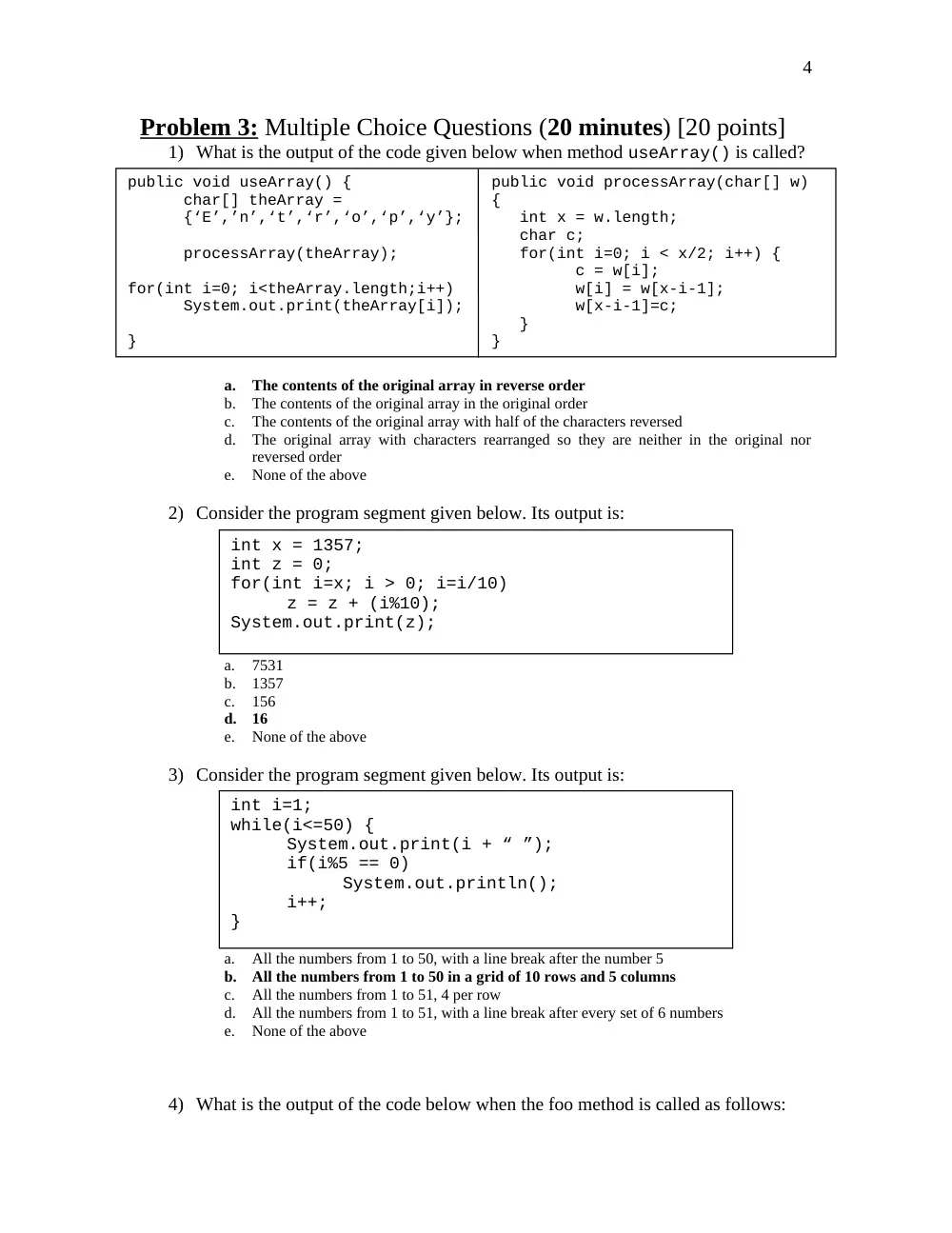
Problem 3: Multiple Choice Questions (20 minutes) [20 points]
1) What is the output of the code given below when method useArray() is called?
a.
The contents of the original array in reverse order
b.
The contents of the original array in the original order
c.
The contents of the original array with half of the characters reversed
d.
The original array with characters rearranged so they are neither in the original nor
reversed order
e.
None of the above
2) Consider the program segment given below. Its output is:
a.
7531
b.
1357
c.
156
d.
16
e.
None of the above
3) Consider the program segment given below. Its output is:
a.
All the numbers from 1 to 50, with a line break after the number 5
b.
All the numbers from 1 to 50 in a grid of 10 rows and 5 columns
c.
All the numbers from 1 to 51, 4 per row
d.
All the numbers from 1 to 51, with a line break after every set of 6 numbers
e.
None of the above
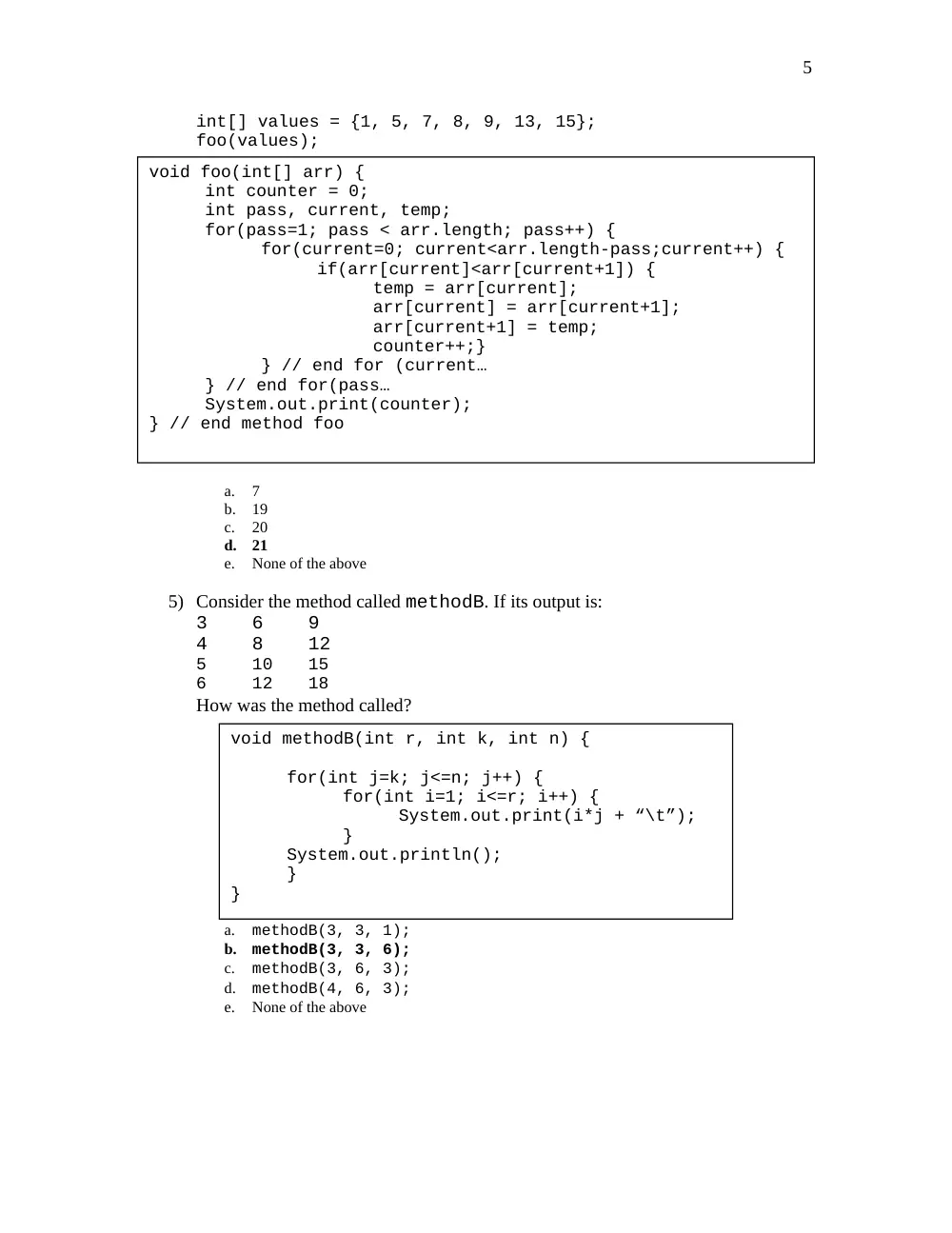
4) What is the output of the code below when the foo method is called as follows:
public void useArray() {
public void processArray(char[] w)
char[] theArray =
{
{‘E’,’n’,‘t’,‘r’,‘o’,‘p’,‘y’};
int x = w.length;
char c;
processArray(theArray);
for(int i=0; i < x/2; i++) {
c = w[i];
for(int i=0; i<theArray.length;i++)
w[i] = w[x-i-1];
System.out.print(theArray[i]);
w[x-i-1]=c;
}
}
}
int i=1;
while(i<=50) {
System.out.print(i + “ ”);
if(i%5 == 0)
System.out.println();
i++;
}
int x = 1357;
int z = 0;
for(int i=x; i > 0; i=i/10)
z = z + (i%10);
System.out.print(z);
4
int[] values = {1, 5, 7, 8, 9, 13, 15};
foo(values);
a.
7
b.
19
c.
20
d.
21
e.
None of the above
5) Consider the method called methodB. If its output is:
3
6
9
4
8
12
5
10
15
6
12
18
How was the method called?
a.
methodB(3, 3, 1);
b.
methodB(3, 3, 6);
c.
methodB(3, 6, 3);
d.
methodB(4, 6, 3);
e.
None of the above
void foo(int[] arr) {
int counter = 0;
int pass, current, temp;
for(pass=1; pass < arr.length; pass++) {
for(current=0; current<arr.length-pass;current++) {
if(arr[current]<arr[current+1]) {
temp = arr[current];
arr[current] = arr[current+1];
arr[current+1] = temp;
counter++;}
} // end for (current…
} // end for(pass…
System.out.print(counter);
} // end method foo
void methodB(int r, int k, int n) {
for(int j=k; j<=n; j++) {
for(int i=1; i<=r; i++) {
System.out.print(i*j + “\t”);
}
System.out.println();
}
}
5
Problem 4: Code analysis (20 minutes) [11 points]
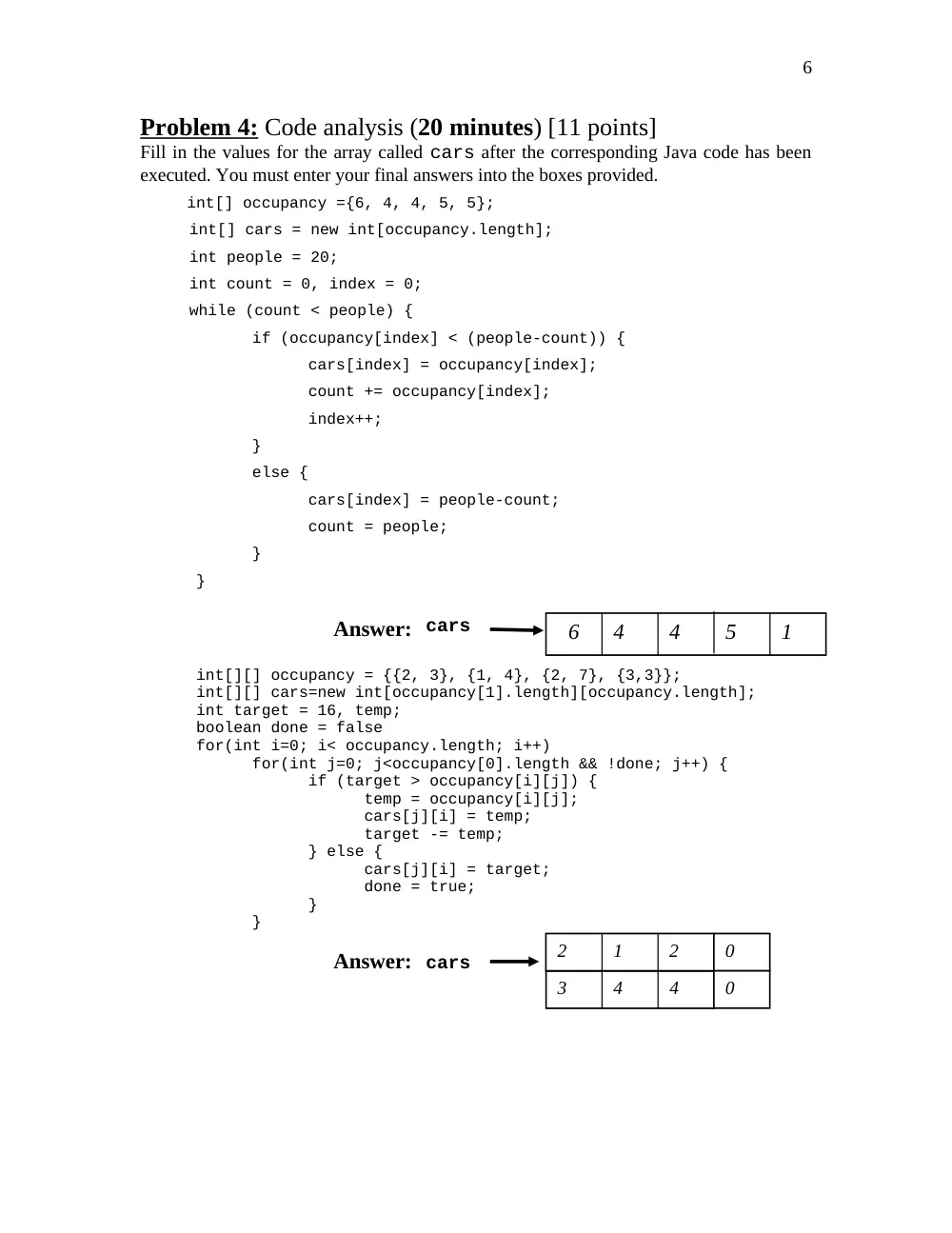
Fill in the values for the array called cars after the corresponding Java code has been
executed. You must enter your final answers into the boxes provided.
int[] occupancy ={6, 4, 4, 5, 5};
int[] cars = new int[occupancy.length];
int people = 20;
int count = 0, index = 0;
while (count < people) {
if (occupancy[index] < (people-count)) {
cars[index] = occupancy[index];
count += occupancy[index];
index++;
}
else {
cars[index] = people-count;
count = people;
}
}
int[][] occupancy = {{2, 3}, {1, 4}, {2, 7}, {3,3}};
int[][] cars=new int[occupancy[1].length][occupancy.length];
int target = 16, temp;
boolean done = false
for(int i=0; i< occupancy.length; i++)
for(int j=0; j<occupancy[0].length && !done; j++) {
if (target > occupancy[i][j]) {
temp = occupancy[i][j];
cars[j][i] = temp;
target -= temp;
} else {
cars[j][i] = target;
done = true;
}
}
cars
Answer:
6
4
4
5
1
Answer: cars
0
0
2
1
2
3
4
4
6
Problem 5: Method definition (20 minutes) [9 points]
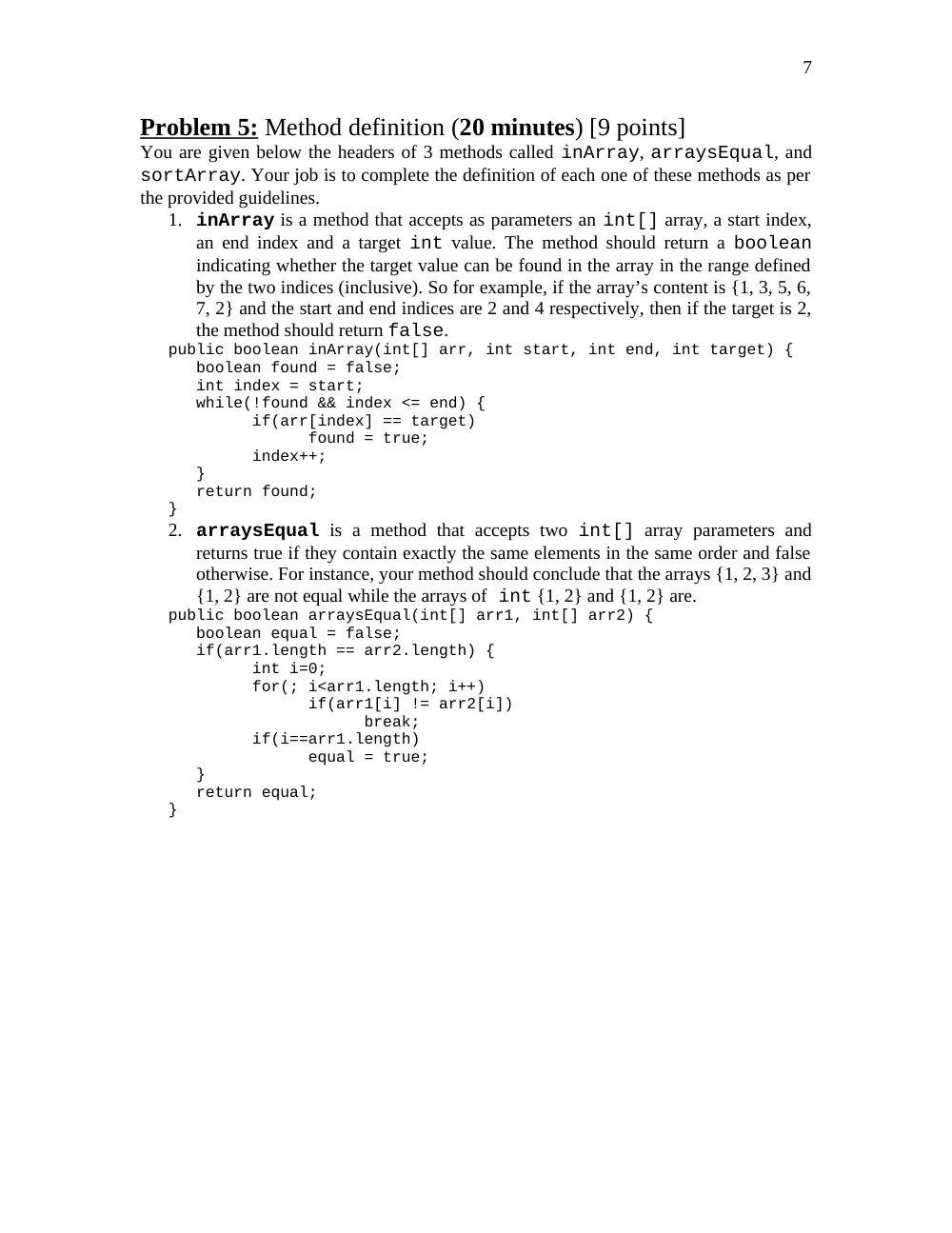
You are given below the headers of 3 methods called inArray, arraysEqual, and
sortArray. Your job is to complete the definition of each one of these methods as per
the provided guidelines.
1. inArray is a method that accepts as parameters an int[] array, a start index,
an end index and a target int value. The method should return a boolean
indicating whether the target value can be found in the array in the range defined
by the two indices (inclusive). So for example, if the array’s content is {1, 3, 5, 6,
7, 2} and the start and end indices are 2 and 4 respectively, then if the target is 2,
the method should return false.
public boolean inArray(int[] arr, int start, int end, int target) {
boolean found = false;
int index = start;
while(!found && index <= end) {
if(arr[index] == target)
found = true;
index++;
}
return found;
}
2. arraysEqual is a method that accepts two int[] array parameters and
returns true if they contain exactly the same elements in the same order and false
otherwise. For instance, your method should conclude that the arrays {1, 2, 3} and
{1, 2} are not equal while the arrays of int {1, 2} and {1, 2} are.
public boolean arraysEqual(int[] arr1, int[] arr2) {
boolean equal = false;
if(arr1.length == arr2.length) {
int i=0;
for(; i<arr1.length; i++)
if(arr1[i] != arr2[i])
break;
if(i==arr1.length)
equal = true;
}
return equal;
}
7
3. sortArray is a method that accepts an int[] array parameter and sorts its
elements in a descending order.
public void sortArray(int[] arr) {
int temp, max;
for(int index=0; index < arr.length; index++) {
max = index;
for(int scan=index+1; scan < arr.length; scan++)
if(arr[max] < arr[scan])
scan = max;
temp = list[max];
list[max] = list[index];
list[index] = temp;
}
}
8
Problem 6: Completing code fragments (20 minutes) [10 points]
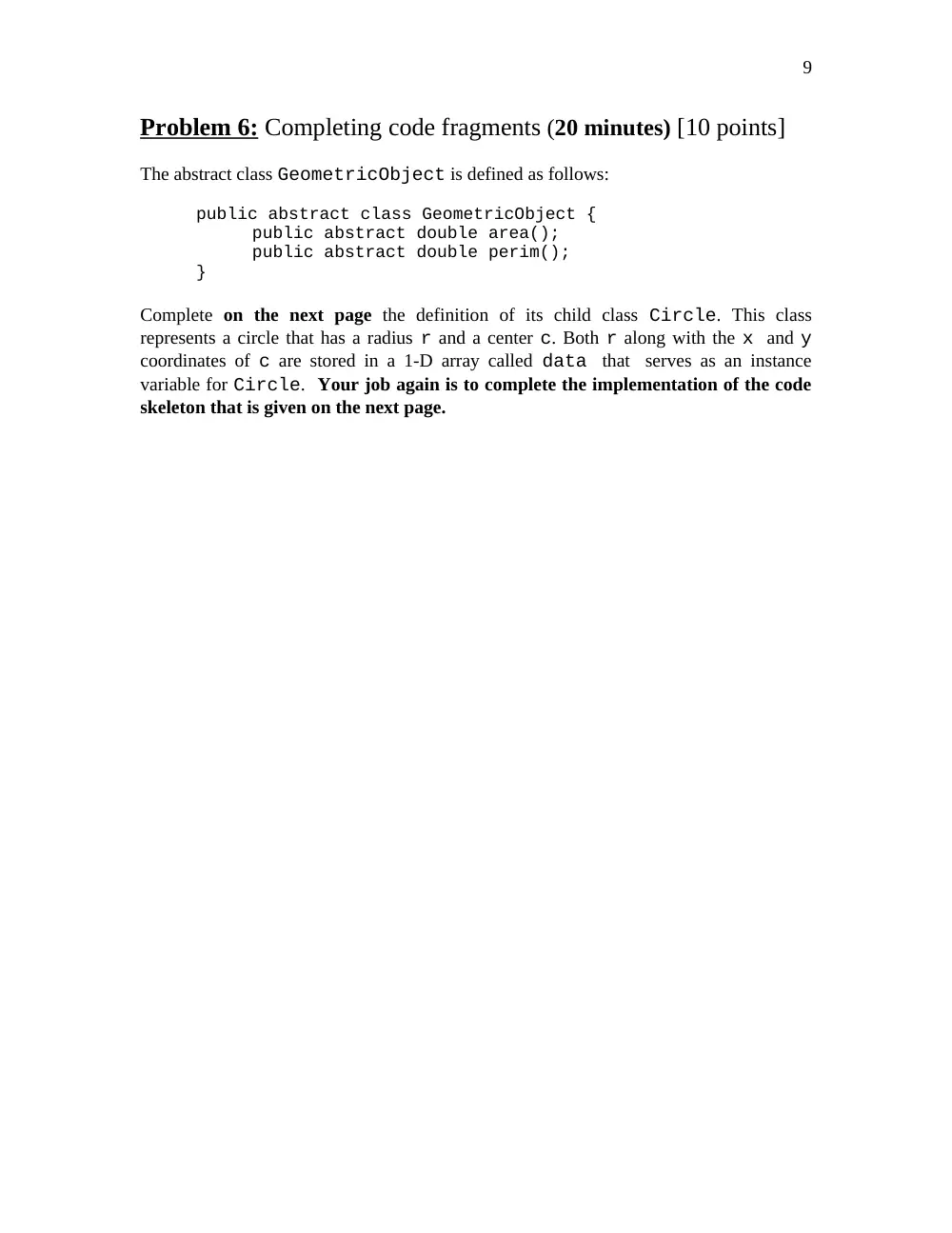
The abstract class GeometricObject is defined as follows:
public abstract class GeometricObject {
public abstract double area();
public abstract double perim();
}
Complete on the next page the definition of its child class Circle. This class
represents a circle that has a radius r and a center c. Both r along with the x and y
coordinates of c are stored in a 1-D array called data that serves as an instance
variable for Circle. Your job again is to complete the implementation of the code
skeleton that is given on the next page.
9
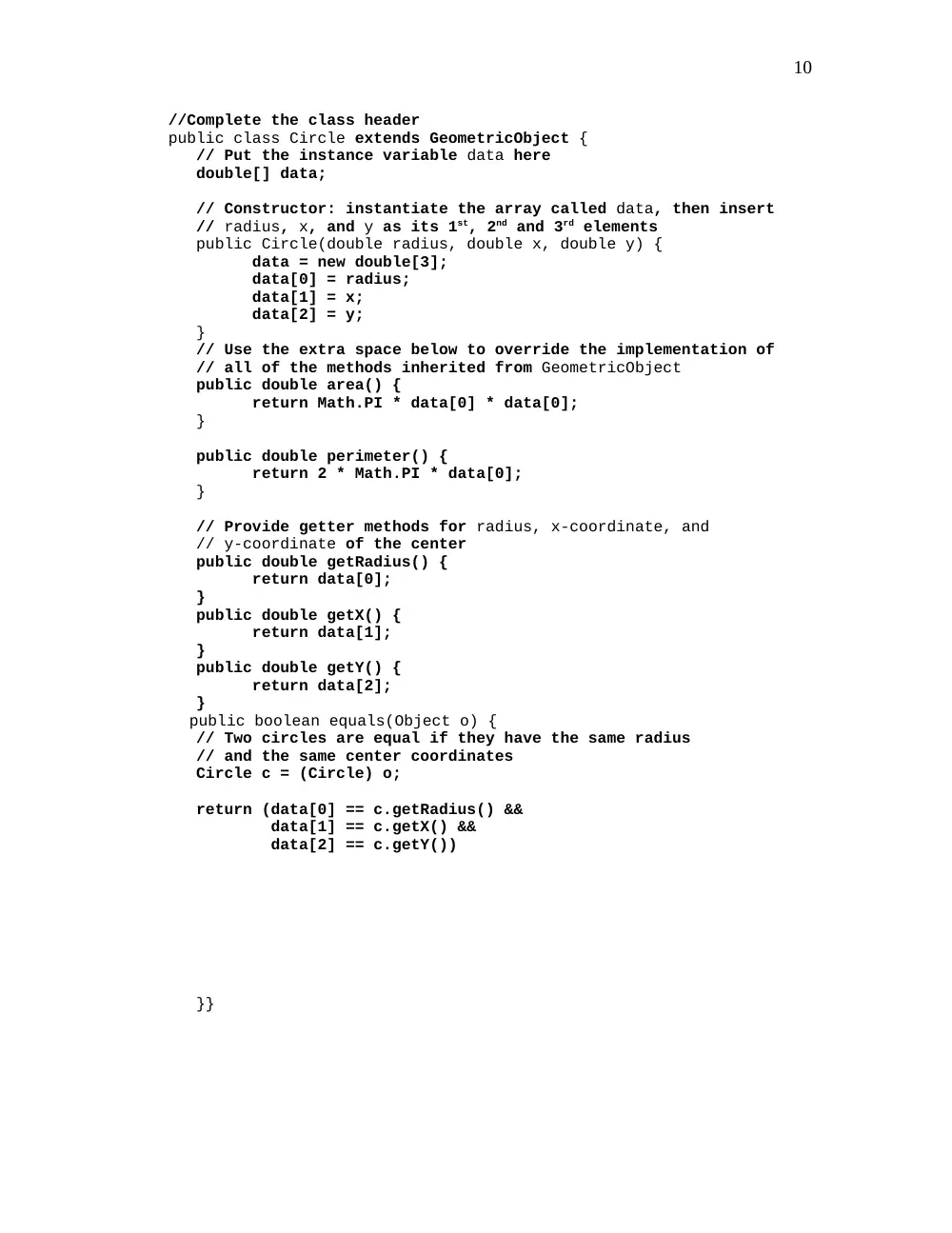
//Complete the class header
public class Circle extends GeometricObject {
// Put the instance variable data here
double[] data;
// Constructor: instantiate the array called data, then insert
// radius, x, and y as its 1st, 2nd and 3rd elements
public Circle(double radius, double x, double y) {
data = new double[3];
data[0] = radius;
data[1] = x;
data[2] = y;
}
// Use the extra space below to override the implementation of
// all of the methods inherited from GeometricObject
public double area() {
return Math.PI * data[0] * data[0];
}
public double perimeter() {
return 2 * Math.PI * data[0];
}
// Provide getter methods for radius, x-coordinate, and
// y-coordinate of the center
public double getRadius() {
return data[0];
}
public double getX() {
return data[1];
}
public double getY() {
return data[2];
}
public boolean equals(Object o) {
// Two circles are equal if they have the same radius
// and the same center coordinates
Circle c = (Circle) o;
return (data[0] == c.getRadius() &&
data[1] == c.getX() &&
data[2] == c.getY())
}}
10
Problem 7: Coding (35 minutes) [30 points]
1. Write a JAVA program called GradingScheme that reads in from the user a
set of student scores (each between 0 and 100). First, the program has to find the
best score and store in a variable called bestScore. Second, the program will
assign letter grades to the remaining scores based on the following scheme:
Grade is A if score is >= best – 10;
Grade is B if score is >= best – 20;
Grade is C if score is >= best – 30;
Grade is D if score is >= best – 40;
Grade is F otherwise.
Note: The program should first ask for the total number of students, then prompt
the user to enter all of the scores sequentially, and finally terminate by displaying
the letter grades.
Sample output:
Enter the number of students: 5
Enter 5 scores: 70 75 85 91 87
Student 0 scored 70; his letter grade is C
Student 1 scored 75; his letter grade is B
Student 2 scored 85; his letter grade is A
Student 3 scored 91; his letter grade is A
Student 4 scored 87; his letter grade is A
11
import java.util.Scanner;
public class GradingScheme {
public static void main(String[] args) {
int nbStudents;
Scanner scan = new Scanner(System.in);
System.out.println(“Enter nb of students”);
nbStudents = scan.nextInt();
double[]scores = new double[nbStudents];
double bestScore=0.0;
System.out.println(“Enter ” + nbStudents + “ scores:”);
for(int i=0; i < nbStudents; i++) {
scores[i] = scan.nextDouble();
if(scores[i] > bestScore)
bestScore = scores[i];
}
for(int i=0; i<scores.length; i++) {
if(scores[i] >= (bestScores-10))
System.out.println(“Student ” + i + “ scored ”
+ scores[i] + “; his letter grade is A”);
else if(scores[i] >= (bestScores-20))
System.out.println(“Student ” + i + “ scored ”
+ scores[i] + “; his letter grade is B”);
else if(scores[i] >= (bestScores-30))
System.out.println(“Student ” + i + “ scored ”
+ scores[i] + “; his letter grade is C”);
else if(scores[i] >= (bestScores-40))
System.out.println(“Student ” + i + “ scored ”
+ scores[i] + “; his letter grade is D”);
else
System.out.println(“Student ” + i + “ scored ”
+ scores[i] + “; his letter grade is F”);
}
}
}
12
2. Write a JAVA program called String2D that reads from the user a String of
length 16. Then the program should store every character of this String in a 2-
D array (4 by 4). Finally the program must print the elements of the 2-D array in a
table format consisting of 4 rows and 4 columns.
Sample output:
Enter a 16 character String: abeautifulexam:)
The 2D String is:
a
b e a
u
t i f
u
l e x
a
m : )
import java.util.Scanner;
public class String2D {
public static void main(String[] args) {
String line;
Scanner scan = new Scanner(System.in);
char[][] arr = new char[4][4];
do {
System.out.println(“Enter a 16 char long line:”);
line = scan.nextLine();
} while(line.length() != 16);
for(int i=0; i<4; i++)
for(int j=0; j<4; j++) {
arr[i][j] = line[i*4+j];
System.out.print(arr[i][j] + “\t”);
}
System.out.println();
}
}
}
13
3. Write a JAVA program that reads an integer N from the user and creates an N-by-
N boolean array a[][] such that a[i][j] is true if (i+1) and (j+1)
have a greatest common divisor (gcd) of 1 and false otherwise. Then, the
program should print the elements stored in the array a in a table format with N
rows and N columns.
Sample output:
Enter the value of N: 3
The boolean values in a:
true true true
true false true
true true false
import java.util.Scanner;
public class NByNMatrix {
public static void main(String[] args) {
Scanner scan = new Scanner(System.in);
int N;
System.out.println(“Enter value of N:”);
N = scan.nextInt();
boolean[][] a = new boolean[N][N];
for(int i=0; i<N; i++)
for(int j=0; j<N; j++)
if(gcd(i+1,j+1) == 1)
a[i][j] = true;
else
a[i][j] = false;
for(int i=0; i<N; i++) {
for(int j=0; j<N; j++)
System.out.print(a[i][j] + “ ”);
System.out.println();
}
}
private static int gcd(int x, int y) {
while(x!=y)
if(x>y)
x = x-y;
else
y = y-x;
return x;
}
}
14