
COE 312 Project 2, Fall 2012
Lebanese American University · Data Structures · 6 pages · Dr. Wissam Fawaz


More COE 312 files
Show the text of this project
COE 312
Data Structures
Fall 2012
W. FAWAZ
Projects II
Project II (Due date: Thursday December 20, 2012)
I. Objective
In this project, you will be creating a projectile motion simulator. In particular, your job is
to develop a user interface that would allow the end user to launch an “angry bird”
through mouse click events. So, the main actor in your simulator will be an “angry bird”
character from the famous “Angry Birds” game. If you are not familiar with the said game,
note that it is a game where the player uses his finger to launch birds attempting to
destroy structures and enemy pigs. Given that your implementation will be targeting
personal computers rather than mobile phones, your end user is required to use his
mouse to interact with the angry bird. While the premise of the project is very appealing,
simulating the motion of an “angry bird” projectile is somewhat a challenging task. Now, if
you are a little worried about having to deal with heavy physics and mathematics, don’t
worry! You do not need to go very deep into it, and the formulas you shall use are really
quite simple.
II. Problem: Frictionless Projectile motion
The trajectory followed by the angry bird will depend on both the angle θ relative to the
horizon as well as on the initial velocity V0 as shown in Figure 1. Let us denote by T the
total hang time, which is the amount of time the projectile remains in the air. The projectile
hits the ground at a horizontal distance x=R away from the launching point.
L E B A N E S E A M E R I C A N U N I V E R S I T Y
Electrical and Computer Engineering Dept
Figure 1. Trajectory of projectile
A program that simulates the motion of a projectile has to go through the following
steps:
1.
Determine the values of θ and V0
2.
Setup the “equations of motion” that govern the evolution of the position of the
projectile
3.
Compute the “hang time” T, the range R, and the height H from the equations
of motion
4.
Vary the position of the projectile as a function of time based on the equations
of motion
The above-presented steps are discussed in great details in what follows.
III. Determining the values of θ and V0
To make the “angry bird” object move from its initial position, the end user is expected to
apply some force to that object. The way the “angry bird” is pushed is as follows. The user
will have to click the left mouse button over the “angry bird” object and then drag the
mouse while the mouse button is held down. When the button is released, the “angry
bird” object is launched. It is clear that the process of giving a push to the object will result
in the creation of two points that we denote by P1 and P2 respectively. As a matter of fact,
when the mouse is first pressed over the “angry bird”, the coordinates of P1 are set. After
the mouse is dragged and released the coordinates of the second point P2 are set.
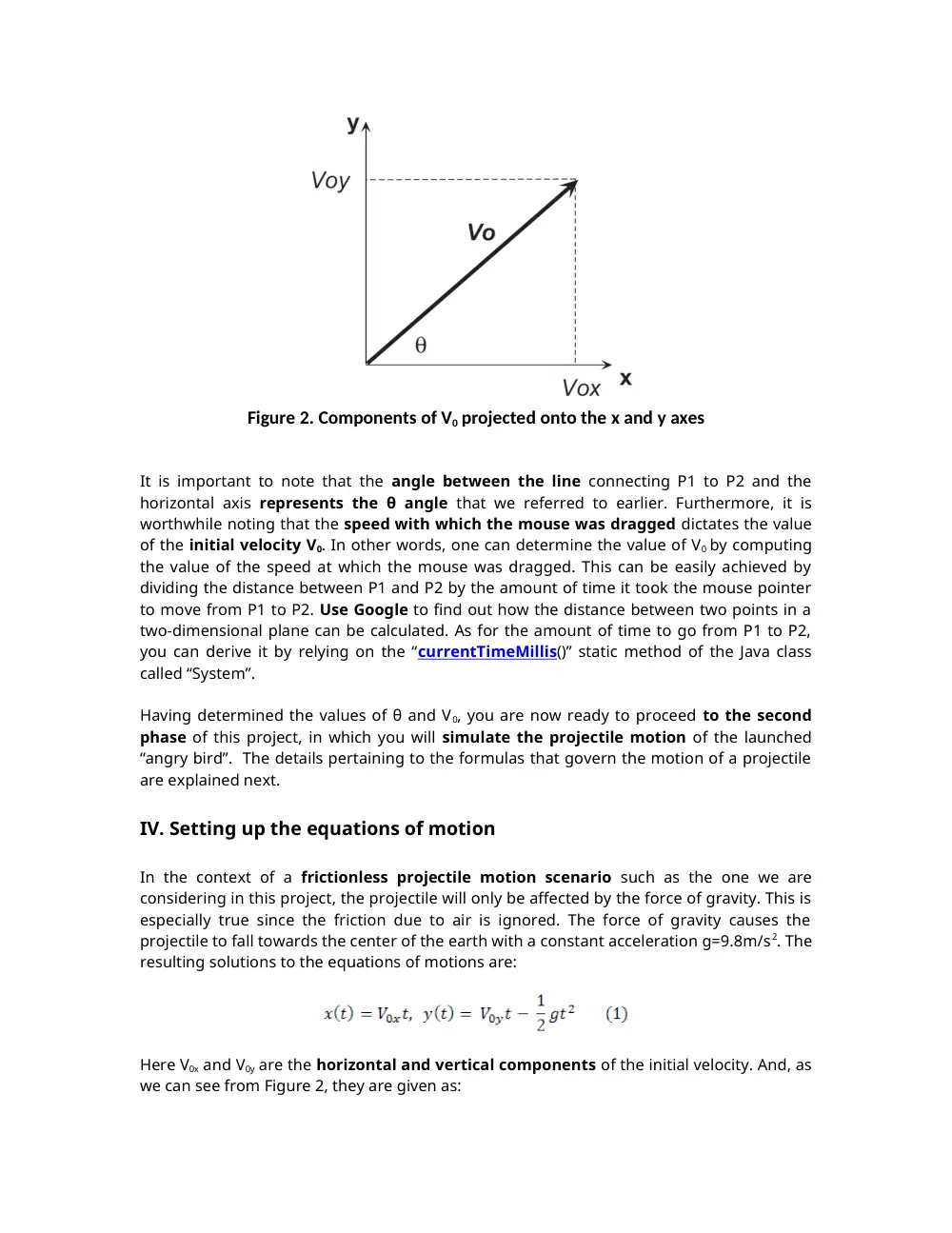
Figure 2. Components of V0 projected onto the x and y axes
It is important to note that the angle between the line connecting P1 to P2 and the
horizontal axis represents the θ angle that we referred to earlier. Furthermore, it is
worthwhile noting that the speed with which the mouse was dragged dictates the value
of the initial velocity V0. In other words, one can determine the value of V0 by computing
the value of the speed at which the mouse was dragged. This can be easily achieved by
dividing the distance between P1 and P2 by the amount of time it took the mouse pointer
to move from P1 to P2. Use Google to find out how the distance between two points in a
two-dimensional plane can be calculated. As for the amount of time to go from P1 to P2,
you can derive it by relying on the “currentTimeMillis()” static method of the Java class
called “System”.
Having determined the values of θ and V0, you are now ready to proceed to the second
phase of this project, in which you will simulate the projectile motion of the launched
“angry bird”. The details pertaining to the formulas that govern the motion of a projectile
are explained next.
IV. Setting up the equations of motion
In the context of a frictionless projectile motion scenario such as the one we are
considering in this project, the projectile will only be affected by the force of gravity. This is
especially true since the friction due to air is ignored. The force of gravity causes the
projectile to fall towards the center of the earth with a constant acceleration g=9.8m/s2. The
resulting solutions to the equations of motions are:
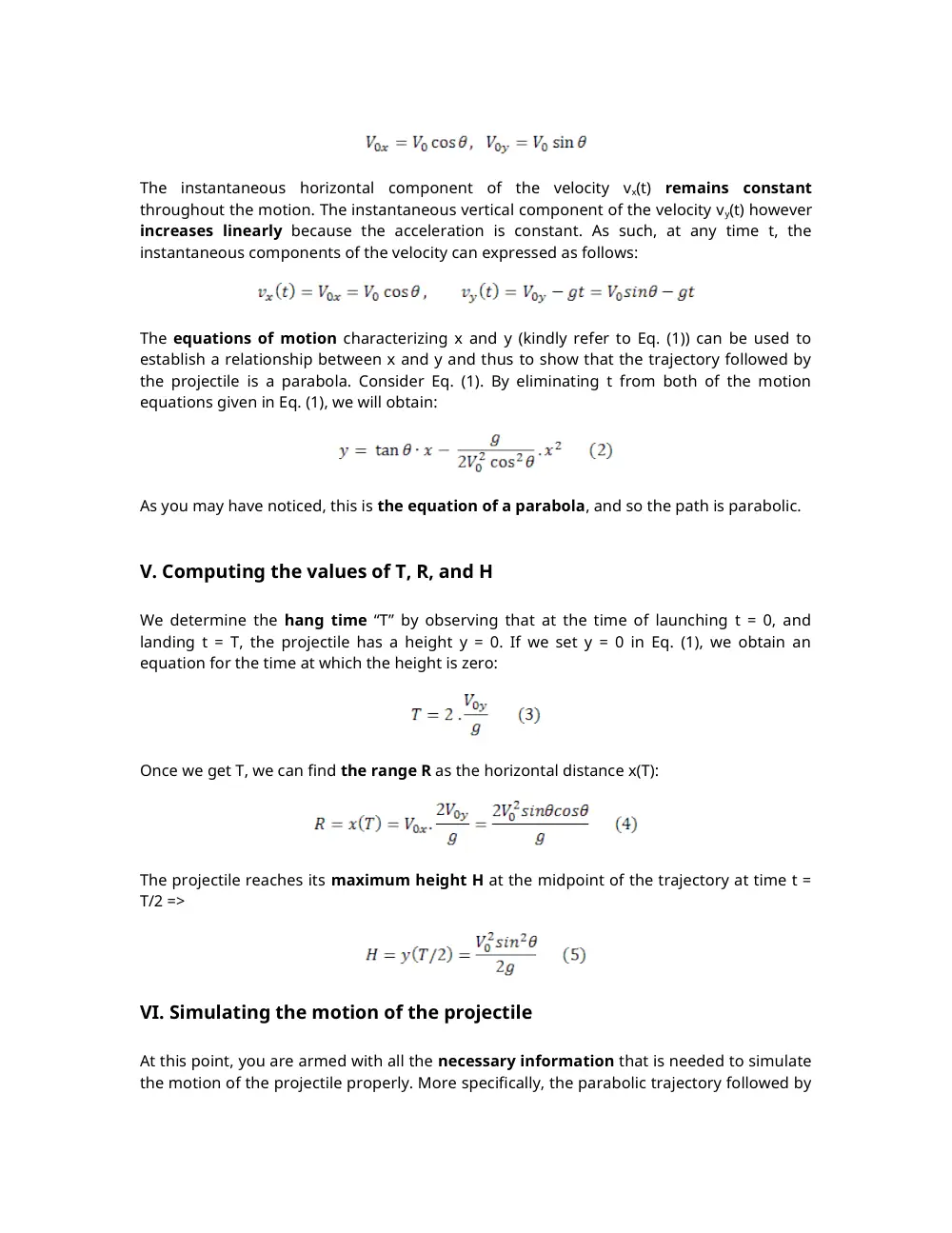
Here V0x and V0y are the horizontal and vertical components of the initial velocity. And, as
we can see from Figure 2, they are given as:
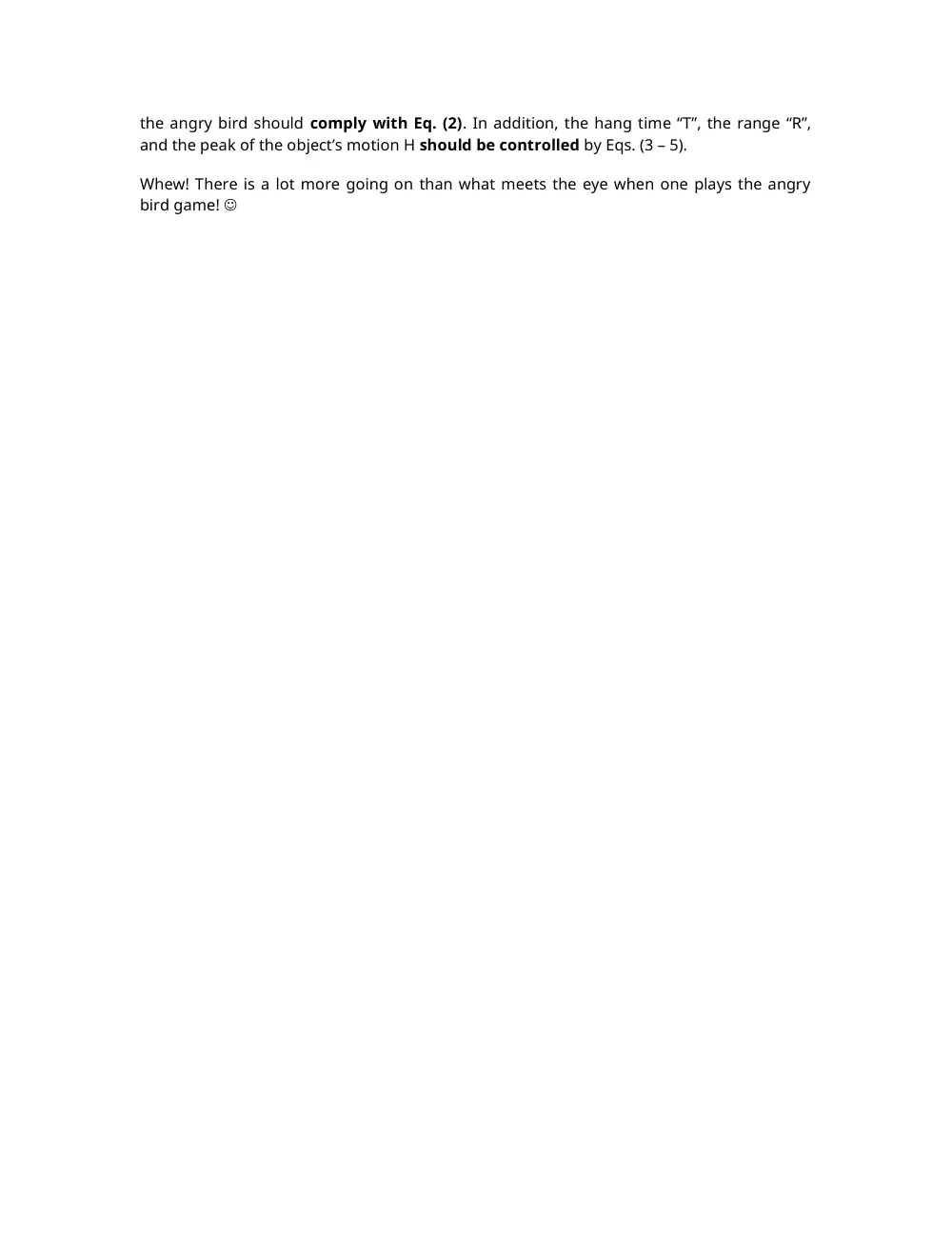
The instantaneous horizontal component of the velocity vx(t) remains constant
throughout the motion. The instantaneous vertical component of the velocity vy(t) however
increases linearly because the acceleration is constant. As such, at any time t, the
instantaneous components of the velocity can expressed as follows:
The equations of motion characterizing x and y (kindly refer to Eq. (1)) can be used to
establish a relationship between x and y and thus to show that the trajectory followed by
the projectile is a parabola. Consider Eq. (1). By eliminating t from both of the motion
equations given in Eq. (1), we will obtain:
As you may have noticed, this is the equation of a parabola, and so the path is parabolic.
V. Computing the values of T, R, and H
We determine the hang time “T” by observing that at the time of launching t = 0, and
landing t = T, the projectile has a height y = 0. If we set y = 0 in Eq. (1), we obtain an
equation for the time at which the height is zero:
Once we get T, we can find the range R as the horizontal distance x(T):
The projectile reaches its maximum height H at the midpoint of the trajectory at time t =
T/2 =>
VI. Simulating the motion of the projectile
At this point, you are armed with all the necessary information that is needed to simulate
the motion of the projectile properly. More specifically, the parabolic trajectory followed by
the angry bird should comply with Eq. (2). In addition, the hang time “T”, the range “R”,
and the peak of the object’s motion H should be controlled by Eqs. (3 – 5).
Whew! There is a lot more going on than what meets the eye when one plays the angry
bird game!
What to turn in?
This project is due at the beginning of class on the due date. You have to turn in the
following material in both hard
and soft copies.
Criteria
Percentage
HTML Documentation of your code. In addition, provide explanations
and illustrations in one or two pages along with a short write-up of
questions and/or problems that you encountered while doing this
assignment.
3 pts (15%)
Source code that contains an appropriate amount of comments. Well-
organized and correct code receives 16 pts, messy yet working code
receives 8 pts, code with bugs receives 2 pts, and incomplete code
receives 1 pt.
16 pts (80 %)
Execution output such as a snapshot of the contents of standard
output. A correct output receives 3 pts, the one with minor errors
receives 2 pts, and an incomplete output receives 1 pt.
1 pts (5%)
Total
20pts (100%)
Good Luck!