
COE 312 Project 3, Fall 2012
Lebanese American University · Data Structures · 7 pages · Dr. Wissam Fawaz


More COE 312 files
Show the text of this project
COE 312 (Data Structures)
Fall 2012
W. FAWAZ
Project III
Project III (Due date: Thursday January 17, 2013)
I. Objective
This project is about writing a Java application that allows two players to play Tic-Tac-Toe.
The Tic-Tac-Toe game is played on a two-dimensional three-by-three board. Two players
alternate placing their symbols on squares. The first to get three squares in a row, column,
or a long diagonal wins. In the context of this project, the computer makes the moves for
one of the players and consequently you will be designing a single player Tic-Tac-Toe game
where your end user will be challenging the computer.
II. Brute-force implementation
As the title of this section suggests, we will first opt for an implementation where the
computer does not make optimal moves. In particular, during the course of the game, the
computer will be inserting his symbols into randomly selected cells.
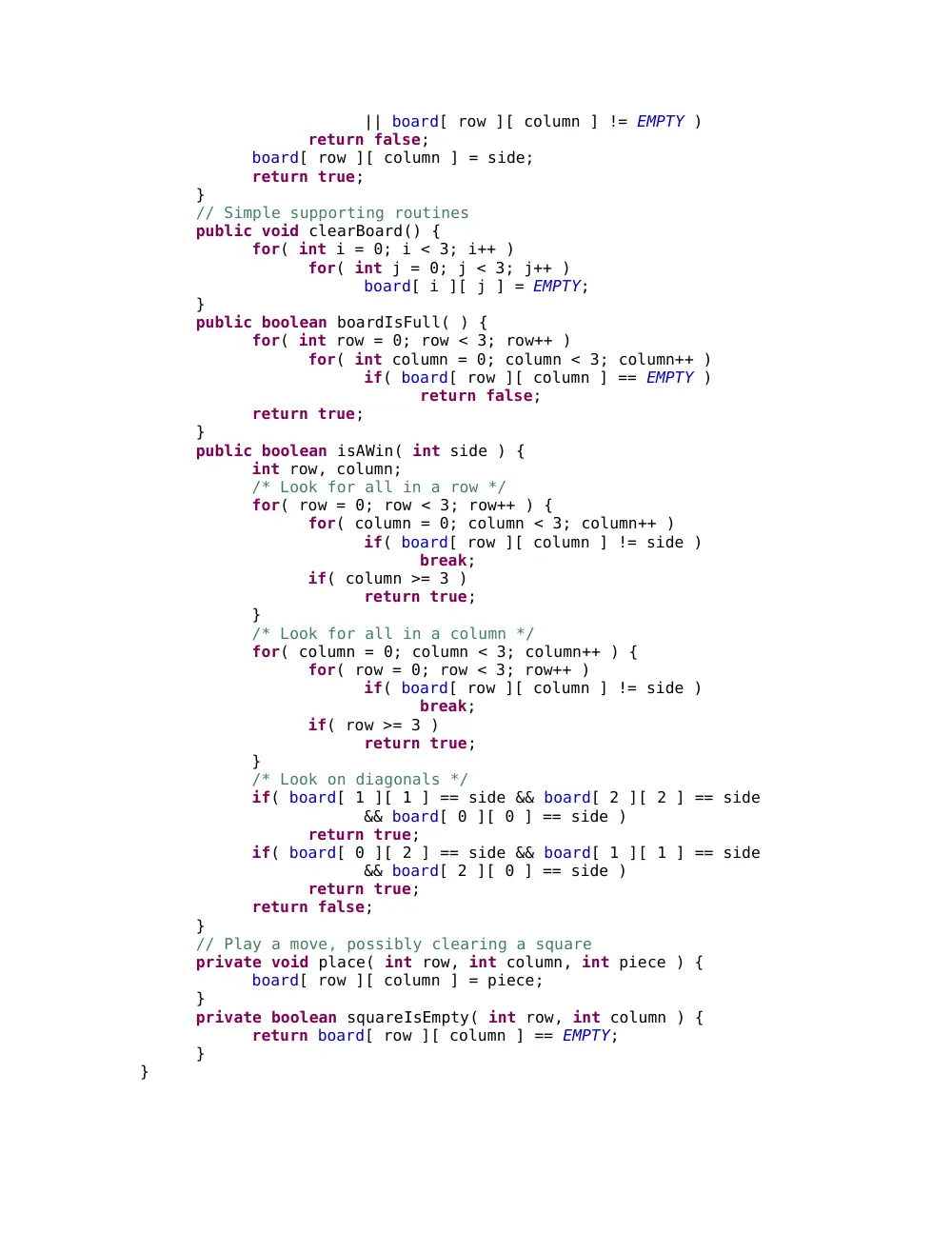
The skeleton for a TicTacToe class is given below. TicTacToe has a data object called
board that represents the current game position. A host of trivial self-descriptive methods
are also defined within the TicTacToe class, including methods to clear the board, test
whether a square is occupied, place a symbol on a square, and to test whether a win has
been achieved. Kindly go over the provided implementation before proceeding to
accomplishing your first assigned task.
public class TicTacToe {
public static final int HUMAN = 0;
public static final int COMPUTER = 1;
public static final int EMPTY = 2;
private int[][] board = new int[3][3];
// Constructor
public TicTacToe() {
clearBoard( );
}
public int [] [] getBoard() {
return board;
}
// Play move, including checking legality
public boolean playMove(int side, int row, int column) {
if( row < 0 || row >= 3 || column < 0 || column >= 3
L E B A N E S E A M E R I C A N U N I V E R S I T Y
Electrical and Computer Engineering Dept
|| board[ row ][ column ] != EMPTY )
return false;
board[ row ][ column ] = side;
return true;
}
// Simple supporting routines
public void clearBoard() {
for( int i = 0; i < 3; i++ )
for( int j = 0; j < 3; j++ )
board[ i ][ j ] = EMPTY;
}
public boolean boardIsFull( ) {
for( int row = 0; row < 3; row++ )
for( int column = 0; column < 3; column++ )
if( board[ row ][ column ] == EMPTY )
return false;
return true;
}
public boolean isAWin( int side ) {
int row, column;
/* Look for all in a row */
for( row = 0; row < 3; row++ ) {
for( column = 0; column < 3; column++ )
if( board[ row ][ column ] != side )
break;
if( column >= 3 )
return true;
}
/* Look for all in a column */
for( column = 0; column < 3; column++ ) {
for( row = 0; row < 3; row++ )
if( board[ row ][ column ] != side )
break;
if( row >= 3 )
return true;
}
/* Look on diagonals */
if( board[ 1 ][ 1 ] == side && board[ 2 ][ 2 ] == side
&& board[ 0 ][ 0 ] == side )
return true;
if( board[ 0 ][ 2 ] == side && board[ 1 ][ 1 ] == side
&& board[ 2 ][ 0 ] == side )
return true;
return false;
}
// Play a move, possibly clearing a square
private void place( int row, int column, int piece ) {
board[ row ][ column ] = piece;
}
private boolean squareIsEmpty( int row, int column ) {
return board[ row ][ column ] == EMPTY;
}
}
Your first task, if you choose to accept it , is to supplement the TicTacToe class
presented earlier with another class called TicTacToeMain whose responsibility is to
define a user interface for your application. More specifically, TicTacToeMain should
present the user with a two-dimensional three-by-three grid of nine JButton objects. Each
of the players involved in the game will be expected to place his/her symbol onto one of
the enabled buttons. After a player has made his/her move, the button receiving the
symbol gets disabled. Whenever the human player makes a move, make sure to place the
letter X in the specified square and the letter O whenever the second player (i.e., computer)
moves. It is needless to say that each move must target an empty square. After each move,
use the methods of the TicTacToe class to determine whether the game has been won
and whether it is a draw. When the game is over, display a dialog box indicating who won
in case there was a winner and enabling the human player to play the game again.
The main limitation of this first implementation of the TicTacToe game is that your
opponent is not following an optimal strategy when making his moves. In view of this, you
may have noticed that beating the computer was within your reach, to say the least! It
would be nice if we can come up with a more optimal implementation of the game in which
the computer would resort to a move selection algorithm to make his moves. This is what
we will try to achieve through the next task.
III. Backtracking-based implementation
The objective of this section is to have the computer select an optimal move during the
game and then to have you incorporate his strategy into your previously developed user
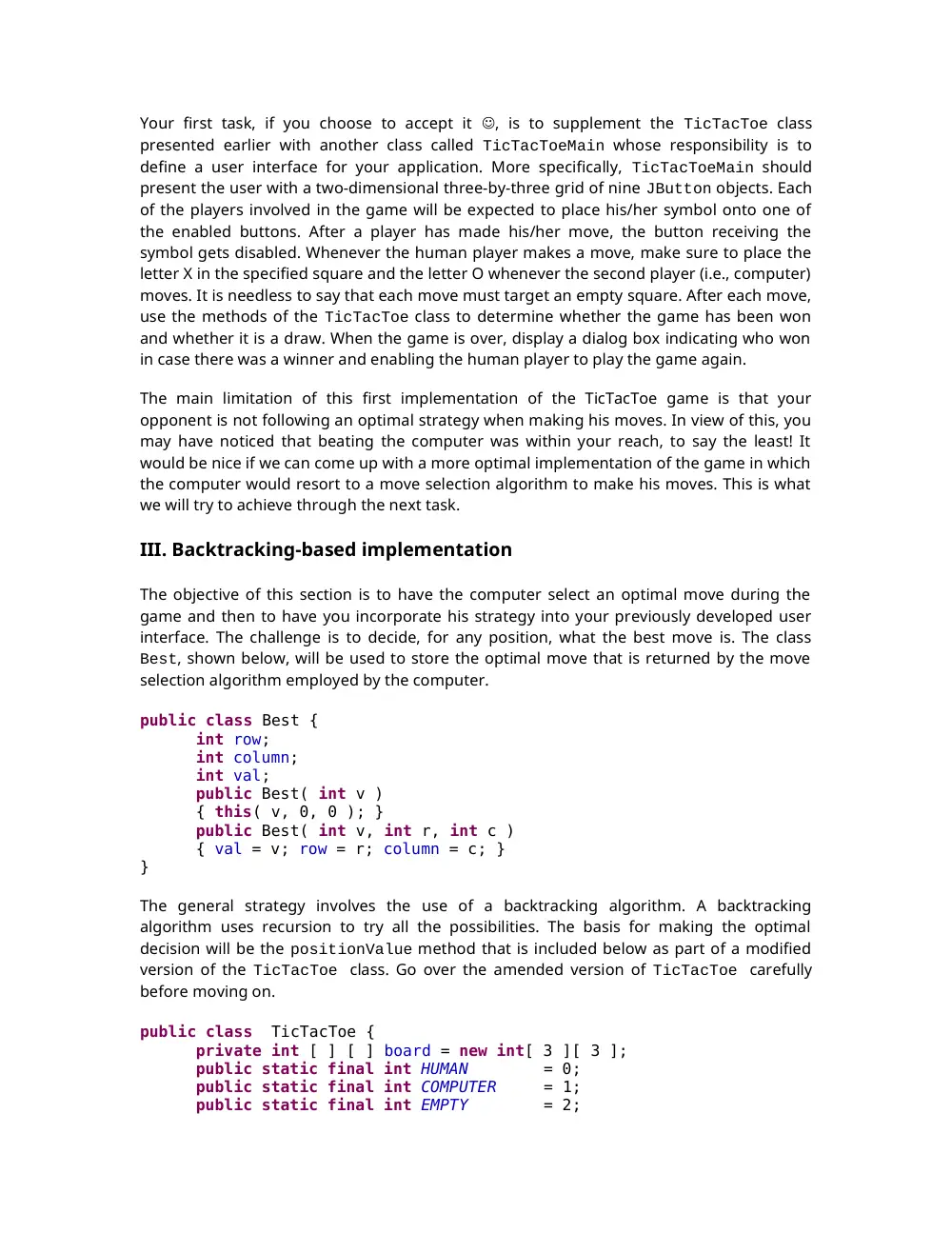
interface. The challenge is to decide, for any position, what the best move is. The class
Best, shown below, will be used to store the optimal move that is returned by the move
selection algorithm employed by the computer.
public class Best {
int row;
int column;
int val;
public Best( int v )
{ this( v, 0, 0 ); }
public Best( int v, int r, int c )
{ val = v; row = r; column = c; }
}
The general strategy involves the use of a backtracking algorithm. A backtracking
algorithm uses recursion to try all the possibilities. The basis for making the optimal
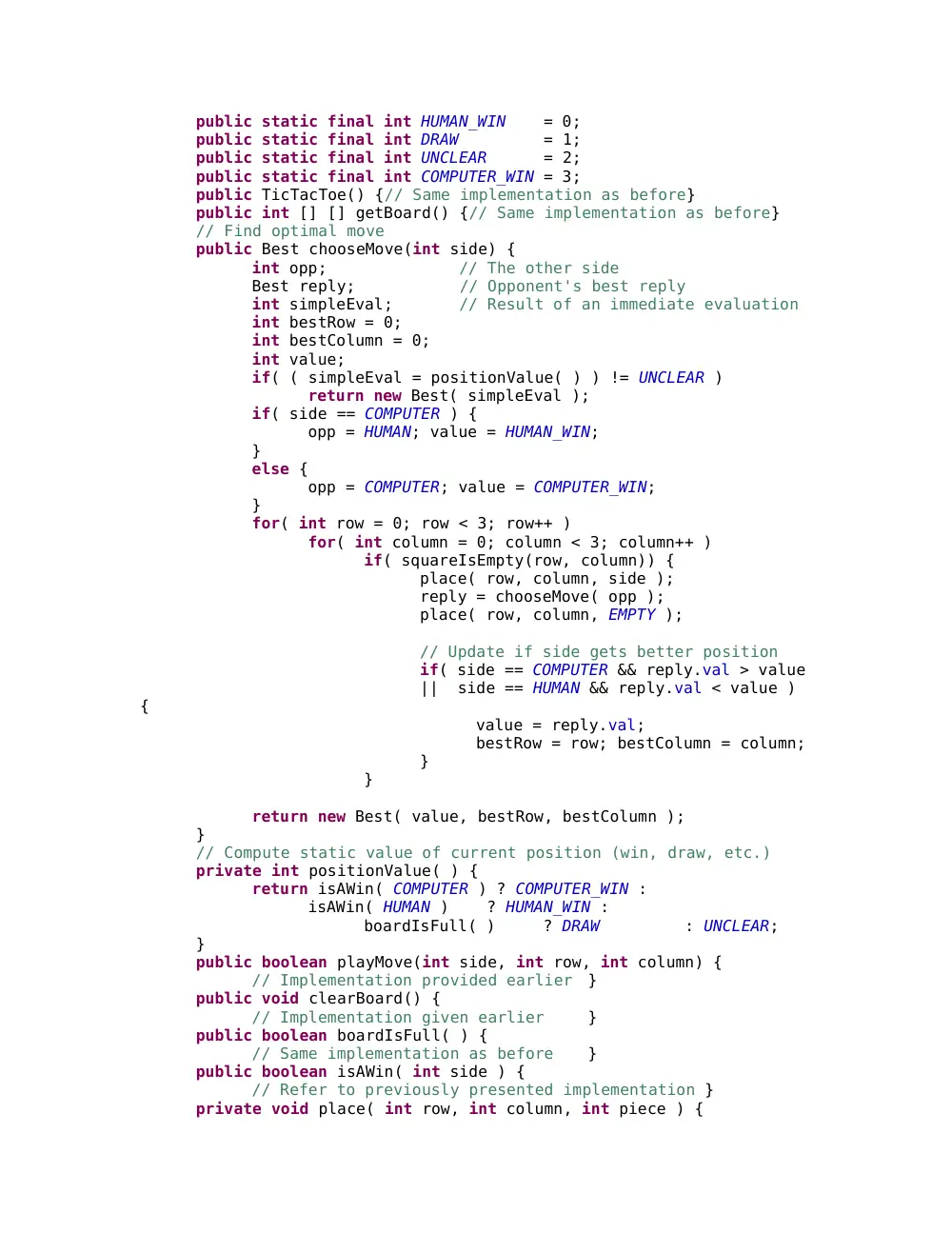
decision will be the positionValue method that is included below as part of a modified
version of the TicTacToe class. Go over the amended version of TicTacToe carefully
before moving on.
public class TicTacToe {
private int [ ] [ ] board = new int[ 3 ][ 3 ];
public static final int HUMAN = 0;
public static final int COMPUTER = 1;
public static final int EMPTY = 2;
public static final int HUMAN_WIN = 0;
public static final int DRAW = 1;
public static final int UNCLEAR = 2;
public static final int COMPUTER_WIN = 3;
public TicTacToe() {// Same implementation as before}
public int [] [] getBoard() {// Same implementation as before}
// Find optimal move
public Best chooseMove(int side) {
int opp; // The other side
Best reply; // Opponent's best reply
int simpleEval; // Result of an immediate evaluation
int bestRow = 0;
int bestColumn = 0;
int value;
if( ( simpleEval = positionValue( ) ) != UNCLEAR )
return new Best( simpleEval );
if( side == COMPUTER ) {
opp = HUMAN; value = HUMAN_WIN;
}
else {
opp = COMPUTER; value = COMPUTER_WIN;
}
for( int row = 0; row < 3; row++ )
for( int column = 0; column < 3; column++ )
if( squareIsEmpty(row, column)) {
place( row, column, side );
reply = chooseMove( opp );
place( row, column, EMPTY );
// Update if side gets better position
if( side == COMPUTER && reply.val > value
|| side == HUMAN && reply.val < value )
{
value = reply.val;
bestRow = row; bestColumn = column;
}
}
return new Best( value, bestRow, bestColumn );
}
// Compute static value of current position (win, draw, etc.)
private int positionValue( ) {
return isAWin( COMPUTER ) ? COMPUTER_WIN :
isAWin( HUMAN ) ? HUMAN_WIN :
boardIsFull( ) ? DRAW : UNCLEAR;
}
public boolean playMove(int side, int row, int column) {
// Implementation provided earlier
}
public void clearBoard() {
// Implementation given earlier
}
public boolean boardIsFull( ) {
// Same implementation as before
}
public boolean isAWin( int side ) {
// Refer to previously presented implementation }
private void place( int row, int column, int piece ) {
// Same implementation as before
}
private boolean squareIsEmpty( int row, int column ) {
// Same implementation as before
}}
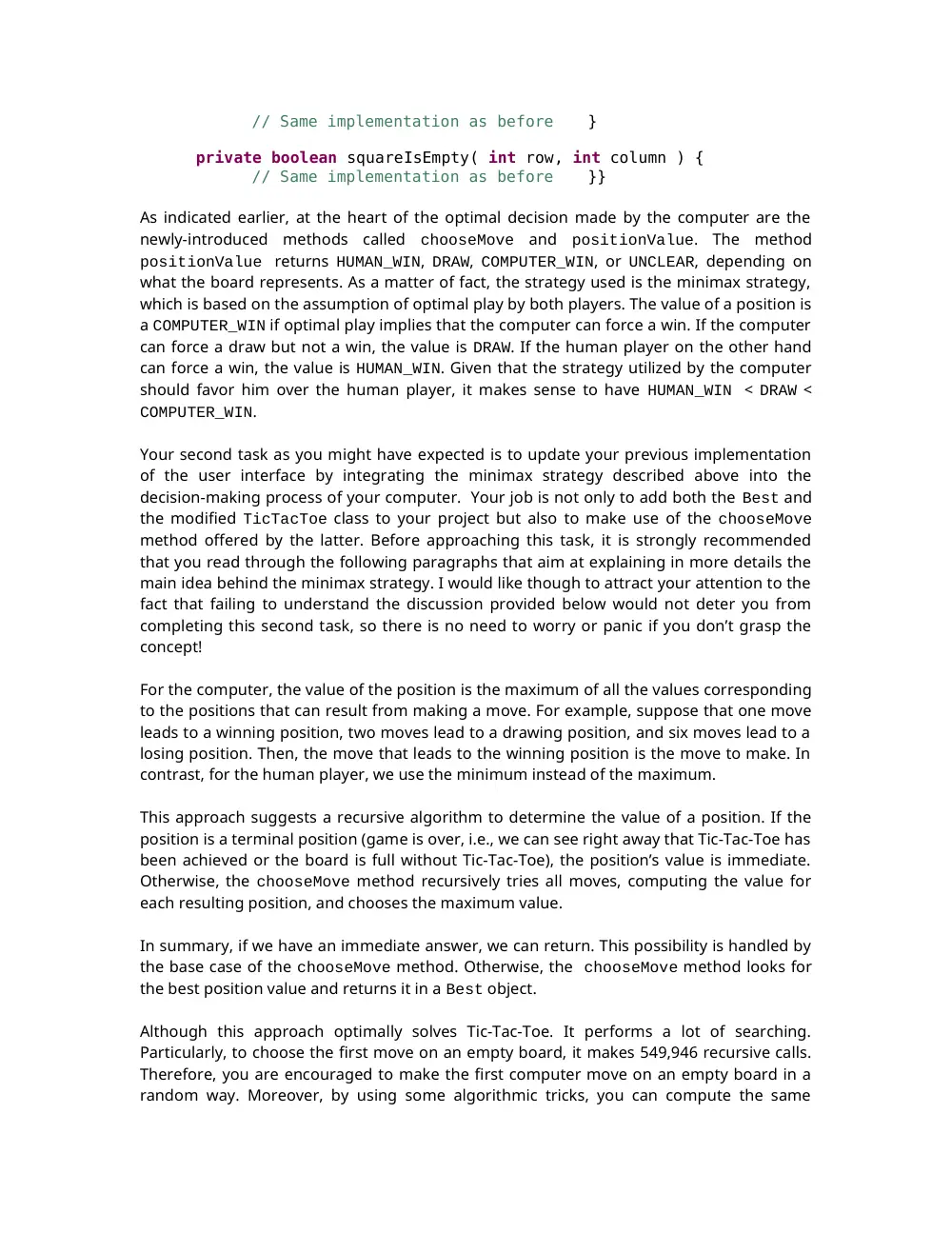
As indicated earlier, at the heart of the optimal decision made by the computer are the
newly-introduced methods called chooseMove and positionValue. The method
positionValue returns HUMAN_WIN, DRAW, COMPUTER_WIN, or UNCLEAR, depending on
what the board represents. As a matter of fact, the strategy used is the minimax strategy,
which is based on the assumption of optimal play by both players. The value of a position is
a COMPUTER_WIN if optimal play implies that the computer can force a win. If the computer
can force a draw but not a win, the value is DRAW. If the human player on the other hand
can force a win, the value is HUMAN_WIN. Given that the strategy utilized by the computer
should favor him over the human player, it makes sense to have HUMAN_WIN < DRAW <
COMPUTER_WIN.
Your second task as you might have expected is to update your previous implementation
of the user interface by integrating the minimax strategy described above into the
decision-making process of your computer. Your job is not only to add both the Best and
the modified TicTacToe class to your project but also to make use of the chooseMove
method offered by the latter. Before approaching this task, it is strongly recommended
that you read through the following paragraphs that aim at explaining in more details the
main idea behind the minimax strategy. I would like though to attract your attention to the
fact that failing to understand the discussion provided below would not deter you from
completing this second task, so there is no need to worry or panic if you don’t grasp the
concept!
For the computer, the value of the position is the maximum of all the values corresponding
to the positions that can result from making a move. For example, suppose that one move
leads to a winning position, two moves lead to a drawing position, and six moves lead to a
losing position. Then, the move that leads to the winning position is the move to make. In
contrast, for the human player, we use the minimum instead of the maximum.
This approach suggests a recursive algorithm to determine the value of a position. If the
position is a terminal position (game is over, i.e., we can see right away that Tic-Tac-Toe has
been achieved or the board is full without Tic-Tac-Toe), the position’s value is immediate.
Otherwise, the chooseMove method recursively tries all moves, computing the value for
each resulting position, and chooses the maximum value.
In summary, if we have an immediate answer, we can return. This possibility is handled by
the base case of the chooseMove method. Otherwise, the chooseMove method looks for
the best position value and returns it in a Best object.
Although this approach optimally solves Tic-Tac-Toe. It performs a lot of searching.
Particularly, to choose the first move on an empty board, it makes 549,946 recursive calls.
Therefore, you are encouraged to make the first computer move on an empty board in a
random way. Moreover, by using some algorithmic tricks, you can compute the same
information with fewer searches. One such technique is known as alpha-beta-pruning,
which is an improvement over the minimax algorithm.
You will get bonus marks if you go the extra mile and introduce the alpha-beta-pruning
strategy to your project for the purpose of achieving the highest level of optimality. Note
that Google is a good starting point if you are interested in knowing more about alpha-
beta-pruning.
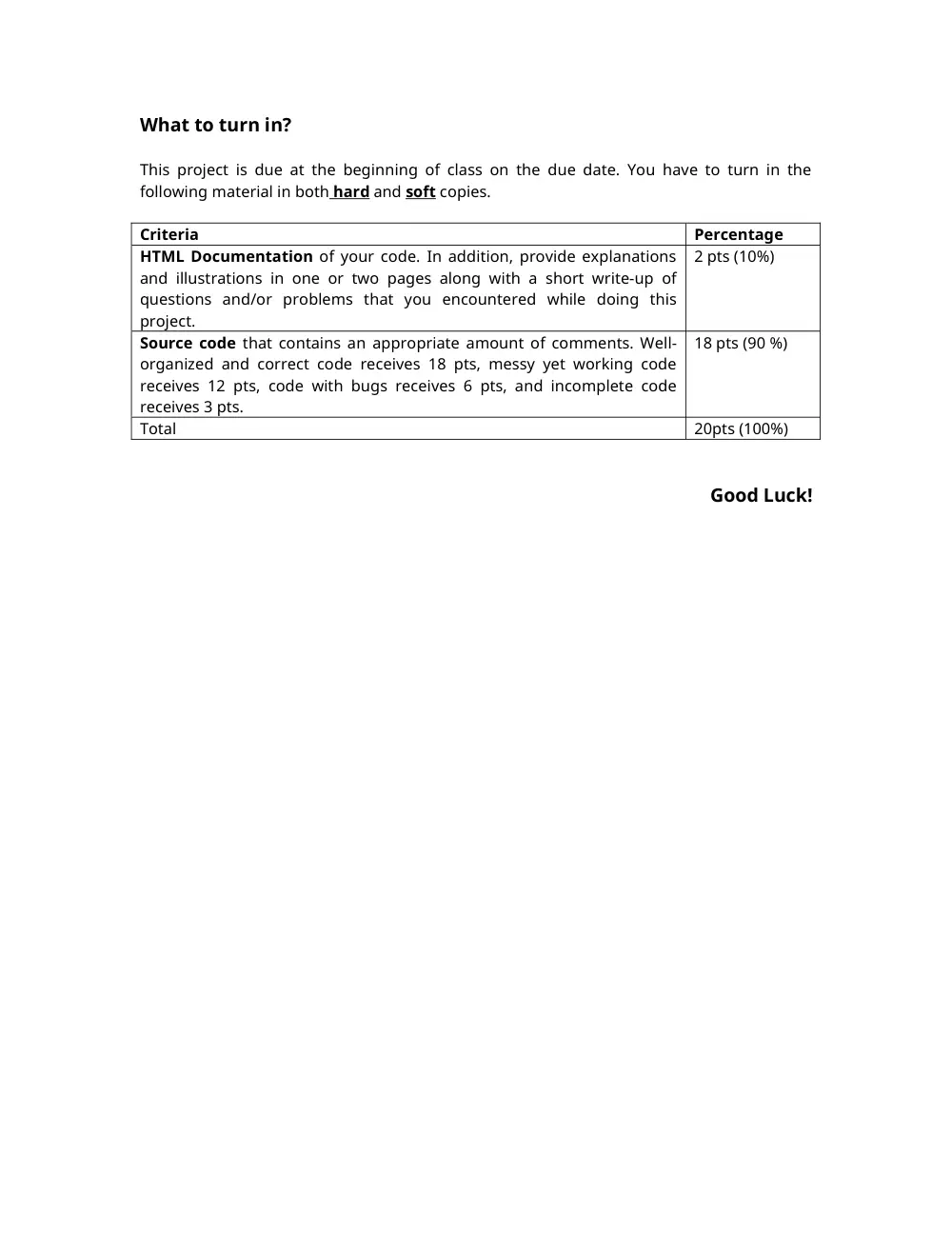
What to turn in?
This project is due at the beginning of class on the due date. You have to turn in the
following material in both hard
and soft copies.
Criteria
Percentage
HTML Documentation of your code. In addition, provide explanations
and illustrations in one or two pages along with a short write-up of
questions and/or problems that you encountered while doing this
project.
2 pts (10%)
Source code that contains an appropriate amount of comments. Well-
organized and correct code receives 18 pts, messy yet working code
receives 12 pts, code with bugs receives 6 pts, and incomplete code
receives 3 pts.
18 pts (90 %)
Total
20pts (100%)
Good Luck!