
COE 799 Problems In Class, Fall 2011
Lebanese American University · Optical Networks · 2 pages · Dr. Wissam Fawaz
More COE 799 files
Show the text of this problems
Problem I
Consider an optical fiber with an attenuation of 0.2 dB/km. The transmitter power is 1 mW
and the receiver sensitivity is 10-5 mW. What is the maximum length of the optical link,
assuming that there are no amplifiers? (Sensitivity: min power needed to detect the signal).
Problem II
An access network, also known as the first mile network is used to connect the service
provider central office to residential subscribers. The next wave of access networks promise
to bring fiber closer to the home providing potential for unprecedented bandwidth to end
users.
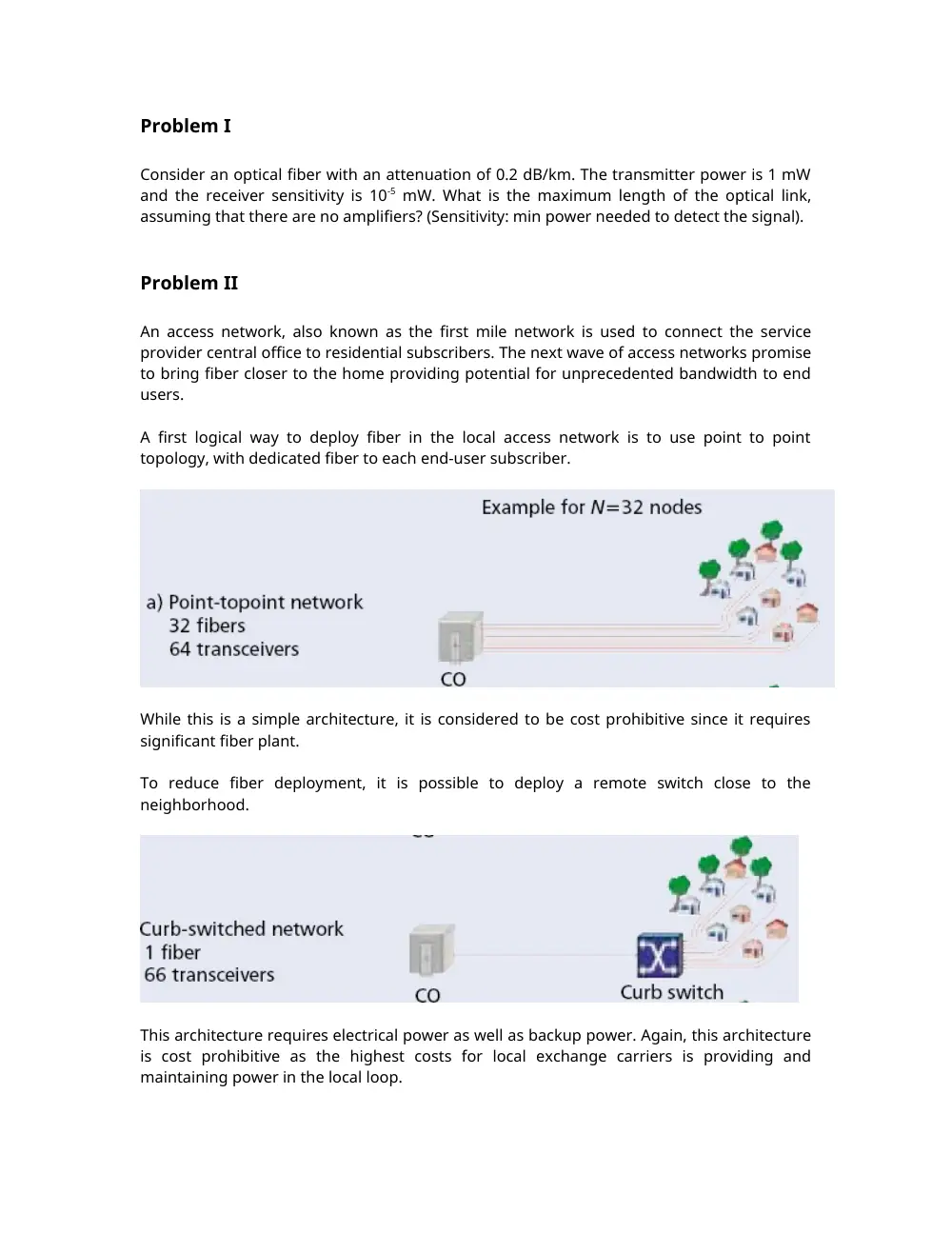
A first logical way to deploy fiber in the local access network is to use point to point
topology, with dedicated fiber to each end-user subscriber.
While this is a simple architecture, it is considered to be cost prohibitive since it requires
significant fiber plant.
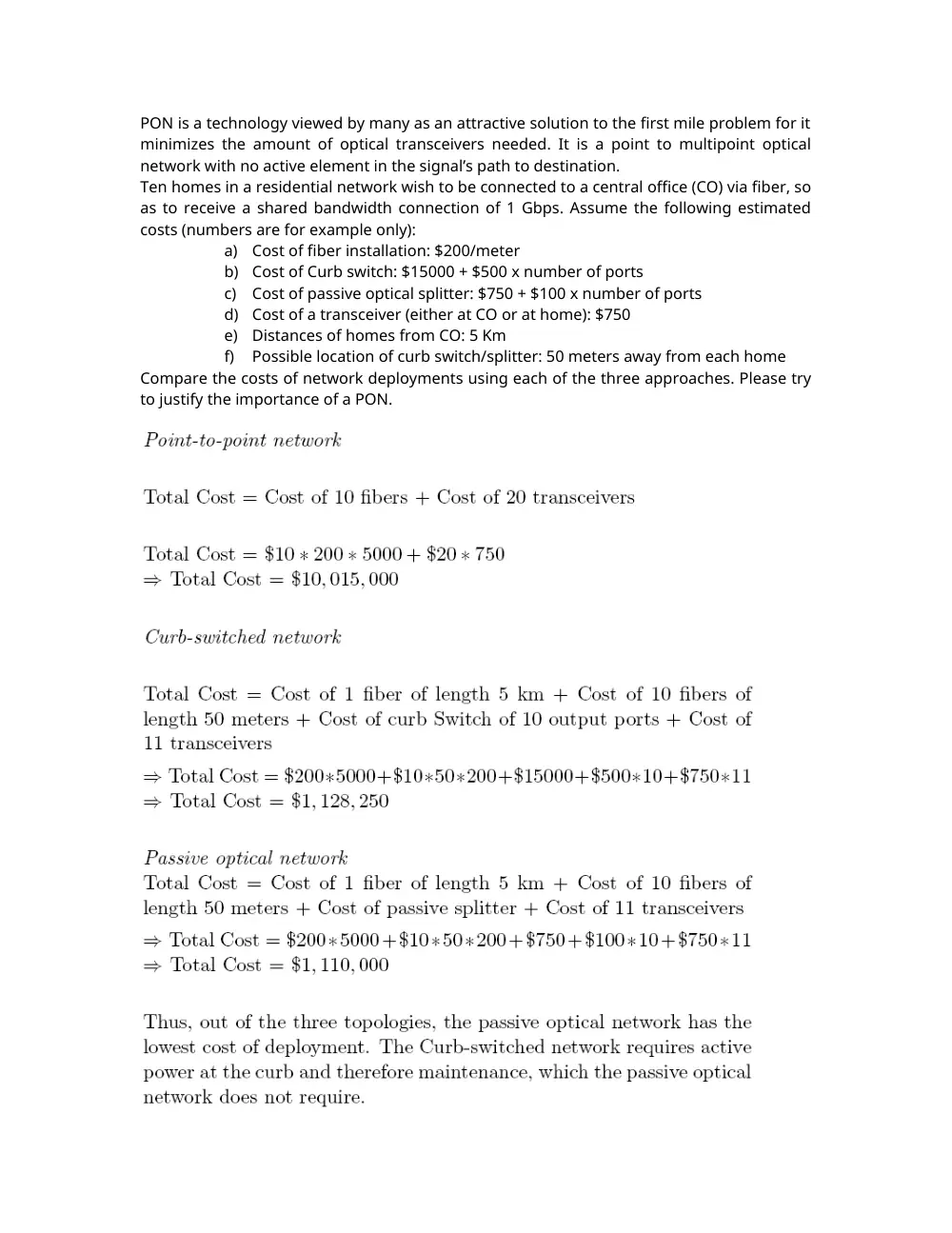
To reduce fiber deployment, it is possible to deploy a remote switch close to the
neighborhood.
This architecture requires electrical power as well as backup power. Again, this architecture
is cost prohibitive as the highest costs for local exchange carriers is providing and
maintaining power in the local loop.
PON is a technology viewed by many as an attractive solution to the first mile problem for it
minimizes the amount of optical transceivers needed. It is a point to multipoint optical
network with no active element in the signal’s path to destination.
Ten homes in a residential network wish to be connected to a central office (CO) via fiber, so
as to receive a shared bandwidth connection of 1 Gbps. Assume the following estimated
costs (numbers are for example only):
a)
Cost of fiber installation: $200/meter
b)
Cost of Curb switch: $15000 + $500 x number of ports
c)
Cost of passive optical splitter: $750 + $100 x number of ports
d)
Cost of a transceiver (either at CO or at home): $750
e)
Distances of homes from CO: 5 Km
f)
Possible location of curb switch/splitter: 50 meters away from each home
Compare the costs of network deployments using each of the three approaches. Please try
to justify the importance of a PON.