
CSC 310 Lab 6, Spring 2016
Lebanese American University · Algorithms & Data Structures · 3 pages · Dr. Faisal Abu-Khzam

More CSC 310 files
Show the text of this lab
LEBANESE AMERICAN UNIVERSITY
School of Arts and Science
Department of Computer Science and Mathematics
CSC 310: Algorithms and Data Structures
Lab VI
26. Feb. 2016
Problem 1
Given an array of integers, sort it using the bucket sort algorithm.
Input
Your program will be tested against multiple test cases. Each test case is made up of two lines.
The first line contains an integer N representing the number of integers. The second line has N
integers to be added to the array.
Output
For each test case, print the sorted array.
Sample Input
Sample Output
7
25 13 10 30 15 27 37
4
7 6 8 9
6
10 7 15 13 4 6
10 13 15 25 27 30 37
6 7 8 9
4 6 7 10 13 15
Problem 2
Given an array of integers, sort it using the radix sort algorithm.
Input
Your program will be tested against multiple test cases. Each test case is made up of two lines.
The first line contains an integer N representing the number of integers. The second line has N
integers to be added to the array.
Output
For each test case, print the sorted array.
Sample Input
Sample Output
7
25 13 10 30 15 27 37
4
7 6 8 9
6
10 7 15 13 4 6
10 13 15 25 27 30 37
6 7 8 9
4 6 7 10 13 15
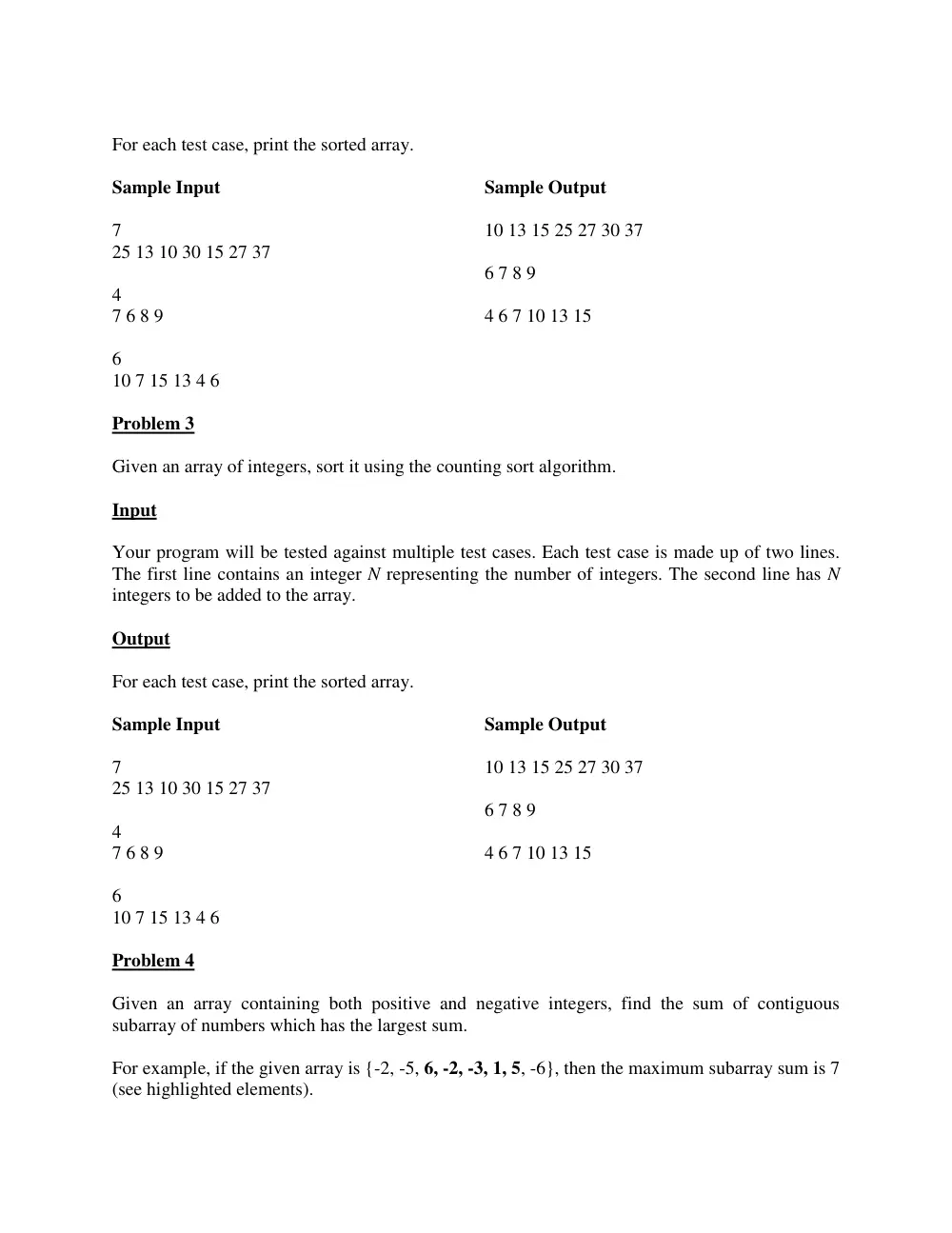
Problem 3
Given an array of integers, sort it using the counting sort algorithm.
Input
Your program will be tested against multiple test cases. Each test case is made up of two lines.
The first line contains an integer N representing the number of integers. The second line has N
integers to be added to the array.
Output
For each test case, print the sorted array.
Sample Input
Sample Output
7
25 13 10 30 15 27 37
4
7 6 8 9
6
10 7 15 13 4 6
10 13 15 25 27 30 37
6 7 8 9
4 6 7 10 13 15
Problem 4
Given an array containing both positive and negative integers, find the sum of contiguous
subarray of numbers which has the largest sum.
For example, if the given array is {-2, -5, 6, -2, -3, 1, 5, -6}, then the maximum subarray sum is 7
(see highlighted elements).
Note: your solution should be in O(n log n)
Input
Your program will be tested against multiple test cases. Each test case is made up of two lines.
The first line contains an integer N representing the number of integers. The second line has N
integers to be added to the array.
Output
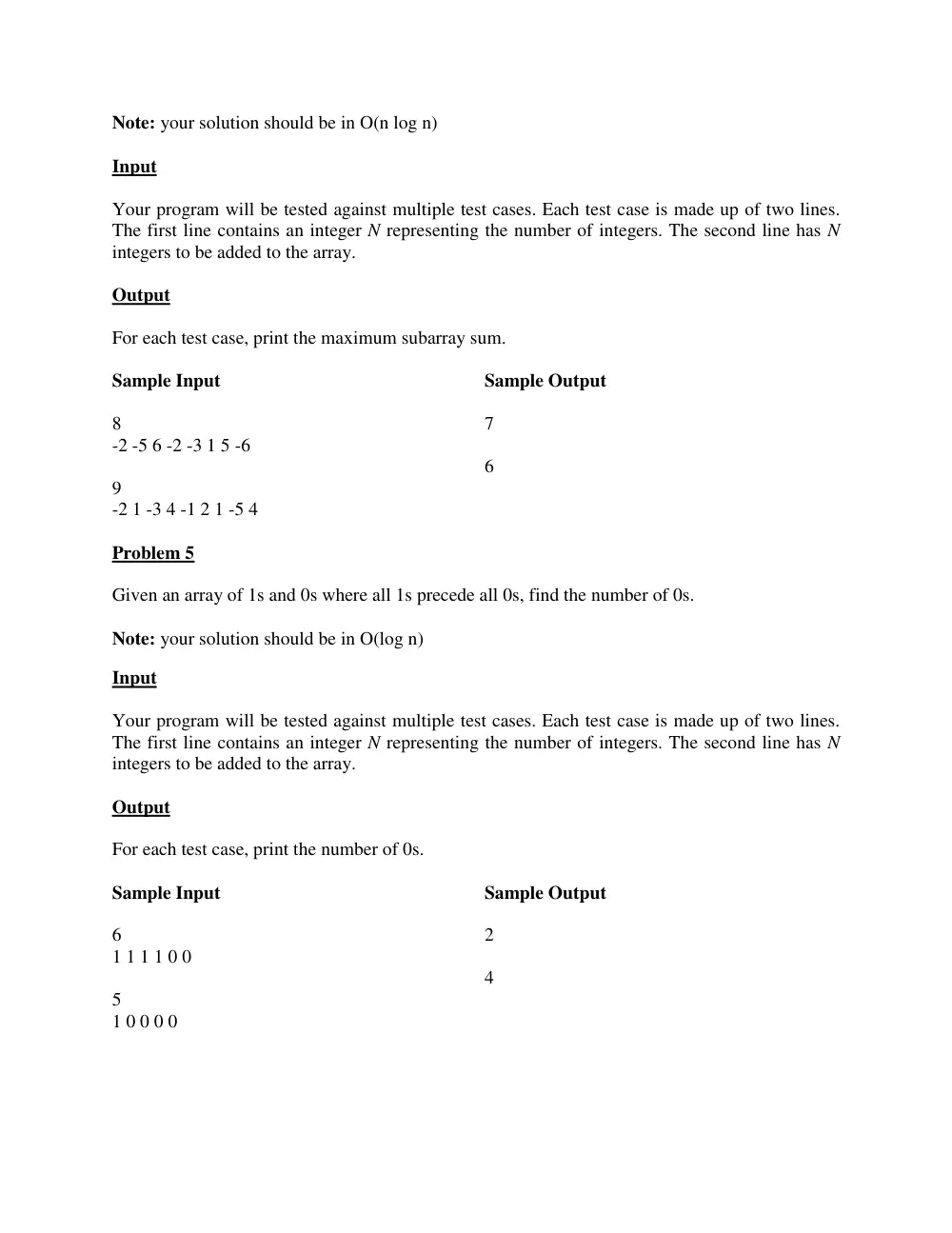
For each test case, print the maximum subarray sum.
Sample Input
Sample Output
8
-2 -5 6 -2 -3 1 5 -6
9
-2 1 -3 4 -1 2 1 -5 4
7
6
Problem 5
Given an array of 1s and 0s where all 1s precede all 0s, find the number of 0s.
Note: your solution should be in O(log n)
Input
Your program will be tested against multiple test cases. Each test case is made up of two lines.
The first line contains an integer N representing the number of integers. The second line has N
integers to be added to the array.
Output
For each test case, print the number of 0s.
Sample Input
Sample Output
6
1 1 1 1 0 0
5
1 0 0 0 0
2
4