
CSC 310 Lab 9, Spring 2016
Lebanese American University · Algorithms & Data Structures · 5 pages · Dr. Faisal Abu-Khzam
More CSC 310 files
Show the text of this lab
LEBANESE AMERICAN UNIVERSITY
School of Arts and Science
Department of Computer Science and Mathematics
CSC 310: Algorithms and Data Structures
Lab IX
07. Apr. 2016
Problem 1
Given two sequences of characters, you are required to find the length of the longest common
subsequence present in both of them.
Input
Your program will be tested against multiple test cases. Each test case is composed of two
strings S1 and S2 representing the sequences.
Output
For each test case, print the length of the longest common subsequence.
Sample Input
Sample Output
ABCD
BACD
AGCAT
GAC
XMJYAUZ
MZJAWXU
3
2
4
Problem 2
Given an undirected graph G and an integer k, you should determine whether G is k-colorable or
not.
Input
Your program will be tested against multiple test cases. Each test case begins with three integers
n, e, and k representing the number of vertices, edges, and colors respectively. The next e lines
represent the vertices that are connected by an edge.
Output
For each test case, print “yes” if G is k-colorable; else print “no”.
Sample Input
Sample Output
10 15 3
0 1
0 4
0 5
1 2
1 6
2 3
2 7
3 4
3 8
4 9
5 7
5 8
6 8
6 9
7 9
5 10 4
0 1
0 2
0 3
0 4
1 2
1 3
1 4
2 3
2 4
3 4
yes
no
Problem 3
A magic square is an arrangement of numbers (integers in our case) in a square grid, where the
numbers in each row, each column and the numbers in the forward and backward main
diagonals, all sum up to the same number.
You have been given an incomplete magic square (with a size from 3 to 5). With your coding
skills, you must finish the square. It must be a normal magic square and contain integers from 1
to n2 without repeating.
Input
Your program will be tested against multiple test cases. Each test case begins with an integer n
representing the size of the square. The next n lines will each contain n integers representing the
numbers in the square. A value of zero indicates an empty cell that needs to be filled up.
Output
For each test case, print the square after filling it up.
Sample Input
Sample Output
3
0 7 0
9 0 1
4 3 0
4
1 15 14 4
12 0 0 9
8 0 0 5
13 3 2 16
2 7 6
9 5 1
4 3 8
1 15 14 4
12 6 7 9
8 10 11 5
13 3 2 16
Problem 4
Given two integers n and k, you are required to enumerate all binary strings of length n that have
exactly k ones.
Input
Your program will be tested against multiple test cases. Each test case is composed of two
integers n and k, representing the length of the string and the number of ones.
Output
For each test case, print the enumerations.
Sample Input
Sample Output
3 1
3 2
001
010
100
011
101
110
Problem 5
Given a numerical triangle, you are required to find the maximum total of the sum of numbers
from the top to the bottom of the triangle. From each number in the triangle, you can only add to
it the number directly below it or the number to the right of the number below it. For example,
given the following numerical triangle,
3
7 4
2 4 6
6 5 9 3
The maximum total from top to bottom is 3 + 7 + 4 + 9 = 23.
Input
Your program will be tested against multiple test cases. Each test case begins with an integer n
representing the number of rows in the triangle. The next n lines contain the numbers on each
row.
Output
For each test case, print the maximum total.
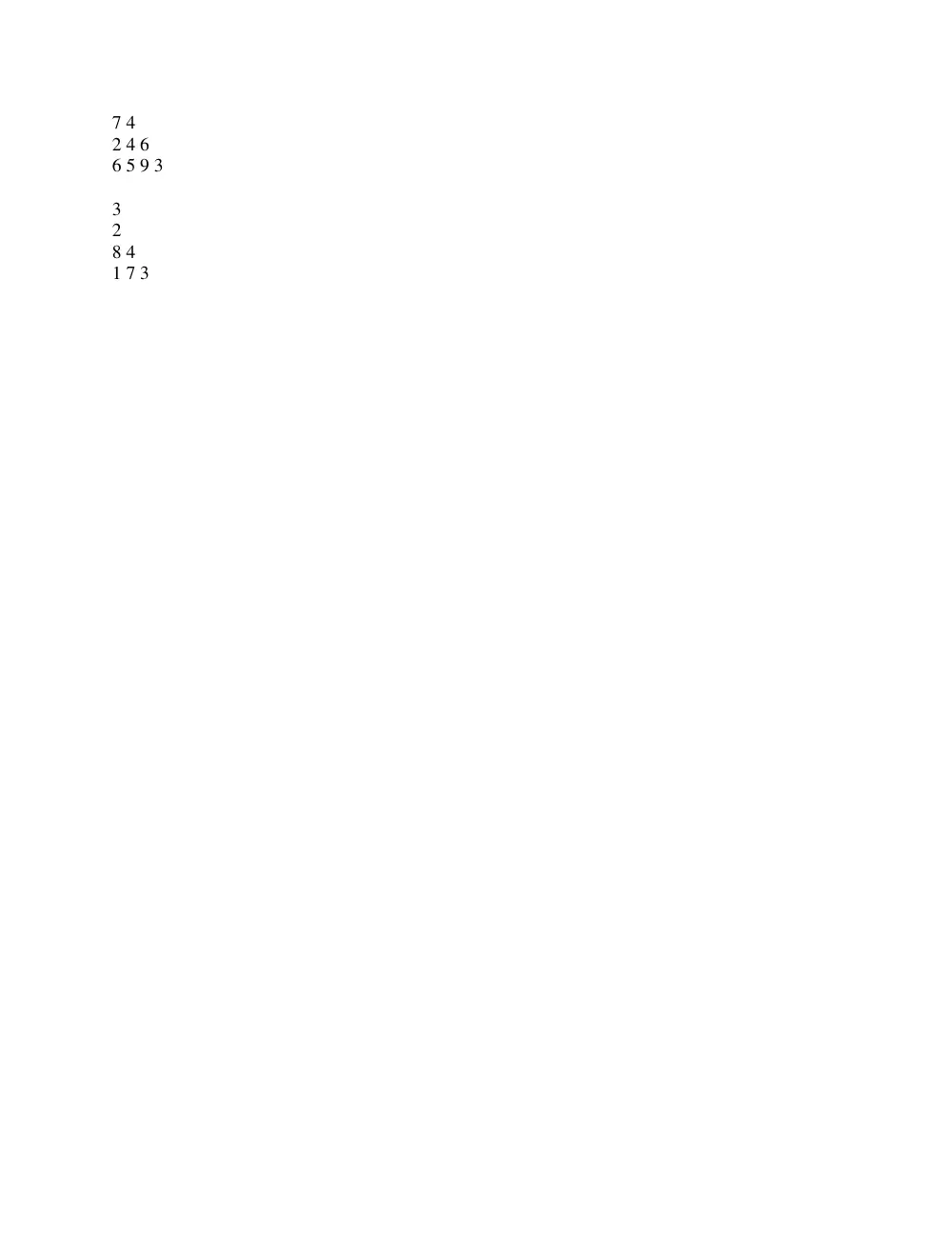
Sample Input
4
3
Sample Output
23
17
7 4
2 4 6
6 5 9 3
3
2
8 4
1 7 3