
CSC 310 Notes for Final, Fall 2018
Lebanese American University · Algorithms & Data Structures · 13 pages


Showing the first 10 of 13 pages. Download the PDF to see all of it.
More CSC 310 files
Show the text of this final exam
Graphs:
DFS (Depth First Search) and BFS (Breadth First Search) are search algorithms used for
graphs and trees.
Breadth-first search (BFS) : starts at the tree root and explores the neighbor nodes first,
before moving to the next level neighbors.
Start from node s.
Visit all neighbors of node s.
Then visit all of their neighbors, if not already visited
Continue until all nodes visited
Depth-first search (DFS) : the idea is to travel as deep as possible from neighbor to
neighbor before backtracking.
First visit all nodes reachable from node s (ie visit neighbors of s and their neighbors)
Then visit all (unvisited) nodes that are neighbors of s
Repeat until all nodes are visited
A directed graph G, is a pair (V, E) where V is a set of vertices (nodes) and E is a set of directed
edges. A directed graph is often called a digraph.
An undirected graph is also a pair (V,E) where V is the set of vertices and E is the set of edges.
Edges are bi-directional. A to B then B to A.
A directed edge is an edge from one vertex to another. Sometimes called arcs.
A symmetric diagraph is a directed graph in which every directed edge has a reserve edge: a to
b then b to a.
Adjacent: Two vertices a and b are adjacent if there is an edge connecting them.
Neighborhood NG(v), of a vertex v in G is the set of vertices that are adjacent to it.
Vertices u and v are neighbors if they are adjacent. So we say v is a neighbor of u and u is a
neighbor of v. Every vertex have (n-1) neighbors.
Two vertices u and v are neighbors if they are adjacent.
Incident: Edges connecting a vertex v to its neighbors are said to be incident on v.
Degree of a vertex v is the number of edges incident on v . (the sum of degree = 2 * (no of
edges).
The minimum degree of a vertex in a graph G is called the minimum degree of G, denoted δ(G).
The maximum degree of G is the maximum among all the vertex degrees in G. It is denoted Δ(G).
Planar graph: a graph without edge crossing(K4)
Smallest non-planar with 5 vert
Any non-Planar graph contains K5 or K3,3
A subgraph of G is a graph G’= (V’, E’) where V’ is a subset of V and E’ is a subset of E.
it is zero or more vertex/edges deletion.
A proper subgraph of G is a subgraph G’ of G such that: G’ ≠ G and G’ different from empty
set.
An induced subgraph: its only obtained by vertex deletion , if an edge exist in G the its must
exist in the induced subgraph
Handshaking Lemma: The sum of degrees in a graph is twice the number of edges.
number of edges is n(n-1)/2 by handshaking
A complete graph is an undirected graph such that any two vertices are connected (adjacent).The
complete graph on n vertices is denoted by Kn.
Clique: a complete subgraph
Path: graph (or subgraph) whose vertices can be ordered so that two vertices are adjacent if and
only if they are consecutive in the list.Where all nodes in subgraph are connected to every other
node in that subgraph. We often denote a path of length n by Pn
Cycles: Cn: equal number of vertices and edges. Cycle in a diagraph is a non-empty path form
one vertex back to itself.
Acyclic: Graph with no cycle.
Reachable: a vertex is reachable from another vertex if there is a path between them.
Connected components: Maximal connected subgraphs of a graph are the connected
components of the graph
Strongly connected: A diagraph is strongly connected if there’s is a path between every pair of
vertices
Tree: Connected ,not cycle.
Forest: not connected, not cycle
Topological order: is a sequence of vertices that can be visited when traversing a DAG(Directed
acyclic graph.
If a digraph has a cycle, it has no topological order
An adjacency list of a vertex v ∈Vis the list Adj[v]of vertices adjacent to v
A shortest path from u to v is a path of minimum weight from u to v. The shortest-path weight
from u to v is defined as δ .
A subpath of a shortest path is a shortest path.
If a graph G contains a negative-weight cycle, then some shortest paths may not exist.
If all edge weights w(u, v)are nonnegative, all shortest-path weights must exist.
The Bellman–Ford algorithm is an algorithm that computes shortest paths from a single source
vertex to all of the other vertices in a weighted digraph.
Bellman–Ford can be used on graphs with negative edge weights, as long as the graph
contains no negative cycle reachable from the source vertex s.
https://www.youtube.com/watch?v=iTW2yFYd1Nc
A minimum spanning tree: A minimum spanning tree (MST) is the tree subgraph T of G such
that it (a) contains all vertices of G and (b) has the minimum sum of edge weights.
A single graph can have many different spanning trees.
An algorithm employed to find minimum spanning trees is Prim’s algorithm.
A spanning subgraph of a graph G is one that contains all vertices of G, but “may”not contain
all edges.
the cost of a spanning tree is the sum of the weights of all its edges.
A problem is said to have optimal substructure if an optimal solution can be constructed
efficiently from optimal solutions of its subproblems. This property is used to determine the
usefulness of dynamic programming and greedy algorithms for a problem.
Optimization problem: Seeking for the best possible solution with the least or best cost
Dynamic Programming:
In one sense, dynamic programming can be thought of as the opposite of divide-and-conquer.
Instead of starting from a top-down, divide-and-conquer approach (like recursion), dynamic
programming instead solves the smallest subproblems first. It then caches these smallest solutions
into a table and uses those solutions to progressively solve the next-larger-set of problems. A
dynamic programming is a bottom-up solution method, in contrast to recursion as a top-down
solution method.
A dynamic programming is a method for solving a complex problem by breaking it down
into a collection of simpler subproblems, solving each of those subproblems just once
Dp applies under 2 conditions:
1- Optimal substructure: an optimal solution can be constructed efficiently from the optimal
solution of the subproblems.
A given problems has Optimal Substructure Property if optimal solution of the given
problem can be obtained by using optimal solutions of its subproblems.
For example the shortest path problem has following optimal substructure property: If a
node x lies in the shortest path from a source node u to destination node v then the
shortest path from u to v is combination of shortest path from u to x and shortest path
from x to v.
2- Overlapping subproblems: Revisiting and solving the same problem repeatedly
overlapping subproblems (problem can be broken down into subproblems which are
reused several times)
The longest common subsequence (LCS) problem is the problem of finding the
longest subsequence common to all sequences in a set of sequences.
https://www.youtube.com/watch?v=P-mMvhfJhu8
Code:
public static int longestCS(char str1[], char str2[], int length[][]) {
int m = str1.length;
int n = str2.length;
for (int i = 1; i < m; i++)
for (int j = 1; j < n; j++) {
if (str1[i] == str2[j])
length[i][j] = length[i-1][j-1] + 1;
else if (length[i-1][j] >= length[i][j-1])
length[i][j] = length[i-1][j];
else
length[i][j] = length[i][j-1]; }
return length[m-1][n-1];} }
The longest increasing subsequence (LIS) problem is to find a subsequence of a
given sequence in which the subsequence's elements are in sorted order, lowest to highest, and in
which the subsequence is as long as possible.
https://www.youtube.com/watch?v=CE2b_-XfVDk
Code:
public static int LongestIS(int A[], int n) {
int sol[] = new int[n];
int ans = 0;
sol[0] = 1;
for (int i = 1; i < n; i++) {
sol[i] = 1;
for (int j = 0; j < i; j++)
if (A[j] < A[i])
if (sol[i] < sol[j] + 1)
sol[i] = sol[j] + 1;
if (ans < sol[i])
ans = sol[i]; }
return ans ;}}
Dijkstra's algorithm is an algorithm for finding the shortest paths between nodes in a graph,
which may represent, for example, road networks
From a dynamic programming point of view, Dijkstra's algorithm is a successive
approximation scheme that solves the dynamic programming functional equation for the shortest
path problem by the Reaching method
https://www.youtube.com/watch?v=WN3Rb9wVYDY
The pseudo code:
while Q ≠∅
do u ←EXTRACT-MIN(Q)
S←S∪{u}
(SAME AS SLIDES)
for each v ∈Adj[u]
do if d[v] > d[u] + w(u, v)
then d[v] ←d[u] + w(u, v)
The knapsack problem is a problem in combinatorial optimization(is a topic that consists of
finding an optimal object from a finite set of objects) Ex:Given a set of items, each with a weight
and a value, determine the number of each item to include in a collection so that the total weight
is less than or equal to a given limit and the total value is as large as possible. (slides)
Meaning, given n items of weight wi and value vi find the items that should be taken such
that the weight is less than the maximum weight W and the corresponding total value is
maximum.
Greedy:
A greedy algorithm always makes the choice that looks best at the moment. That ism it makes a
locally optimal choice in the hope that his choice will lead to a globally optimal solution. A
greedy algorithm obtains an optimal solution to a problem by making a sequence of choices. At
each decision point, the algorithm makes choice that seems best at the moment. This decision
does not always lead to an optimal solution.
A greedy algorithm is an algorithm that follows the problem solving heuristic of
making the locally optimal choice at each stage with the hope of finding a global
optimum. (a heuristic is a technique designed for solving a problem more quickly )
A greedy algorithm always makes the choice that looks best at the moment
Prim's algorithm is a greedy algorithm that finds a minimum spanning tree for
a weighted undirected graph. This means it finds a subset of the edges that forms a tree that
includes every vertex, where the total weight of all the edges in the tree is minimized. The
algorithm operates by building this tree one vertex at a time, from an arbitrary starting vertex, at
each step adding the cheapest possible connection from the tree to another vertex.
https://www.youtube.com/watch?v=z1L3rMzG1_A
The pseudo code:
Q←V
key[v] ←∞ for all v ∈V
key[s] ←0 for some arbitrary s ∈V
while Q≠∅
(SAME AS SLIDES)
do u← EXTRACT-MIN(Q)
for each v ∈Adj[u]
do if v ∈Q and w(u, v) < key[v]
then key[v] ←w(u, v)
[v] ←u degree
Kruskal's algorithm is a minimum-spanning-tree algorithm where the algorithm finds an edge
of the least possible weight that connects any two trees in the forest. It is a greedy algorithm in
graph theory as it finds a minimum spanning tree for a connected weighted graph adding
increasing cost arcs at each step.
https://www.youtube.com/watch?v=71UQH7Pr9kU
CHECK THE SLIDES EXAMPLE
Greedy AND Dynamic programming:
In dynamic programming, we make a choice at each step, but the choice may depend on
solutions to subproblems. In a greedy algorithm, we make whatever choice seems best at the
moment and then solve the subproblems arising after the choice is made. The choice made by a
greedy algorithm may depend on choices made so far, but it cannot depend on any future
choices or on the solutions to subproblems. Thus, unlike dynamic programming, which solves
the subproblems bottom up, a greedy strategy usually progresses in top-down fashion, making
one greedy choice after another, iteratively reducing each given problem instance to a smaller
one.
Greedy vs. Dynamic programming:
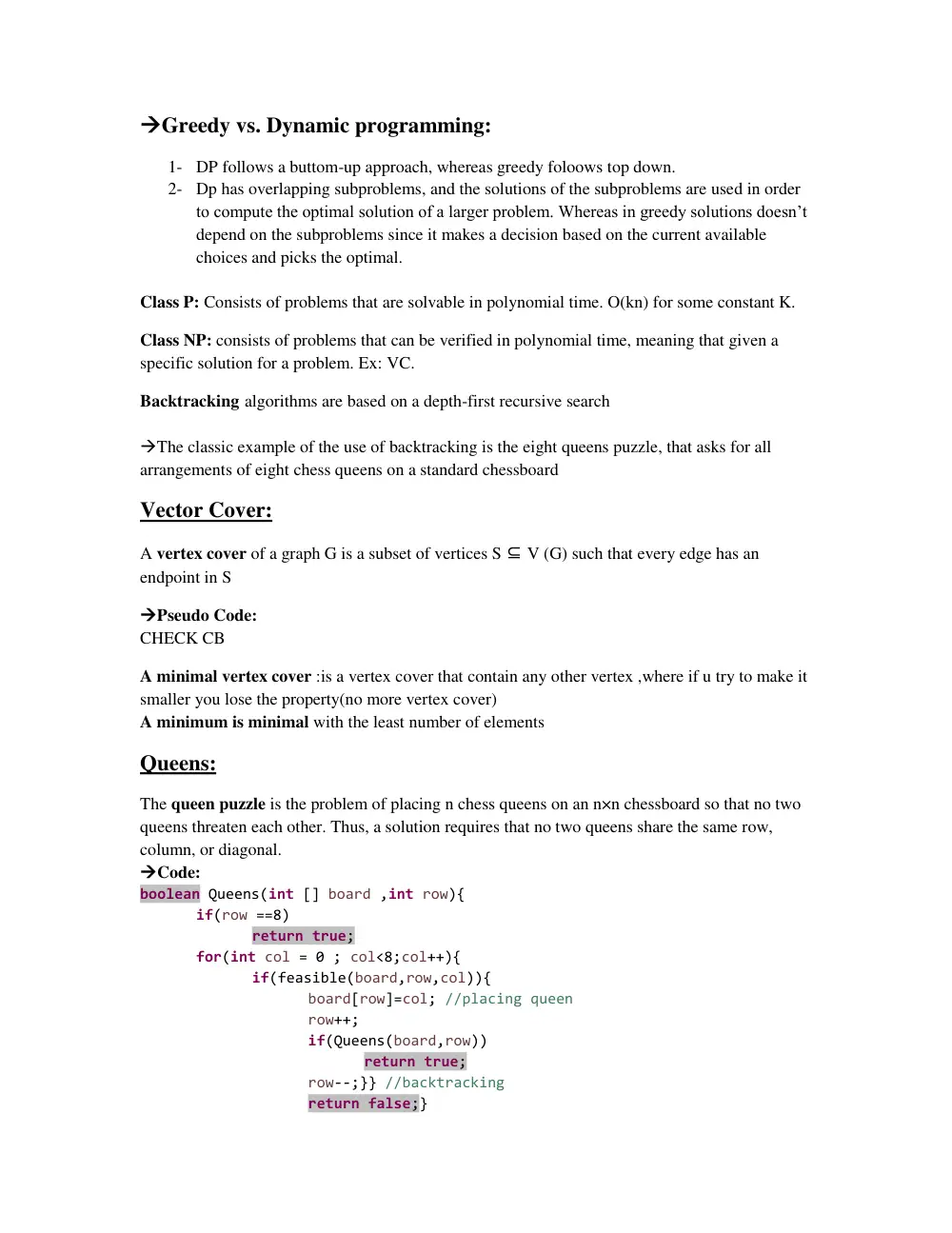
1- DP follows a buttom-up approach, whereas greedy foloows top down.
2- Dp has overlapping subproblems, and the solutions of the subproblems are used in order
to compute the optimal solution of a larger problem. Whereas in greedy solutions doesn’t
depend on the subproblems since it makes a decision based on the current available
choices and picks the optimal.
Class P: Consists of problems that are solvable in polynomial time. O(kn) for some constant K.
Class NP: consists of problems that can be verified in polynomial time, meaning that given a
specific solution for a problem. Ex: VC.
Backtracking algorithms are based on a depth-first recursive search
The classic example of the use of backtracking is the eight queens puzzle, that asks for all
arrangements of eight chess queens on a standard chessboard
Vector Cover:
A vertex cover of a graph G is a subset of vertices S ⊆ V (G) such that every edge has an
endpoint in S
Pseudo Code:
CHECK CB
A minimal vertex cover :is a vertex cover that contain any other vertex ,where if u try to make it
smaller you lose the property(no more vertex cover)
A minimum is minimal with the least number of elements
Queens:
The queen puzzle is the problem of placing n chess queens on an n×n chessboard so that no two
queens threaten each other. Thus, a solution requires that no two queens share the same row,
column, or diagonal.
Code:
boolean Queens(int [] board ,int row){
if(row ==8)
return true;
for(int col = 0 ; col<8;col++){
if(feasible(board,row,col)){
board[row]=col; //placing queen
row++;
if(Queens(board,row))
return true;
row--;}} //backtracking
return false;}
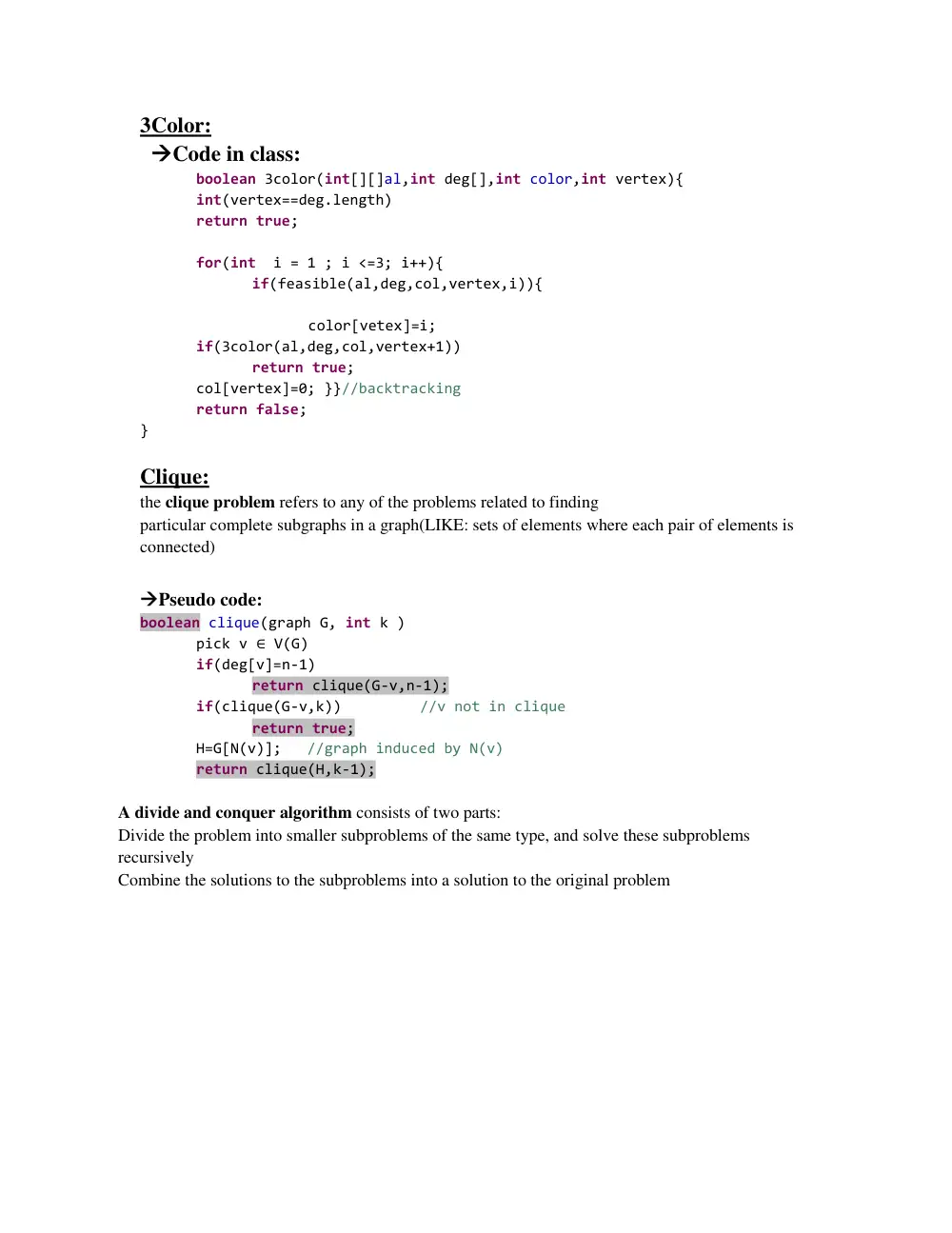
3Color:
Code in class:
boolean 3color(int[][]al,int deg[],int color,int vertex){
int(vertex==deg.length)
return true;
for(int i = 1 ; i <=3; i++){
if(feasible(al,deg,col,vertex,i)){
color[vetex]=i;
if(3color(al,deg,col,vertex+1))
return true;
col[vertex]=0; }}//backtracking
return false;
}
Clique:
the clique problem refers to any of the problems related to finding
particular complete subgraphs in a graph(LIKE: sets of elements where each pair of elements is
connected)
Pseudo code:
boolean clique(graph G, int k )
pick v ∈ V(G)
if(deg[v]=n-1)
return clique(G-v,n-1);
if(clique(G-v,k))
//v not in clique
return true;
H=G[N(v)]; //graph induced by N(v)
return clique(H,k-1);
A divide and conquer algorithm consists of two parts:
Divide the problem into smaller subproblems of the same type, and solve these subproblems
recursively
Combine the solutions to the subproblems into a solution to the original problem
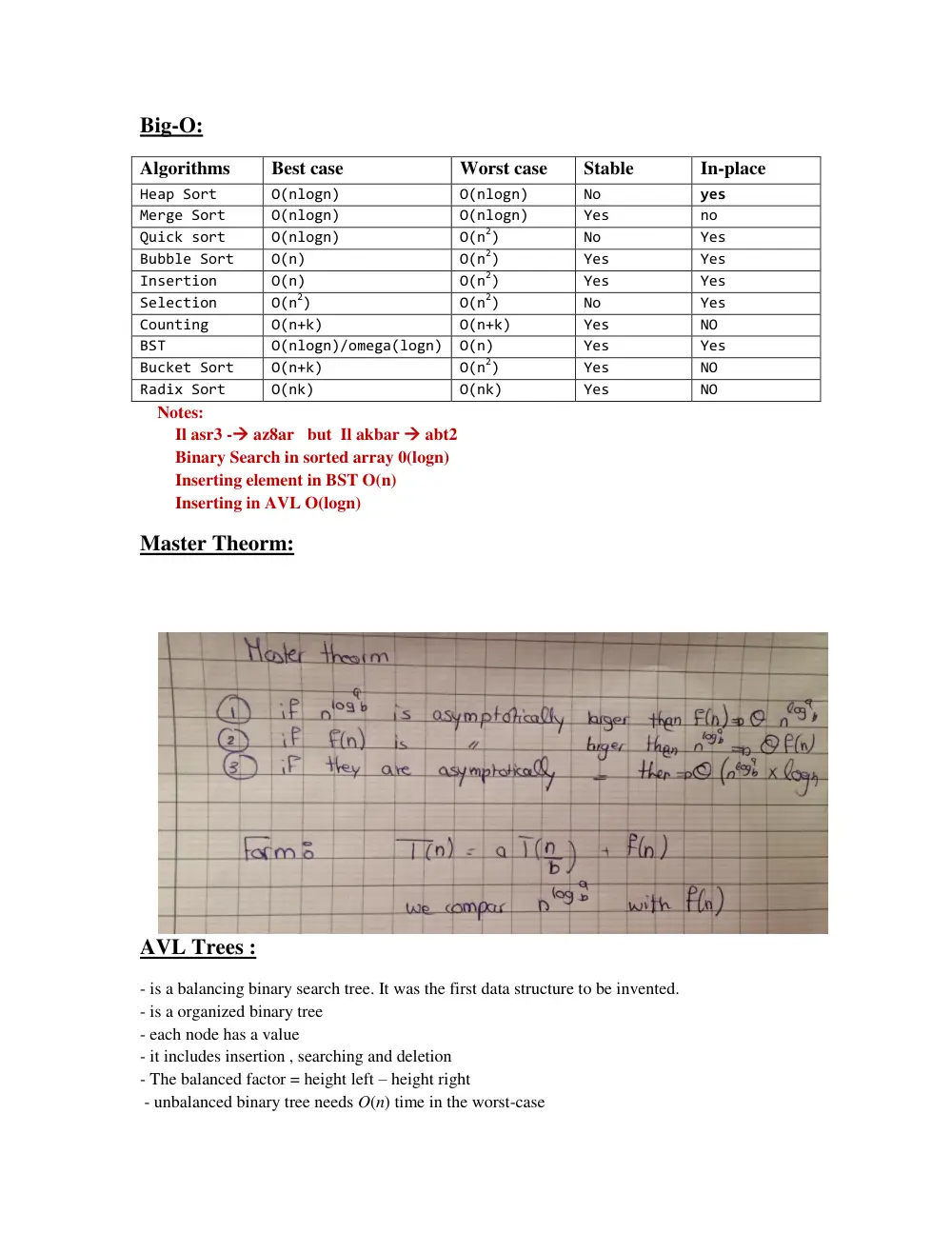
Big-O:
Algorithms
Best case
Worst case
Stable
In-place
Heap Sort
O(nlogn)
O(nlogn)
No
yes
Merge Sort
O(nlogn)
O(nlogn)
Yes
no
Quick sort
O(nlogn)
O(n2)
No
Yes
Bubble Sort
O(n)
O(n2)
Yes
Yes
Insertion
O(n)
O(n2)
Yes
Yes
Selection
O(n2)
O(n2)
No
Yes
Counting
O(n+k)
O(n+k)
Yes
NO
BST
O(nlogn)/omega(logn) O(n)
Yes
Yes
Bucket Sort
O(n+k)
O(n2)
Yes
NO
Radix Sort
O(nk)
O(nk)
Yes
NO
Notes:
Il asr3 - az8ar but Il akbar abt2
Binary Search in sorted array 0(logn)
Inserting element in BST O(n)
Inserting in AVL O(logn)
Master Theorm:
AVL Trees :
- is a balancing binary search tree. It was the first data structure to be invented.
- is a organized binary tree
- each node has a value
- it includes insertion , searching and deletion
- The balanced factor = height left – height right
- unbalanced binary tree needs O(n) time in the worst-case
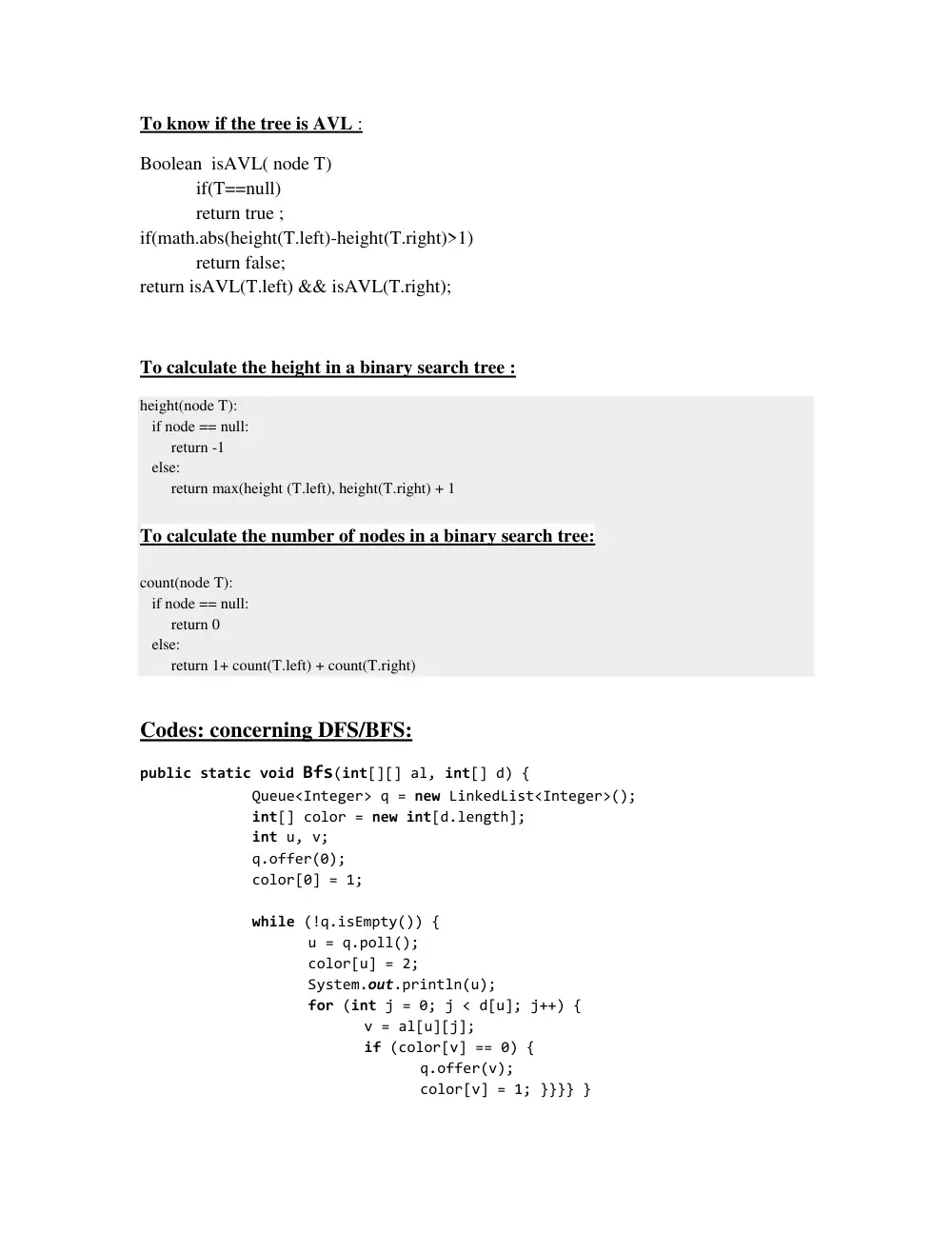
To know if the tree is AVL :
Boolean isAVL( node T)
if(T==null)
return true ;
if(math.abs(height(T.left)-height(T.right)>1)
return false;
return isAVL(T.left) && isAVL(T.right);
To calculate the height in a binary search tree :
height(node T):
if node == null:
return -1
else:
return max(height (T.left), height(T.right) + 1
To calculate the number of nodes in a binary search tree:
count(node T):
if node == null:
return 0
else:
return 1+ count(T.left) + count(T.right)
Codes: concerning DFS/BFS:
public static void Bfs(int[][] al, int[] d) {
Queue<Integer> q = new LinkedList<Integer>();
int[] color = new int[d.length];
int u, v;
q.offer(0);
color[0] = 1;
while (!q.isEmpty()) {
u = q.poll();
color[u] = 2;
System.out.println(u);
for (int j = 0; j < d[u]; j++) {
v = al[u][j];
if (color[v] == 0) {
q.offer(v);
color[v] = 1; }}}} }
public static void Dfs(int[][] al, int[] d){
Stack <Integer> q = new Stack<Integer>();
int[] color = new int[d.length];
int u, v;
q.push(0);
color[0] = 1;
while(!q.empty())
{
u = q.pop();
color[u] = 2;
System.out.println(u);
for(int j = 0; j < d[u]; j++)
{
v = al[u][j];
if(color[v] == 0)
{
q.push(v);
color[v] = 1; } } } }
public static void checkCycle(int al[][], int deg[]) {
int color[] = new int[deg.length];
Queue<Integer> q = new LinkedList<Integer>();
int u, v;
for (int i = 0; i < color.length; i++) {
if (color[i] == 0) {
q.offer(i);
color[i] = 1;
while (!q.isEmpty()) {
u = q.poll();
for (int j = 0; j < deg[u]; j++) {
v = al[u][j];
if (color[v] == 0) {
q.offer(v);
color[v] = 1;
} else {
System.out.print("has cycle");
return; } }
color[u] = 2; } } }
System.out.print("has no cycle"); } }
public static boolean bipartite(int al[][], int deg[]) {
int u, v;
Queue<Integer> q = new LinkedList<Integer>();
int color[] = new int[deg.length];
for (int i = 0; i < deg.length; i++) {
if (color[i] == 0) {
q.offer(i);
color[i] = 1;
while (!q.isEmpty()) {
u = q.poll();
for (int j = 0; j < deg[u]; j++) {
v = al[u][j];
if (color[v] == color[u])
return false;
if (color[v] == 0) {
q.offer(v);
color[v] = 3 - color[u];
} } } } }
return true; }
public static boolean BfsConnected(int[][] al, int deg[]) {
int[] color = new int[deg.length];
Queue<Integer> q = new LinkedList<Integer>();
int u, v, count = 0;
for (int i = 0; i < color.length; i++) {
if (color[i] == 0) {
count++;
if (count > 1) {
return false;
}
q.add(i);
color[i] = 1;
while (!q.isEmpty()) {
u = q.poll();
color[u] = 2;
for (int k = 0; k < deg[u]; k++) {
v = al[u][k];
if (color[v] == 0) {
q.add(v);
color[v] = 1; } } } } }
return true; }
Notes:
-In case of a planar graph we can use 4 colors
-Vertices can’t have same color
-Best algorithm for K coloring is : O *(2k) (exponential)
-Check from slides: activity selection, running time of prims…etc
+codes of recursion(C.B)
Code for MAX SUM(we did with yassin):
public class maxsum {
// i have a seq b2lbo number w bade le2e akbr sum bil array through subseq
// its dp
public static void main(String[] args) {
// TODO Auto-generated method stub
Scanner scan=new Scanner(System.in);
int n = scan.nextInt();
int [] array = new int[n];
for(int i=0;i<array.length;i++){
array[i]=scan.nextInt();
}
int [] sol = new int[n+1];
sol[0]=array[0];
for(int i = 1 ; i <array.length;i++){
if(array[i]>=0){
if(array[i-1] >=0){
sol[i]+=sol[i-1]+array[i];
}
else sol[i]=array[i];}
else sol[i]=array[i];
}
for(int i = 0 ; i <array.length;i++){
System.out.println(sol[i]+ " ");
}
System.out.println(); } }