
ECO 201 Final, Spring 2012
Lebanese American University · Microeconomics · 11 pages




Showing the first 10 of 11 pages. Download the PDF to see all of it.
More ECO 201 files
Show the text of this final exam
LEBANESE AMERICAN UNIVERSITY
Business School
Beirut
Microeconomics
(ECO 201)
Final Exam *
Spring 2007
Name:
ID:
Instructor:
Section:
Date: June 11, 2007
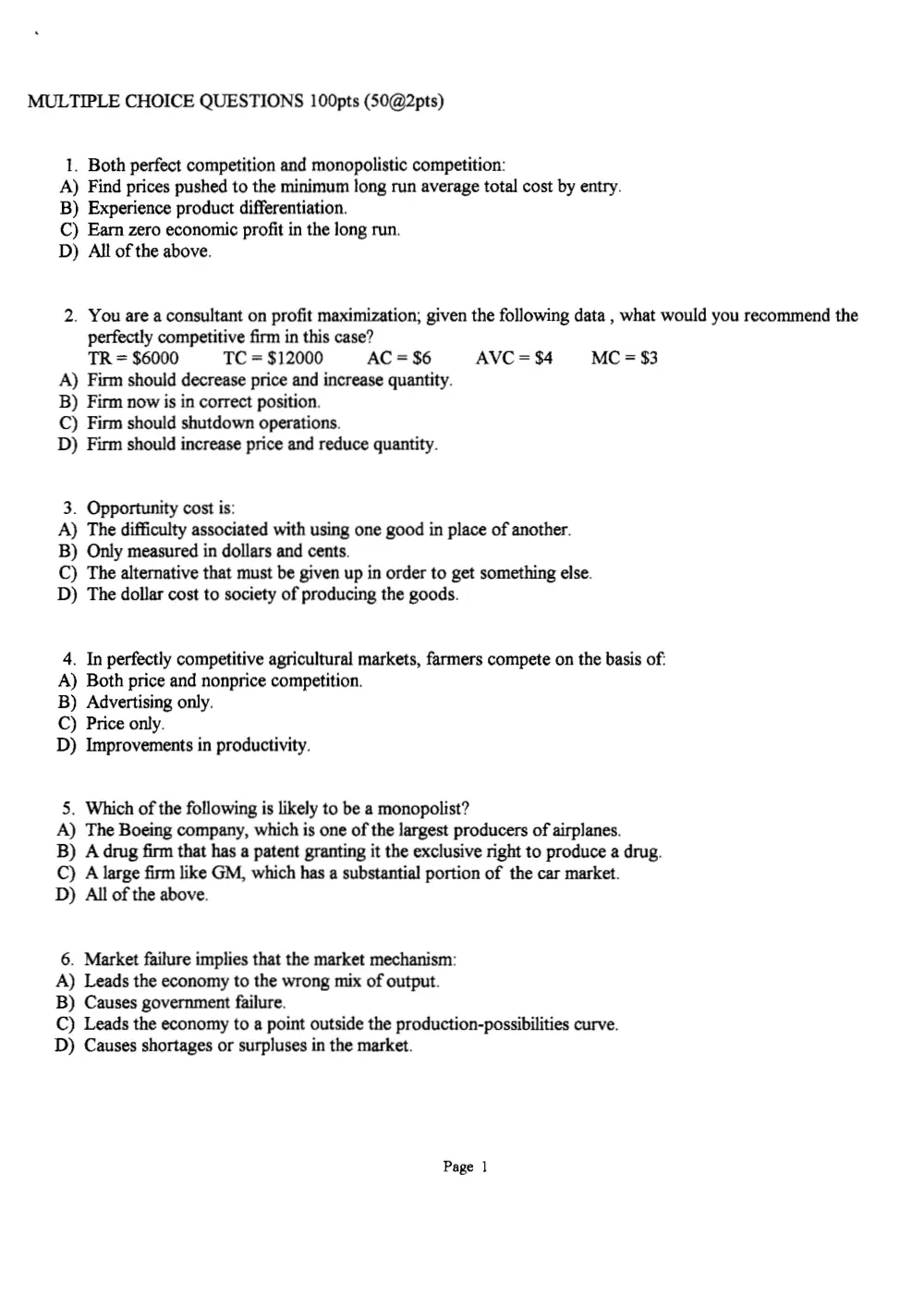
MULTIPLE CHOICE QUESTIONS 100pts (SO@2pts)
1. Both perfect competition and monopolistic competition:
A) Find prices pushed to the minimum long run average total cost by entry.
B) Experience product differentiation.
C) Earn zero economic profit in the long run.
D) All of the above.
2. You are a consultant on profit maximization; given the following data , what would you recommend the
perfectly competitive firm in this case?
TR = $6000 TC = $12000 AC = $6 AVC = $4 MC = $3
A) Firm should decrease price and increase quantity.
B) Firm now is in correct position.
C) Firm should shutdown operations.
D) Firm should increase price and reduce quantity.
3. Opportunity cost is:
A) The difficulty associated with using one good in place of another.
B) Only measured in dollars and cents.
C) The alternative that must be given up in order to get something else.
D) The dollar cost to society of producing the goods.
4. In perfectly competitive agricultural markets, farmers compete on the basis of:
A) Both price and nonprice competition.
B) Advertising only.
C) Price only.
D) Improvements in productivity.
5. Which of the following is likely to be a monopolist?
A) The Boeing company, which is one of the largest producers of airplanes.
B) A drug firm that has a patent granting it the exclusive right to produce a drug.
C) A large firm like GM, which has a substantial portion of the car market.
D) All of the above.
6. Market failure implies that the market mechanism:
A) Leads the economy to the wrong mix of output.
B) Causes government failure.
C) Leads the economy to a point outside the production-possibilities curve.
D) Causes shortages or surpluses in the market.
Page 1
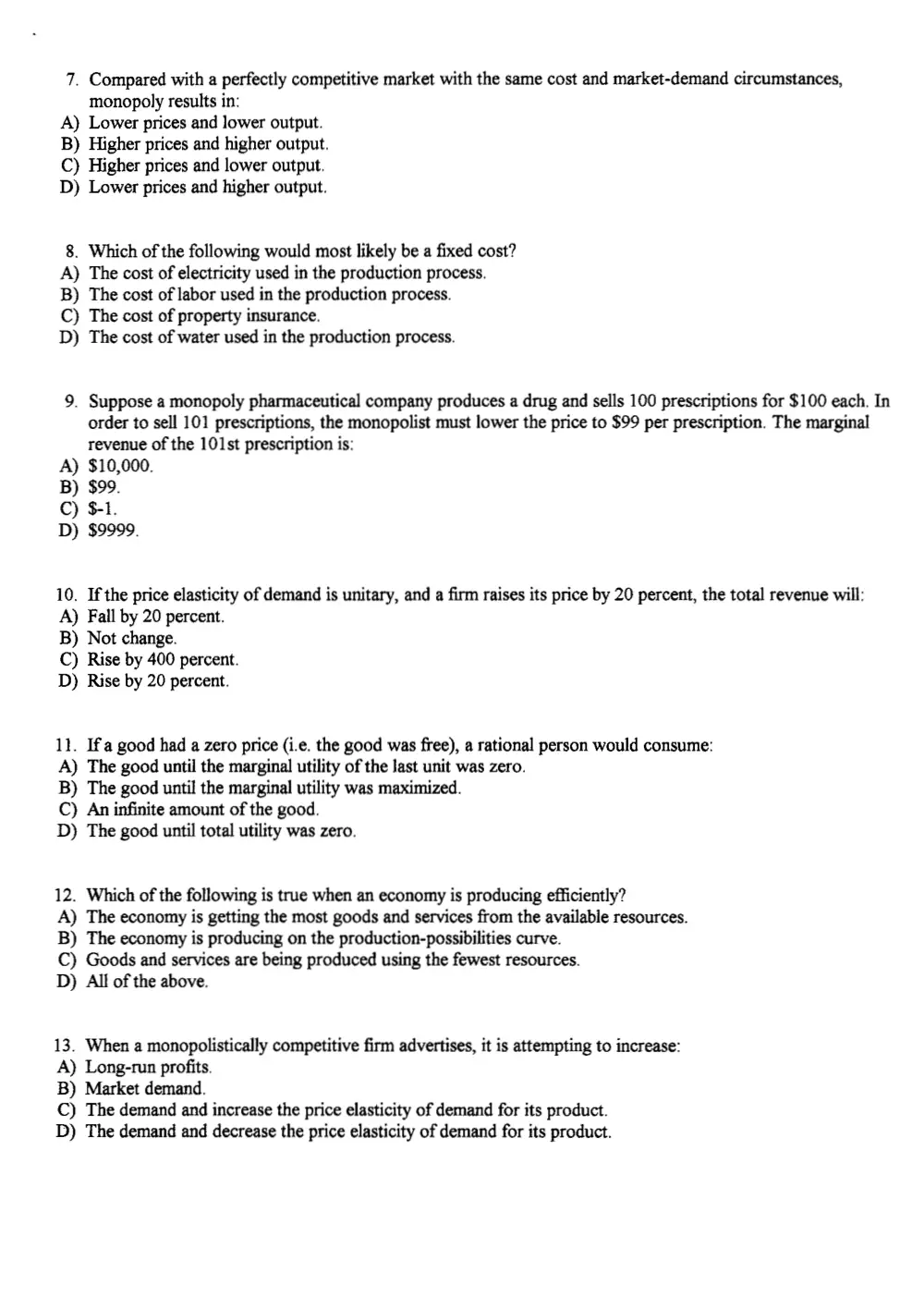
7. Compared with a perfectly competitive market with the same cost and market-demand circumstances,
monopoly results in:
A) Lower prices and lower output.
B) Higher prices and higher output.
C) Higher prices and lower output.
D) Lower prices and higher output.
8. Which of the following would most likely be a fixed cost?
A) The cost of electricity used in the production process.
B) The cost of labor used in the production process.
C) The cost of property insurance.
D) The cost of water used in the production process.
9. Suppose a monopoly pharmaceutical company produces a drug and sells 100 prescriptions for $100 each. In
order to sell 101 prescriptions, the monopolist must lower the price to $99 per prescription. The marginal
revenue of the 101st prescription is:
A) $10,000.
B) $99.
C) $1.
D) $9999.
10. If the price elasticity of demand is unitary, and a firm raises its price by 20 percent, the total revenue will:
A) Fall by 20 percent.
B) Not change.
C) Rise by 400 percent.
D) Rise by 20 percent.
11. Ifa good had a zero price (i.e. the good was free), a rational person would consume:
A) The good until the marginal utility of the last unit was zero.
B) The good until the marginal utility was maximized.
C) An infinite amount of the good.
D) The good until total utility was zero.
12. Which of the following is true when an economy is producing efficiently?
A) The economy is getting the most goods and services from the available resources.
B) The economy is producing on the production-possibilities curve.
C) Goods and services are being produced using the fewest resources.
D) All of the above.
13. When a monopolistically competitive firm advertises, it is attempting to increase:
A) Long-run profits.
B) Market demand.
C) The demand and increase the price elasticity of demand for its product.
D) The demand and decrease the price elasticity of demand for its product.
14. You are a consultant on profit maximization; given the following data , what would you recommend the
monopoly in this case?
Quantity = 2000 units TR = $4000 TFC = $1000 AC = $1.5 MC = $2
A) Firm should increase price and reduce quantity.
B) Firm should decrease price and increase quantity.
C) Firm should shutdown operations.
D) Firm now is in correct position.
Figure 11.1
PRICE OR COST
8 iy 10 \2 12
QUANTITY
15. Refer to Figure 11.1 for a monopolistically competitive firm. The profit-maximizing output and price
combination for this firm in the short run is:
A) 10 units, $49.
B) 12 units, $25.
C) 18 units, $36.
D) 10 units, $22.
16. The allocatively efficient output and price combination for the firm in Figure 11.1 is:
A) 18 units, $36.
B) 10 units, $49.
C) 10 units, $36.
D) 12 units, $25.
17. Refer to Figure 11.1. The output that maximizes production efficiency for this firm is:
A) 18 units.
B) 4 units.
C) 10 units.
D) 12 units.
Page 3
18. You are a consultant on profit maximization; given the following data , what would you recommend the
monopoly in this case?
MR = $2 TR = $15000 TC = $12000 AC = $4 MC = $2
A) Firm should decrease price and increase quantity.
B) Firm now is in correct position.
C) Firm should shutdown operations.
D) Firm should increase price and reduce quantity.
Figure 8.2
MC
ATC
AVC
10 MR,
30 MR3
PRICE OR COST
(dollars per unit)
&
wv
ro)
4
B
2
QUANTITY
19. Refer to Figure 8.2 for a perfectly competitive firm. This firm should shutdown in the short run if the market
price is below:
A) $30.
B) $20.
C) $10.
D) $40.
20. Refer to Figure 8.2 for a perfectly competitive firm. In long run equilibrium, the market price would be equal
to:
A) $30.
B) $10.
C) $40.
D) $20.
21. Refer to Figure 8.2. If the market price equaled $20, in the short run this firm should:
A) Produce where the ATC is at a minimum.
B) Raise the price.
C) Shutdown.
D) Produce with an economic loss.
22. The only market structure in which there is significant interdependence among firms with regard to their
pricing and output decisions is:
A) Oligopoly.
B) Perfect competition.
C) Monopoly.
D) Monopolistic competition.
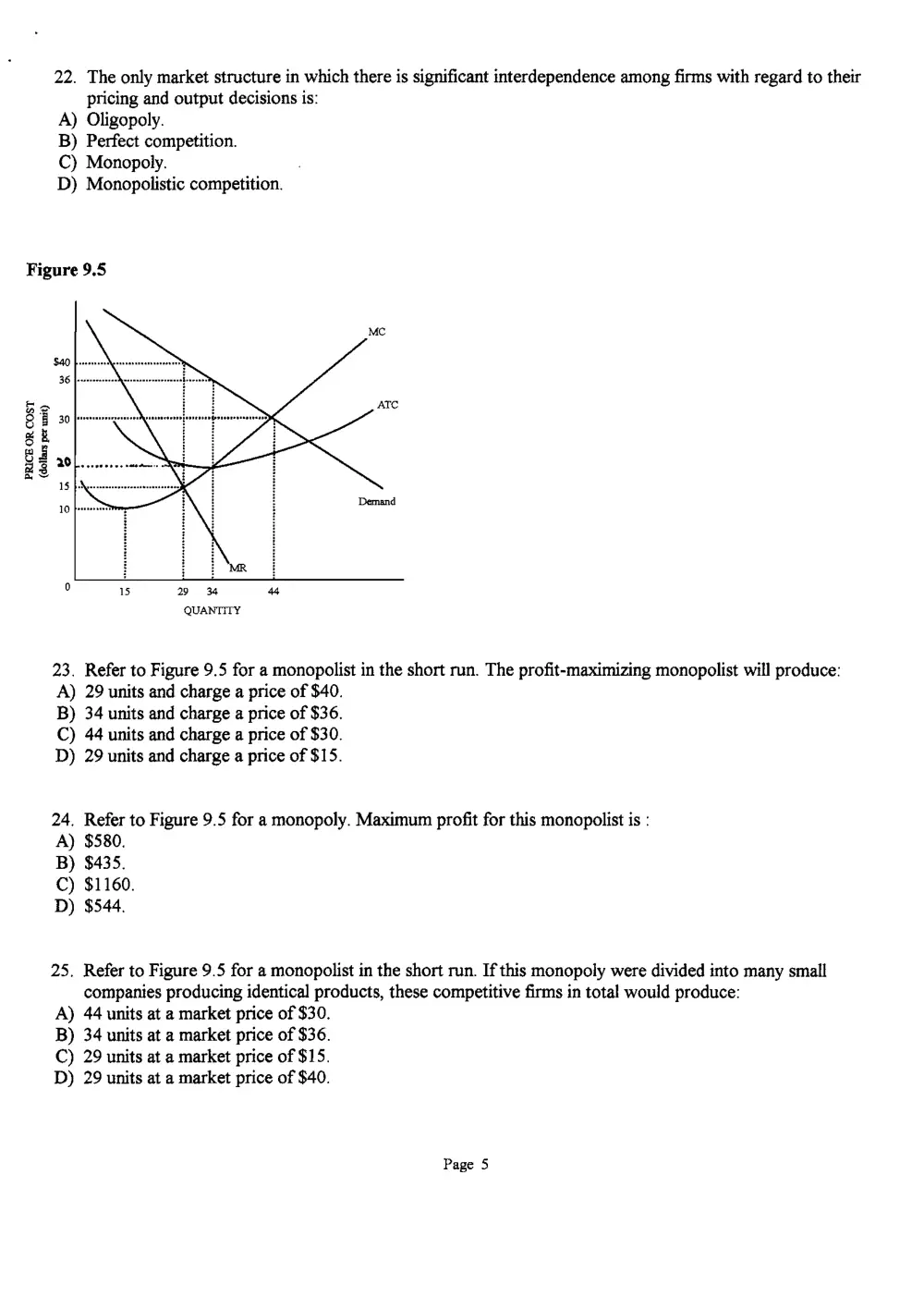
Figure 9.5
PRICE OR COST
8
dollars per unit)
aa
0 15 29 34 44
QUANTITY
23. Refer to Figure 9.5 for a monopolist in the short run. The profit-maximizing monopolist will produce:
A) 29 units and charge a price of $40.
B) 34 units and charge a price of $36.
C) 44 units and charge a price of $30.
D) 29 units and charge a price of $15.
24. Refer to Figure 9.5 for a monopoly. Maximum profit for this monopolist is :
A) $580.
B) $435.
C) $1160.
D) $544.
25. Refer to Figure 9.5 for a monopolist in the short run. If this monopoly were divided into many small
companies producing identical products, these competitive firms in total would produce:
A) 44 units at a market price of $30.
B) 34 units at a market price of $36.
C) 29 units at a market price of $15.
D) 29 units at a market price of $40.
Page 5
26. In monopolistic competition, the entry of new firms will:
A) Shift the firm's demand curve to the left.
B) Cause long-run economic profits to be zero.
C) Shift the market supply curve to the right.
D) All of the above.
27. Assume Pepsi and Coke are substitutes. An increase in the price of one will result in:
A) A decrease in the quantity demanded of the other.
B) An increase in the demand for the other.
C) An increase in the quantity demanded of the other.
D) A decrease in demand for the other.
28. The correct ranking of degree of market power (from highest to lowest) is:
A) Oligopoly, monopoly, monopolistic competition, perfect competition.
B) Monopoly, oligopoly, monopolistic competition, perfect competition.
C) Monopoly, monopolistic competition, perfect competition, oligopoly.
D) Monopoly, monopolistic competition, oligopoly, perfect competition.
Complete Table 5.5. Then use the information in the table to answer the indicated questions. Assume the price of cola
is $4 per unit and the price of pretzels is $2 per unit.
Table 5.5
Michael's utility schedule
Units of TU of MU of
Units ofcola TUofcola MUofcola pretzels pretzels _ pretzels
1 40 40 1 30 30
2 32 2 20
3 96 24 3 66 16
4 112 4 78
5 124 5 84
29. Refer to Table 5.5. Suppose Michael has $20 to spend on cola and pretzels. What combination should he
purchase in order to maximize his utility?
A) 4 cola and 2 pretzels.
B) 5 colas and no pretzels.
C) 3 colas and 4 pretzels.
D) 2 colas and 3 pretzels.
30. Refer to Table 5.5. If Michael has $20 to spend on cola and pretzels, what is his maximum total utility?
A) 96.
B) 72.
C) 174.
D) 78.
31. A major difference between monopoly and monopolistic competition is:
A) The number of firms in the market.
B) One type of firm has market power, and the other does not.
C) One has a downward-sloping demand curve, and the other does not.
D) One maximizes profits by setting AZR equal to MC, and the other does not.
32. Marginal cost:
A) Rises in the short run because some resources are fixed.
B) Increases as a direct result of diminishing returns.
C) Rises whenever marginal physical product decreases.
D) All of the above.
33. Which of the following market structures will have higher output in the long run than monopolistic
competition, ceteris paribus?
A) Duopoly.
B) Oligopoly.
C) Monopoly.
D) Perfect competition.
34. Which of the following is an example of price discrimination at the only bar in town?
A) Charging lower prices to customers who bring their own glasses.
B) Charging women lower prices for drinks than men.
C) Charging higher prices for beer than it could under a more competitive situation.
D) Charging higher prices for foreign beer than domestic beer.
35. When oligopolists coordinate price, the market demand curve will be:
A) Perfectly inelastic.
B) Elastic.
C) Kinked.
D) Strongly inelastic like a monopolist's.
36. Which of the following contributes to a firm maintaining a monopoly?
A) A large number of firms in the industry.
B) The existence of substitute goods.
C) Exclusive franchises.
D) All of the above.
37. Other things being equal, if income increases and as a result, the demand for good X increases and the demand
for good Y decreases:
A) Goods X and Y are complementary goods.
B) Goods X and Y are substitute goods.
C) Good Xis an inferior good and good Y is a normal good.
D) Good X is a normal good and good Y is an inferior good.
Bann 7
38. Which of the following events would cause a rightward shift in the market supply curve for automobiles?
A) A decrease in the number of sellers.
B) A higher sales tax on automobiles.
C) A technological improvement which reduces the cost of production.
D) An increase in the wages of autoworkers.
39. If the MPP of an additional unit of labor is 2 units per hour, product price is constant at $5 per unit, and the
wage rate is $12 per hour, then:
A) The employer should lower wages and accept Jess employment of labor.
B) Product price must be reduced if profits are to be made.
C) The additional unit of labor should not be employed because it costs more than it is worth.
D) The additional unit of labor should be employed.
Answer the following questions based on the demand and cost data for Sarah's Birdhouse Co., a monopolistically
competitive firm.
Table 11.1
Demand Data .
Price Quantity Totat Cost
$11 6 $48
$10 7 $52
$9 8 $57
$8 9 $63
$7 10 $70
40. Refer to Table 11.1. In order to maximize profit, Sarah's Birdhouse Co. should produce birdhouses
and charge a price of each.
A) 8 birdhouses, $9.
®) 6 birdhouses, $11.
Cc) 7 birdhouses, $10.
D) 9 birdhouses, $8.
41. Refer to Table 11.1. At the profit-maximizing output and price, Sarah's Birdhouse Co. would earn an
economic profit of:
A) $72.
B) -$12.
C) $70.
D) $18.
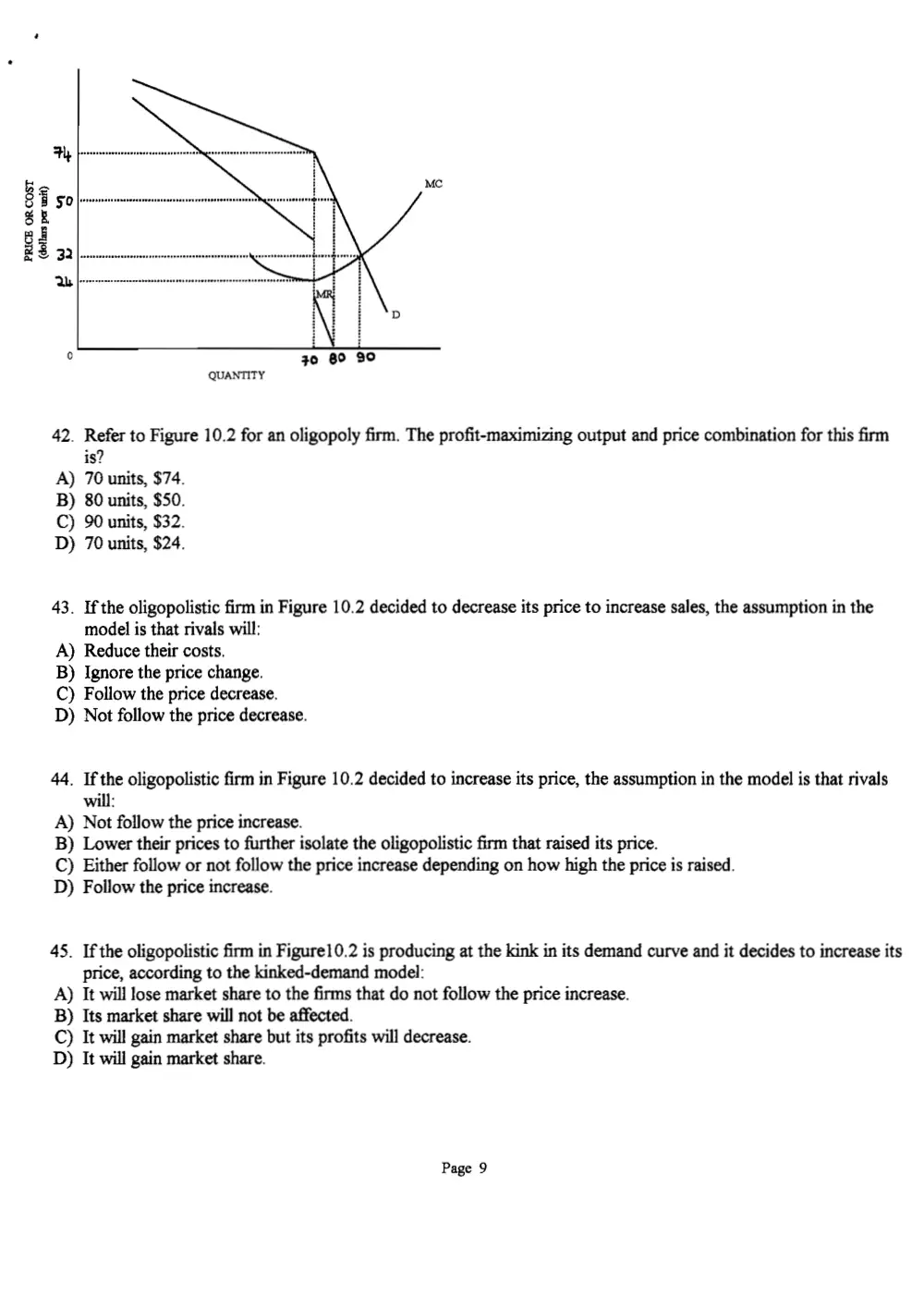
Figure 10.2
Page 8
4
aa
PRICE OR COST
(dollars per unit)
“
9
0 #0 BO 30
QUANTITY
42. Refer to Figure 10.2 for an oligopoly firm. The profit-maximizing output and price combination for this firm
is?
A) 70 units, $74.
B) 80 units, $50.
C) 90 units, $32.
D) 70 units, $24.
43. If the oligopolistic firm in Figure 10.2 decided to decrease its price to increase sales, the assumption in the
model is that rivals will:
A) Reduce their costs.
B) Ignore the price change.
C) Follow the price decrease.
D) Not follow the price decrease.
44. If the oligopolistic firm in Figure 10.2 decided to increase its price, the assumption in the model is that rivals
will:
A) Not follow the price increase.
B) Lower their prices to further isolate the oligopolistic firm that raised its price.
C) Either follow or not follow the price increase depending on how high the price is raised.
D) Follow the price increase.
45. Ifthe oligopolistic firm in Figure10.2 is producing at the kink in its demand curve and it decides to increase its
price, according to the kinked-demand model:
A) It will lose market share to the firms that do not follow the price increase.
B) Its market share will not be affected.
C) It will gain market share but its profits will decrease.
D) It will gain market share.
Page 9