
ECO 201 Notes, Fall 2013
Lebanese American University · Microeconomics · 24 pages




Showing the first 10 of 24 pages. Download the PDF to see all of it.
More ECO 201 files
Show the text of this notes
Economics 201: Principles of Microeconomics
Amjad Toukan
Fall 2013
PROBLEM SET #5 Answers
PROBLEM 1:
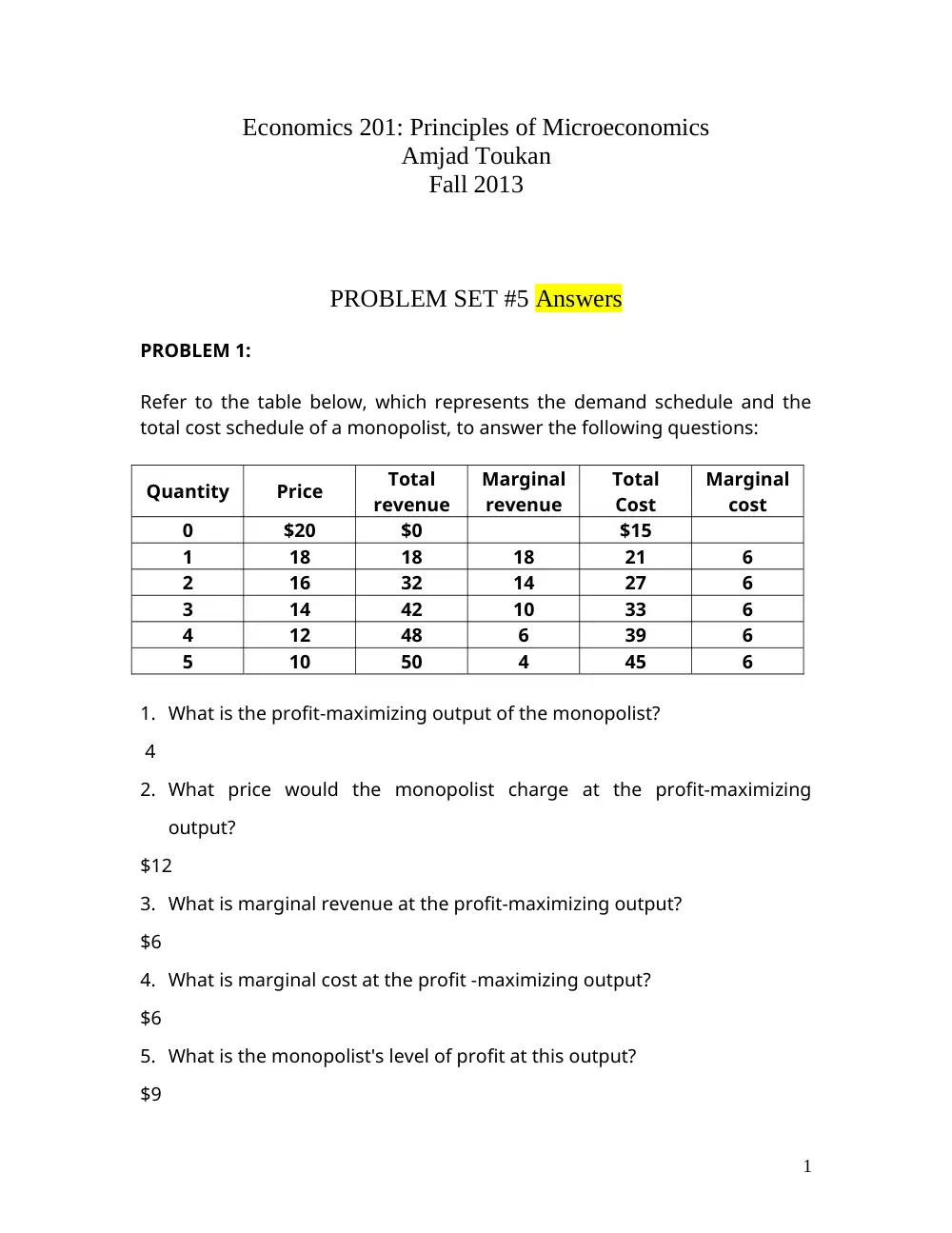
Refer to the table below, which represents the demand schedule and the
total cost schedule of a monopolist, to answer the following questions:
Quantity
Price
Total
revenue
Marginal
revenue
Total
Cost
Marginal
cost
0
$20
$0
$15
1
18
18
18
21
6
2
16
32
14
27
6
3
14
42
10
33
6
4
12
48
6
39
6
5
10
50
4
45
6
1. What is the profit-maximizing output of the monopolist?
4
2. What price would the monopolist charge at the profit-maximizing
output?
$12
3. What is marginal revenue at the profit-maximizing output?
$6
4. What is marginal cost at the profit -maximizing output?
$6
5. What is the monopolist's level of profit at this output?
$9
1
6. What is the monopolist's fixed cost?
$15
PROBLEM 2:
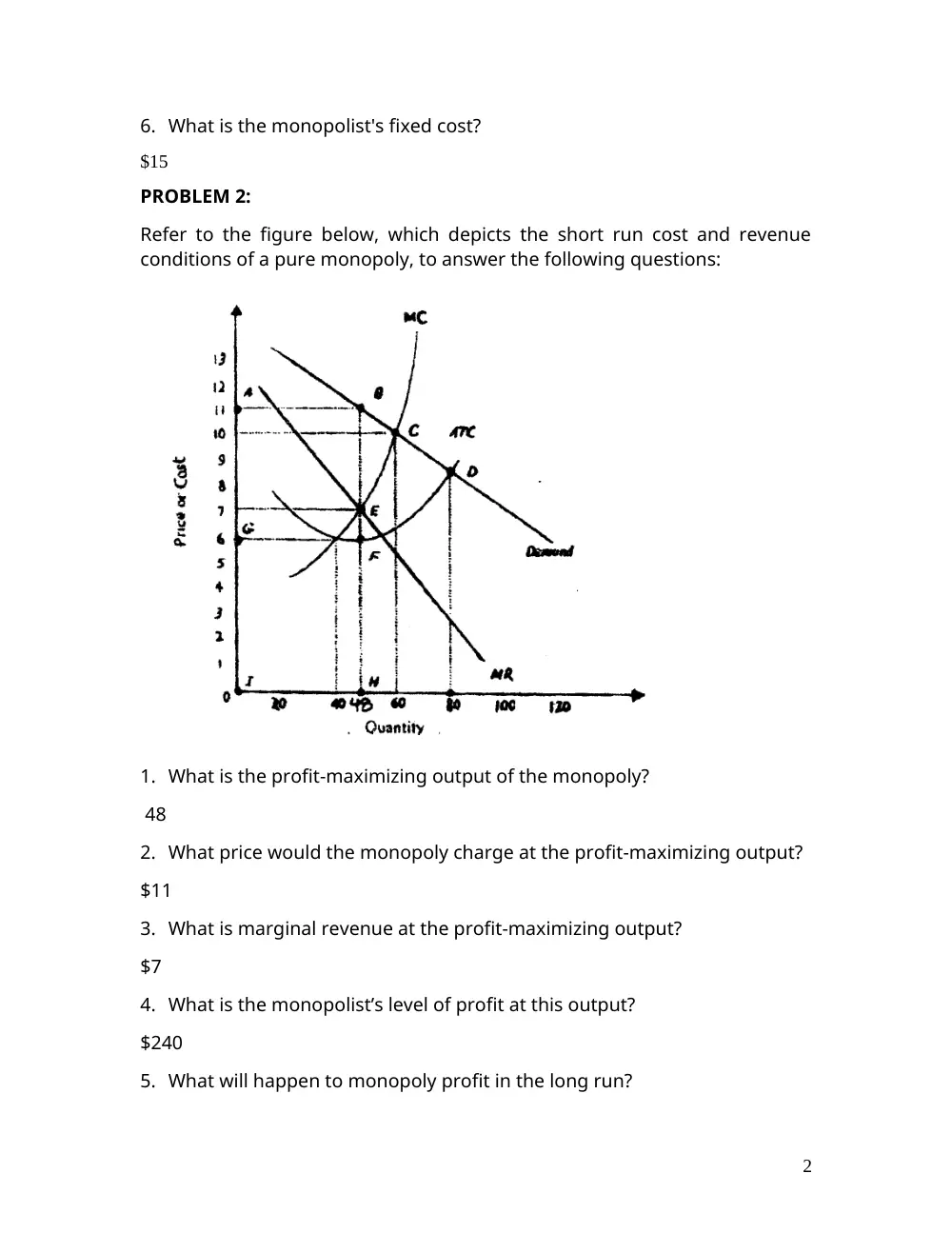
Refer to the figure below, which depicts the short run cost and revenue
conditions of a pure monopoly, to answer the following questions:
1. What is the profit-maximizing output of the monopoly?
48
2. What price would the monopoly charge at the profit-maximizing output?
$11
3. What is marginal revenue at the profit-maximizing output?
$7
4. What is the monopolist’s level of profit at this output?
$240
5. What will happen to monopoly profit in the long run?
2
Nothing, it will stay at $240
6. If this monopoly were divided into many small firms producing identical
products, how much output would these perfectly competitive firm
produce in total, and what price would prevail in the long run?
They would produce 60 units of output at a price of $10.
PROBLEM 3:
Use the figure below to answer the following questions:
1. Assume that the market indicated in this figure is perfectly competitive:
a. What is the equilibrium quantity?
H
b. What is the equilibrium price?
C
c. Which area represents the consumer surplus at this price?
The triangle AGC
2. Assume that the market indicated in this figure is a monopoly:
3
a. What is the monopoly output?
F
b. What is the monopoly price?
B
c. Which area represents the consumer surplus at this price?
The triangle ABD
d. Which area represents the monopoly profit at this price?
Rectangle BCED
3. Compared to pricing under perfect competition, which area represents
the loss in consumer surplus due to monopoly pricing?
Area BDGC
4. Compared to pricing under perfect competition, which area represents
the deadweight loss due to monopoly pricing?
Area DEG
PROBLEM 4:
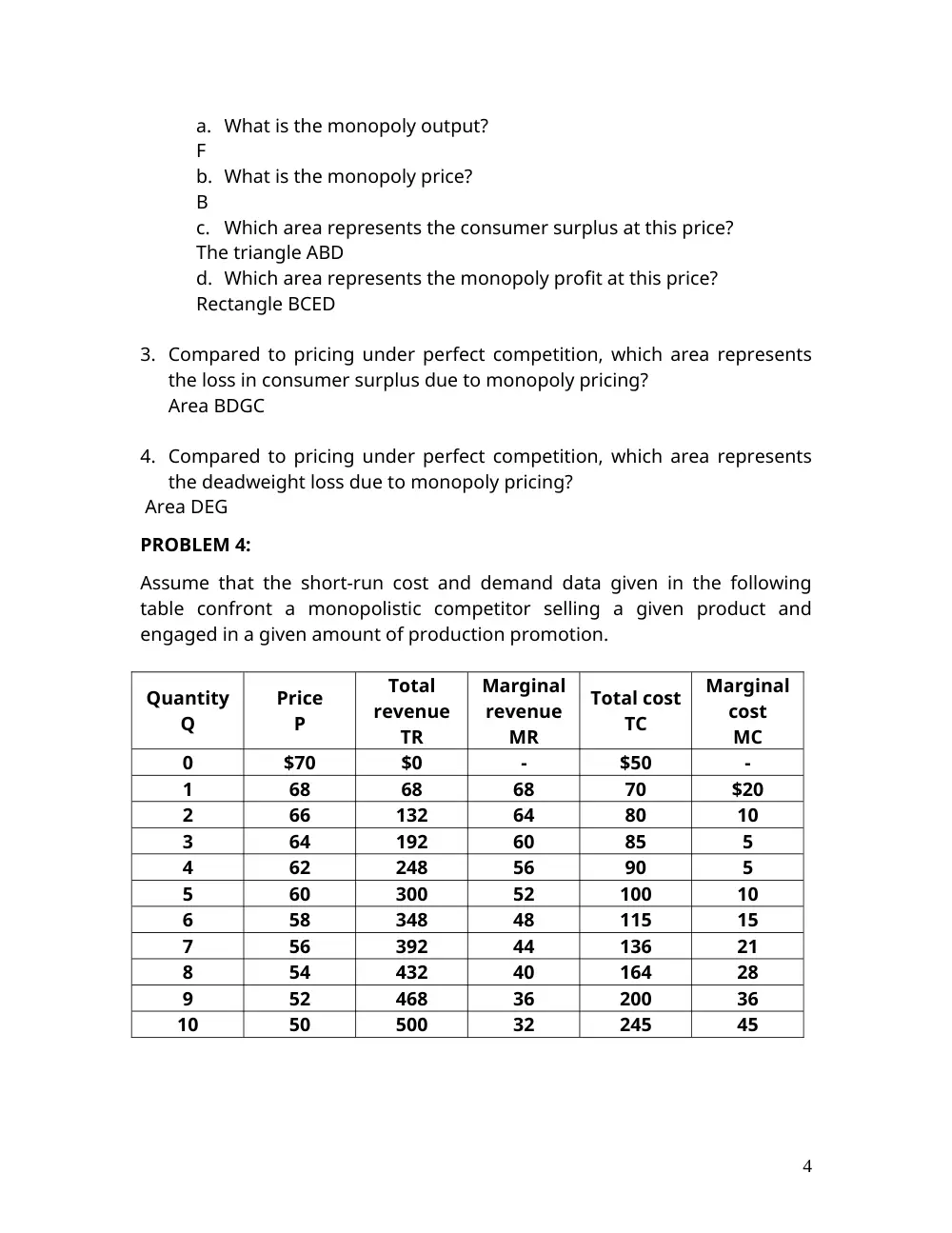
Assume that the short-run cost and demand data given in the following
table confront a monopolistic competitor selling a given product and
engaged in a given amount of production promotion.
Quantity
Q
Price
P
Total
revenue
TR
Marginal
revenue
MR
Total cost
TC
Marginal
cost
MC
0
$70
$0
-
$50
-
1
68
68
68
70
$20
2
66
132
64
80
10
3
64
192
60
85
5
4
62
248
56
90
5
5
60
300
52
100
10
6
58
348
48
115
15
7
56
392
44
136
21
8
54
432
40
164
28
9
52
468
36
200
36
10
50
500
32
245
45
4
1. Compute total revenue, marginal revenue, and marginal cost at each unit
of output for this firm.
Shown Above
2. In the short run,
a. What is the profit-maximizing output of this firm?
9
b. What price will this firm charge at the profit-maximizing output?
$52
c. What is the level of profit that this firm earns at this output?
$268
3. In the long run, the demand for this firm’s product will
__decrease__________, until the price of the product equals
______ATC__________, and total economic profits of the firm are
____Zero________.
PROBLEM 5:
5
6
7
PROBLEM 6:
8
9
PROBLEM 7:
10
11
PROBLEM 8:
PROBLEM 9:
12
13
14
PROBLEM 10:
15
16
17
PROBLEM 11:
18
19
PROBLEM 12:
20
21
PROBLEM 13:
22
PROBLEM 14:
PROBLEM 15:
23
24