
ENG 101 Syllabus, Fall 2014
Lebanese American University · English I · 5 pages

More ENG 101 files
Show the text of this lab
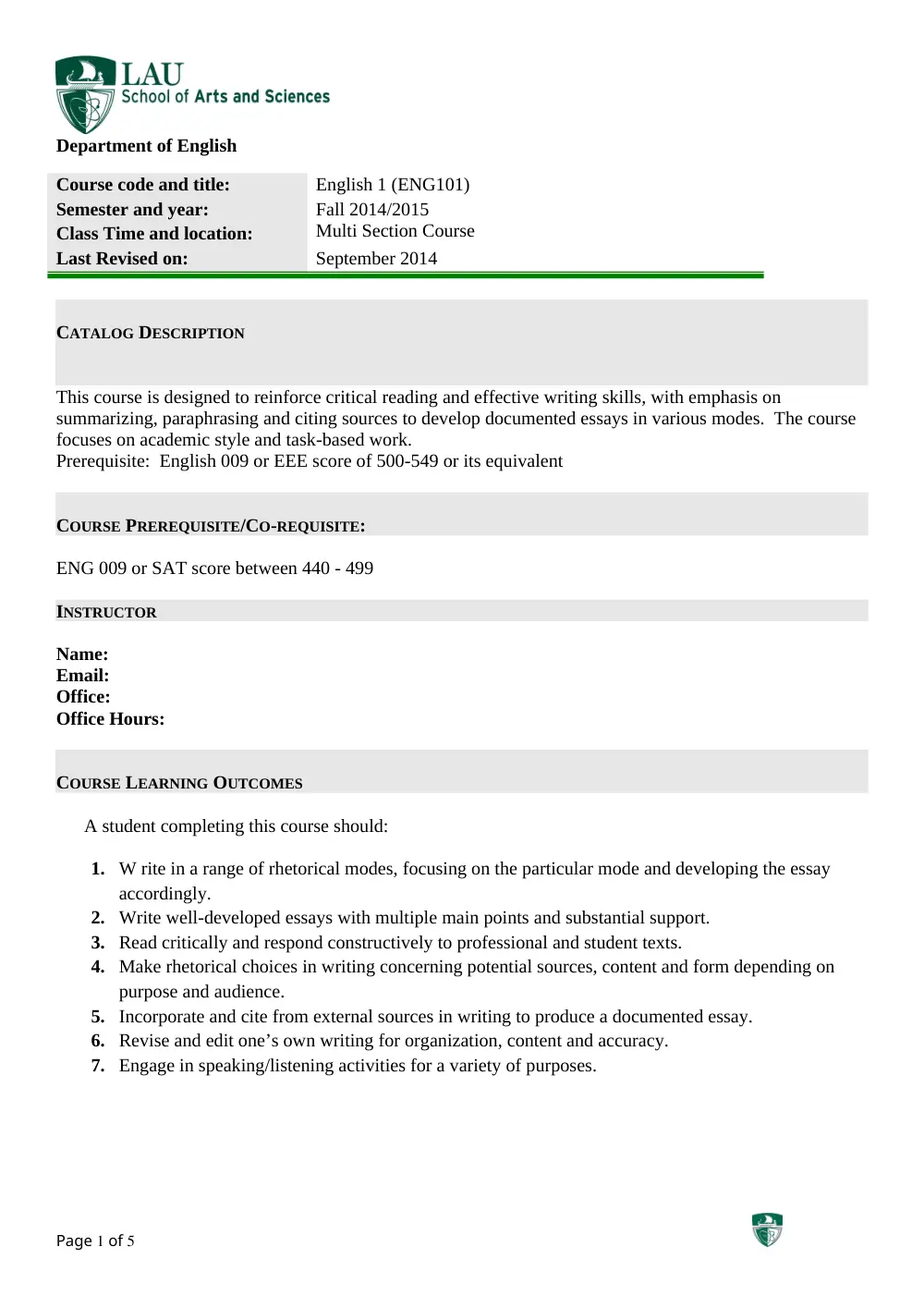
Department of English
Course code and title:
Semester and year:
Class Time and location:
English 1 (ENG101)
Fall 2014/2015
Multi Section Course
Last Revised on:
September 2014
CATALOG DESCRIPTION
This course is designed to reinforce critical reading and effective writing skills, with emphasis on
summarizing, paraphrasing and citing sources to develop documented essays in various modes. The course
focuses on academic style and task-based work.
Prerequisite: English 009 or EEE score of 500-549 or its equivalent
COURSE PREREQUISITE/CO-REQUISITE:
ENG 009 or SAT score between 440 - 499
INSTRUCTOR
Name:
Email:
Office:
Office Hours:
COURSE LEARNING OUTCOMES
A student completing this course should:
1. W rite in a range of rhetorical modes, focusing on the particular mode and developing the essay
accordingly.
2. Write well-developed essays with multiple main points and substantial support.
3. Read critically and respond constructively to professional and student texts.
4. Make rhetorical choices in writing concerning potential sources, content and form depending on
purpose and audience.
5. Incorporate and cite from external sources in writing to produce a documented essay.
6. Revise and edit one’s own writing for organization, content and accuracy.
7. Engage in speaking/listening activities for a variety of purposes.
Page 1 of 5
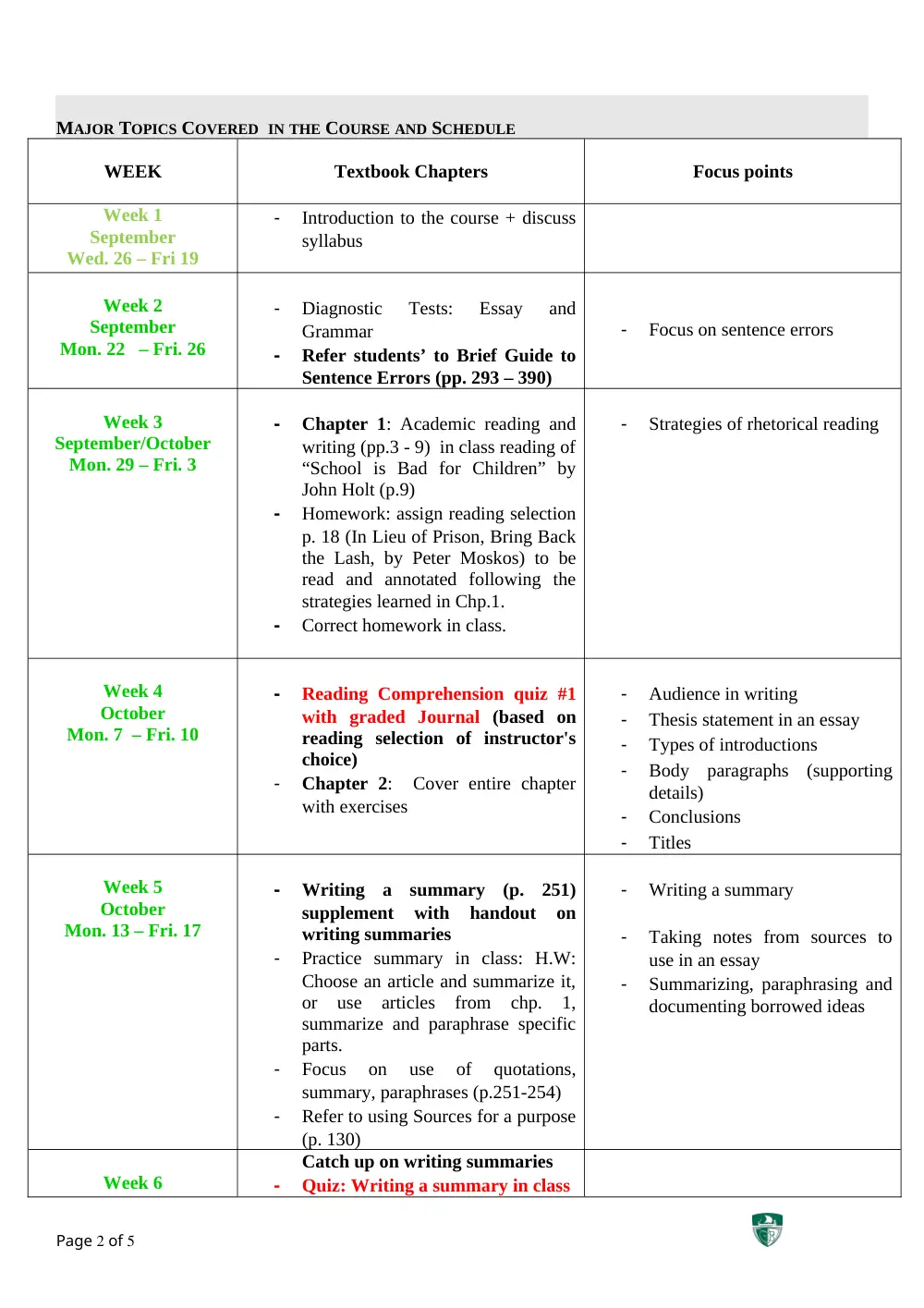
MAJOR TOPICS COVERED IN THE COURSE AND SCHEDULE
WEEK
Textbook Chapters
Focus points
Week 1
September
Wed. 26 – Fri 19
-
Introduction to the course + discuss
syllabus
Week 2
September
Mon. 22 – Fri. 26
-
Diagnostic Tests: Essay and
Grammar
-
Refer students’ to Brief Guide to
Sentence Errors (pp. 293 – 390)
-
Focus on sentence errors
Week 3
September/October
Mon. 29 – Fri. 3
-
Chapter 1: Academic reading and
writing (pp.3 - 9) in class reading of
“School is Bad for Children” by
John Holt (p.9)
-
Homework: assign reading selection
p. 18 (In Lieu of Prison, Bring Back
the Lash, by Peter Moskos) to be
read and annotated following the
strategies learned in Chp.1.
-
Correct homework in class.
-
Strategies of rhetorical reading
Week 4
October
Mon. 7 – Fri. 10
-
Reading Comprehension quiz #1
with graded Journal (based on
reading selection of instructor's
choice)
-
Chapter 2: Cover entire chapter
with exercises
-
Audience in writing
-
Thesis statement in an essay
-
Types of introductions
-
Body paragraphs (supporting
details)
-
Conclusions
-
Titles
Week 5
October
Mon. 13 – Fri. 17
-
Writing a summary (p. 251)
supplement with handout on
writing summaries
-
Practice summary in class: H.W:
Choose an article and summarize it,
or use articles from chp. 1,
summarize and paraphrase specific
parts.
-
Focus on use of quotations,
summary, paraphrases (p.251-254)
-
Refer to using Sources for a purpose
(p. 130)
-
Writing a summary
-
Taking notes from sources to
use in an essay
-
Summarizing, paraphrasing and
documenting borrowed ideas
Week 6
Catch up on writing summaries
-
Quiz: Writing a summary in class
Page 2 of 5
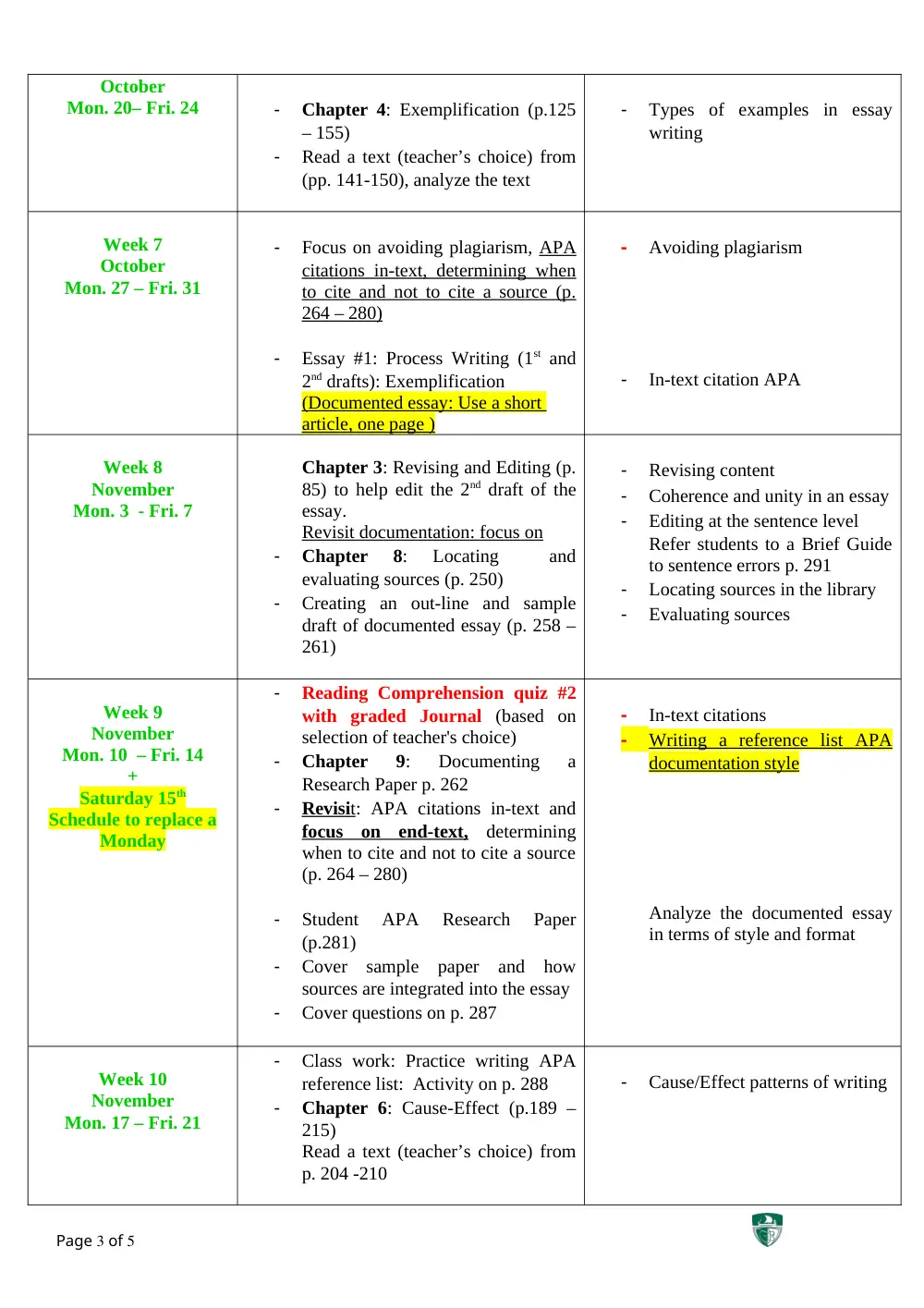
October
Mon. 20– Fri. 24
-
Chapter 4: Exemplification (p.125
– 155)
-
Read a text (teacher’s choice) from
(pp. 141-150), analyze the text
-
Types of examples in essay
writing
Week 7
October
Mon. 27 – Fri. 31
-
Focus on avoiding plagiarism, APA
citations in-text, determining when
to cite and not to cite a source (p.
264 – 280)
-
Essay #1: Process Writing (1st and
2nd drafts): Exemplification
(Documented essay: Use a short
article, one page )
-
Avoiding plagiarism
-
In-text citation APA
Week 8
November
Mon. 3 - Fri. 7
Chapter 3: Revising and Editing (p.
85) to help edit the 2nd draft of the
essay.
Revisit documentation: focus on
-
Chapter 8: Locating
and
evaluating sources (p. 250)
-
Creating an out-line and sample
draft of documented essay (p. 258 –
261)
-
Revising content
-
Coherence and unity in an essay
-
Editing at the sentence level
Refer students to a Brief Guide
to sentence errors p. 291
-
Locating sources in the library
-
Evaluating sources
Week 9
November
Mon. 10 – Fri. 14
+
Saturday 15th
Schedule to replace a
Monday
-
Reading Comprehension quiz #2
with graded Journal (based on
selection of teacher's choice)
-
Chapter 9: Documenting a
Research Paper p. 262
-
Revisi
t : APA citations in-text and
focus on end-text, determining
when to cite and not to cite a source
(p. 264 – 280)
-
Student APA Research Paper
(p.281)
-
Cover sample paper and how
sources are integrated into the essay
-
Cover questions on p. 287
-
In-text citations
-
Writing a reference list APA
documentation style
Analyze the documented essay
in terms of style and format
Week 10
November
Mon. 17 – Fri. 21
-
Class work: Practice writing APA
reference list: Activity on p. 288
-
Chapter 6: Cause-Effect (p.189 –
215)
Read a text (teacher’s choice) from
p. 204 -210
-
Cause/Effect patterns of writing
Page 3 of 5
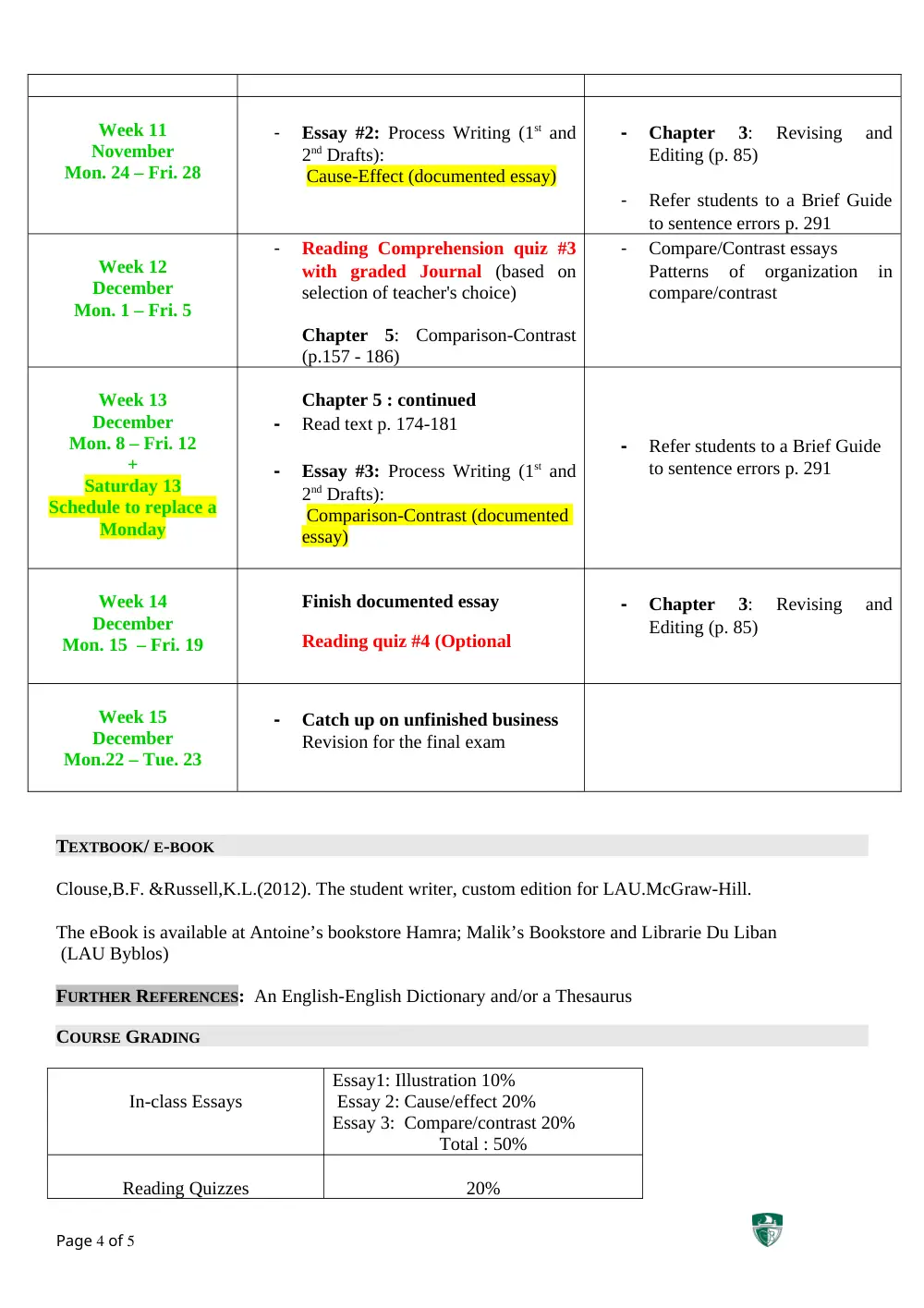
Week 11
November
Mon. 24 – Fri. 28
-
Essay #2: Process Writing (1st and
2nd Drafts):
Cause-Effect (documented essay)
-
Chapter 3: Revising and
Editing (p. 85)
-
Refer students to a Brief Guide
to sentence errors p. 291
Week 12
December
Mon. 1 – Fri. 5
-
Reading Comprehension quiz #3
with graded Journal (based on
selection of teacher's choice)
Chapter 5: Comparison-Contrast
(p.157 - 186)
-
Compare/Contrast essays
Patterns of organization in
compare/contrast
Week 13
December
Mon. 8 – Fri. 12
+
Saturday 13
Schedule to replace a
Monday
Chapter 5 : continued
-
Read text p. 174-181
-
Essay #3: Process Writing (1st and
2nd Drafts):
Comparison-Contrast (documented
essay)
-
Refer students to a Brief Guide
to sentence errors p. 291
Week 14
December
Mon. 15 – Fri. 19
Finish documented essay
Reading quiz #4 (Optional
-
Chapter 3: Revising and
Editing (p. 85)
Week 15
December
Mon.22 – Tue. 23
-
Catch up on unfinished business
Revision for the final exam
TEXTBOOK/ E-BOOK
Clouse,B.F. &Russell,K.L.(2012). The student writer, custom edition for LAU.McGraw-Hill.
The eBook is available at Antoine’s bookstore Hamra; Malik’s Bookstore and Librarie Du Liban
(LAU Byblos)
FURTHER REFERENCES: An English-English Dictionary and/or a Thesaurus
COURSE GRADING
In-class Essays
Essay1: Illustration 10%
Essay 2: Cause/effect 20%
Essay 3: Compare/contrast 20%
Total : 50%
Reading Quizzes
20%
Page 4 of 5
Guided Journals based on
readings
5%
Summary
5%
Final Exam
20%
POLICY ON CHEATING AND PLAGIARISM
Students caught cheating on an exam receive a grade of zero on the exam in their first cheating attempt and
receive a warning. Students caught cheating for the second time will receive a grade of “F” in the course and
another warning.
Plagiarism on assignments and project work is a serious offense. If plagiarism is detected, a student will be
subject to penalty, similar to the cheating case, which ranges from receiving a zero on the assignment
concerned to an “F” in the course in addition to a warning.
UNIVERSITY ATTENDANCE POLICY
Missing one third of classes implies that a student has to drop the course.
WITHDRAWAL POLICY
1. A student who withdraws after the Drop/Add period and by the end of the 5th week of classes (10th day
of classes for Summer Modules) will obtain a “WI” on that particular course. The student may process such
request directly through the Registrar’s Office.
2. A student who withdraws from a course between the 6th week and the end of the 10th week of classes
(18th day of classes for Summer Modules) will receive either a “WP” or a “WF”. “WP” or “WF” will be
determined by the instructor based on the achieved academic performance in that course till the time of
withdrawal.
3. The “WI” and the “WP” will not count as a repeat; whereas the “WF” will count as a repeat.
4. “WI”, “WP” and “WF” will not count towards the GPA calculation.
5. The deadlines for “WI” or “WP”/”WF” are clearly stated on the revised academic calendar on the LAU
website: http://www.lau.edu.lb/academics/calendar/20122013/#spring_2013
WI is equivalent to Early withdrawal
WP is equivalent to Withdrawal/Pass
WF is equivalent to Withdrawal/Fail
Deadline for withdrawal from courses: Wednesday 26, 2014. (It is the student’s responsibility to drop
the course).
Page 5 of 5