
ENG 101 Syllabus, Fall 2016
Lebanese American University · English I · 5 pages
More ENG 101 files
Show the text of this lab
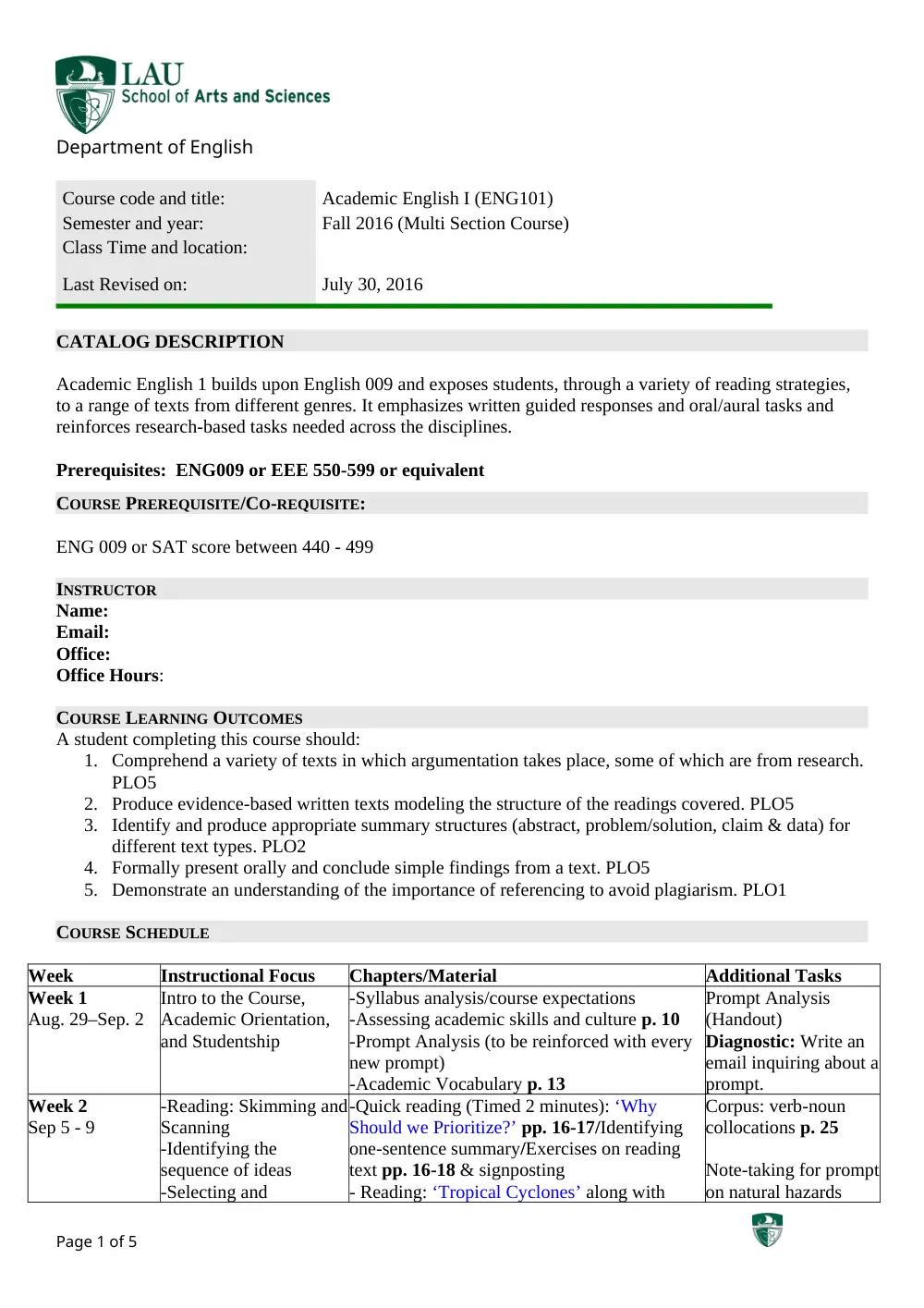
Department of English
Course code and title:
Semester and year:
Class Time and location:
Academic English I (ENG101)
Fall 2016 (Multi Section Course)
Last Revised on:
July 30, 2016
CATALOG DESCRIPTION
Academic English 1 builds upon English 009 and exposes students, through a variety of reading strategies,
to a range of texts from different genres. It emphasizes written guided responses and oral/aural tasks and
reinforces research-based tasks needed across the disciplines.
Prerequisites: ENG009 or EEE 550-599 or equivalent
COURSE PREREQUISITE/CO-REQUISITE:
ENG 009 or SAT score between 440 - 499
INSTRUCTOR
Name:
Email:
Office:
Office Hours:
COURSE LEARNING OUTCOMES
A student completing this course should:
1. Comprehend a variety of texts in which argumentation takes place, some of which are from research.
PLO5
2. Produce evidence-based written texts modeling the structure of the readings covered. PLO5
3. Identify and produce appropriate summary structures (abstract, problem/solution, claim & data) for
different text types. PLO2
4. Formally present orally and conclude simple findings from a text. PLO5
5. Demonstrate an understanding of the importance of referencing to avoid plagiarism. PLO1
COURSE SCHEDULE
Week
Instructional Focus
Chapters/Material
Additional Tasks
Week 1
Aug. 29–Sep. 2
Intro to the Course,
Academic Orientation,
and Studentship
-Syllabus analysis/course expectations
-Assessing academic skills and culture p. 10
-Prompt Analysis (to be reinforced with every
new prompt)
-Academic Vocabulary p. 13
Prompt Analysis
(Handout)
Diagnostic: Write an
email inquiring about a
prompt.
Week 2
Sep 5 - 9
-Reading: Skimming and
Scanning
-Identifying the
sequence of ideas
-Selecting and
-Quick reading (Timed 2 minutes): ‘Why
Should we Prioritize?’ pp. 16-17/Identifying
one-sentence summary/Exercises on reading
text pp. 16-18 & signposting
- Reading: ‘Tropical Cyclones’ along with
Corpus: verb-noun
collocations p. 25
Note-taking for prompt
on natural hazards
Page 1 of 5
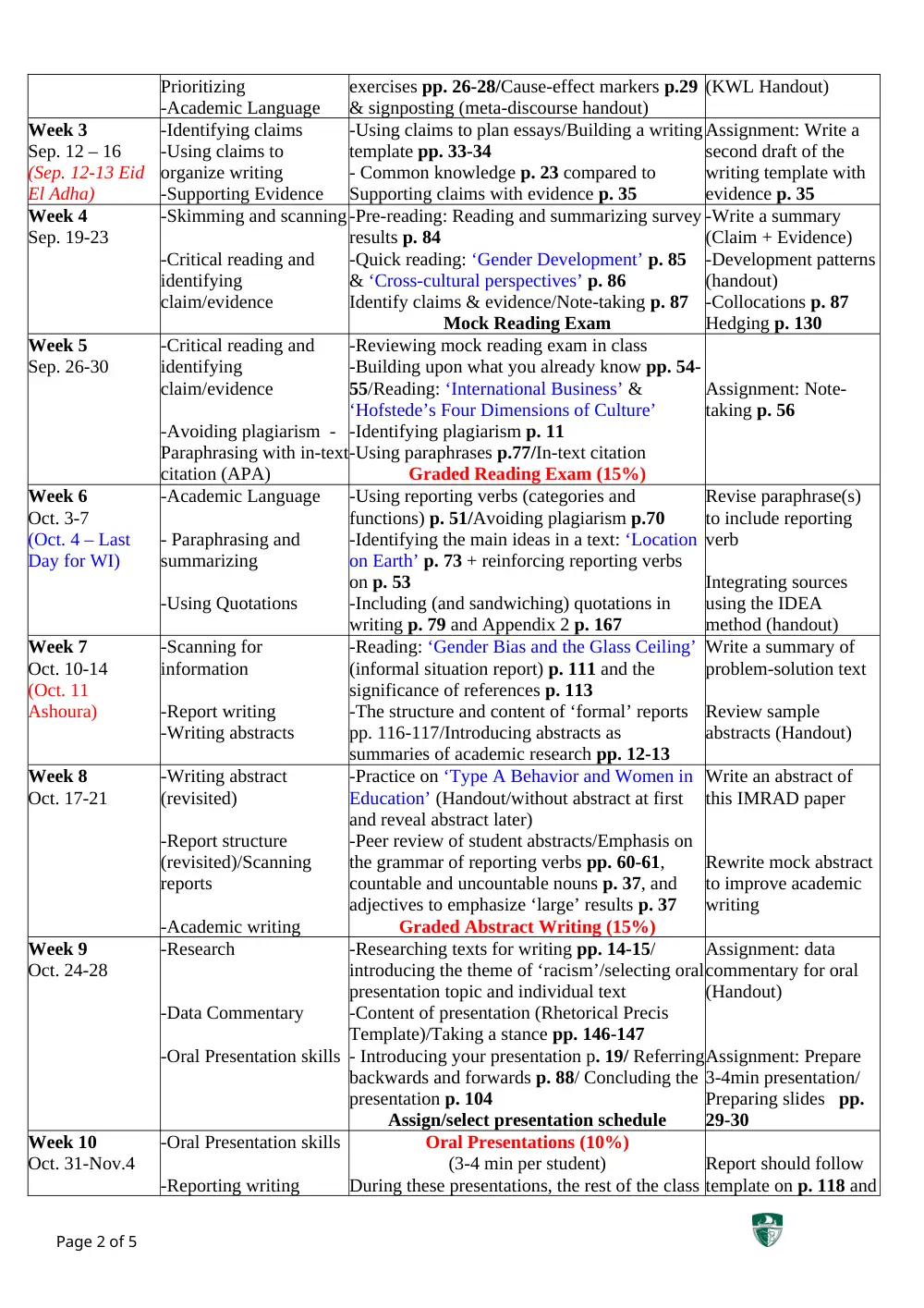
Prioritizing
-Academic Language
exercises pp. 26-28/Cause-effect markers p.29
& signposting (meta-discourse handout)
(KWL Handout)
Week 3
Sep. 12 – 16
(Sep. 12-13 Eid
El Adha)
-Identifying claims
-Using claims to
organize writing
-Supporting Evidence
-Using claims to plan essays/Building a writing
template pp. 33-34
- Common knowledge p. 23 compared to
Supporting claims with evidence p. 35
Assignment: Write a
second draft of the
writing template with
evidence p. 35
Week 4
Sep. 19-23
-Skimming and scanning
-Critical reading and
identifying
claim/evidence
-Pre-reading: Reading and summarizing survey
results p. 84
-Quick reading: ‘Gender Development’ p. 85
& ‘Cross-cultural perspectives’ p. 86
Identify claims & evidence/Note-taking p. 87
Mock Reading Exam
-Write a summary
(Claim + Evidence)
-Development patterns
(handout)
-Collocations p. 87
Hedging p. 130
Week 5
Sep. 26-30
-Critical reading and
identifying
claim/evidence
-Avoiding plagiarism -
Paraphrasing with in-text
citation (APA)
-Reviewing mock reading exam in class
-Building upon what you already know pp. 54-
55/Reading: ‘International Business’ &
‘Hofstede’s Four Dimensions of Culture’
-Identifying plagiarism p. 11
-Using paraphrases p.77/In-text citation
Graded Reading Exam (15%)
Assignment: Note-
taking p. 56
Week 6
Oct. 3-7
(Oct. 4 – Last
Day for WI)
-Academic Language
- Paraphrasing and
summarizing
-Using Quotations
-Using reporting verbs (categories and
functions) p. 51/Avoiding plagiarism p.70
-Identifying the main ideas in a text: ‘Location
on Earth’ p. 73 + reinforcing reporting verbs
on p. 53
-Including (and sandwiching) quotations in
writing p. 79 and Appendix 2 p. 167
Revise paraphrase(s)
to include reporting
verb
Integrating sources
using the IDEA
method (handout)
Week 7
Oct. 10-14
(Oct. 11
Ashoura)
-Scanning for
information
-Report writing
-Writing abstracts
-Reading: ‘Gender Bias and the Glass Ceiling’
(informal situation report) p. 111 and the
significance of references p. 113
-The structure and content of ‘formal’ reports
pp. 116-117/Introducing abstracts as
summaries of academic research pp. 12-13
Write a summary of
problem-solution text
Review sample
abstracts (Handout)
Week 8
Oct. 17-21
-Writing abstract
(revisited)
-Report structure
(revisited)/Scanning
reports
-Academic writing
-Practice on ‘Type A Behavior and Women in
Education’ (Handout/without abstract at first
and reveal abstract later)
-Peer review of student abstracts/Emphasis on
the grammar of reporting verbs pp. 60-61,
countable and uncountable nouns p. 37, and
adjectives to emphasize ‘large’ results p. 37
Graded Abstract Writing (15%)
Write an abstract of
this IMRAD paper
Rewrite mock abstract
to improve academic
writing
Week 9
Oct. 24-28
-Research
-Data Commentary
-Oral Presentation skills
-Researching texts for writing pp. 14-15/
introducing the theme of ‘racism’/selecting oral
presentation topic and individual text
-Content of presentation (Rhetorical Precis
Template)/Taking a stance pp. 146-147
- Introducing your presentation p. 19/ Referring
backwards and forwards p. 88/ Concluding the
presentation p. 104
Assign/select presentation schedule
Assignment: data
commentary for oral
(Handout)
Assignment: Prepare
3-4min presentation/
Preparing slides pp.
29-30
Week 10
Oct. 31-Nov.4
-Oral Presentation skills
-Reporting writing
Oral Presentations (10%)
(3-4 min per student)
During these presentations, the rest of the class
Report should follow
template on p. 118 and
Page 2 of 5
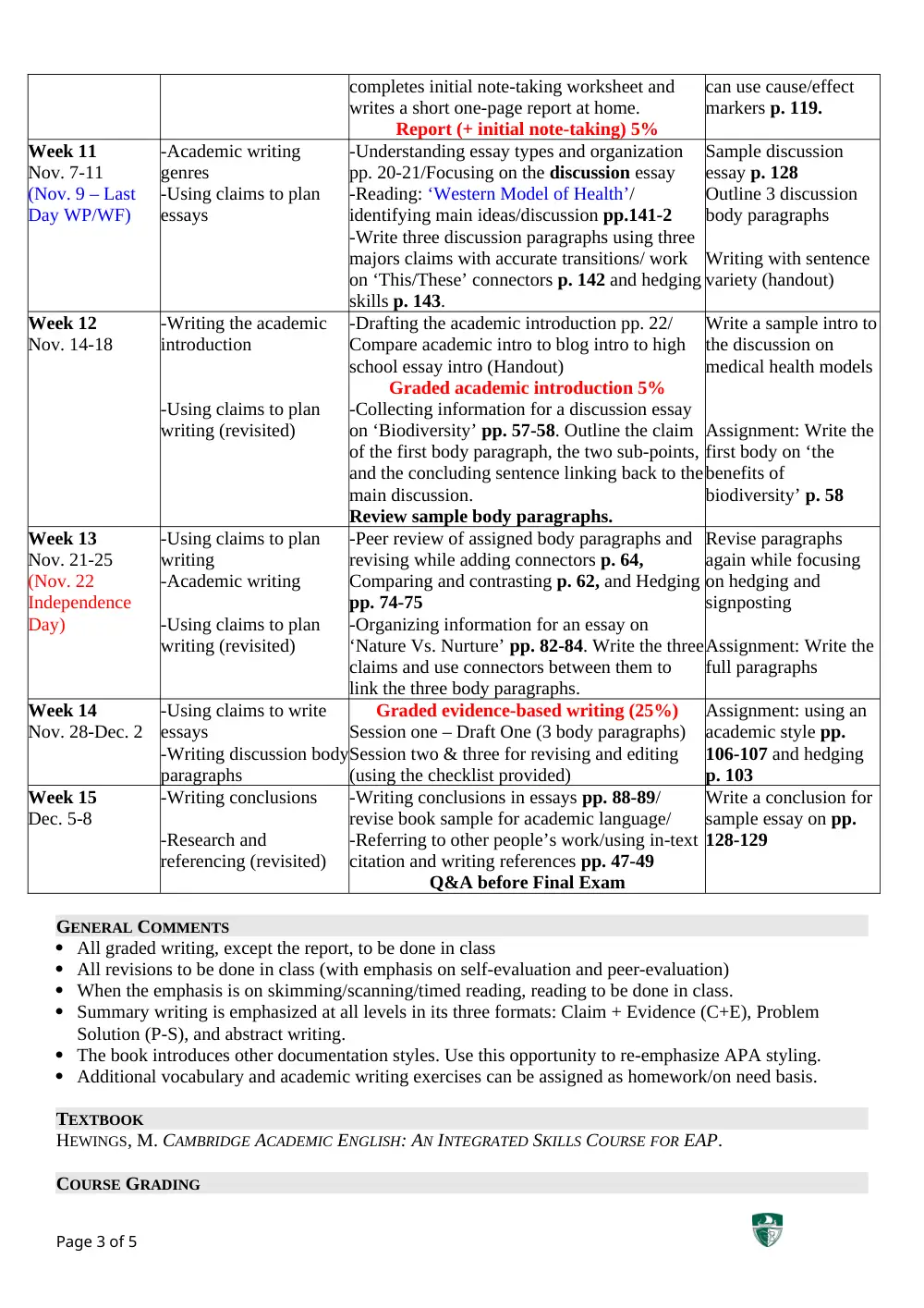
completes initial note-taking worksheet and
writes a short one-page report at home.
Report (+ initial note-taking) 5%
can use cause/effect
markers p. 119.
Week 11
Nov. 7-11
(Nov. 9 – Last
Day WP/WF)
-Academic writing
genres
-Using claims to plan
essays
-Understanding essay types and organization
pp. 20-21/Focusing on the discussion essay
-Reading: ‘Western Model of Health’/
identifying main ideas/discussion pp.141-2
-Write three discussion paragraphs using three
majors claims with accurate transitions/ work
on ‘This/These’ connectors p. 142 and hedging
skills p. 143.
Sample discussion
essay p. 128
Outline 3 discussion
body paragraphs
Writing with sentence
variety (handout)
Week 12
Nov. 14-18
-Writing the academic
introduction
-Using claims to plan
writing (revisited)
-Drafting the academic introduction pp. 22/
Compare academic intro to blog intro to high
school essay intro (Handout)
Graded academic introduction 5%
-Collecting information for a discussion essay
on ‘Biodiversity’ pp. 57-58. Outline the claim
of the first body paragraph, the two sub-points,
and the concluding sentence linking back to the
main discussion.
Review sample body paragraphs.
Write a sample intro to
the discussion on
medical health models
Assignment: Write the
first body on ‘the
benefits of
biodiversity’ p. 58
Week 13
Nov. 21-25
(Nov. 22
Independence
Day)
-Using claims to plan
writing
-Academic writing
-Using claims to plan
writing (revisited)
-Peer review of assigned body paragraphs and
revising while adding connectors p. 64,
Comparing and contrasting p. 62, and Hedging
pp. 74-75
-Organizing information for an essay on
‘Nature Vs. Nurture’ pp. 82-84. Write the three
claims and use connectors between them to
link the three body paragraphs.
Revise paragraphs
again while focusing
on hedging and
signposting
Assignment: Write the
full paragraphs
Week 14
Nov. 28-Dec. 2
-Using claims to write
essays
-Writing discussion body
paragraphs
Graded evidence-based writing (25%)
Session one – Draft One (3 body paragraphs)
Session two & three for revising and editing
(using the checklist provided)
Assignment: using an
academic style pp.
106-107 and hedging
p. 103
Week 15
Dec. 5-8
-Writing conclusions
-Research and
referencing (revisited)
-Writing conclusions in essays pp. 88-89/
revise book sample for academic language/
-Referring to other people’s work/using in-text
citation and writing references pp. 47-49
Q&A before Final Exam
Write a conclusion for
sample essay on pp.
128-129
GENERAL COMMENTS
All graded writing, except the report, to be done in class
All revisions to be done in class (with emphasis on self-evaluation and peer-evaluation)
When the emphasis is on skimming/scanning/timed reading, reading to be done in class.
Summary writing is emphasized at all levels in its three formats: Claim + Evidence (C+E), Problem
Solution (P-S), and abstract writing.
The book introduces other documentation styles. Use this opportunity to re-emphasize APA styling.
Additional vocabulary and academic writing exercises can be assigned as homework/on need basis.
TEXTBOOK
HEWINGS, M. CAMBRIDGE ACADEMIC ENGLISH: AN INTEGRATED SKILLS COURSE FOR EAP.
COURSE GRADING
Page 3 of 5
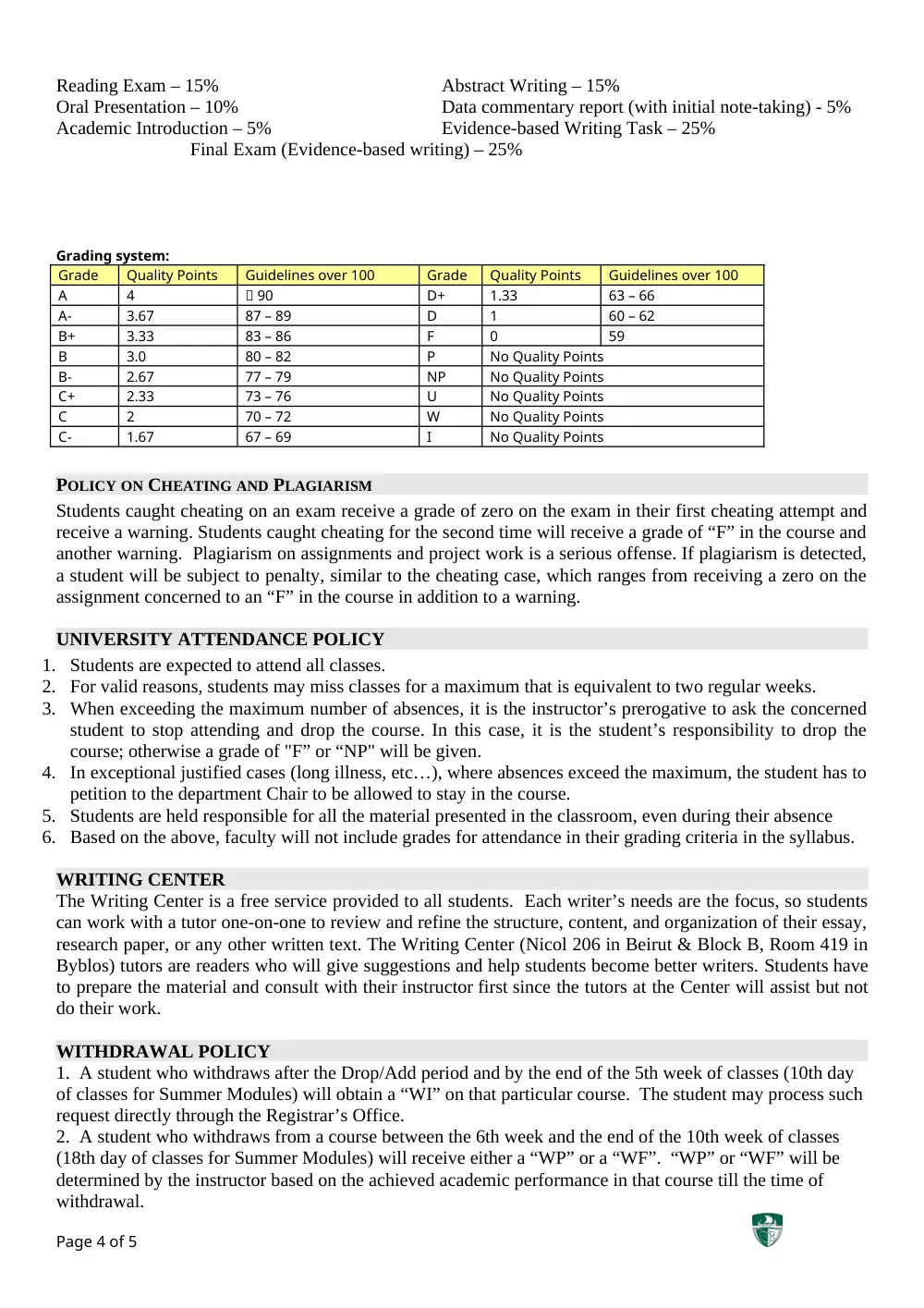
Reading Exam – 15%
Abstract Writing – 15%
Oral Presentation – 10%
Data commentary report (with initial note-taking) - 5%
Academic Introduction – 5%
Evidence-based Writing Task – 25%
Final Exam (Evidence-based writing) – 25%
Grading system:
Grade
Quality Points
Guidelines over 100
Grade
Quality Points
Guidelines over 100
A
4
90
D+
1.33
63 – 66
A-
3.67
87 – 89
D
1
60 – 62
B+
3.33
83 – 86
F
0
59
B
3.0
80 – 82
P
No Quality Points
B-
2.67
77 – 79
NP
No Quality Points
C+
2.33
73 – 76
U
No Quality Points
C
2
70 – 72
W
No Quality Points
C-
1.67
67 – 69
I
No Quality Points
POLICY ON CHEATING AND PLAGIARISM
Students caught cheating on an exam receive a grade of zero on the exam in their first cheating attempt and
receive a warning. Students caught cheating for the second time will receive a grade of “F” in the course and
another warning. Plagiarism on assignments and project work is a serious offense. If plagiarism is detected,
a student will be subject to penalty, similar to the cheating case, which ranges from receiving a zero on the
assignment concerned to an “F” in the course in addition to a warning.
UNIVERSITY ATTENDANCE POLICY
1. Students are expected to attend all classes.
2. For valid reasons, students may miss classes for a maximum that is equivalent to two regular weeks.
3. When exceeding the maximum number of absences, it is the instructor’s prerogative to ask the concerned
student to stop attending and drop the course. In this case, it is the student’s responsibility to drop the
course; otherwise a grade of "F” or “NP" will be given.
4. In exceptional justified cases (long illness, etc…), where absences exceed the maximum, the student has to
petition to the department Chair to be allowed to stay in the course.
5. Students are held responsible for all the material presented in the classroom, even during their absence
6. Based on the above, faculty will not include grades for attendance in their grading criteria in the syllabus.
WRITING CENTER
The Writing Center is a free service provided to all students. Each writer’s needs are the focus, so students
can work with a tutor one-on-one to review and refine the structure, content, and organization of their essay,
research paper, or any other written text. The Writing Center (Nicol 206 in Beirut & Block B, Room 419 in
Byblos) tutors are readers who will give suggestions and help students become better writers. Students have
to prepare the material and consult with their instructor first since the tutors at the Center will assist but not
do their work.
WITHDRAWAL POLICY
1. A student who withdraws after the Drop/Add period and by the end of the 5th week of classes (10th day
of classes for Summer Modules) will obtain a “WI” on that particular course. The student may process such
request directly through the Registrar’s Office.
2. A student who withdraws from a course between the 6th week and the end of the 10th week of classes
(18th day of classes for Summer Modules) will receive either a “WP” or a “WF”. “WP” or “WF” will be
determined by the instructor based on the achieved academic performance in that course till the time of
withdrawal.
Page 4 of 5
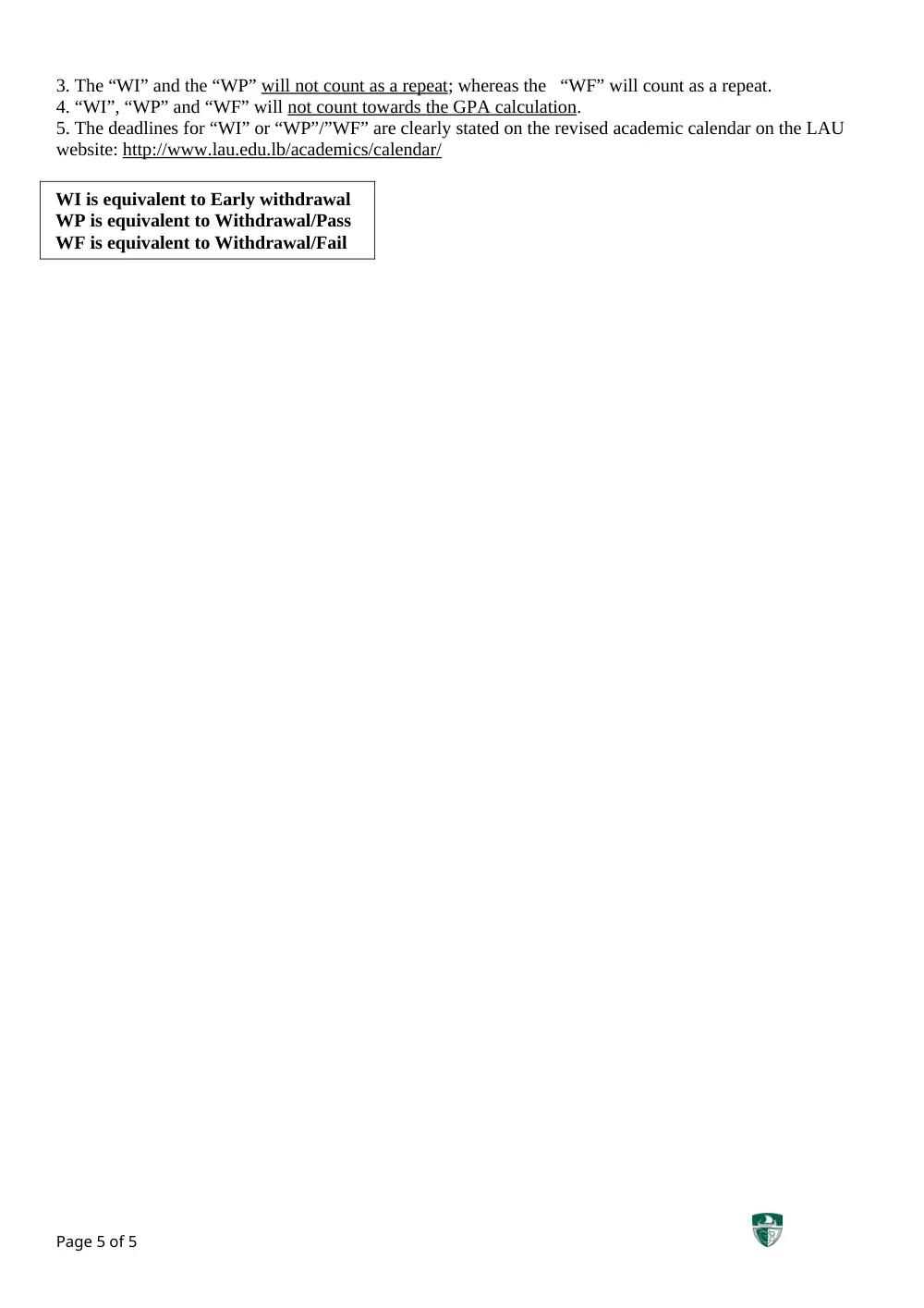
3. The “WI” and the “WP” will not count as a repeat; whereas the “WF” will count as a repeat.
4. “WI”, “WP” and “WF” will not count towards the GPA calculation.
5. The deadlines for “WI” or “WP”/”WF” are clearly stated on the revised academic calendar on the LAU
website: http://www.lau.edu.lb/academics/calendar/
WI is equivalent to Early withdrawal
WP is equivalent to Withdrawal/Pass
WF is equivalent to Withdrawal/Fail
Page 5 of 5