
ENG 212 Lecture
Lebanese American University · Literature II · 12 pages · Dr. Larissa Vassilenko
Showing the first 10 of 12 pages. Download the PDF to see all of it.
More ENG 212 files
Show the text of this lab
"Tickets, Please!'
D. H. Lawrence
1919
There is in the North a single-line system of tramcars which boldly leaves the
county town and plunges off into the black, industrial countryside, up hill and down
dale, through the long, ugly villages of workmen's houses, over canals and railways,
past churches perched high and nobly over the smoke and shadows, through dark,
grimy, cold little market-places, tilting away in a rush past cinemas and shops down
to the hollow where the collieries are, then up again, past a little rural church under
the ash-trees, on in a bolt to the terminus, the last little ugly place of industry, the
cold little town that shivers on the edge of the wild, gloomy country beyond. There
the blue and creamy coloured tramcar seems to pause and purr with curious
satisfaction. But in a few minutes—the clock on the turret of the Co-operative
Wholesale Society's shops gives the time—away it starts once more on the
adventure. Again there are the reckless swoops downhill, bouncing the loops; again
the chilly wait in the hill-top market-place: again the breathless slithering round
the precipitous drop under the church: again the patient halts at the loops, waiting
for the outcoming car: so on and on, for two long hours, till at last the city looms
beyond, the fat gasworks, the narrow factories draw near, we are in the sordid
streets of the great town, once more we sidle to a standstill at our terminus,
abashed by the great crimson and cream-coloured city cars, but still jerky, jaunty,
somewhat daredevil, pert as a blue-tit out of a black colliery garden.
To ride on these cars is always an adventure. The drivers are often men unfit for
active service: cripples and hunchbacks. So they have the spirit of the devil in them.
The ride becomes a steeplechase. Hurrah! we have leapt in a clean jump over the
canal bridges—now for the four-lane corner! With a shriek and a trail of sparks we
are clear again. To be sure a tram often leaps the rails—but what matter! It sits in
a ditch till other trams come to haul it out. It is quite common for a car, packed with
one solid mass of living people, to come to a dead halt in the midst of unbroken
blackness, the heart of nowhere on a dark night, and for the driver and the girl-
conductor to call: 'All get off—car's on fire.' Instead of rushing out in a panic, the
passengers stolidly reply: 'Get on—get on. We're not coming out. We're stopping
where we are. Push on, George.' So till flames actually appear.
The reason for this reluctance to dismount is that the nights are howlingly cold,
black and windswept, and a car is a haven of refuge. From village to village the
miners travel, for a change of cinema, of girl, of pub. The trams are desperately
packed. Who is going to risk himself in the black gulf outside, to wait perhaps an
hour for another tram, then to see the forlorn notice 'Depot Only'—because there is
iL
something wrong; or to greet a unit of three bright cars all so tight with people that
they sail past with a howl of derision? Trams that pass in the night!
This, the most dangerous tram-service in England, as the authorities themselves
declare, with pride, is entirely conducted by girls, and driven by rash young men, or
else by invalids who creep forward in terror. The girls are fearless young hussies. In
their ugly blue uniforms, skirts up to their knees, shapeless old peaked caps on
their heads, they have all the sang-froid of an old non-commissioned officer. With a
tram packed with howling colliers, roaring hymns downstairs and a sort of
antiphony of obscenities upstairs, the lasses are perfectly at their ease. They pounce
on the youths who try to evade their ticket-machine. They push off the men at the
end of their distance. They are not going to be done in the eye—not they. They fear
nobody—and everybody fears them.
'Halloa, Annie!'
'Halloa, Ted!’ 'Oh, mind my corn, Miss Stone! It's my belief you've got a heart of
stone, for you've trod on it again.’
"You should keep it in your pocket,' replies Miss Stone, and she goes sturdily
upstairs in her high boots.
‘Tickets, please.'
She is peremptory, suspicious, and ready to hit first. She can hold her own against
ten thousand.
Therefore there is a certain wild romance aboard these cars—and in the sturdy
bosom of Annie herself. The romantic time is in the morning, between ten o'clock
and one, when things are rather slack: that is, except market-day and Saturday.
Then Annie has time to look about her. Then she often hops off her car and into a
shop where she has spied something, while her driver chats in the main road. There
is very good feeling between the girls and the drivers. Are they not companions in
peril, shipmates aboard this careering vessel of a tramcar, for ever rocking on the
waves of a hilly land?
Then, also, in the easy hours the inspectors are most in evidence. For some reason,
everybody employed in this tram-service is young: there are no grey heads. It would
not do. Therefore the inspectors are of the right age, and one, the chief, is also good-
looking. See him stand on a wet, gloomy morning in his long oilskin, his peaked cap
well down over his eyes, waiting to board a car. His face is ruddy, his small brown
moustache is weathered, he has a faint, impudent smile. Fairly tall and agile, even
in his waterproof, he springs aboard a car and greets Annie.
'Halloa, Annie! Keeping the wet out?"
od
‘Trying to."
There are only two people in the car. Inspecting is soon over. Then for a long and
impudent chat on the footboard—a good, easy, twelve-mile chat.
The inspector's name is John Joseph Raynor: always called John Joseph. His face
sets in fury when he is addressed, from a distance, with this abbreviation. There is
considerable scandal about John Joseph in half-a-dozen villages. He flirts with the
girl-conductors in the morning, and walks out with them in the dark night when
they leave their tramcar at the depot. Of course, the girls quit the service
frequently. Then he flirts and walks out with a newcomer: always providing she is
sufficiently attractive, and that she will consent to walk. It is remarkable, however,
that most of the girls are quite comely, they are all young, and this roving life
aboard the car gives them a sailor's dash and recklessness. What matter how they
behave when the ship is in port? Tomorrow they will be aboard again.
Annie, however, was something of a tartar, and her sharp tongue had kept John
Joseph at arm's length for many months. Perhaps, therefore, she liked him all the
more; for he always came up smiling, with impudence. She watched him vanquish
one girl, then another. She could tell by the movement of his mouth and eyes, when
he flirted with her in the morning, that he had been walking out with this lass, or
the other the night before. She could sum him up pretty well.
In their subtle antagonism, they knew each other like old friends; they were as
shrewd with one another almost as man and wife. But Annie had always kept him
fully at arm's length. Besides, she had a boy of her own.
The Statutes fair, however, came in November, at Middleton. It happened that
Annie had the Monday night off. It was a drizzling, ugly night, yet she dressed
herself up and went to the fairground. She was alone, but she expected soon to find
a pal of some sort.
The roundabouts were veering round and grinding out their music, the side-shows
were making as much commotion as possible. In the coconut shies there were no
coconuts, but artificial substitutes, which the lads declared were fastened into the
irons. There was a sad decline in brilliance and luxury. None the less, the ground
was muddy as ever, there was the same crush, the press of faces lighted up by the
flares and the electric lights, the same smell of naphtha and fried potatoes and
electricity.
Who should be the first to greet Miss Annie, on the show-ground, but John Joseph!
He had a black overcoat buttoned up to his chin, and a tweed cap pulled down over
his brows, his face between was ruddy and smiling and hardy as ever. She knew so
well the way his mouth moved.
She was very glad to have a ‘boy’. To be at the Statutes without a fellow was no fun.
Instantly, like the gallant he was, he took her on the dragons, grim-toothed, round-
about switchbacks. It was not nearly so exciting as a tramcar, actually. But then, to
be seated in a shaking green dragon, uplifted above the sea of bubble faces,
careering in a rickety fashion in the lower heavens, whilst John Joseph leaned over
her, his cigarette in his mouth, was, after all, the right style. She was a plump,
quick, alive little creature. So she was quite excited and happy.
John Joseph made her stay on for the next round. And therefore she could hardly
for shame to repulse him when he put his arm round her and drew her a little
nearer to him, in a very warm and cuddly manner. Besides, he was fairly discreet,
he kept his movement as hidden as possible. She looked down, and saw that his red,
clean hand was out of sight of the crowd. And they knew each other so well. So they
warmed up to the fair.
After the dragons they went on the horses. John Joseph paid each time, she could
but be complaisant. He, of course, sat astride on the outer horse—named ‘Black
Bess'—and she sat sideways towards him, on the inner horse—named ‘Wildfire’.
But, of course, John Joseph was not going to sit discreetly on 'Black Bess’, holding
the brass bar. Round they spun and heaved, in the light. And round he swung on his
wooden steed, flinging one leg across her mount, and perilously tipping up and
down, across the space, half-lying back, laughing at her. He was perfectly happy;
she was afraid her hat was on one side, but she was excited.
He threw quoits on a table, and won her two large, pale-blue hatpins. And then,
hearing the noise of the cinema, announcing another performance, they climbed the
boards and went in.
Of course, during these performances, pitch darkness falls from time to time, when
the machine goes wrong. Then there is a wild whooping, and a loud smacking of
simulated kisses. In these moments John Joseph drew Annie towards him. After all,
he had a wonderfully warm, cosy way of holding a girl with his arm, he seemed to
make such a nice fit. And, after all, it was pleasant to be so held; so very comforting
and cosy and nice. He leaned over her and she felt his breath on her hair. She knew
he wanted to kiss her on the lips. And, after all, he was so warm and she fitted in to
him so softly. After all, she wanted him to touch her lips.
But the light sprang up, she also started electrically, and put her hat straight. He
left his arm lying nonchalant behind her. Well, it was fun, it was exciting to be at
the Statutes with John Joseph.
When the cinema was over they went for a walk across the dark, damp fields. He
had all the arts of love-making. He was especially good at holding a girl, when he
sat with her on a stile in the black, drizzling darkness. He seemed to be holding her
in space, against his own warmth and gratification. And his kisses were soft and
slow and searching.
So Annie walked out with John Joseph, though she kept her own boy dangling in
the distance. Some of the tram-girls chose to be huffy. But there, you must take
things as you find them, in this life.
There was no mistake about it, Annie liked John Joseph a good deal. She felt so
pleasant and warm in herself, whenever he was near. And John Joseph really liked
Annie, more than usual. The soft, melting way in which she could flow into a fellow,
as if she melted into his very bones, was something rare and gratifying. He fully
appreciated this.
But with a developing acquaintance there began a developing intimacy. Annie
wanted to consider him a person, a man; she wanted to take an intelligent interest
in him, and to have an intelligent response. She did not want a mere nocturnal
presence— which was what he was so far. And she prided herself that he could not
leave her.
Here she made a mistake. John Joseph intended to remain a nocturnal presence, he
had no idea of becoming an all-round individual to her. When she started to take an
intelligent interest in him and his life and his character, he sheered off. He hated
intelligent interest. And he knew that the only way to stop it was to avoid it. The
possessive female was aroused in Annie. So he left her.
It was no use saying she was not surprised. She was at first startled, thrown out of
her count. For she had been so very sure of holding him. For a while she was
staggered, and everything became uncertain to her. Then she wept with fury,
indignation, desolation, and misery. Then she had a spasm of despair. And then,
when he came, still impudently, on to her car, still familiar, but letting her see by
the movement of his eyes that he had gone away to somebody else, for the time
being, and was enjoying pastures new, then she determined to have her own back.
She had a very shrewd idea what girls John Joseph had taken out. She went to
Nora Purdy. Nora was a tall, rather pale, but well-built girl, with beautiful yellow
hair. She was somewhat secretive.
'Hey!' said Annie, accosting her; then, softly: 'Who's John Joseph on with now?’
'I don't know,' said Nora.
‘Why tha does,' said Annie, ironically lapsing into dialect. 'Tha knows as well as I
do.'
'Well, I do, then,' said Nora. ‘It isn't me, so don't bother.'
‘It's Cissy Meakin, isn't it?’
‘It is for all I know.'
‘Hasn't he got a face on him!" said Annie. 'I don't half like his cheek! I could knock
him off the footboard when he comes round me"
‘He'll get dropped on one of these days,' said Nora.
‘Ay, he will when somebody makes up their mind to drop it on him. I should like to
see him taken down a peg or two, shouldn't you?’
'T shouldn't mind,' said Nora.
"You've got quite as much cause to as I have,' said Annie. 'But we'll drop on him one
of these days, my girl. What! don't you want to?’
'T don't mind,' said Nora.
But as a matter of fact Nora was much more vindictive than Annie.
One by one Annie went the round of the old flames. It so happened that Cissy
Meakin left the tramway service in quite a short time. Her mother made her leave.
Then John Joseph was on the qui vive. He cast his eyes over his old flock. And his
eyes lighted on Annie. He thought she would be safe now. Besides, he liked her.
She arranged to walk home with him on Sunday night. It so happened that her car
would be in the depot at half-past nine: the last car would come in at ten-fifteen. So
John Joseph was to wait for her there.
At the depot the girls had a little waiting-room of their own. It was quite rough, but
cosy, with a fire and an oven and a mirror and table and wooden chairs. The half.
dozen girls who knew John Joseph only too well had arranged to take service this
Sunday afternoon. So as the cars began to come in early, the girls dropped into the
waiting-room. And instead of hurrying off home they sat round the fire and had a
cup of tea.
John Joseph came on the car after Annie, at about a quarter to ten. He poked his
head easily into the girls' waiting-room.
‘Prayer meeting?’ he asked.
'Ay,' said Laura Sharp. 'Ladies' effort.’
‘That's me!' said John Joseph. It was one of his favourite exclamations.
6
‘Shut the door, boy,' said Muriel Baggaley.
‘On which side of me?' said John Joseph.
"Which tha likes,' said Polly Birken.
He had come in and closed the door behind him. The girls moved in their circle to
= a place for him near the fire. He took off his greatcoat and pushed back his
‘Who handles the teapot?' he said.
Nora silently poured him out a cup of tea.
‘Want a bit o' my bread and dripping?’ said Muriel Baggaley to him.
"Ay, all's welcome.'
And he began to eat his piece of bread.
‘There's no place like home, girls,' he said.
They all looked at him as he uttered this piece of impudence. He seemed to be
sunning himself in the presence of so many damsels.
‘Especially if you're not afraid to go home in the dark,' said Laura Sharp.
"Me? By myself I am!'
They sat till they heard the last tram come in. In a few minutes Emma Housely
entered.
‘Come on, my old duck!' cried Polly Birkin.
‘It is perishing,' said Emma, holding her fingers to the fire.
"But I'm afraid to go home in the dark," sang Laura Sharp, the tune having got
into her mind.
'Who're you going with tonight, Mr Raynor?' asked Muriel Baggaley, coolly.
‘Tonight?' said John Joseph. 'Oh, I'm going home by myself tonight—all on my
lonely-o.'
‘That's me!' said Nora Purdy, using his own ejaculation. The girls laughed shrilly.
‘Me as well, Nora,' said John Joseph.
"Don't know what you mean,' said Laura.
"Yes, I'm toddling,' said he, rising and reaching for his coat.
'Nay,' said Polly. ‘We're all here waiting for you.'
'We've got to be up in good time in the morning,' he said, in the benevolent official
manner. They all laughed.
‘Nay,’ said Muriel. 'Don't disappoint us all.' 'T'll take the lot, if you like,' he
responded, gallantly.
‘That you won't, either,’ said Muriel. 'Two's company; seven's too much of a good
thing.'
"Nay, take one,' said Laura. 'Fair and square, all above board, say which one.'
‘Ay! cried Annie, speaking for the first time. ‘Choose, John Joseph—let's hear thee.'
‘Nay,’ he said. 'I'm going home quiet tonight.’ He frowned at the use of his double
name.
‘Who says?' said Annie. 'Tha's got to ta'e one.’
"Nay, how can I take one?’ he said, laughing uneasily. 'I don't want to make
enemies.'
‘You'd only make one,' said Annie, grimly.
‘The chosen one,' said Laura. A laugh went up.
‘Oh, ay! Who said girls!' exclaimed John Joseph, again turning as if to escape. 'Well,
good-night!!'
"Nay, you've got to take one,' said Muriel. 'Turn your face to the wall, and say which
one touches you. Go on—we shall only just touch your back—one of us. Go on—turn
your face to the wall, and don't look, and say which one touches you.'
They pushed him to a wall and stood him there with his face to it. Behind his back
they all grimaced, tittering. He looked so comical.
'Go on!" he cried.
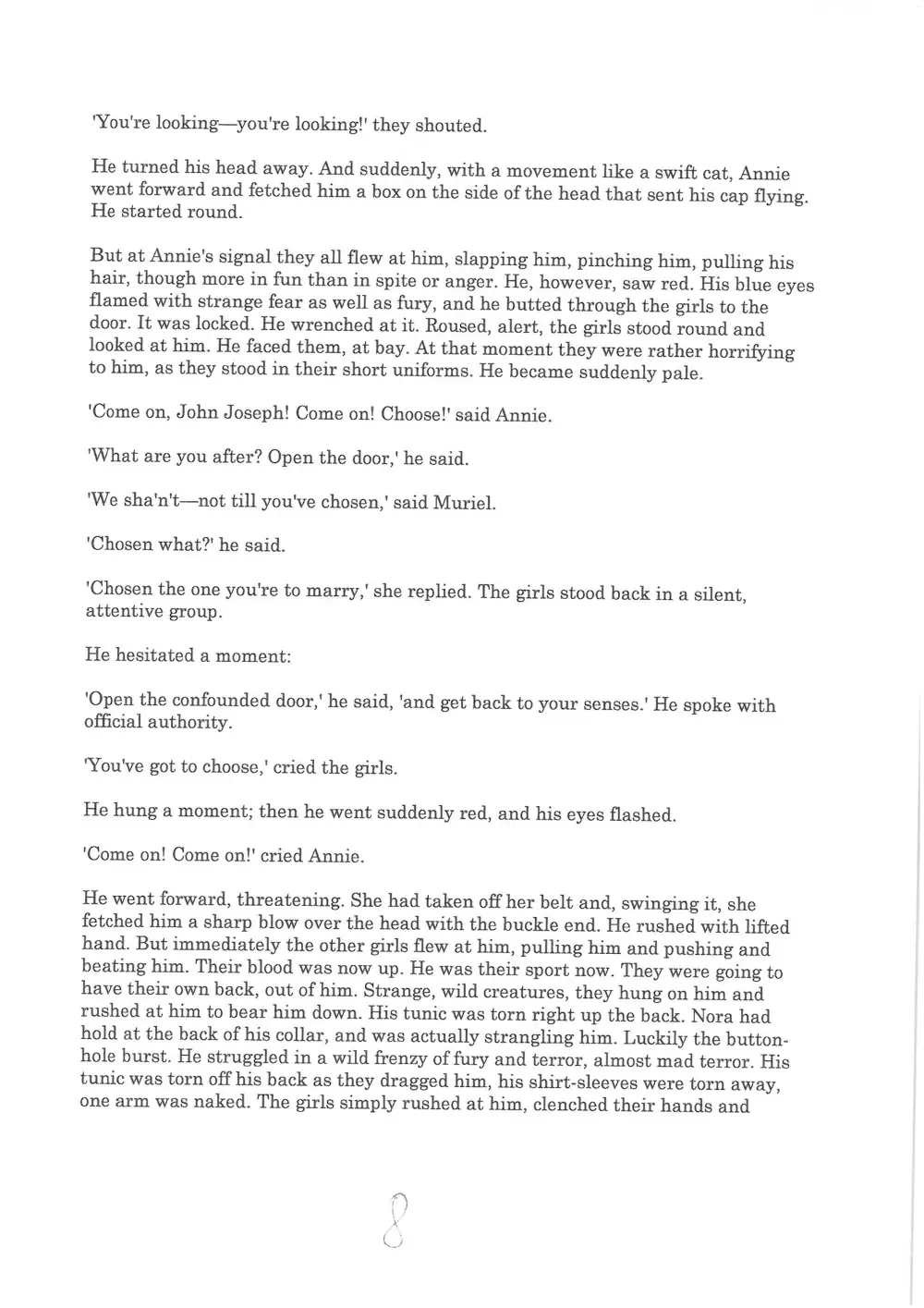
"You're looking—you're looking!' they shouted.
He turned his head away. And suddenly, with a movement like a swift cat, Annie
went forward and fetched him a box on the side of the head that sent his cap flying.
He started round.
But at Annie's signal they all flew at him, slapping him, pinching him, pulling his
hair, though more in fun than in spite or anger. He, however, saw red. His blue eyes
flamed with strange fear as well as fury, and he butted through the girls to the
door. It was locked. He wrenched at it. Roused, alert, the girls stood round and
looked at him. He faced them, at bay. At that moment they were rather horrifying
to him, as they stood in their short uniforms. He became suddenly pale.
‘Come on, John Joseph! Come on! Choose!' said Annie.
‘What are you after? Open the door,’ he said.
'We sha'n't—not till you've chosen,' said Muriel.
‘Chosen what”' he said.
‘Chosen the one you're to marry,' she replied. The girls stood back in a silent,
attentive group.
He hesitated a moment:
‘Open the confounded door,' he said, 'and get back to your senses.’ He spoke with
official authority.
"You've got to choose,' cried the girls.
He hung a moment; then he went suddenly red, and his eyes flashed.
‘Come on! Come on! cried Annie.
He went forward, threatening. She had taken off her belt and, swinging it, she
fetched him a sharp blow over the head with the buckle end. He rushed with lifted
hand. But immediately the other girls flew at him, pulling him and pushing and
beating him. Their blood was now up. He was their sport now. They were going to
have their own back, out of him. Strange, wild creatures, they hung on him and
rushed at him to bear him down. His tunic was torn right up the back. Nora had
hold at the back of his collar, and was actually strangling him. Luckily the button-
hole burst. He struggled in a wild frenzy of fury and terror, almost mad terror. His
tunic was torn off his back as they dragged him, his shirt-sleeves were torn away,
one arm was naked. The girls simply rushed at him, clenched their hands and
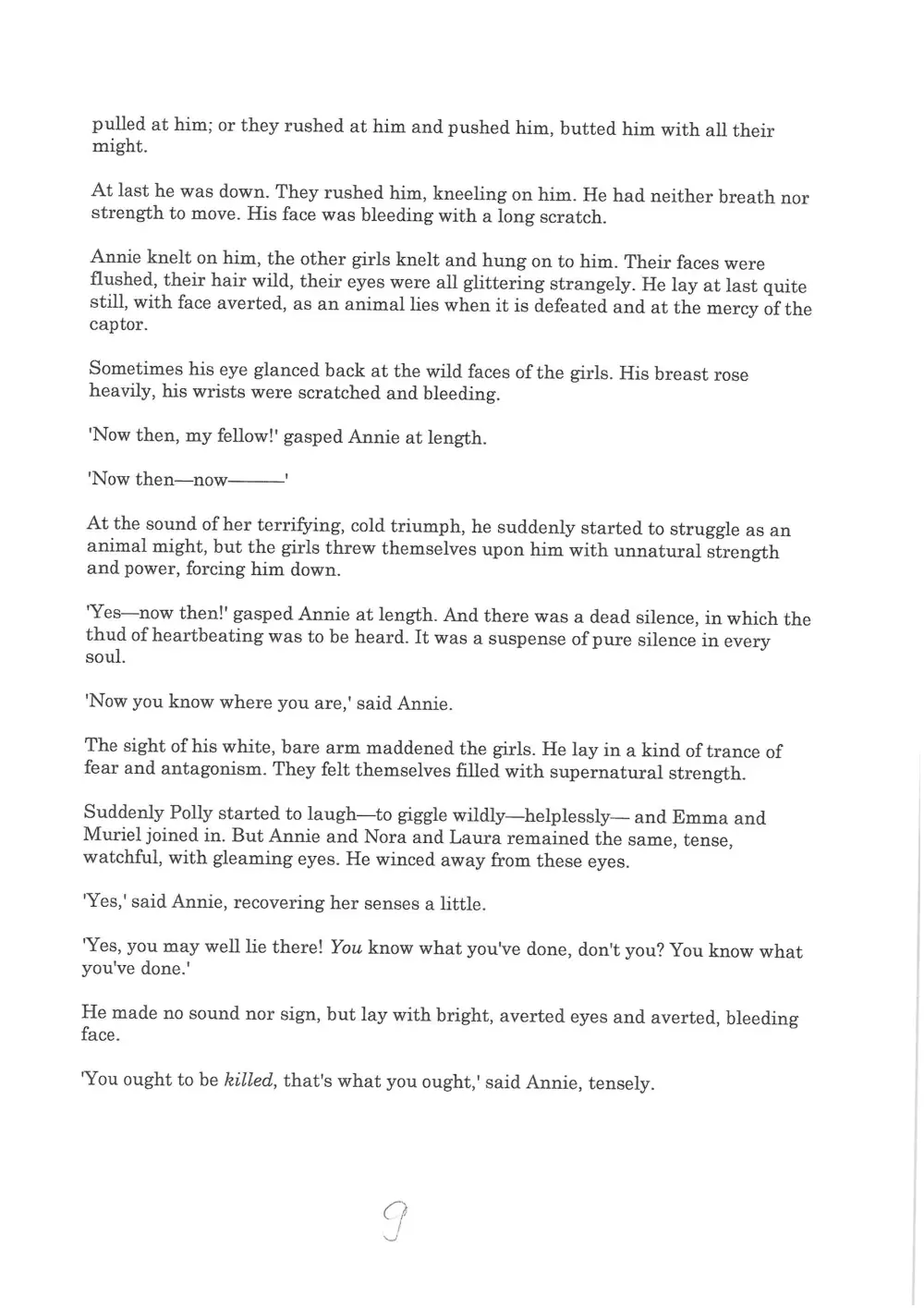
pulled at him; or they rushed at him and pushed him, butted him with all their
might.
At last he was down. They rushed him, kneeling on him. He had neither breath nor
strength to move. His face was bleeding with a long scratch.
Annie knelt on him, the other girls knelt and hung on to him. Their faces were
flushed, their hair wild, their eyes were all glittering strangely. He lay at last quite
still, with face averted, as an animal lies when it is defeated and at the mercy of the
captor.
Sometimes his eye glanced back at the wild faces of the girls. His breast rose
heavily, his wrists were scratched and bleeding.
‘Now then, my fellow!' gasped Annie at length.
"Now then—now-
At the sound of her terrifying, cold triumph, he suddenly started to struggle as an
animal might, but the girls threw themselves upon him with unnatural strength
and power, forcing him down.
"Yes—now then!' gasped Annie at length. And there was a dead silence, in which the
thud of heartbeating was to be heard. It was a suspense of pure silence in every
soul.
"Now you know where you are,' said Annie.
The sight of his white, bare arm maddened the girls. He lay in a kind of trance of
fear and antagonism. They felt themselves filled with supernatural strength.
Suddenly Polly started to laugh—to giggle wildly—helplessly— and Emma and
Muriel joined in. But Annie and Nora and Laura remained the same, tense,
watchful, with gleaming eyes. He winced away from these eyes.
'Yes,' said Annie, recovering her senses a little.
"Yes, you may well lie there! You know what you've done, don't you? You know what
you've done.'
He made no sound nor sign, but lay with bright, averted eyes and averted, bleeding
face.
"You ought to be killed, that's what you ought,' said Annie, tensely.