
MTH 304 Syllabus
Lebanese American University · Differential Equations · 3 pages
More MTH 304 files
Show the text of this lab
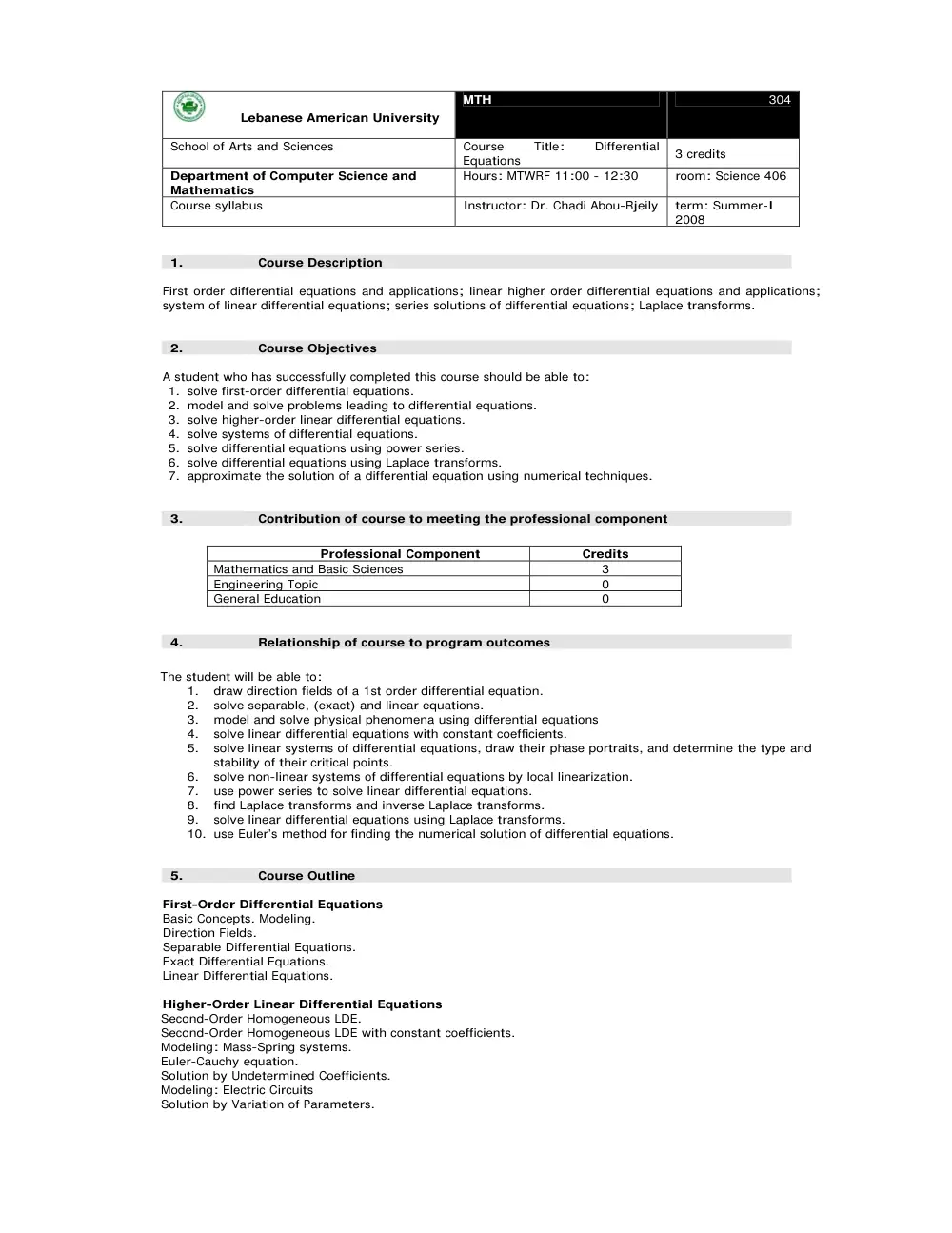
Lebanese American University
MTH
304
School of Arts and Sciences
Course
Title:
Differential
Equations
3 credits
Department of Computer Science and
Mathematics
Hours: MTWRF 11:00 - 12:30
room: Science 406
Course syllabus
Instructor: Dr. Chadi Abou-Rjeily
term: Summer-I
2008
1.
Course Description
First order differential equations and applications; linear higher order differential equations and applications;
system of linear differential equations; series solutions of differential equations; Laplace transforms.
2.
Course Objectives
A student who has successfully completed this course should be able to:
1. solve first-order differential equations.
2. model and solve problems leading to differential equations.
3. solve higher-order linear differential equations.
4. solve systems of differential equations.
5. solve differential equations using power series.
6. solve differential equations using Laplace transforms.
7. approximate the solution of a differential equation using numerical techniques.
3.
Contribution of course to meeting the professional component
Professional Component
Credits
Mathematics and Basic Sciences
3
Engineering Topic
0
General Education
0
4.
Relationship of course to program outcomes
The student will be able to:
1.
draw direction fields of a 1st order differential equation.
2.
solve separable, (exact) and linear equations.
3.
model and solve physical phenomena using differential equations
4.
solve linear differential equations with constant coefficients.
5.
solve linear systems of differential equations, draw their phase portraits, and determine the type and
stability of their critical points.
6.
solve non-linear systems of differential equations by local linearization.
7.
use power series to solve linear differential equations.
8.
find Laplace transforms and inverse Laplace transforms.
9.
solve linear differential equations using Laplace transforms.
10. use Euler’s method for finding the numerical solution of differential equations.
5.
Course Outline
First-Order Differential Equations
Basic Concepts. Modeling.
Direction Fields.
Separable Differential Equations.
Exact Differential Equations.
Linear Differential Equations.
Higher-Order Linear Differential Equations
Second-Order Homogeneous LDE.
Second-Order Homogeneous LDE with constant coefficients.
Modeling: Mass-Spring systems.
Euler-Cauchy equation.
Solution by Undetermined Coefficients.
Modeling: Electric Circuits
Solution by Variation of Parameters.
Differential Equations – MTH304 – Summer-I 2008
2/3
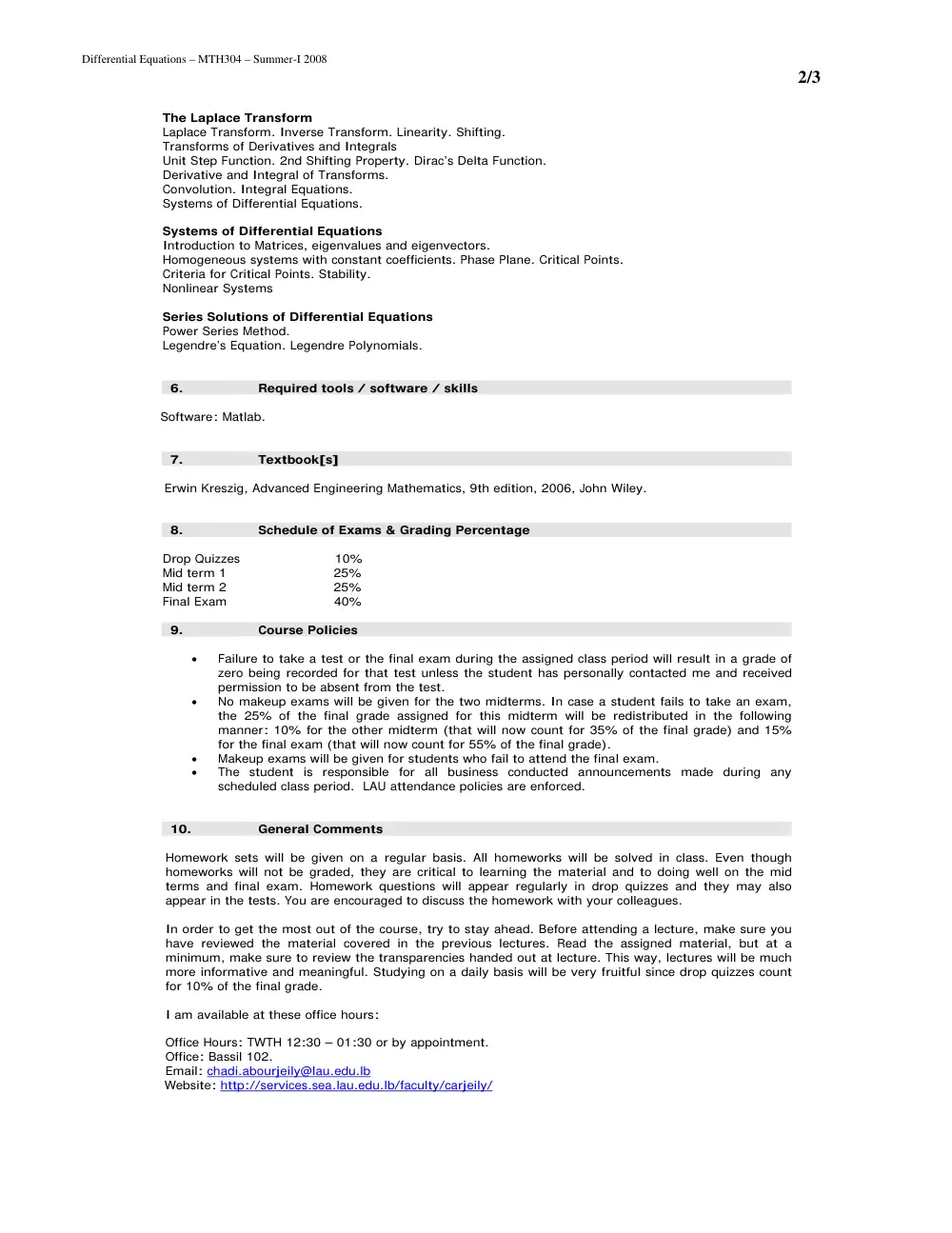
The Laplace Transform
Laplace Transform. Inverse Transform. Linearity. Shifting.
Transforms of Derivatives and Integrals
Unit Step Function. 2nd Shifting Property. Dirac’s Delta Function.
Derivative and Integral of Transforms.
Convolution. Integral Equations.
Systems of Differential Equations.
Systems of Differential Equations
Introduction to Matrices, eigenvalues and eigenvectors.
Homogeneous systems with constant coefficients. Phase Plane. Critical Points.
Criteria for Critical Points. Stability.
Nonlinear Systems
Series Solutions of Differential Equations
Power Series Method.
Legendre’s Equation. Legendre Polynomials.
6.
Required tools / software / skills
Software: Matlab.
7.
Textbook[s]
Erwin Kreszig, Advanced Engineering Mathematics, 9th edition, 2006, John Wiley.
8.
Schedule of Exams & Grading Percentage
Drop Quizzes 10%
Mid term 1 25%
Mid term 2 25%
Final Exam 40%
9.
Course Policies
•
Failure to take a test or the final exam during the assigned class period will result in a grade of
zero being recorded for that test unless the student has personally contacted me and received
permission to be absent from the test.
•
No makeup exams will be given for the two midterms. In case a student fails to take an exam,
the 25% of the final grade assigned for this midterm will be redistributed in the following
manner: 10% for the other midterm (that will now count for 35% of the final grade) and 15%
for the final exam (that will now count for 55% of the final grade).
•
Makeup exams will be given for students who fail to attend the final exam.
•
The student is responsible for all business conducted announcements made during any
scheduled class period. LAU attendance policies are enforced.
10.
General Comments
Homework sets will be given on a regular basis. All homeworks will be solved in class. Even though
homeworks will not be graded, they are critical to learning the material and to doing well on the mid
terms and final exam. Homework questions will appear regularly in drop quizzes and they may also
appear in the tests. You are encouraged to discuss the homework with your colleagues.
In order to get the most out of the course, try to stay ahead. Before attending a lecture, make sure you
have reviewed the material covered in the previous lectures. Read the assigned material, but at a
minimum, make sure to review the transparencies handed out at lecture. This way, lectures will be much
more informative and meaningful. Studying on a daily basis will be very fruitful since drop quizzes count
for 10% of the final grade.
I am available at these office hours:
Office Hours: TWTH 12:30 – 01:30 or by appointment.
Office: Bassil 102.
Email: chadi.abourjeily@lau.edu.lb
Website: http://services.sea.lau.edu.lb/faculty/carjeily/
Differential Equations – MTH304 – Summer-I 2008
3/3
11.
General Rules & Regulations
•
A student can miss no more than 4 sessions of instruction. By the 5th session, the instructor may
ask the student to drop the course.
•
Plagiarism: students caught cheating on an exam receive a grade of zero on the exam in the
first cheating attempt and a warning. Students caught cheating for the second time in the same
course receive an F grade in the course and a second warning. A grade of zero on an exam
resulting from cheating must be counted in the student’s course grade. The zero cannot be
dropped in computing the final grade in case the instructor has a policy of allowing students to
drop their worst exam grade.
•
Any student who receives 3 warnings will be suspended.