
PHY 201 Syllabus, Spring 2013
Lebanese American University · Electricit and Magnetism · 3 pages
More PHY 201 files
Show the text of this lab
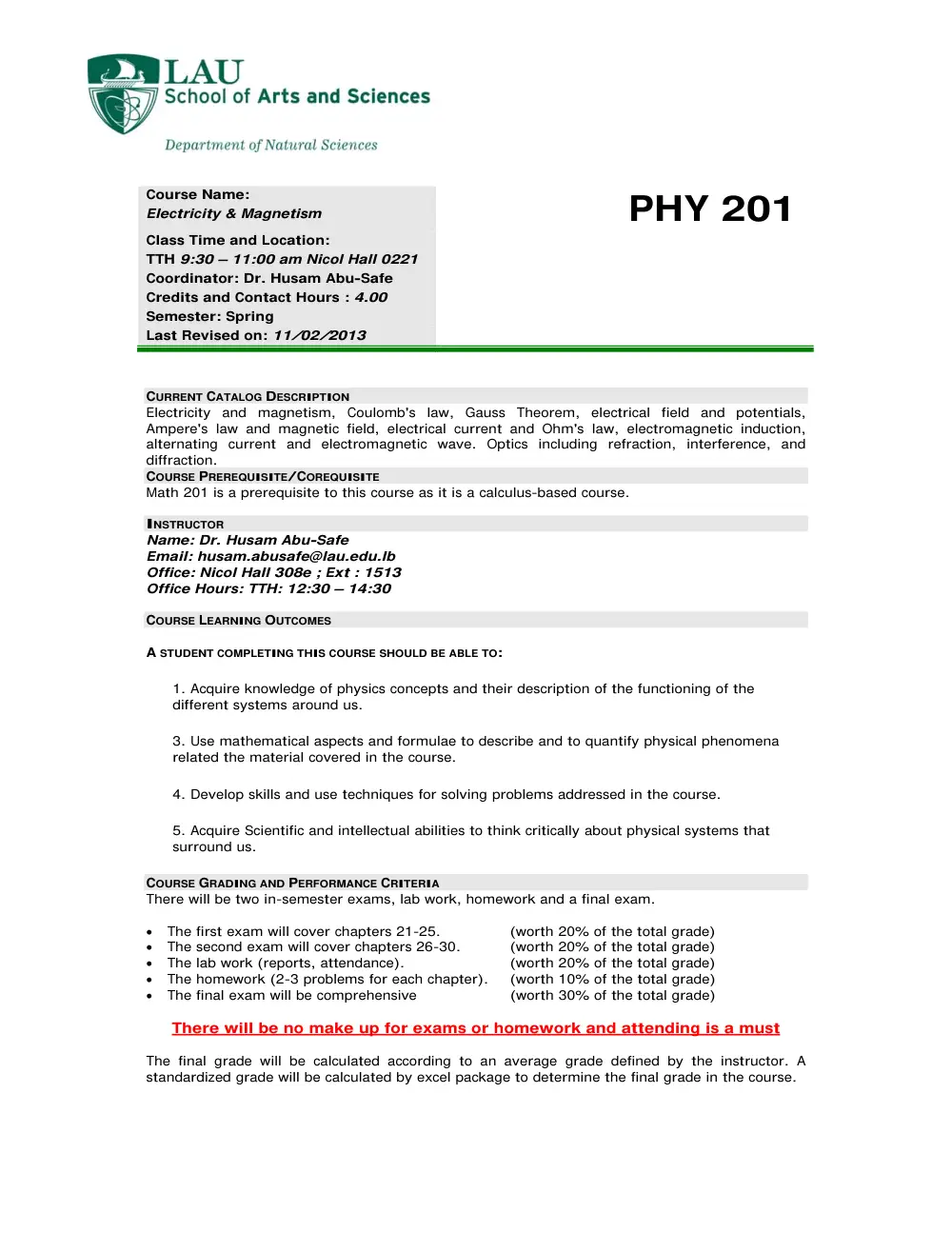
Course Name:
Electricity & Magnetism
PHY 201
Class Time and Location:
TTH 9:30 – 11:00 am Nicol Hall 0221
Coordinator: Dr. Husam Abu-Safe
Credits and Contact Hours : 4.00
Semester: Spring
Last Revised on: 11/02/2013
CURRENT CATALOG DESCRIPTION
Electricity and magnetism, Coulomb's law, Gauss Theorem, electrical field and potentials,
Ampere's law and magnetic field, electrical current and Ohm's law, electromagnetic induction,
alternating current and electromagnetic wave. Optics including refraction, interference, and
diffraction.
COURSE PREREQUISITE/COREQUISITE
Math 201 is a prerequisite to this course as it is a calculus-based course.
INSTRUCTOR
Name: Dr. Husam Abu-Safe
Email: husam.abusafe@lau.edu.lb
Office: Nicol Hall 308e ; Ext : 1513
Office Hours: TTH: 12:30 – 14:30
COURSE LEARNING OUTCOMES
A STUDENT COMPLETING THIS COURSE SHOULD BE ABLE TO:
1. Acquire knowledge of physics concepts and their description of the functioning of the
different systems around us.
3. Use mathematical aspects and formulae to describe and to quantify physical phenomena
related the material covered in the course.
4. Develop skills and use techniques for solving problems addressed in the course.
5. Acquire Scientific and intellectual abilities to think critically about physical systems that
surround us.
COURSE GRADING AND PERFORMANCE CRITERIA
There will be two in-semester exams, lab work, homework and a final exam.
The first exam will cover chapters 21-25.
(worth 20% of the total grade)
The second exam will cover chapters 26-30.
(worth 20% of the total grade)
The lab work (reports, attendance).
(worth 20% of the total grade)
The homework (2-3 problems for each chapter).
(worth 10% of the total grade)
The final exam will be comprehensive
(worth 30% of the total grade)
There will be no make up for exams or homework and attending is a must
The final grade will be calculated according to an average grade defined by the instructor. A
standardized grade will be calculated by excel package to determine the final grade in the course.
Page 2 of 3
TEACHING METHOD
Mainly, every week one chapter will be introduced, around 5 assigned problems will be solved in
class and important aspects related to the concepts introduced during the lecture will be
discussed. The student is requested to read the chapter at home before the lecture, and to
study daily. All lecture notes will be posted on the blackboard, you are advised to printout the
lectures and to bring them to class as you will often need to add your personal notes on the
printouts.
Students are advised to form groups of 4 (or 3) students and prepare the assigned homework as a
group. Each student will be expected to be capable of explaining and solving all homework
problems on the board.
TEXTBOOK AND REFERENCES
Principles of Physics.by Halliday/ Resnick/ Jearl Walker, (Wiley 9th Edition).
ISBN: 978-0-470-56158-4.
MAJOR TOPICS COVERED IN THE COURSE AND TENTATIVE SCHEDULE
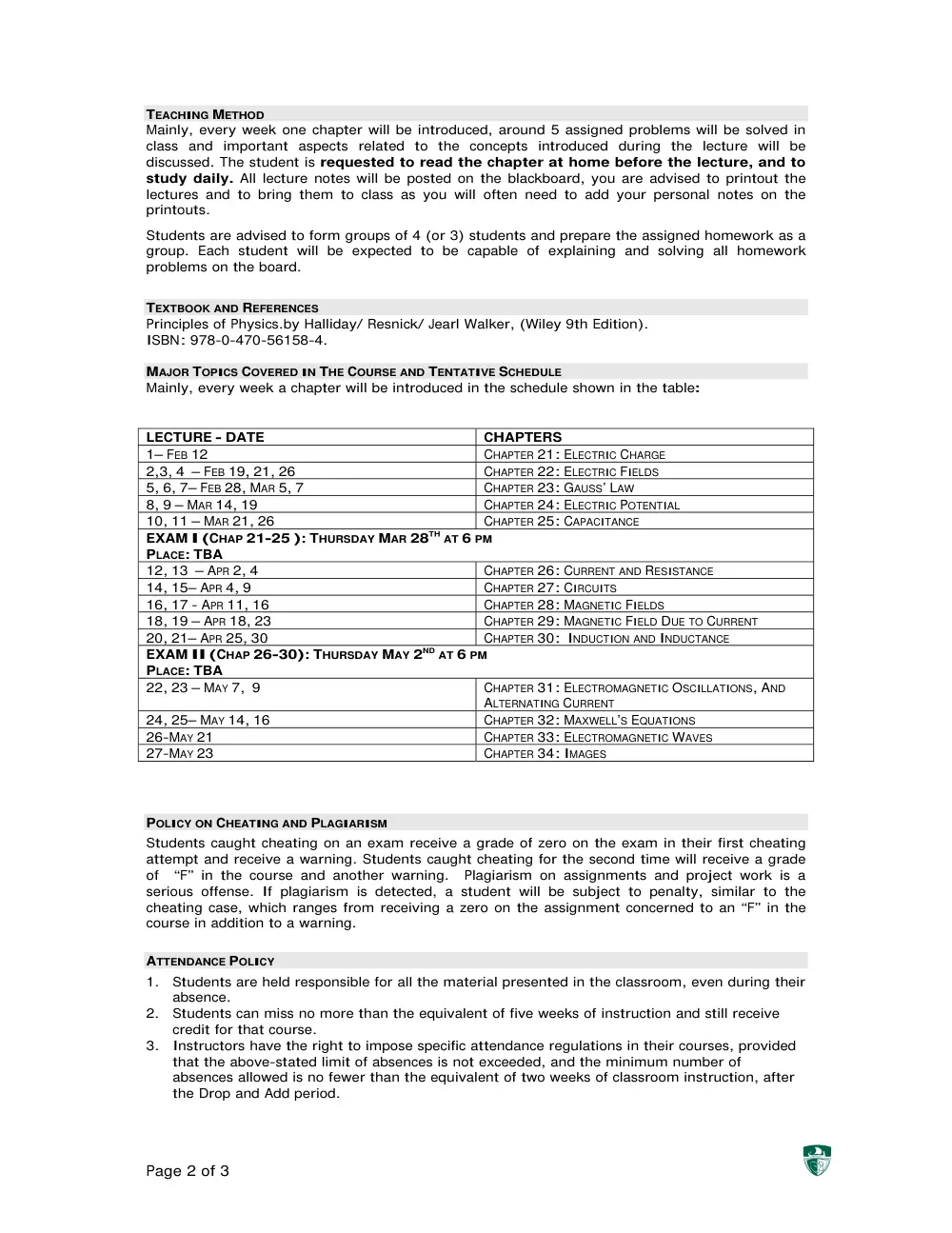
Mainly, every week a chapter will be introduced in the schedule shown in the table:
LECTURE - DATE
CHAPTERS
1– FEB 12
CHAPTER 21: ELECTRIC CHARGE
2,3, 4 – FEB 19, 21, 26
CHAPTER 22: ELECTRIC FIELDS
5, 6, 7– FEB 28, MAR 5, 7
CHAPTER 23: GAUSS’ LAW
8, 9 – MAR 14, 19
CHAPTER 24: ELECTRIC POTENTIAL
10, 11 – MAR 21, 26
CHAPTER 25: CAPACITANCE
EXAM I (CHAP 21-25 ): THURSDAY MAR 28
TH AT 6 PM
PLACE: TBA
12, 13 – APR 2, 4
CHAPTER 26: CURRENT AND RESISTANCE
14, 15– APR 4, 9
CHAPTER 27: CIRCUITS
16, 17 - APR 11, 16
CHAPTER 28: MAGNETIC FIELDS
18, 19 – APR 18, 23
CHAPTER 29: MAGNETIC FIELD DUE TO CURRENT
20, 21– APR 25, 30
CHAPTER 30: INDUCTION AND INDUCTANCE
EXAM II (CHAP 26-30): THURSDAY MAY 2
ND AT 6 PM
PLACE: TBA
22, 23 – MAY 7, 9
CHAPTER 31: ELECTROMAGNETIC OSCILLATIONS, AND
ALTERNATING CURRENT
24, 25– MAY 14, 16
CHAPTER 32: MAXWELL’S EQUATIONS
26-MAY 21
CHAPTER 33: ELECTROMAGNETIC WAVES
27-MAY 23
CHAPTER 34: IMAGES
POLICY ON CHEATING AND PLAGIARISM
Students caught cheating on an exam receive a grade of zero on the exam in their first cheating
attempt and receive a warning. Students caught cheating for the second time will receive a grade
of “F” in the course and another warning. Plagiarism on assignments and project work is a
serious offense. If plagiarism is detected, a student will be subject to penalty, similar to the
cheating case, which ranges from receiving a zero on the assignment concerned to an “F” in the
course in addition to a warning.
ATTENDANCE POLICY
1. Students are held responsible for all the material presented in the classroom, even during their
absence.
2. Students can miss no more than the equivalent of five weeks of instruction and still receive
credit for that course.
3. Instructors have the right to impose specific attendance regulations in their courses, provided
that the above-stated limit of absences is not exceeded, and the minimum number of
absences allowed is no fewer than the equivalent of two weeks of classroom instruction, after
the Drop and Add period.
Page 3 of 3
4. Instructors will inform the Departments Chairperson and the Guidance Office, of any prolonged
unexplained absence.
5. Students who exceed the allowed number of absences must withdraw from the course;
otherwise, the course grade will be recorded as “F” (NP).
WITHDRAWAL POLICY
1. A student who withdraws after the Drop/Add period and by the end of the 5th week of classes
(10th day of classes for Summer Modules) will obtain a “WI” on that particular course. The
student may process such request directly through the Registrar’s Office.
2. A student who withdraws from a course between the 6th week and the end of the 10th week of
classes (18th day of classes for Summer Modules) will receive either a “WP” or a “WF”. “WP” or
“WF” will be determined by the instructor based on the achieved academic performance in that
course till the time of withdrawal.
3. The “WI” and the “WP” will not count as a repeat; whereas the “WF” will count as a repeat.
4. “WI”, “WP” and “WF” will not count towards the GPA calculation.
5. The deadlines for “WI” or “WP”/”WF” are clearly stated on the revised academic calendar on
the LAU website: http://www.lau.edu.lb/academics/calendar/20122013/#spring_2013
WI is equivalent to Early Withdrawal
WP is equivalent to Withdrawal/Pass
WF is equivalent to Withdrawal/Fail
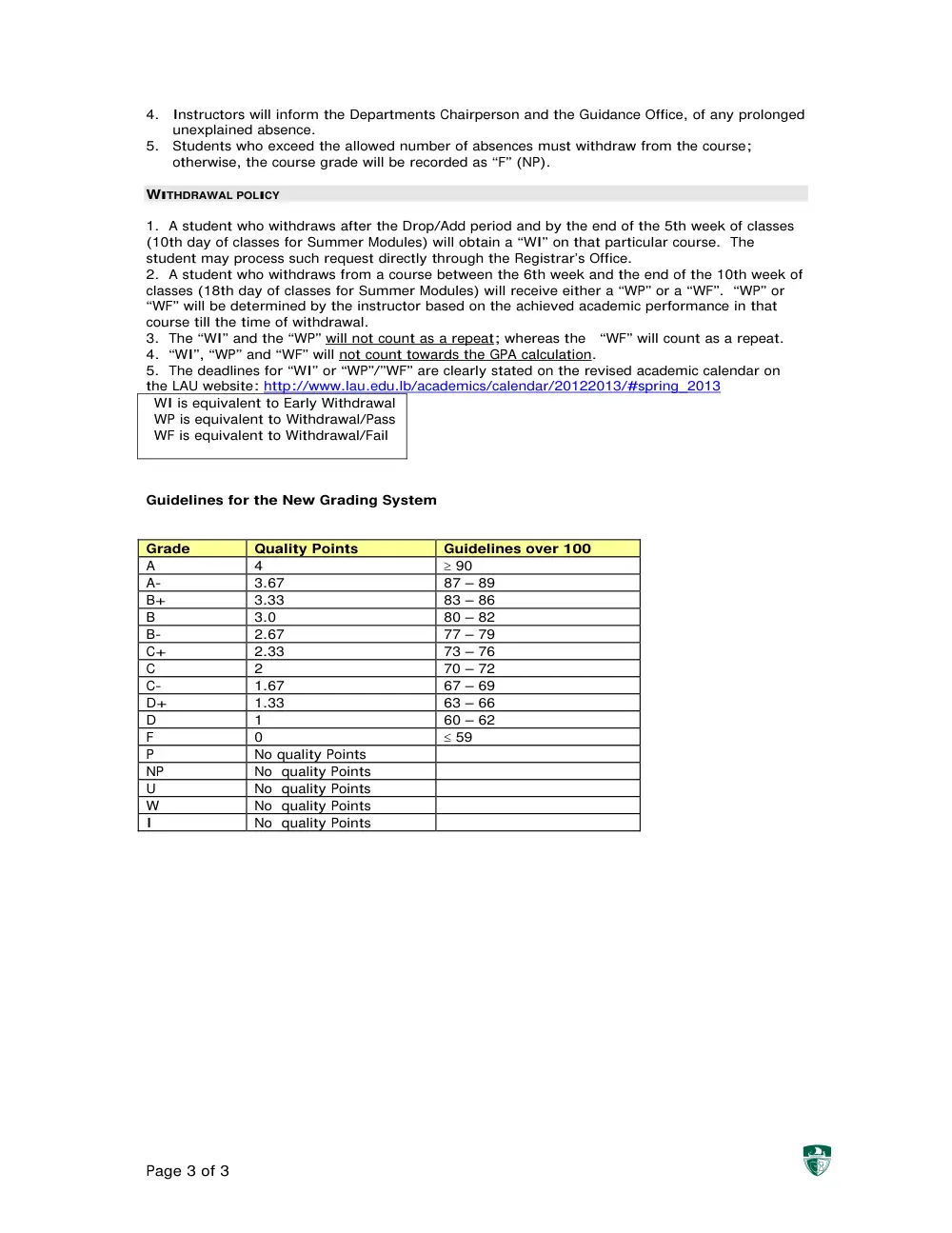
Guidelines for the New Grading System
Grade
Quality Points
Guidelines over 100
A
4
90
A-
3.67
87 – 89
B+
3.33
83 – 86
B
3.0
80 – 82
B-
2.67
77 – 79
C+
2.33
73 – 76
C
2
70 – 72
C-
1.67
67 – 69
D+
1.33
63 – 66
D
1
60 – 62
F
0
59
P
No quality Points
NP
No quality Points
U
No quality Points
W
No quality Points
I
No quality Points