
PSY 201 Chapter 1
Lebanese American University · Introduction To Psychology · 40 pages


Showing the first 10 of 40 pages. Download the PDF to see all of it.
More PSY 201 files
Show the text of this chapter
Psychology
201
Chapter one
Ms. Diala Itani
Psychology
What is psychology ?
= scientific study of behavior and mental processes
Why is Psychology a science?
1.
It is based on supported evidence and experimental
studies
2.
Use of scientific method: gather and analyze
objective information, removing biases and
minimizing errors. To get reliable results that can
predict future behaviors
3.
Defines clear and concrete terms
4.
Analysis of theories
Goals of Psychology
Describe : identify, classify behaviors and
mental processes
Understand: propose reasons for overt
observations ( behaviors) and cognitive
( internal work of the mind)
Predict: offer predictions about a given
condition
Influence: use results to solve future
problems
Areas of psychology
Example: I get a snake class..
Personality psychologist
- Why is he afraid and she is not?
Behavioral psychologist:
- Individual previous learning behaviors: was she
exposed to snakes when she was young and she
learned to be scared?
Social psychologist: How other people’s reactions
influence our own:
Did he look at the classmates who ran away from the
snake and he was influenced by them?
Areas of psychology
Biological psychologist:
Look at the man’s response in terms of heart
rate and sweating
Neuroscientist
Areas of the brain that are activated during fear
such as the amygdala
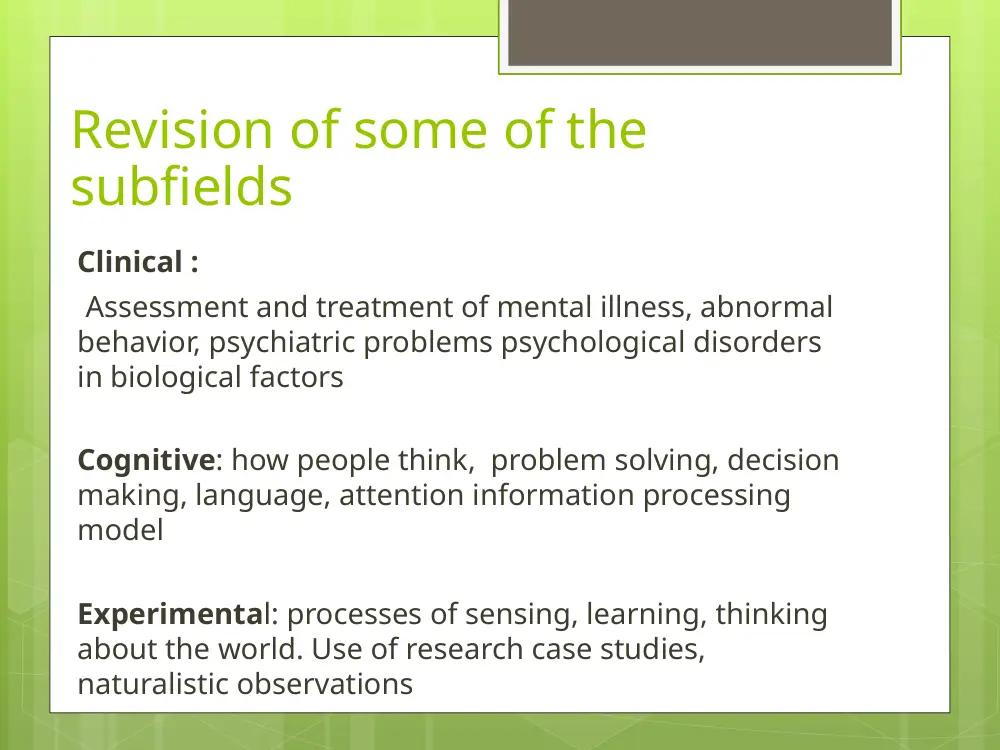
Revision of some of the
subfields
Clinical :
Assessment and treatment of mental illness, abnormal
behavior, psychiatric problems psychological disorders
in biological factors
Cognitive: how people think, problem solving, decision
making, language, attention information processing
model
Experimental: processes of sensing, learning, thinking
about the world. Use of research case studies,
naturalistic observations
Psychology subfields
Developmental: specialization in infant, child, adolescent
adult development of physical , cognitive, emotional
aspects.
Forensic: legal issues, studying criminal behavior and
treatments, working in the court, interviewing witnesses,
conducting evaluations
Counseling: educational , social and career adjustment
problems. Also about enhancing well-being, better
functioning, goal setting, problems not related to biological
deficiencies
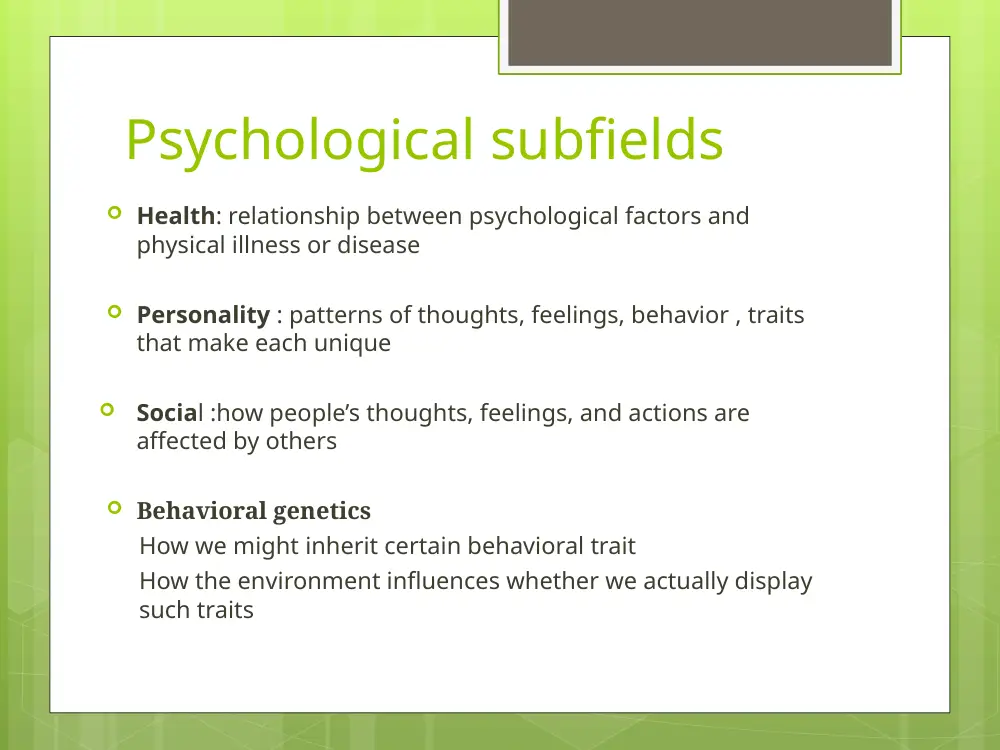
Psychological subfields
Health: relationship between psychological factors and
physical illness or disease
Personality : patterns of thoughts, feelings, behavior , traits
that make each unique
Social :how people’s thoughts, feelings, and actions are
affected by others
Behavioral genetics
How we might inherit certain behavioral trait
How the environment influences whether we actually display
such traits
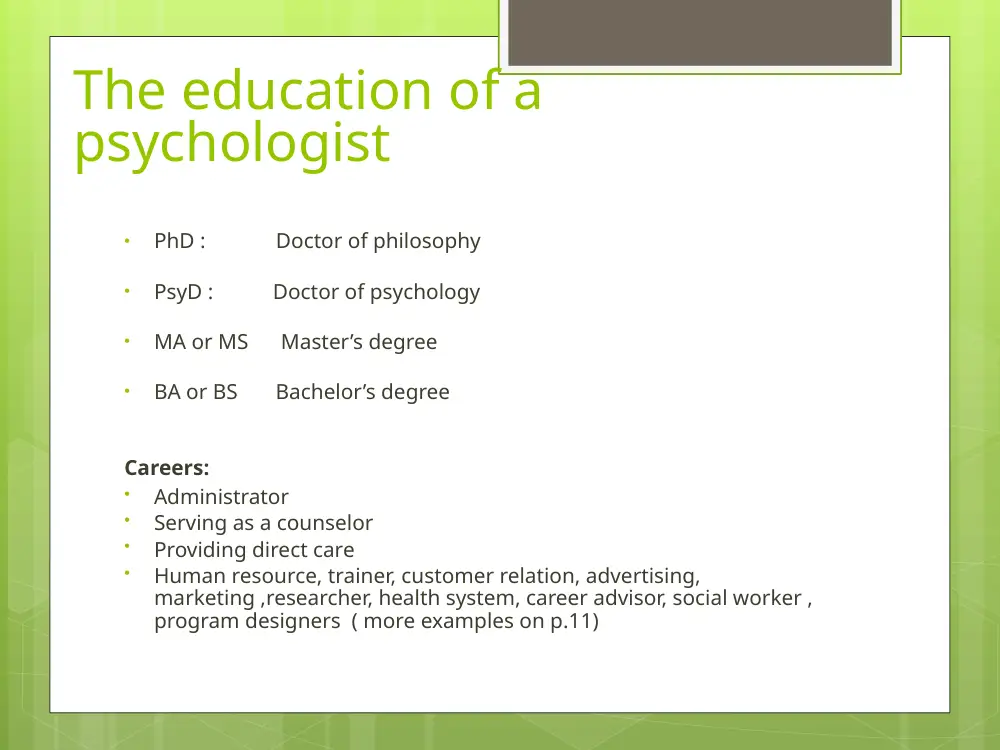
The education of a
psychologist
•
PhD : Doctor of philosophy
•
PsyD : Doctor of psychology
•
MA or MS Master’s degree
•
BA or BS Bachelor’s degree
Careers:
•
Administrator
•
Serving as a counselor
•
Providing direct care
•
Human resource, trainer, customer relation, advertising,
marketing ,researcher, health system, career advisor, social worker ,
program designers ( more examples on p.11)
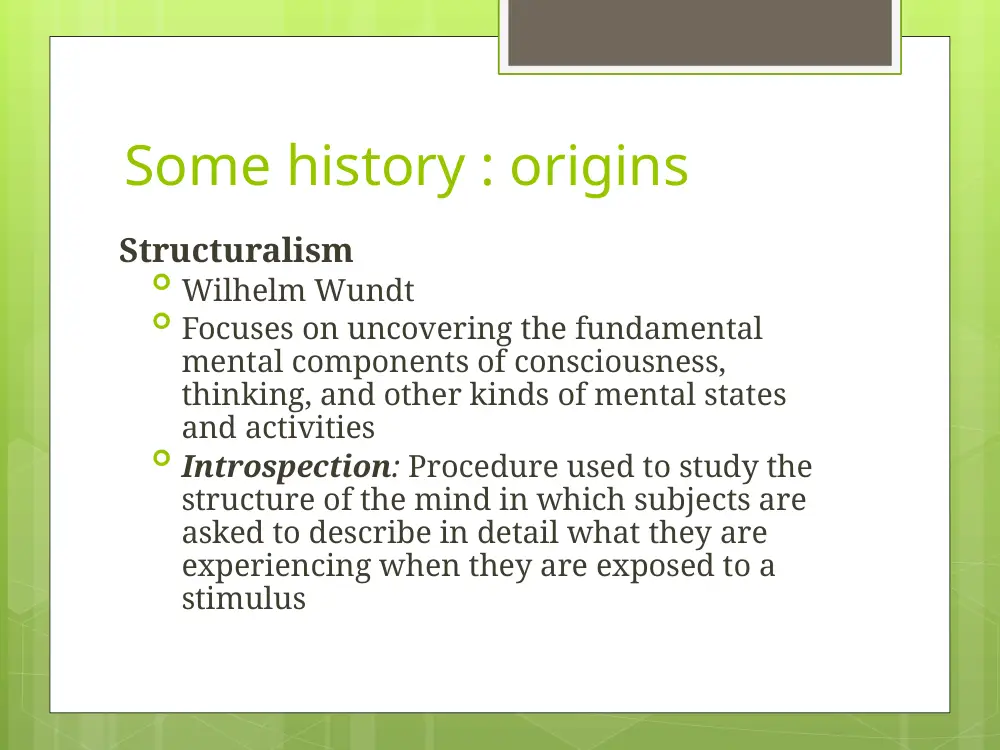
Some history : origins
Structuralism
Wilhelm Wundt
Focuses on uncovering the fundamental
mental components of consciousness,
thinking, and other kinds of mental states
and activities
Introspection: Procedure used to study the
structure of the mind in which subjects are
asked to describe in detail what they are
experiencing when they are exposed to a
stimulus
structuralism
Criticisms of structuralism
Introspection not a scientific technique
People had difficulty describing some kinds
of inner experiences
These drawbacks led to the development
of newer approaches
Functionalism
Functionalism
William James
Concentrated on how behavior functions
and the role of behavior in allowing people
to adapt to their environments
Gestalt
Gestalt psychology
Focuses on the organization of perception
and thinking in a “whole” sense rather than
on the individual elements of perception
Major perspectives of
psychology
Major perspectives
Neuroscience perspective: Views behavior
from the perspective of the brain, the nervous
system, and other biological functions
ex: How damage to different parts of the brain affects
personality, behavior, learning ability, language
Psychodynamic perspective
Sigmund Freud
Behavior is motivated by unconscious inner
forces over which the individual has little
control
Major perspectives
Behavioral perspective
John B. Watson & B. F. Skinner
observable, measurable behavior should be the
focus ex How children adopt certain behaviors by
imitating their parents (social-learning) or by
parents directly rewarding those behaviors
(behavioral)
Cognitive perspective: Focuses on how people
think, understand, and know about the world
Information processing:
- If we believe we will fail, we may not even try
- we remember what is consistent with our beliefs
Major perspectives
Humanistic perspective
Carl Rogers and Abraham Maslow
Suggests that all individuals naturally strive
to grow, develop, and be in control of their
lives and behavior
emphasizes free will, personal growth, and
resilience
Maslow’s Hierarchy of Needs
Ex: Depression & different perspectives
Biological/neuro: abnormalities in neurotransmitters in
the brain
Behavioral: depressive symptoms have been reinforced
(rewarded) by the environment (e.g., getting to stay
home from school because of feeling depressed)
Cognitive: negative, pessimistic thinking style
Psychodynamic: depression is due to unconsciously
displacing anger towards your parent onto yourself
Humanistic: depression is due to being unauthentic or
by being otherwise blocked in fulfilling your potential
Key issues
Table in the book
Scientific Method
Approach through which psychologists
systematically acquire knowledge and
understanding about behavior and other
phenomena of interest
What’s the difference…
Experimental and non-experimental research are
distinguished by the degree of control that the
researcher has over the subjects and conditions in
the study.
In non-experimental research, there is often careful
observation and measurement, but in experimental
research there is also random assignment and
manipulation of a variable.
The increased control in experimental research
allows you to infer causal relationships between
variables.
Non-Experimental Research:
Methods for Gathering Information
Case Studies
Observational Studies*
Naturalistic
Laboratory
Surveys
Correlation = strength of a relationship between two
variables
Positive vs. Negative Correlations = nature of
relationship
Coefficient of Correlation = strength of relationship
CORRELATION DOES NOT EQUAL CAUSATION
Experimental Research
In experimental research, you manipulate one
or more (independent) variables and observe
the effect of this manipulation on one or more
other (dependent) variables, while controlling
for the influence of other (extraneous)
variables.
In this way, you can conclude that it was the
effect of your independent variable that
CAUSED the observed change in your
dependent variable.
The scientific method
What is a theory ?
Broad explanations and predictions
concerning phenomena of interest
Example:
Diffusion of responsibility - Greater the
number of bystanders in an emergency
situation, the smaller the share of the
responsibility each person feels
Hypotheses: Crafting Testable
Predictions
Hypothesis: A prediction, stemming from a theory, stated in a
way that allows it to be tested
Psychologists rely on formal theories and hypotheses for many
reasons:
Permits them to place bits of observations within a coherent
framework
Help psychologists to make deductions about unexplained
phenomena
Develop ideas for future investigation
Operational definition: Translation of a hypothesis into
specific, testable procedures
What does “Research”
mean?
Systematic inquiry aimed at the discovery
of new knowledge
Key to understanding the accuracy of
hypotheses and theories
Descriptive research
Systematic investigation of a person, group,
or pattern of behavior
Archival Research
Existing data is used to investigate a
hypothesis:
Census documents
College records
Newspaper clippings
Problem with using existing data:
Data may not be in a form that allows the
researcher to test a hypothesis fully
Naturalistic Observation
Investigator simply observes some
naturally occurring behavior
Does not make a change in the situation
Advantage - Sample of what people do in
their natural habitat
Disadvantage - Inability to control any of
the factors of interest
Survey Research
People are asked a series of questions about their
behavior, thoughts, or attitudes
Pitfalls
Results will be inconsequential if the sample is not
representative
Survey respondents may not want to admit to
holding socially undesirable attitudes
http://testyourself.psychtests.com/bin/transferreq
=MnwyMTE0fDM2Mzk1ODR8MXwx&refempt=
http://testyourself.psychtests.com
Correlational Research
Research in which the relationship between two
sets of variables is examined to determine:
Whether they are associated, or “correlated”
Correlation coefficient
Positive - As the value of one variable increases,
so will the value of the other variable
Negative - As the value of one variable
increases, value of the other variable will
decrease
disadvantage - Inability to demonstrate cause-
and-effect relationships
Experimental research
Experiment: Investigation of the
relationship between two (or more)
variables by:
Producing a change in one variable in a
situation and observing the effects on the
second variable
Experimental Research
Experimental groups and control groups
Treatment
Manipulation implemented by the
experimenter
Experimental group
Any group participating in an experiment
that receives a treatment
Control group
Group participating in an experiment that
receives no treatment
Experimental Research
Random assignment to condition:
Participants are assigned to different
experimental groups or “conditions” on the
basis of chance
Significant outcome: Meaningful results
Make it possible for researchers to feel
confident that they have confirmed their
hypotheses
Replicated research: Research that is
repeated
The Ethics of Research
Informed consent: A document signed by
participants:
Affirms that they have been told about the
basic outlines of the study
Should Animals Be Used in
Research
Procedures that subject animals to distress are
permitted:
When an alternative procedure is
unavailable
When the research is justified by its
prospective value
Provides greater experimental control over
nonhumans
Procedures that might not be possible with
people can be carried out
Threats to Experimental Validity:
Avoiding Experimental Bias
Experimental bias: Factors that distort
the way the independent variable affects
the dependent variable
Experimenter expectations
Participant expectations
Threats to Experimental Validity:
Avoiding Experimental Bias
Placebo: A false treatment without any
significant chemical properties
Double-blind procedure - Keeping
experimenter and participant “blind” to
the nature of the drug administered
Don’t forget..
Read the recap/evaluate/rethink pages
Read the main definitions & tables
Remember what we focused on..
Enjoy