
PSY 201 Notes Spss, Spring 2018
Lebanese American University · Introduction To Psychology · 17 pages


Showing the first 10 of 17 pages. Download the PDF to see all of it.
More PSY 201 files
Show the text of this notes
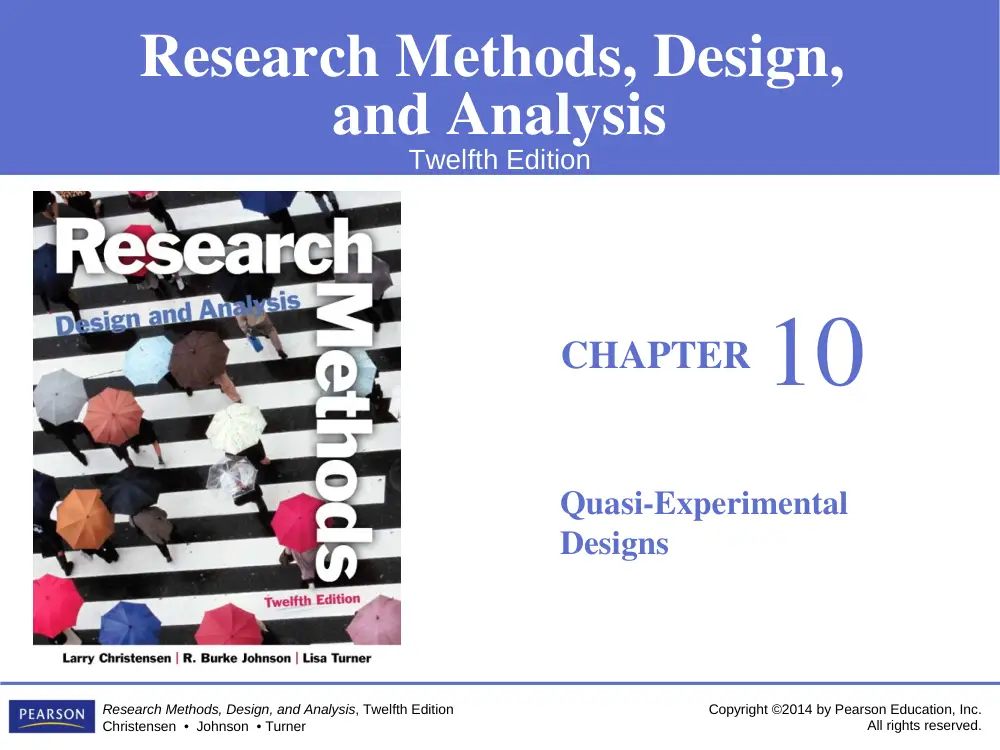
Research Methods, Design,
and Analysis
Copyright ©2014 by Pearson Education, Inc.
All rights reserved.
Research Methods, Design, and Analysis, Twelfth Edition
Christensen • Johnson • Turner
CHAPTER
Twelfth Edition
Quasi-Experimental
Designs
10
Copyright ©2014 by Pearson Education, Inc.
All rights reserved.
Research Methods, Design, and Analysis, Twelfth Edition
Christensen • Johnson • Turner
Introduction
• Quasi-experimental design
– a research design in which an experimental procedure is
applied, but all extraneous variables are not controlled
– typically lacking random assignment
Copyright ©2014 by Pearson Education, Inc.
All rights reserved.
Research Methods, Design, and Analysis, Twelfth Edition
Christensen • Johnson • Turner
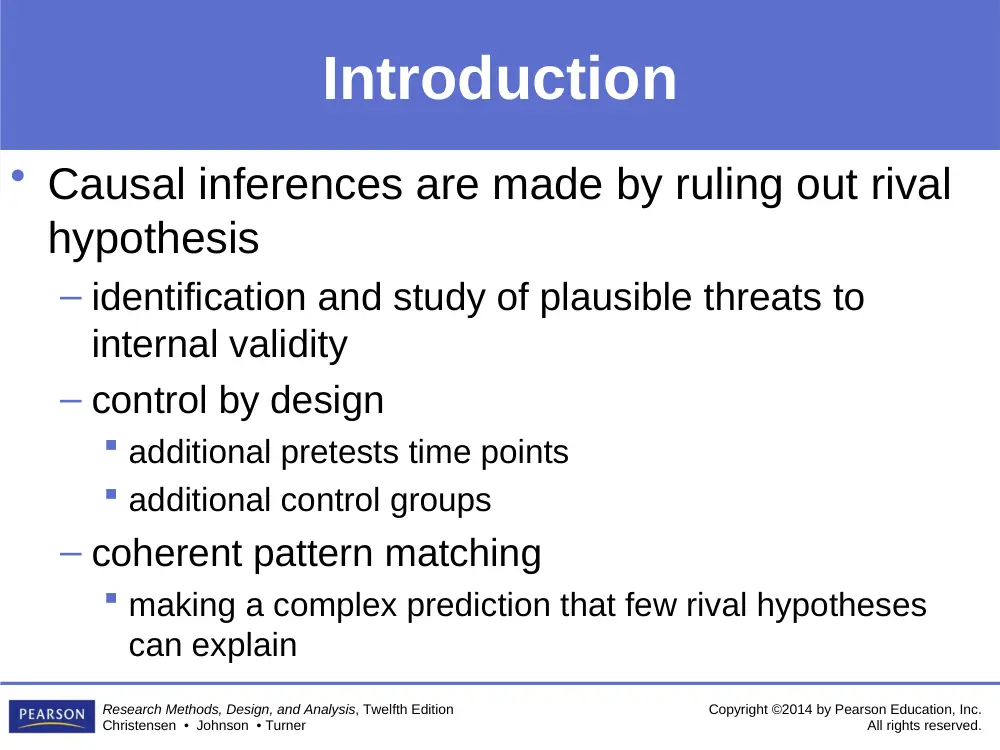
Introduction
• Causal inferences are made by ruling out rival
hypothesis
– identification and study of plausible threats to
internal validity
– control by design
additional pretests time points
additional control groups
– coherent pattern matching
making a complex prediction that few rival hypotheses
can explain
Copyright ©2014 by Pearson Education, Inc.
All rights reserved.
Research Methods, Design, and Analysis, Twelfth Edition
Christensen • Johnson • Turner
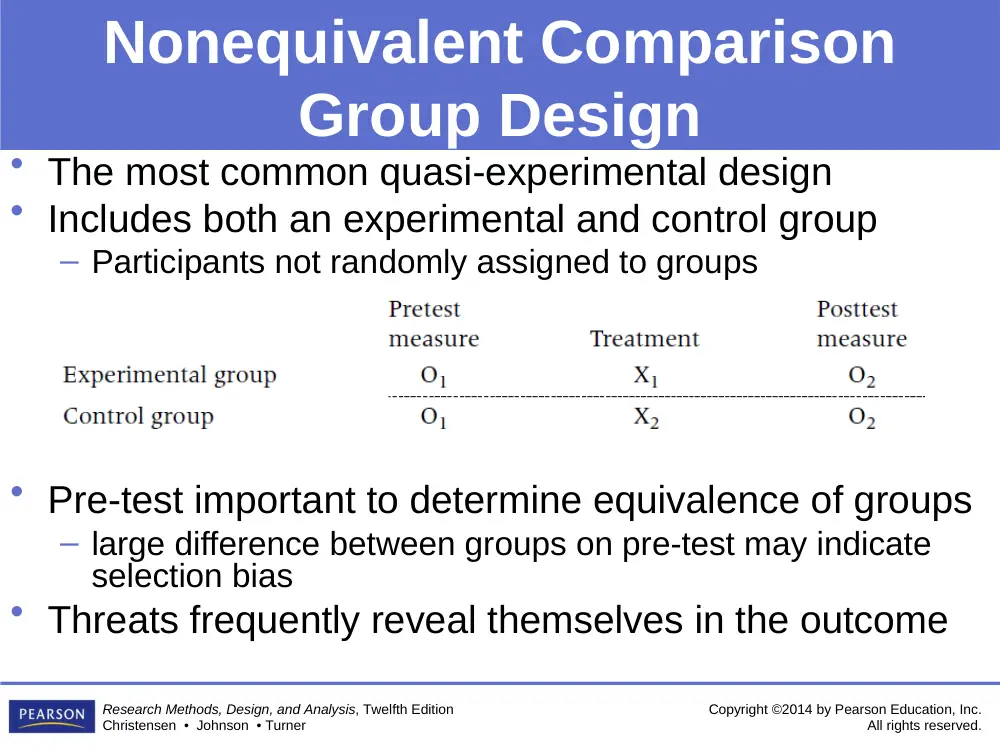
Nonequivalent Comparison
Group Design
• The most common quasi-experimental design
• Includes both an experimental and control group
– Participants not randomly assigned to groups
• Pre-test important to determine equivalence of groups
– large difference between groups on pre-test may indicate
selection bias
• Threats frequently reveal themselves in the outcome
Copyright ©2014 by Pearson Education, Inc.
All rights reserved.
Research Methods, Design, and Analysis, Twelfth Edition
Christensen • Johnson • Turner
Copyright ©2014 by Pearson Education, Inc.
All rights reserved.
Research Methods, Design, and Analysis, Twelfth Edition
Christensen • Johnson • Turner
Outcomes with Rival Hypotheses
• Increasing treatment and
control groups
– greater increase in
treatment condition
– could be caused by a
number of rival hypotheses
selection-maturation
selection-history
other selection-interactive
effects
Copyright ©2014 by Pearson Education, Inc.
All rights reserved.
Research Methods, Design, and Analysis, Twelfth Edition
Christensen • Johnson • Turner
Outcomes with Rival Hypotheses
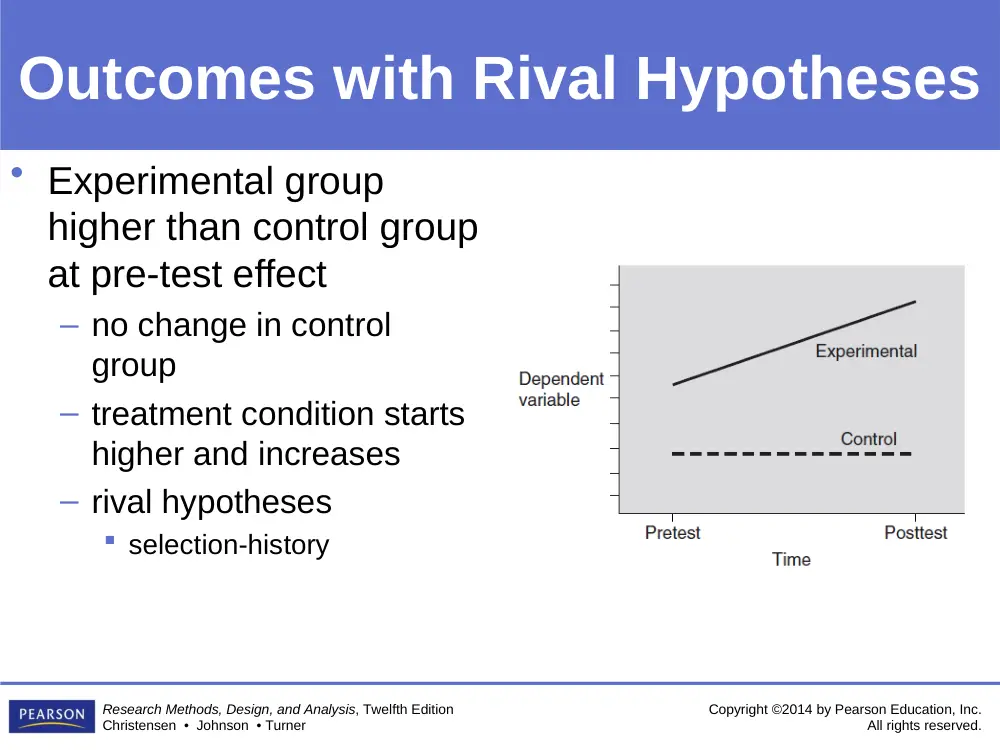
• Experimental group
higher than control group
at pre-test effect
– no change in control
group
– treatment condition starts
higher and increases
– rival hypotheses
selection-history
Copyright ©2014 by Pearson Education, Inc.
All rights reserved.
Research Methods, Design, and Analysis, Twelfth Edition
Christensen • Johnson • Turner
Outcomes with Rival Hypotheses
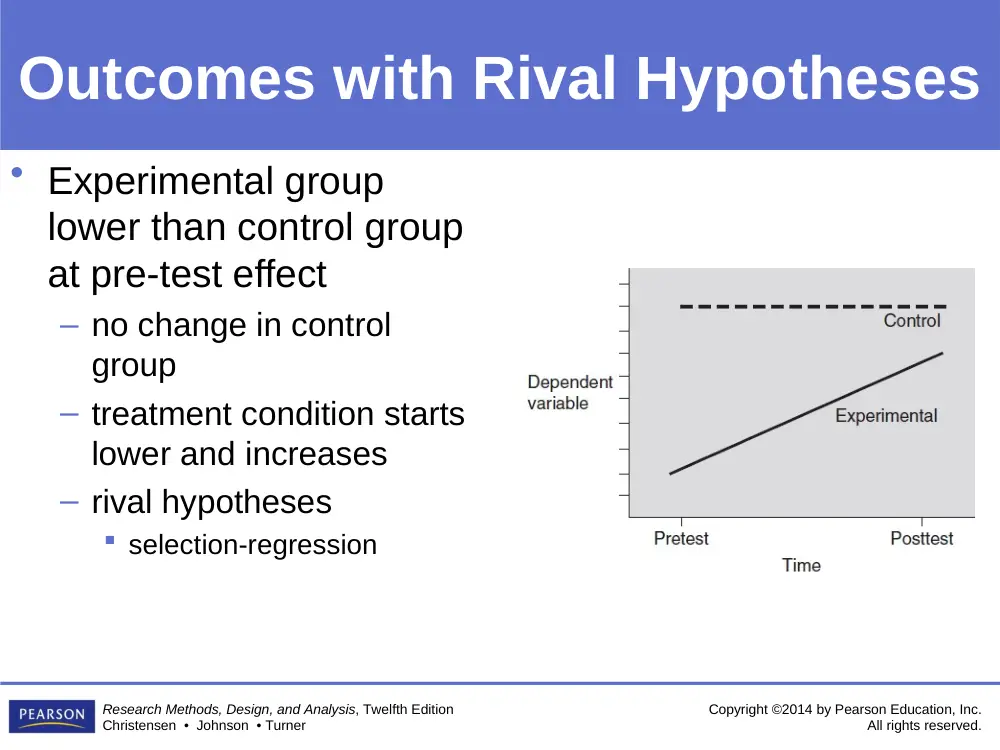
• Experimental group
lower than control group
at pre-test effect
– no change in control
group
– treatment condition starts
lower and increases
– rival hypotheses
selection-regression
Copyright ©2014 by Pearson Education, Inc.
All rights reserved.
Research Methods, Design, and Analysis, Twelfth Edition
Christensen • Johnson • Turner
Outcomes with Rival Hypotheses
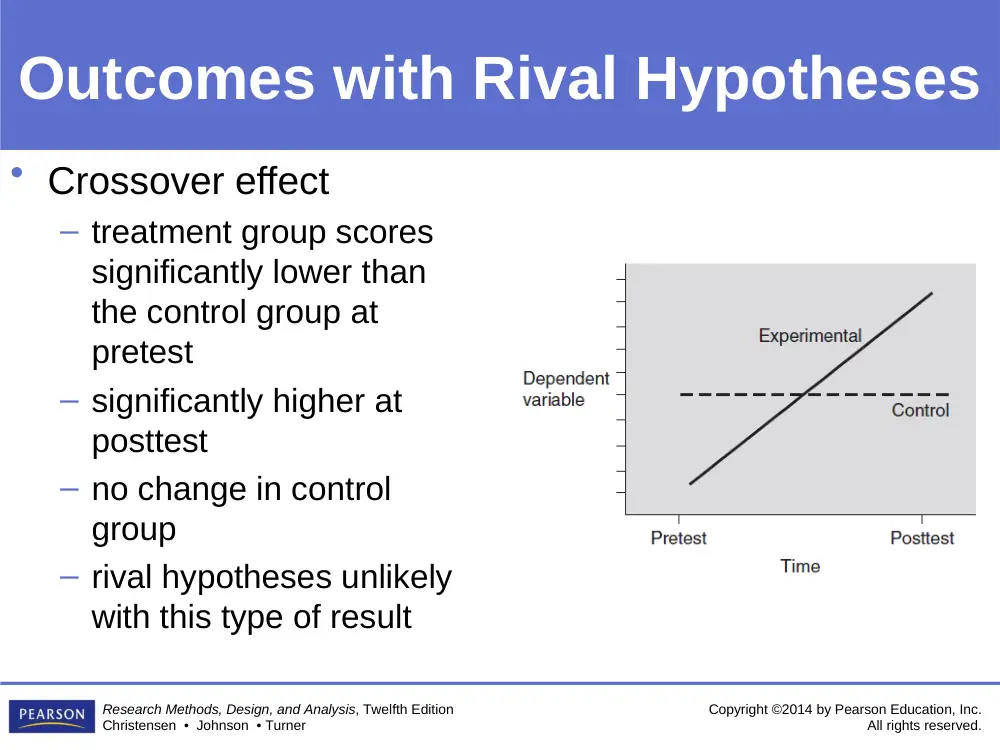
• Crossover effect
– treatment group scores
significantly lower than
the control group at
pretest
– significantly higher at
posttest
– no change in control
group
– rival hypotheses unlikely
with this type of result
Copyright ©2014 by Pearson Education, Inc.
All rights reserved.
Research Methods, Design, and Analysis, Twelfth Edition
Christensen • Johnson • Turner
Ruling out Threats to the
Nonequivalent Comparison Group
• Matching
– equates the groups on important variables
– example
Head Start programs can be matched on income, intelligence, and
parental involvement
– matching not a perfect replacement for random assignment,
but can be used when random assignment is not possible
– selection-regression effects may occur when using extreme
groups
• Statistical control techniques
– ANCOVA
Copyright ©2014 by Pearson Education, Inc.
All rights reserved.
Research Methods, Design, and Analysis, Twelfth Edition
Christensen • Johnson • Turner
Causal Inference from Nonequivalent
Comparison Group Design
• To increase internal validity
– do not let participants self-select into groups
self-selection increases bias
– minimize pretest differences in groups
matching
ANCOVA during data analysis
Copyright ©2014 by Pearson Education, Inc.
All rights reserved.
Research Methods, Design, and Analysis, Twelfth Edition
Christensen • Johnson • Turner
Interrupted Time-Series Design
• Design in which a treatment effect is assessed by
comparing the pattern of pre- and posttest scores for a
single group of research participants
• Looking for discontinuity in the series of dependent
measures
• Example
– Lewis and Eves (2012)
Copyright ©2014 by Pearson Education, Inc.
All rights reserved.
Research Methods, Design, and Analysis, Twelfth Edition
Christensen • Johnson • Turner
Interrupted Time-Series Design
• Use of multiple pretest and
posttest measurements
demonstrates reliability of
effect
• Visual inspection of pre and
posttest measure very
important to determine
treatment effect
• Improvement over one-group
pretest-posttest design
• Primary weakness
– no control of history effects
Copyright ©2014 by Pearson Education, Inc.
All rights reserved.
Research Methods, Design, and Analysis, Twelfth Edition
Christensen • Johnson • Turner
Regression Discontinuity Design
• Design that assigns participants to groups based on
their scores on an assignment variable and assesses
the effect of a treatment by looking for a discontinuity
in the groups regression lines
Copyright ©2014 by Pearson Education, Inc.
All rights reserved.
Research Methods, Design, and Analysis, Twelfth Edition
Christensen • Johnson • Turner
Regression Discontinuity Design
• Characteristics of the design
– all individuals are pretested
– individuals who score above some cutoff score
receive the treatment
– all individuals are posttested
– discontinuity in the regression line indicates a
treatment effect
Copyright ©2014 by Pearson Education, Inc.
All rights reserved.
Research Methods, Design, and Analysis, Twelfth Edition
Christensen • Johnson • Turner
Regression Discontinuity Design
Copyright ©2014 by Pearson Education, Inc.
All rights reserved.
Research Methods, Design, and Analysis, Twelfth Edition
Christensen • Johnson • Turner