
BAD 201 Lecture Chapter 2, Spring 2019
Notre Dame University–Louaize · Fundamentals of Management · 23 pages

Showing the first 10 of 23 pages. Download the PDF to see all of it.
More BAD 201 files
Show the text of this lab
Copyright © 2012 Pearson Education, Inc.
Publishing as Prentice Hall
Copyright © 2016 Pearson Education Ltd
2-1
Copyright © 2012 Pearson Education, Inc.
Publishing as Prentice Hall
Copyright © 2016 Pearson Education Ltd
2-1
Managers,
Society,
and
Sustainability
Chapter 2
Copyright © 2012 Pearson Education, Inc.
Publishing as Prentice Hall
Copyright © 2016 Pearson Education Ltd
2-2
• A thorough understanding of the term social
responsibility
• Insights about the social responsiveness of an
organization
• Insights for meeting social audit challenges
CHAPTER LEARNING OBJECTIVES
Copyright © 2012 Pearson Education, Inc.
Publishing as Prentice Hall
Copyright © 2016 Pearson Education Ltd
2-3
• Thoughts on how to meet philanthropy
challenges
• Ways for building sustainable organizations
• An appreciation for the role that ethics plays
in management
CHAPTER LEARNING OBJECTIVES
Copyright © 2012 Pearson Education, Inc.
Publishing as Prentice Hall
Copyright © 2016 Pearson Education Ltd
2-4
• Social Responsibility
– The managerial obligation to take action that
protects and improves both the welfare of society
as a whole and the interests of the organization
• Areas of Social Responsibility
– Urban/Consumer Affairs, Community
Volunteerism, Employment Practices
– Ecology Conservation
FUNDAMENTALS OF
SOCIAL RESPONSIBILITY
Copyright © 2012 Pearson Education, Inc.
Publishing as Prentice Hall
Copyright © 2016 Pearson Education Ltd
2-5
• Businesses as a whole are a subset of society
• Businesses have a responsibility to help
maintain and improve the overall welfare of
society
• Performing social responsibility activities
earns greater organizational profits
Arguments FOR Social
Responsibility Activities
Copyright © 2012 Pearson Education, Inc.
Publishing as Prentice Hall
Copyright © 2016 Pearson Education Ltd
2-6
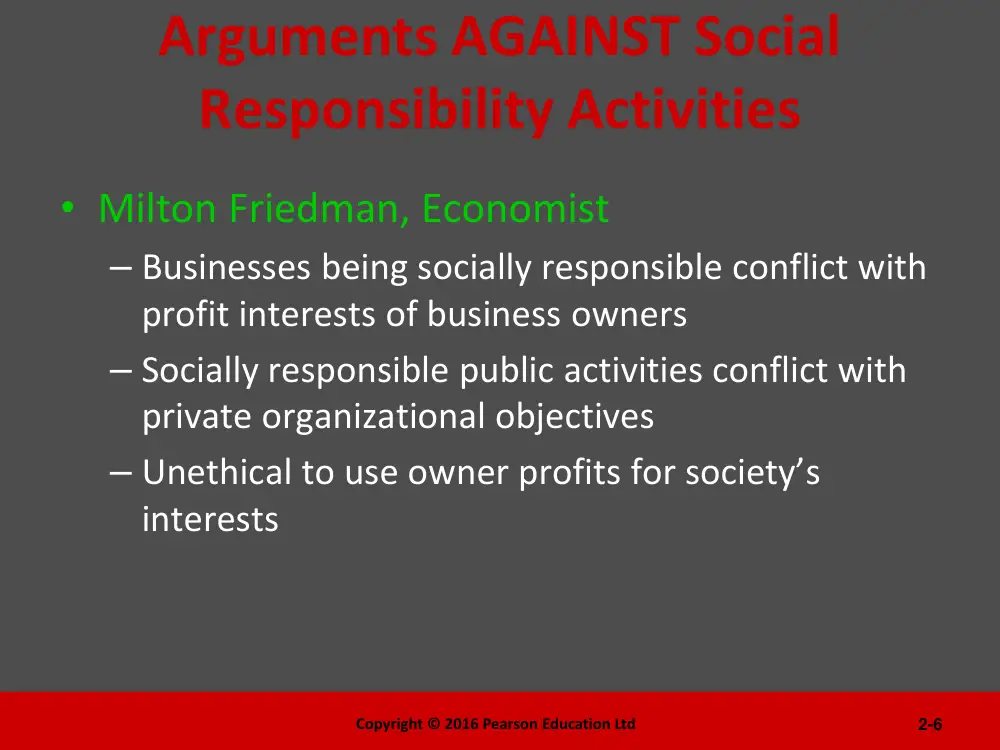
• Milton Friedman, Economist
– Businesses being socially responsible conflict with
profit interests of business owners
– Socially responsible public activities conflict with
private organizational objectives
– Unethical to use owner profits for society’s
interests
Arguments AGAINST Social
Responsibility Activities
Copyright © 2012 Pearson Education, Inc.
Publishing as Prentice Hall
Copyright © 2016 Pearson Education Ltd
2-7
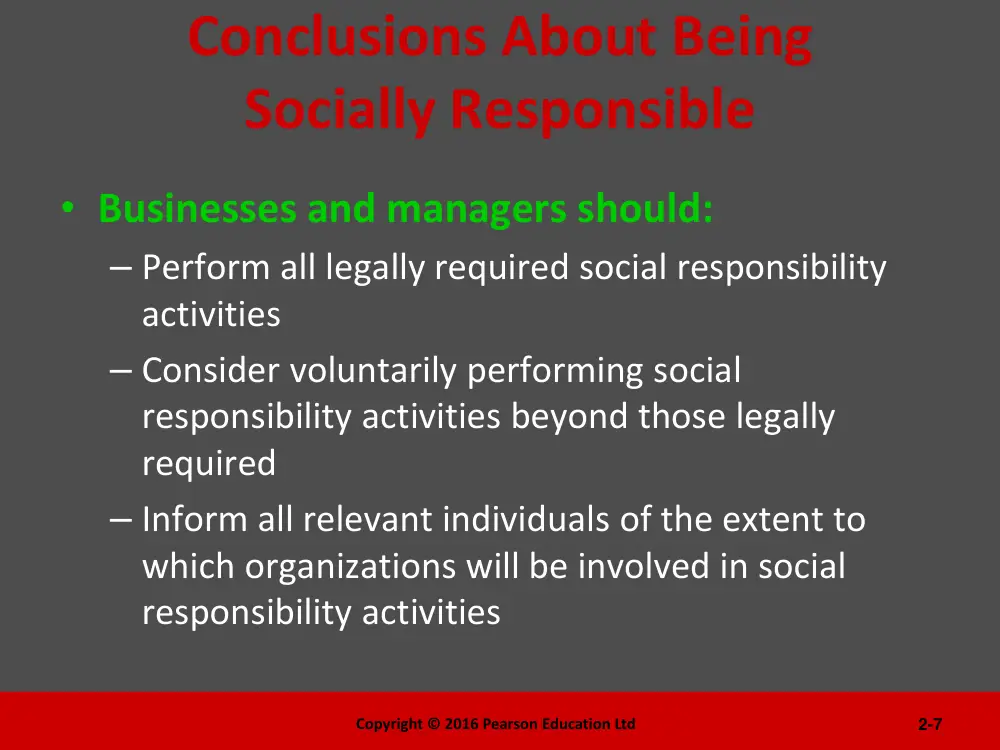
• Businesses and managers should:
– Perform all legally required social responsibility
activities
– Consider voluntarily performing social
responsibility activities beyond those legally
required
– Inform all relevant individuals of the extent to
which organizations will be involved in social
responsibility activities
Conclusions About Being
Socially Responsible
Copyright © 2012 Pearson Education, Inc.
Publishing as Prentice Hall
Copyright © 2016 Pearson Education Ltd
2-8
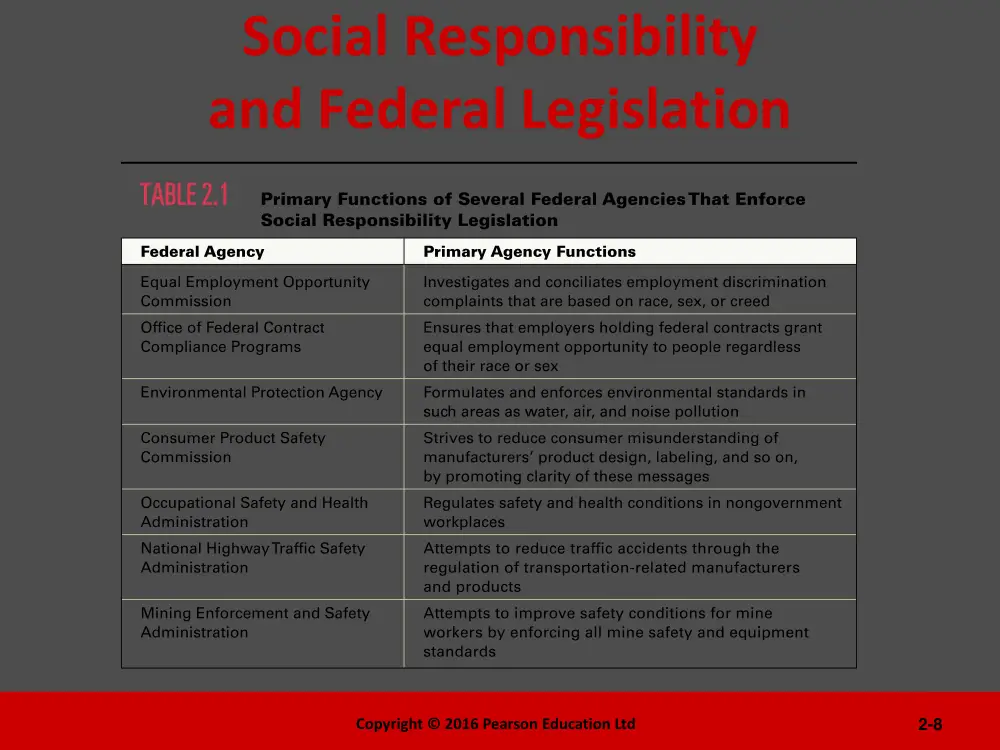
Social Responsibility
and Federal Legislation
Copyright © 2012 Pearson Education, Inc.
Publishing as Prentice Hall
Copyright © 2016 Pearson Education Ltd
2-9
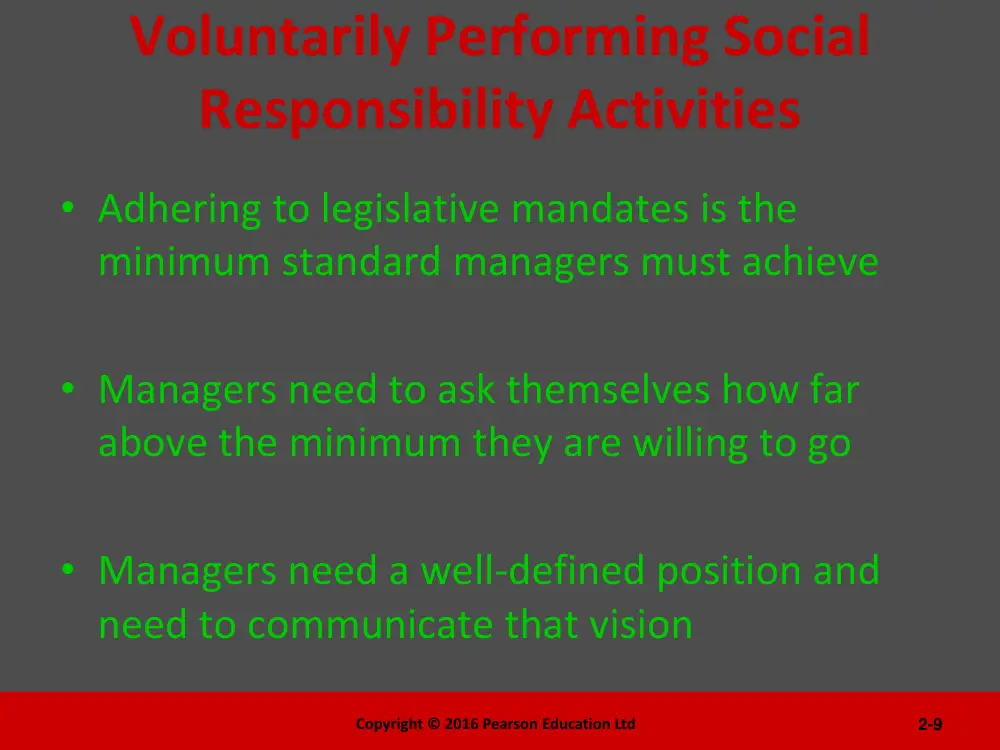
• Adhering to legislative mandates is the
minimum standard managers must achieve
• Managers need to ask themselves how far
above the minimum they are willing to go
• Managers need a well-defined position and
need to communicate that vision
Voluntarily Performing Social
Responsibility Activities
Copyright © 2012 Pearson Education, Inc.
Publishing as Prentice Hall
Copyright © 2016 Pearson Education Ltd
2-10
• The degree of effectiveness and efficiency an
organization displays in pursuing its social
responsiveness
• The greater the degree of effectiveness and
efficiency, the more socially responsive the
organization is said to be
Social Responsiveness
Copyright © 2012 Pearson Education, Inc.
Publishing as Prentice Hall
Copyright © 2016 Pearson Education Ltd
2-11
• Obligations based on:
– Business situation
– Impact on stakeholders
Determining if a Social
Responsibility Exists
Copyright © 2012 Pearson Education, Inc.
Publishing as Prentice Hall
Copyright © 2016 Pearson Education Ltd
2-12
Social Responsiveness
and Decision Making
Managers must
pursue only those
responsibilities
their organization
possesses and has a
right to undertake
Copyright © 2012 Pearson Education, Inc.
Publishing as Prentice Hall
Copyright © 2016 Pearson Education Ltd
2-13
• Incorporate social goals into annual planning
process
• Seek comparative industry norms for social
programs
• Present reports to owners and stakeholders
• Experiment with different approaches
• Attempt to measure cost of social programs
Approaches to Meeting
Social Responsibilities
Copyright © 2012 Pearson Education, Inc.
Publishing as Prentice Hall
Copyright © 2016 Pearson Education Ltd
2-14
• Requirement
– Firm only does what is required by law
• Recognition
– Firm has obligations to pursue both profit and
social goals
• Believing
– Firm has both profit and social goals
Approaches to Social
Responsibility
Copyright © 2012 Pearson Education, Inc.
Publishing as Prentice Hall
Copyright © 2016 Pearson Education Ltd
2-15
• Process of measuring social responsibility
activities to assess organizational
performance
• Social Audit Steps:
– Monitoring
– Measuring
– Appraising
SOCIAL AUDIT CHALLENGE
Copyright © 2012 Pearson Education, Inc.
Publishing as Prentice Hall
Copyright © 2016 Pearson Education Ltd
2-16
• Promote welfare of others through general
monetary donations to social causes
• Aim to increase well-being of people
PHILANTHROPY CHALLENGE
Copyright © 2012 Pearson Education, Inc.
Publishing as Prentice Hall
Copyright © 2016 Pearson Education Ltd
2-17
• The Triple Bottom-Line:
– Management should work toward making their
organizations sustainable in three areas:
• Economy
• Environment
• Society
SUSTAINABLE ORGANIZATION
CHALLENGE
Copyright © 2012 Pearson Education, Inc.
Publishing as Prentice Hall
Copyright © 2016 Pearson Education Ltd
2-18
• Increased profits
• Increased productivity
• Increased innovation
Why Sustainability?
Copyright © 2012 Pearson Education, Inc.
Publishing as Prentice Hall
Copyright © 2016 Pearson Education Ltd
2-19
• Set sustainability goals
• Hire organization members who can help
organization become more sustainable
• Reward employees who contribute to
organization's sustainability goals
• Track progress in reaching sustainability
goals
Steps to Sustainability
Copyright © 2012 Pearson Education, Inc.
Publishing as Prentice Hall
Copyright © 2016 Pearson Education Ltd
2-20
• Capacity to reflect on values in the corporate
decision-making process, to determine how
these values and decisions affect various
stakeholder groups, and to establish how
managers can use these observations in day-
to-day company management
MANAGERS AND ETHICS
Copyright © 2012 Pearson Education, Inc.
Publishing as Prentice Hall
Copyright © 2016 Pearson Education Ltd
2-21
• Increased Productivity
• Stakeholder Relations
• Government Regulation
Benefits of Ethics
in Management Practices
Copyright © 2012 Pearson Education, Inc.
Publishing as Prentice Hall
Copyright © 2016 Pearson Education Ltd
2-22
• Code of Ethics
• Chief Ethics Officer
• Training
• Ethical Standards
– Utilitarian
– Rights
– Virtues
• Sarbanes-Oxley Reform
Creating an Ethical Workplace
Copyright © 2012 Pearson Education, Inc.
Publishing as Prentice Hall
Copyright © 2016 Pearson Education Ltd
2-23
• Guide for the ethics of how people should act
and make decisions
Code of Ethics