
BAD 201 Syllabus, Fall 2012
Notre Dame University–Louaize · Fundamentals of Management · 5 pages · Mr. Salim Karam
More BAD 201 files
Show the text of this lab
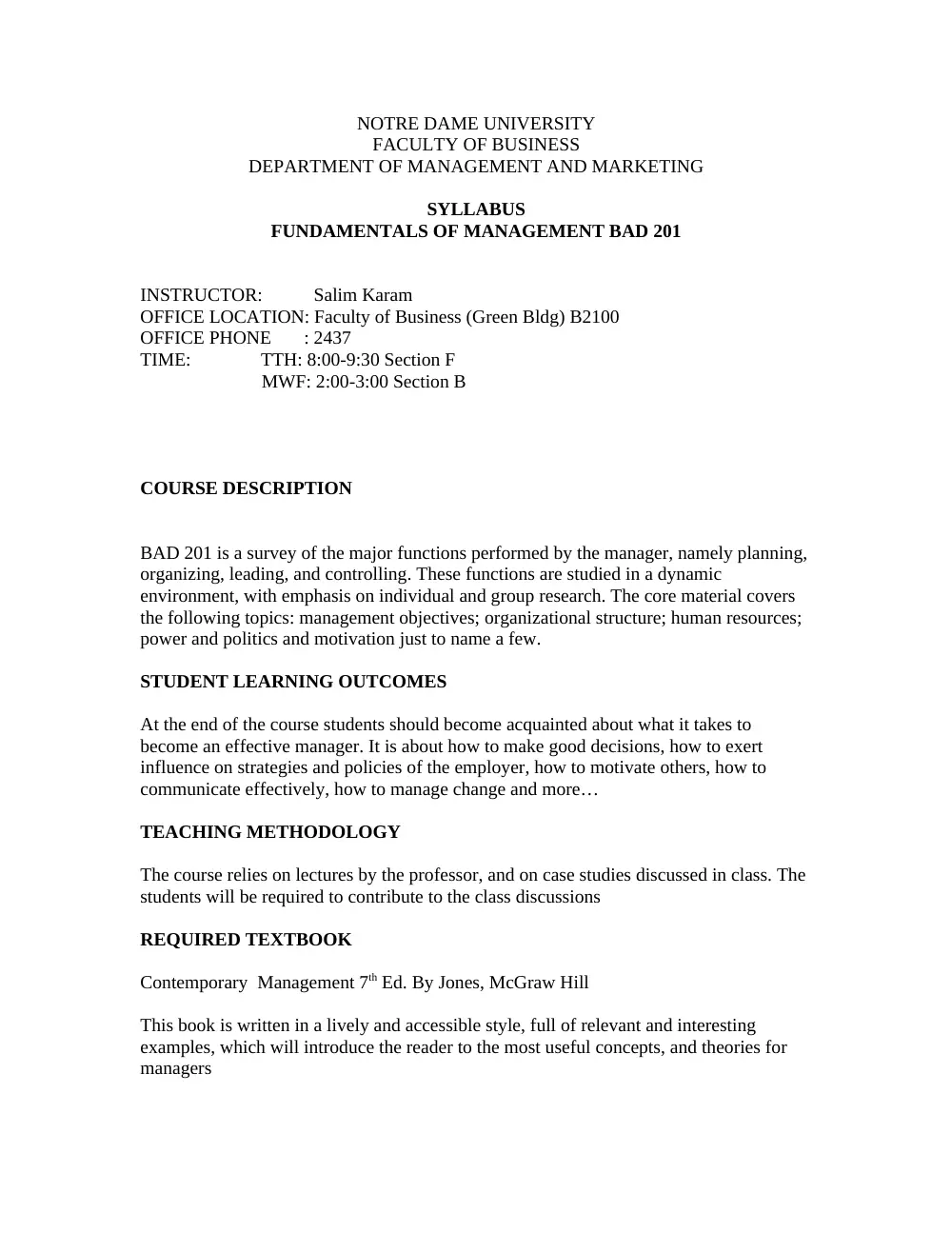
NOTRE DAME UNIVERSITY
FACULTY OF BUSINESS
DEPARTMENT OF MANAGEMENT AND MARKETING
SYLLABUS
FUNDAMENTALS OF MANAGEMENT BAD 201
INSTRUCTOR: Salim Karam
OFFICE LOCATION: Faculty of Business (Green Bldg) B2100
OFFICE PHONE : 2437
TIME: TTH: 8:00-9:30 Section F
MWF: 2:00-3:00 Section B
COURSE DESCRIPTION
BAD 201 is a survey of the major functions performed by the manager, namely planning,
organizing, leading, and controlling. These functions are studied in a dynamic
environment, with emphasis on individual and group research. The core material covers
the following topics: management objectives; organizational structure; human resources;
power and politics and motivation just to name a few.
STUDENT LEARNING OUTCOMES
At the end of the course students should become acquainted about what it takes to
become an effective manager. It is about how to make good decisions, how to exert
influence on strategies and policies of the employer, how to motivate others, how to
communicate effectively, how to manage change and more…
TEACHING METHODOLOGY
The course relies on lectures by the professor, and on case studies discussed in class. The
students will be required to contribute to the class discussions
REQUIRED TEXTBOOK
Contemporary Management 7th Ed. By Jones, McGraw Hill
This book is written in a lively and accessible style, full of relevant and interesting
examples, which will introduce the reader to the most useful concepts, and theories for
managers
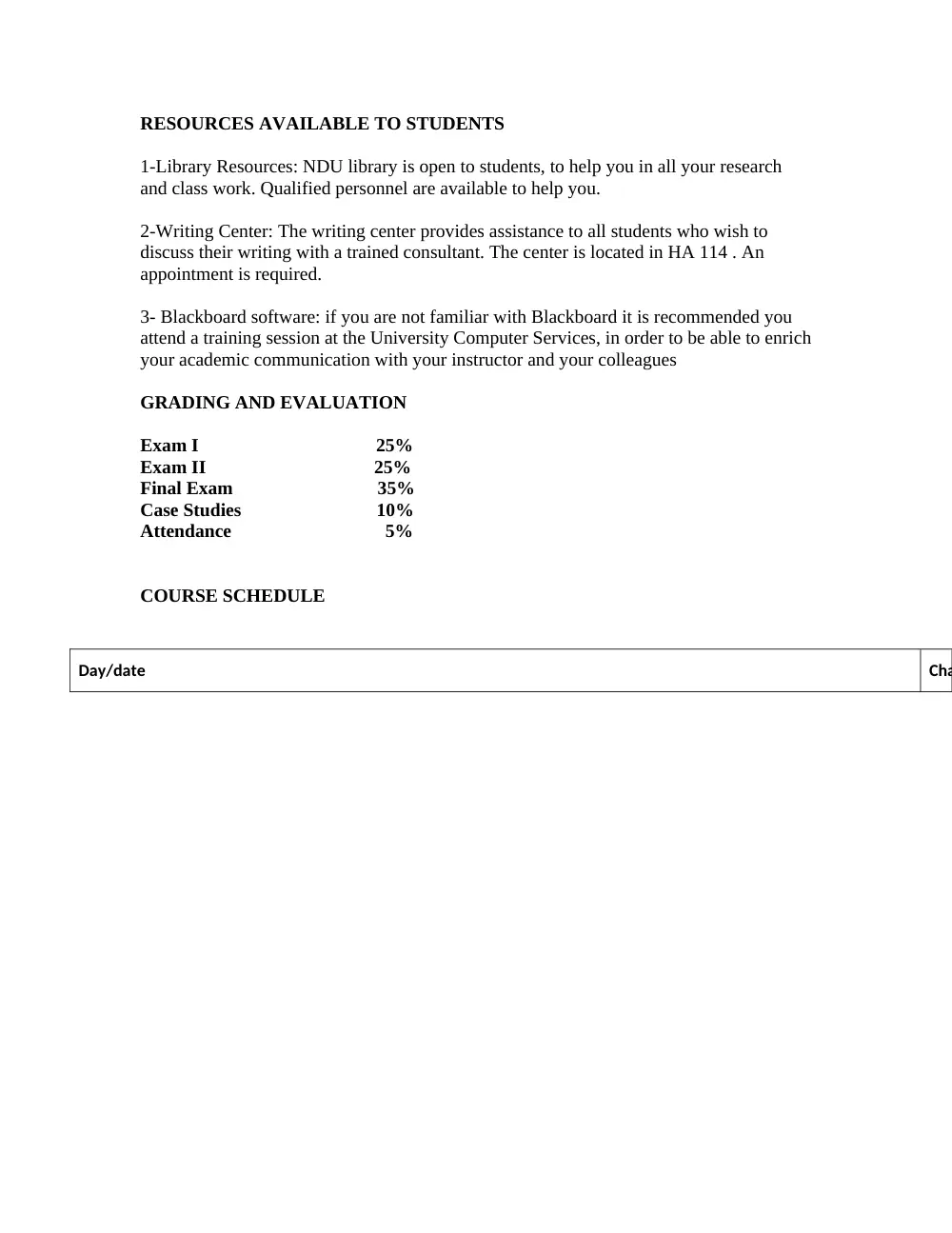
RESOURCES AVAILABLE TO STUDENTS
1-Library Resources: NDU library is open to students, to help you in all your research
and class work. Qualified personnel are available to help you.
2-Writing Center: The writing center provides assistance to all students who wish to
discuss their writing with a trained consultant. The center is located in HA 114 . An
appointment is required.
3- Blackboard software: if you are not familiar with Blackboard it is recommended you
attend a training session at the University Computer Services, in order to be able to enrich
your academic communication with your instructor and your colleagues
GRADING AND EVALUATION
Exam I 25%
Exam II 25%
Final Exam 35%
Case Studies 10%
Attendance 5%
COURSE SCHEDULE
Day/date
Cha
RECOMMENDED READINGS
1-Bovee, Thill (2008), Business in Action, Pearson, 4th Edition
2-Ebert, Griffin (2000), Business Essentials, Prentice Hall, 3rd Edition
3-Jones George (2008), Contemporary Management, McGraw Hill, 5th Edition
4-Rue Byars (2007), Management: Skills and Application, McGraw Hill, 12th Edition
5-Whetten Cameron (2007), Developing Management Skills, Prentice Hall7th Edition
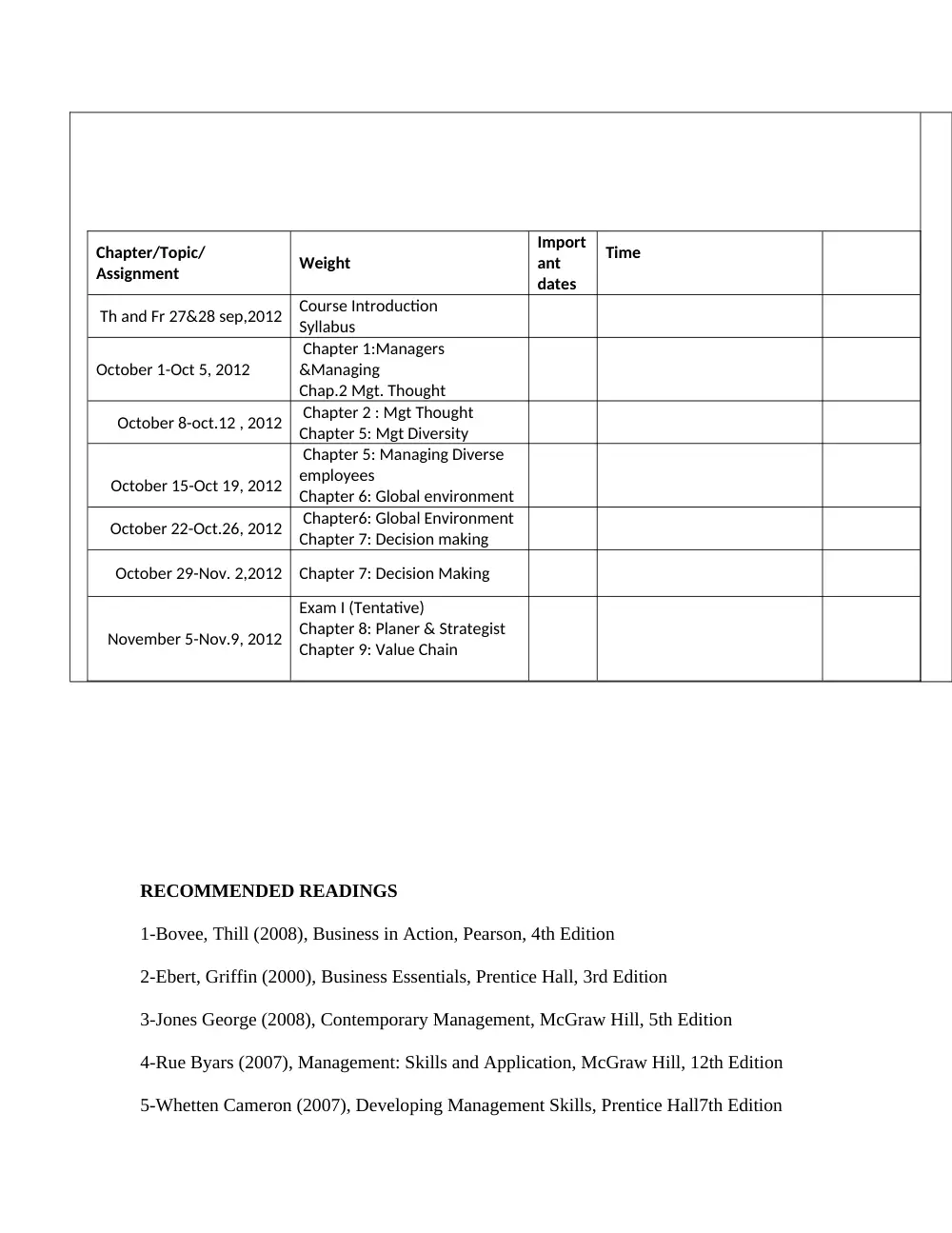
Chapter/Topic/
Assignment
Weight
Import
ant
dates
Time
Th and Fr 27&28 sep,2012
Course Introduction
Syllabus
October 1-Oct 5, 2012
Chapter 1:Managers
&Managing
Chap.2 Mgt. Thought
October 8-oct.12 , 2012
Chapter 2 : Mgt Thought
Chapter 5: Mgt Diversity
October 15-Oct 19, 2012
Chapter 5: Managing Diverse
employees
Chapter 6: Global environment
October 22-Oct.26, 2012
Chapter6: Global Environment
Chapter 7: Decision making
October 29-Nov. 2,2012
Chapter 7: Decision Making
November 5-Nov.9, 2012
Exam I (Tentative)
Chapter 8: Planer & Strategist
Chapter 9: Value Chain
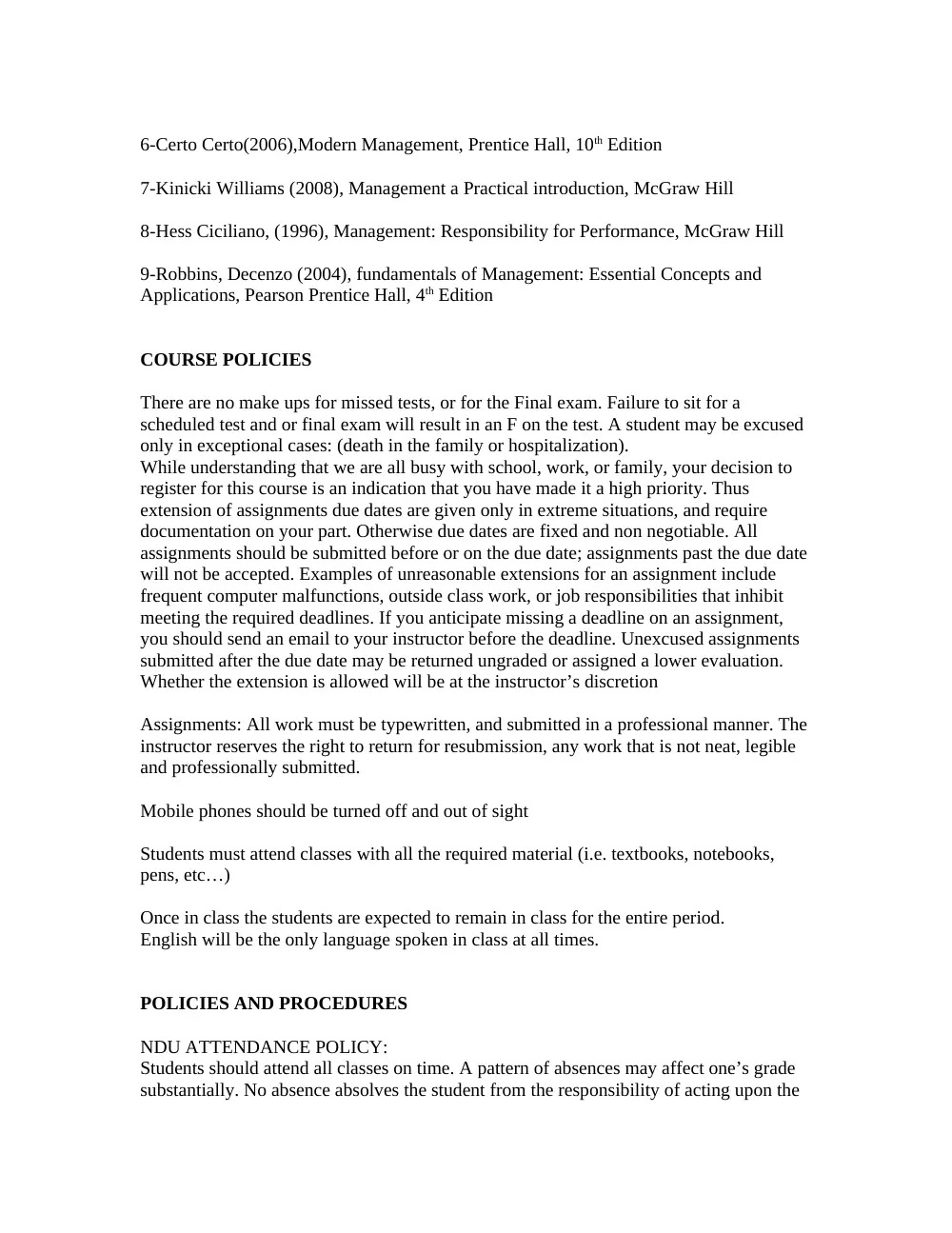
6-Certo Certo(2006),Modern Management, Prentice Hall, 10th Edition
7-Kinicki Williams (2008), Management a Practical introduction, McGraw Hill
8-Hess Ciciliano, (1996), Management: Responsibility for Performance, McGraw Hill
9-Robbins, Decenzo (2004), fundamentals of Management: Essential Concepts and
Applications, Pearson Prentice Hall, 4th Edition
COURSE POLICIES
There are no make ups for missed tests, or for the Final exam. Failure to sit for a
scheduled test and or final exam will result in an F on the test. A student may be excused
only in exceptional cases: (death in the family or hospitalization).
While understanding that we are all busy with school, work, or family, your decision to
register for this course is an indication that you have made it a high priority. Thus
extension of assignments due dates are given only in extreme situations, and require
documentation on your part. Otherwise due dates are fixed and non negotiable. All
assignments should be submitted before or on the due date; assignments past the due date
will not be accepted. Examples of unreasonable extensions for an assignment include
frequent computer malfunctions, outside class work, or job responsibilities that inhibit
meeting the required deadlines. If you anticipate missing a deadline on an assignment,
you should send an email to your instructor before the deadline. Unexcused assignments
submitted after the due date may be returned ungraded or assigned a lower evaluation.
Whether the extension is allowed will be at the instructor’s discretion
Assignments: All work must be typewritten, and submitted in a professional manner. The
instructor reserves the right to return for resubmission, any work that is not neat, legible
and professionally submitted.
Mobile phones should be turned off and out of sight
Students must attend classes with all the required material (i.e. textbooks, notebooks,
pens, etc…)
Once in class the students are expected to remain in class for the entire period.
English will be the only language spoken in class at all times.
POLICIES AND PROCEDURES
NDU ATTENDANCE POLICY:
Students should attend all classes on time. A pattern of absences may affect one’s grade
substantially. No absence absolves the student from the responsibility of acting upon the
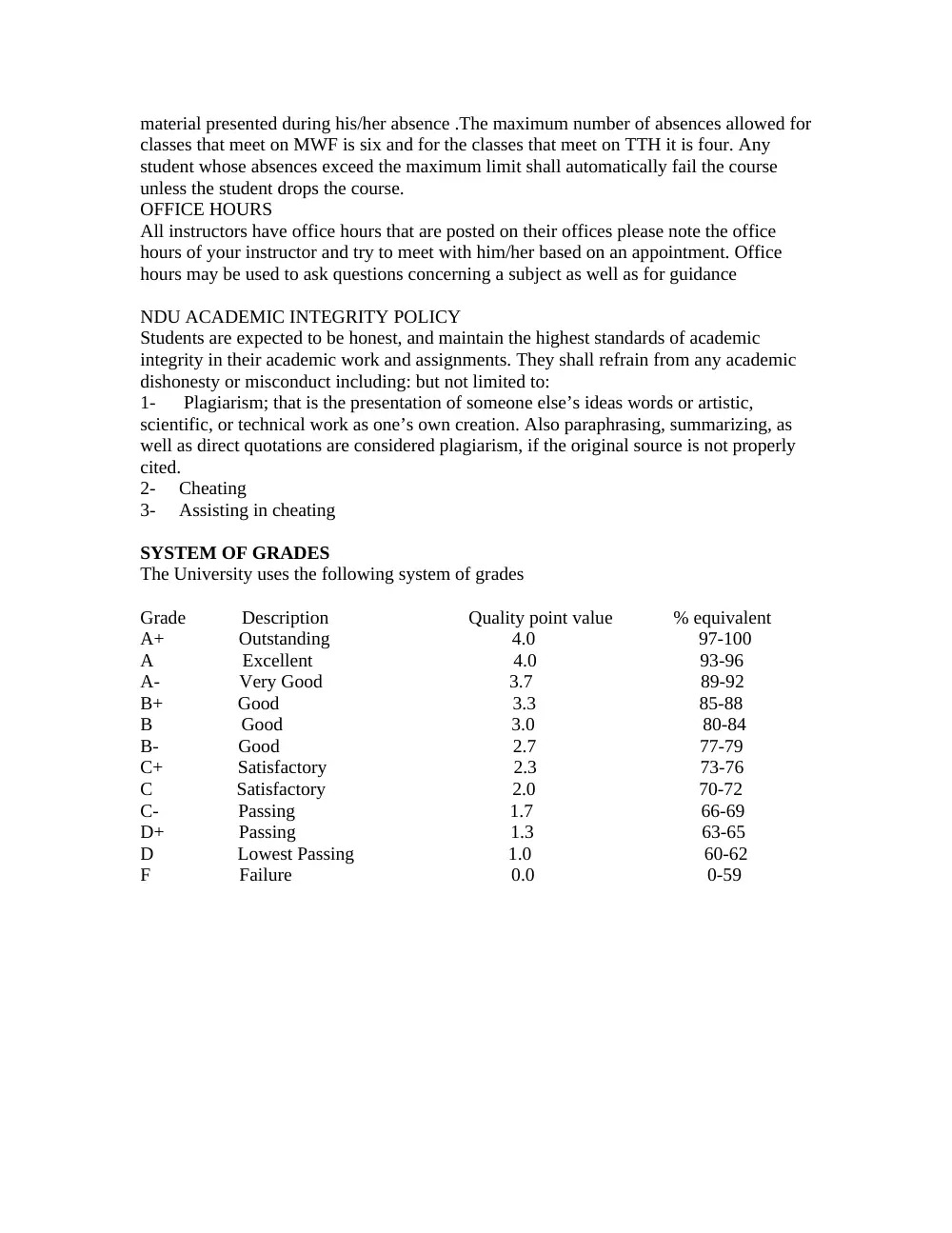
material presented during his/her absence .The maximum number of absences allowed for
classes that meet on MWF is six and for the classes that meet on TTH it is four. Any
student whose absences exceed the maximum limit shall automatically fail the course
unless the student drops the course.
OFFICE HOURS
All instructors have office hours that are posted on their offices please note the office
hours of your instructor and try to meet with him/her based on an appointment. Office
hours may be used to ask questions concerning a subject as well as for guidance
NDU ACADEMIC INTEGRITY POLICY
Students are expected to be honest, and maintain the highest standards of academic
integrity in their academic work and assignments. They shall refrain from any academic
dishonesty or misconduct including: but not limited to:
1- Plagiarism; that is the presentation of someone else’s ideas words or artistic,
scientific, or technical work as one’s own creation. Also paraphrasing, summarizing, as
well as direct quotations are considered plagiarism, if the original source is not properly
cited.
2- Cheating
3- Assisting in cheating
SYSTEM OF GRADES
The University uses the following system of grades
Grade Description Quality point value % equivalent
A+ Outstanding 4.0 97-100
A Excellent 4.0 93-96
A- Very Good 3.7 89-92
B+ Good 3.3 85-88
B Good 3.0 80-84
B- Good 2.7 77-79
C+ Satisfactory 2.3 73-76
C Satisfactory 2.0 70-72
C- Passing 1.7 66-69
D+ Passing 1.3 63-65
D Lowest Passing 1.0 60-62
F Failure 0.0 0-59