
EEN 340 Problems CHAPTER 4, Fall 2011
Notre Dame University–Louaize · Signals and Systems · 8 pages
More EEN 340 files
- Problems CHAPTER 5 · Fall 2011ChapterView
- Exam 1 With Solution · Spring 2016Exam · with solutionView
- Exam 1 · Summer 2011ExamView
- Exam 1 with Solution · Spring 2011Exam · with solutionView
- Exam 2 · Spring 2009ExamView
- Exam 1 with Solution · Spring 2008Exam · with solutionView
- Exam 2 · Fall 2006ExamView
- Exam 1 · Fall 2003ExamView
Show the text of this chapter
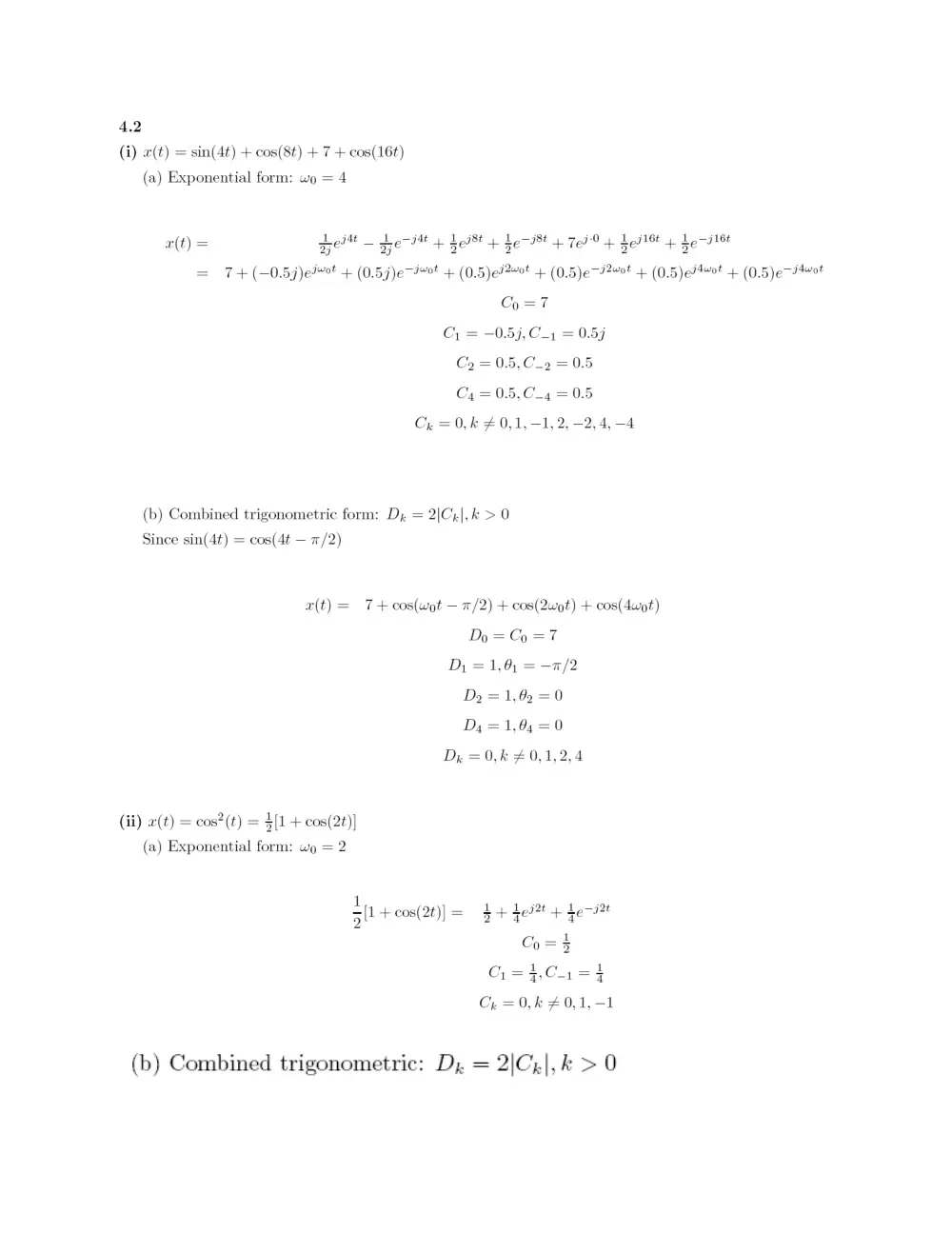
4.2
(i) x(t) = sin(4t) + cos(8t) + 7 + cos(16¢)
(a) Exponential form: wo = 4
a(t) = elt — me + felt + § he —i8t 4 7504 1 desler yb 1 ,—j16¢
= 7+ (-O0.5j)e%ot + (osjye-H0" + (058)e%0t 4 (0.5)e-I0 4 (05)eHH0" 4 (.5)erHHt
Co =7
Cy = -0.5j,C_1 = 0.57
Cz = 0.5,C_9 = 0.5
C4 =05,C_4 = 0.5
Cy =0,k 40,1, -1, 2, -2, 4, 4
(b) Combined trigonometric form: D;, = 2\C;|,k > 0
Since sin(4t) = cos(4t — 7/2)
a(t) = 7+ cos(wot — 7/2) + cos(2wot) + cos(4wot)
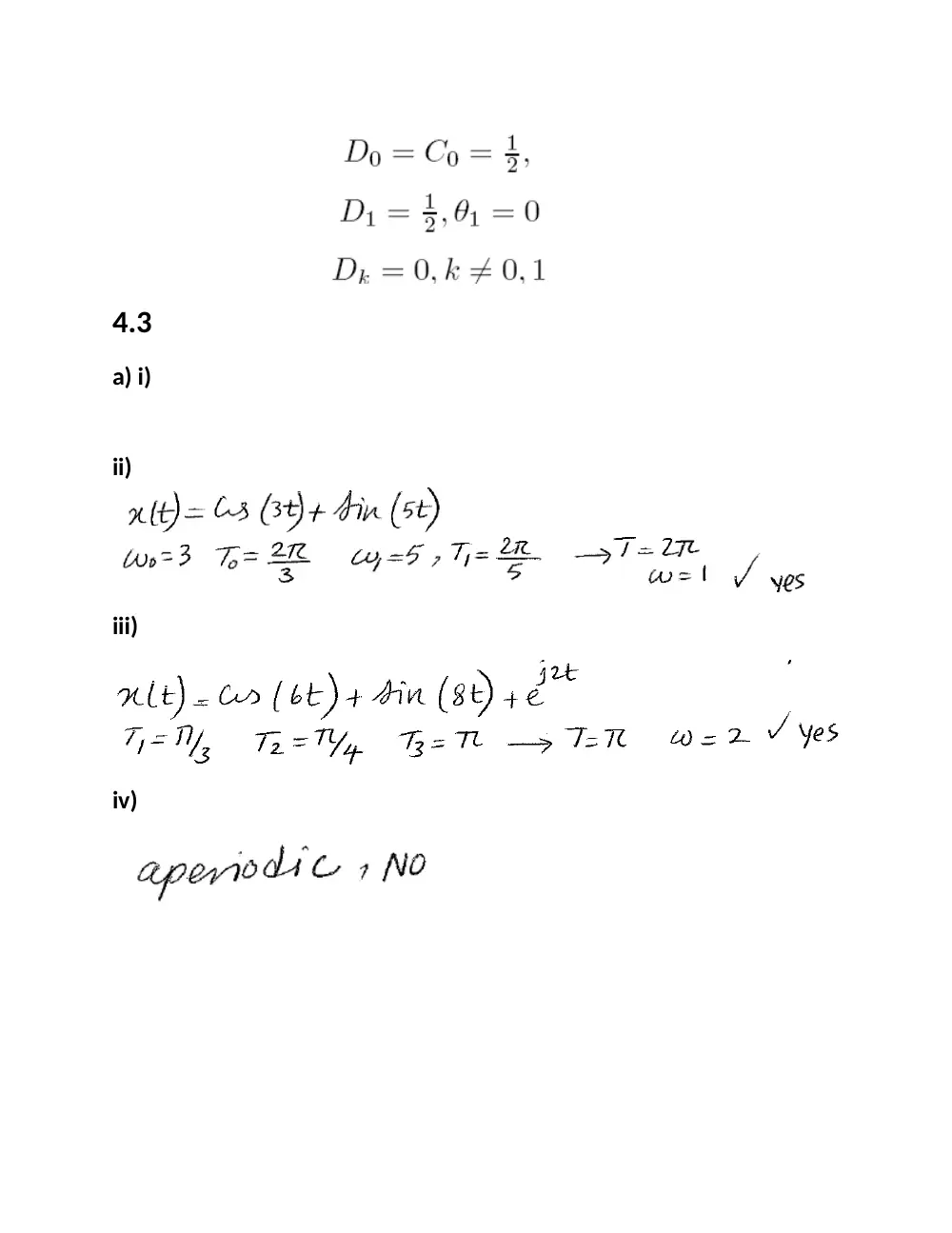
Do = Co =7
Dy, = 1,6, = —1/2
Dy = 1,0) =0
Dy = 1,0, =0
Dy =0,k £0,1,2,4
(ii) x(t) = cos?(t) = 4$[1 + cos(2t)]
(a) Exponential form: wo = 2
1 1,4 1.-
5 + cos(2t)]} = 5+ fest + te jt
C,
ro)
Il
tole
Cy
C, =0,k £0,1,-1
P
ale
(b) Combined trigonometric: D, = j,k > 0
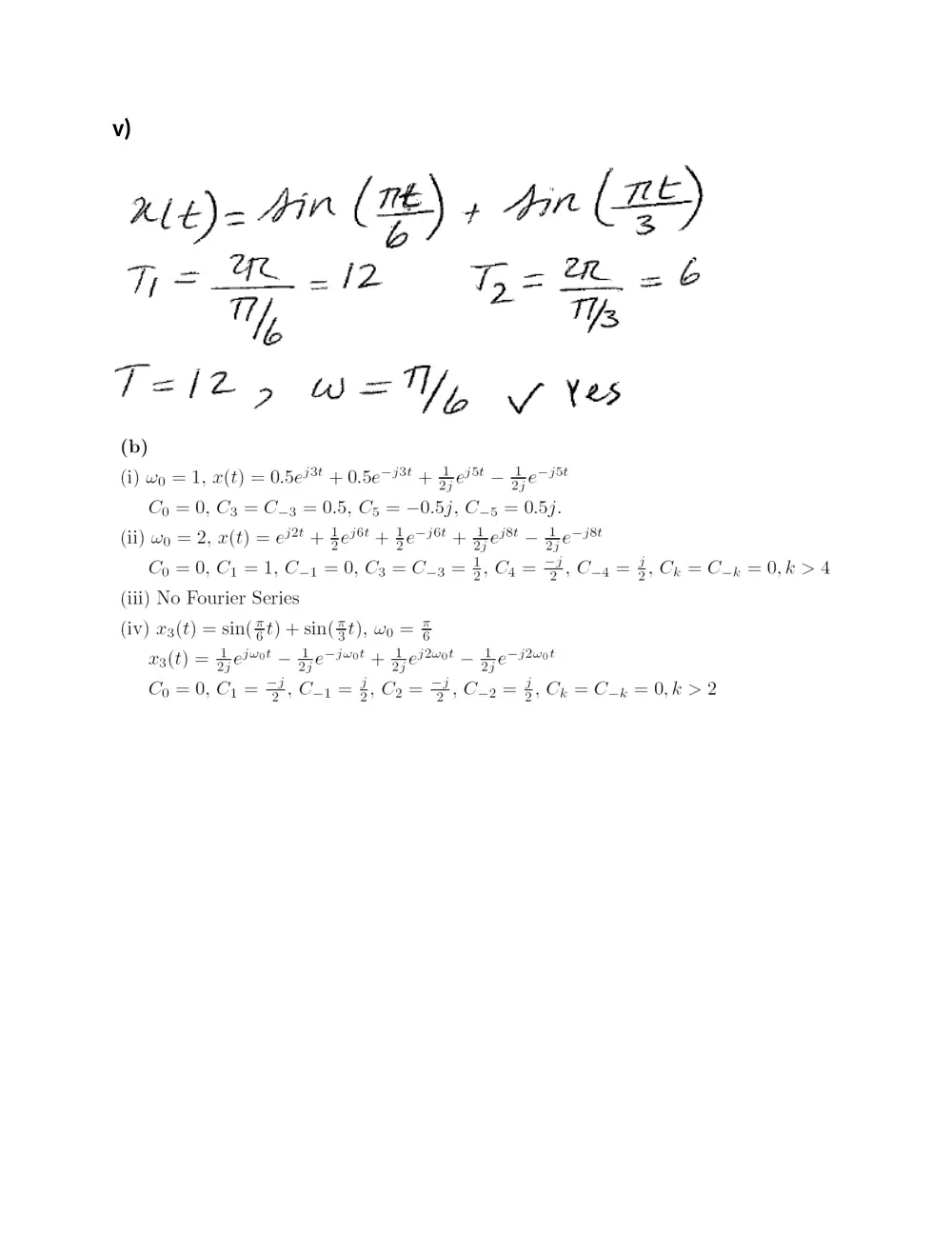
(b)
(i) wo = 1, a(t) = 0.5e + 0.567! + sel! — be
Cy = 0, Cz = C_3 = 0.5, Cs = -0.5 5). C_5 = 0.5).
(ii) wo = 2, a(t) =e?! + del 4 be I yer = uy e—J8t
Co = 0, Cy = 1, C_1 =0, Cy=C4=, C4 ~s1c4=4
(iii) No Fourier Series
(iv) v(t) = sin( Ft) + sin($t), wo =
: 1 1 = —j2wi
x3(t) _— zee — xe jwot 4 we ei2wot _ ze j2wot
J
Co = 0, Cl = 3 Cy 4= 5 C2 = 3. C_» = 5, Ch = C_p =0,k >2
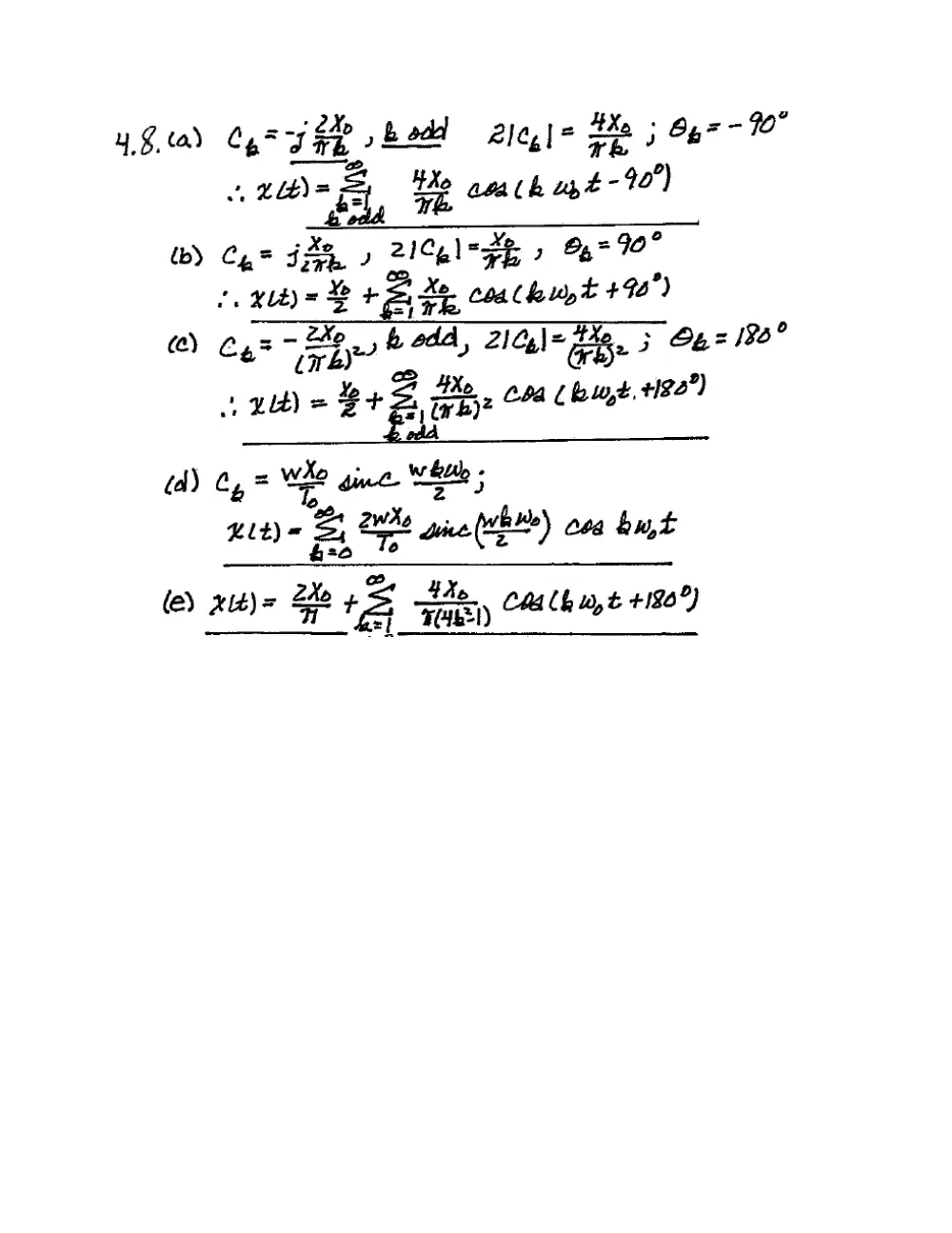
4 (a) C42 732 ) B add £1¢,|= due J 647-70"
1 2td= 8, Bp omthnd-1
lb) Cy 52% 5 21Cpl=2e » 4= 90°
@) C45 ~ Eb badd, 210.|= PR. 3 Ob 195°
oe
Aube 2+ 3 Cha (bw,#, 192")
= wXo whith -
(A Cy = Oe ane 5
ut) = Zi 2 aie (ie) coe buyt
£26
48
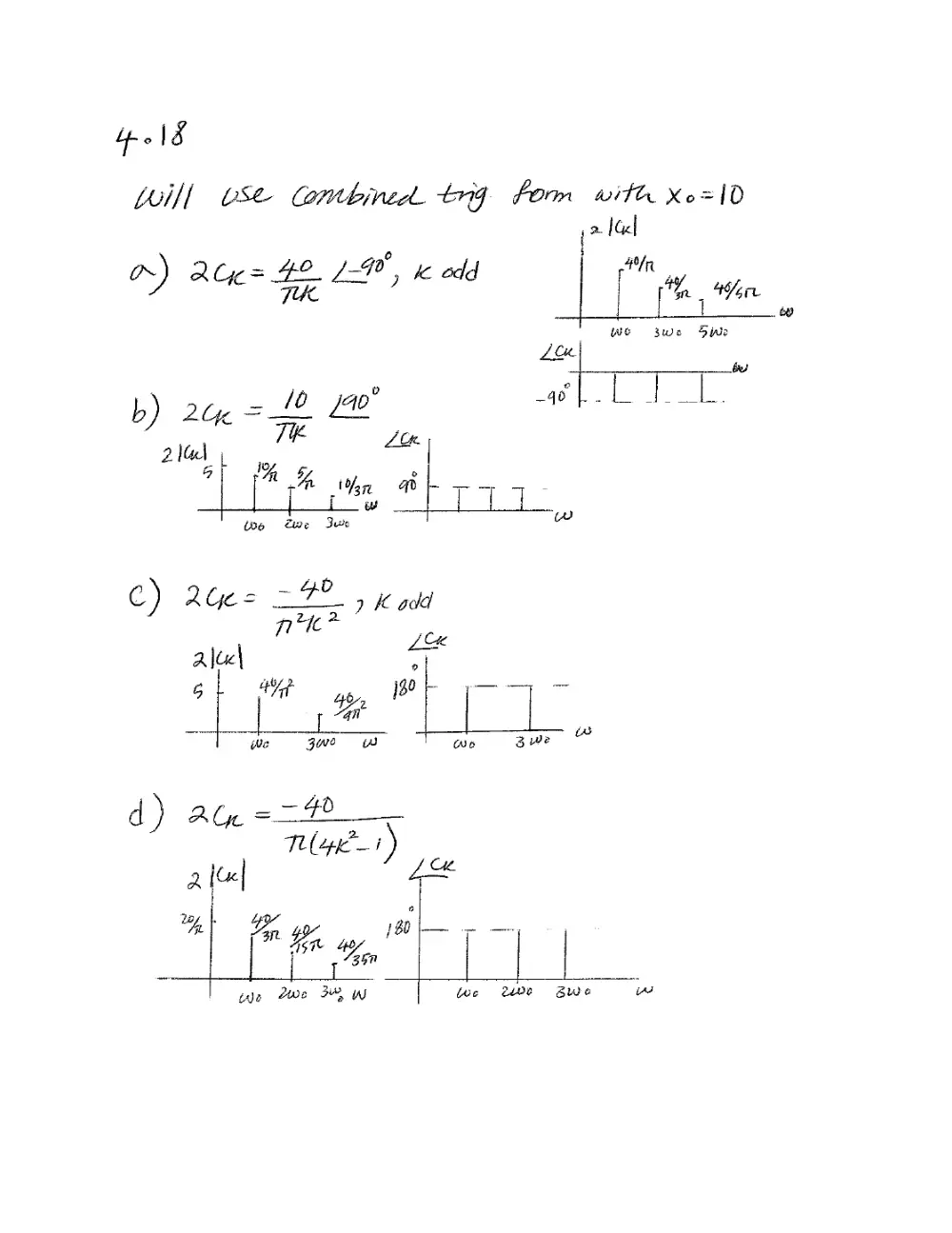
Se@ L, 1 Yn tol =10
7 TO Xo
An
WW se
o Lf y ;
-~ 40 L-2 , ke. ed. .
0) atue= 45. |
nt 7,
alte\ ai 7 _
: _ | Lo Wo au
--40
d) Aue le) .
—Jh ws E
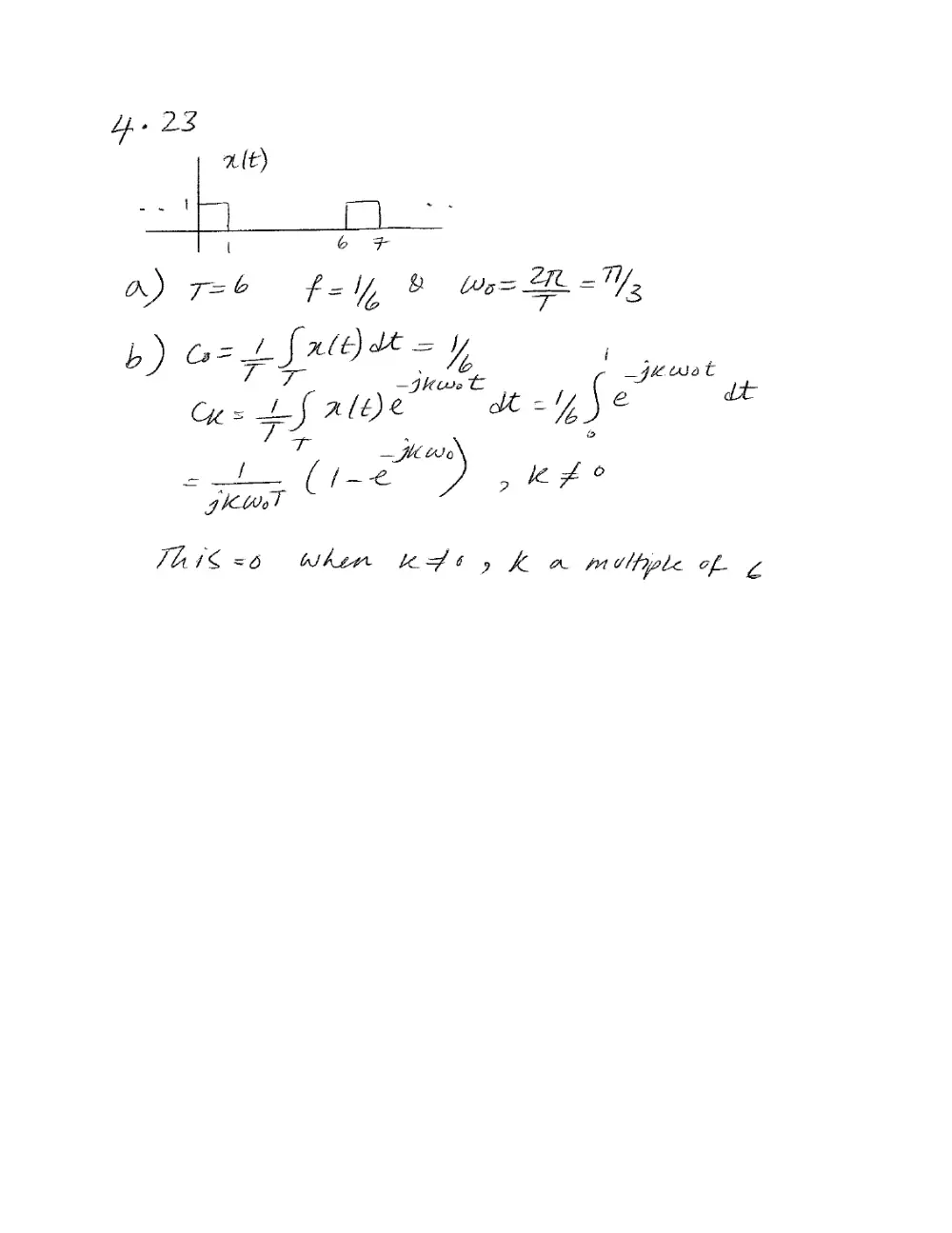
Ce= Lf alee wt -¥fe we
T jie °
(/-<€ > KA?
TALS <6
whin KAty K a miltyle of ¢
=H jk — Ske
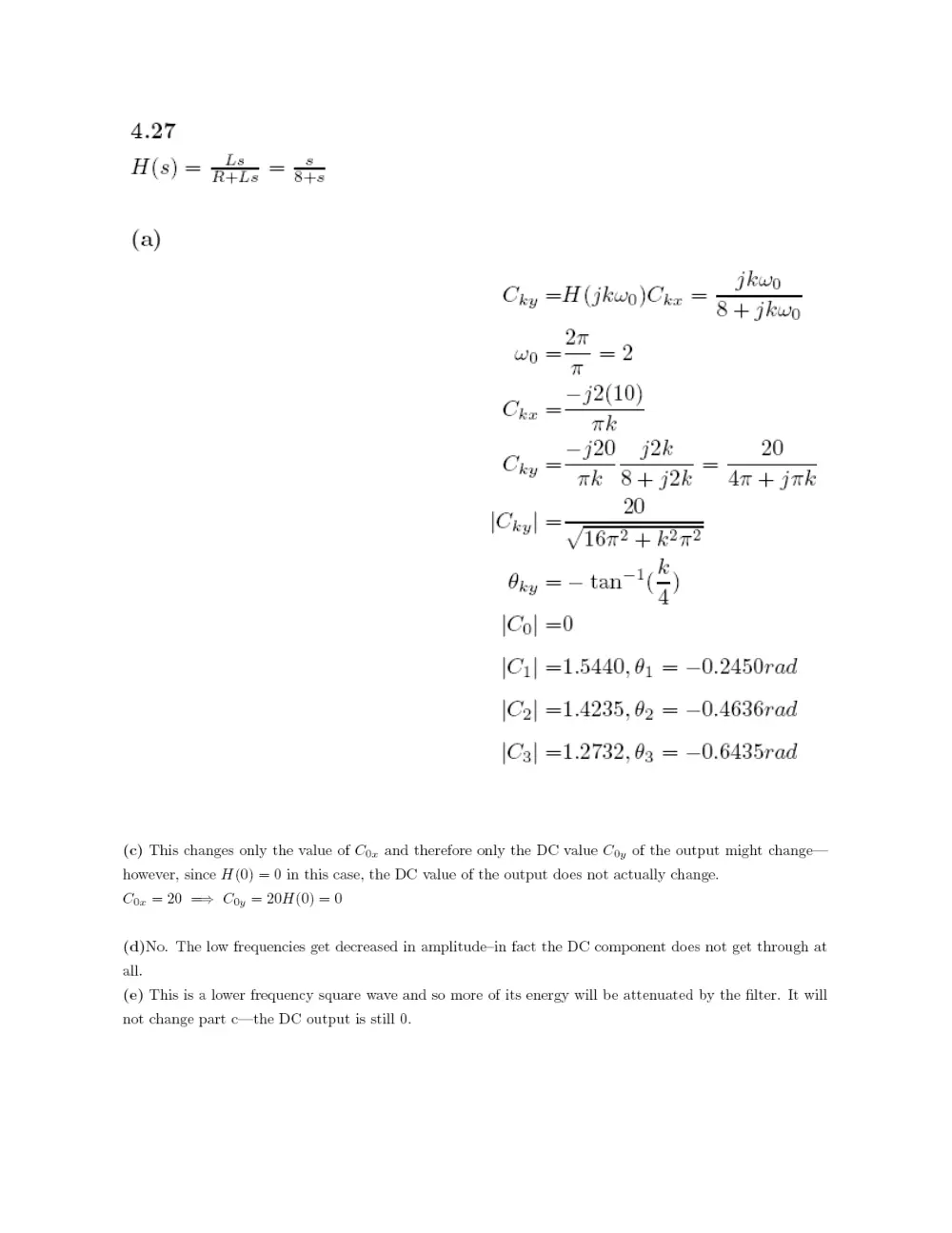
Cry =H (jkwo)C ka = 8 + jkwo
20
wp =— =
7
—j2(10
C,, - 200)
Tk
C —j20 j2k 20
‘ku Ttk S84 52k 4n+ jrk
20
C.,| ——_———
ICey V 1672 + k27?
k
Oey = — tan~'(7)
|Co| =0
\C;| =1.5440, 0; = —0.2450rad
\Cy| =1.4235, 02 = —0.4636rad
|\C3| =1.2732, 63 = —0.6435rad
(c) This changes only the value of Co, and therefore only the DC value Co, of the output might change—
however, since H (0) = 0 in this case, the DC value of the output does not actually change.
Cox = 20 = Co, = 20H(0) = 0
(d)No. The low frequencies get decreased in amplitude—in fact the DC component does not get through at
all.
(e) This is a lower frequency square wave and so more of its energy will be attenuated by the filter. It will
not change part c—the DC output is still 0.
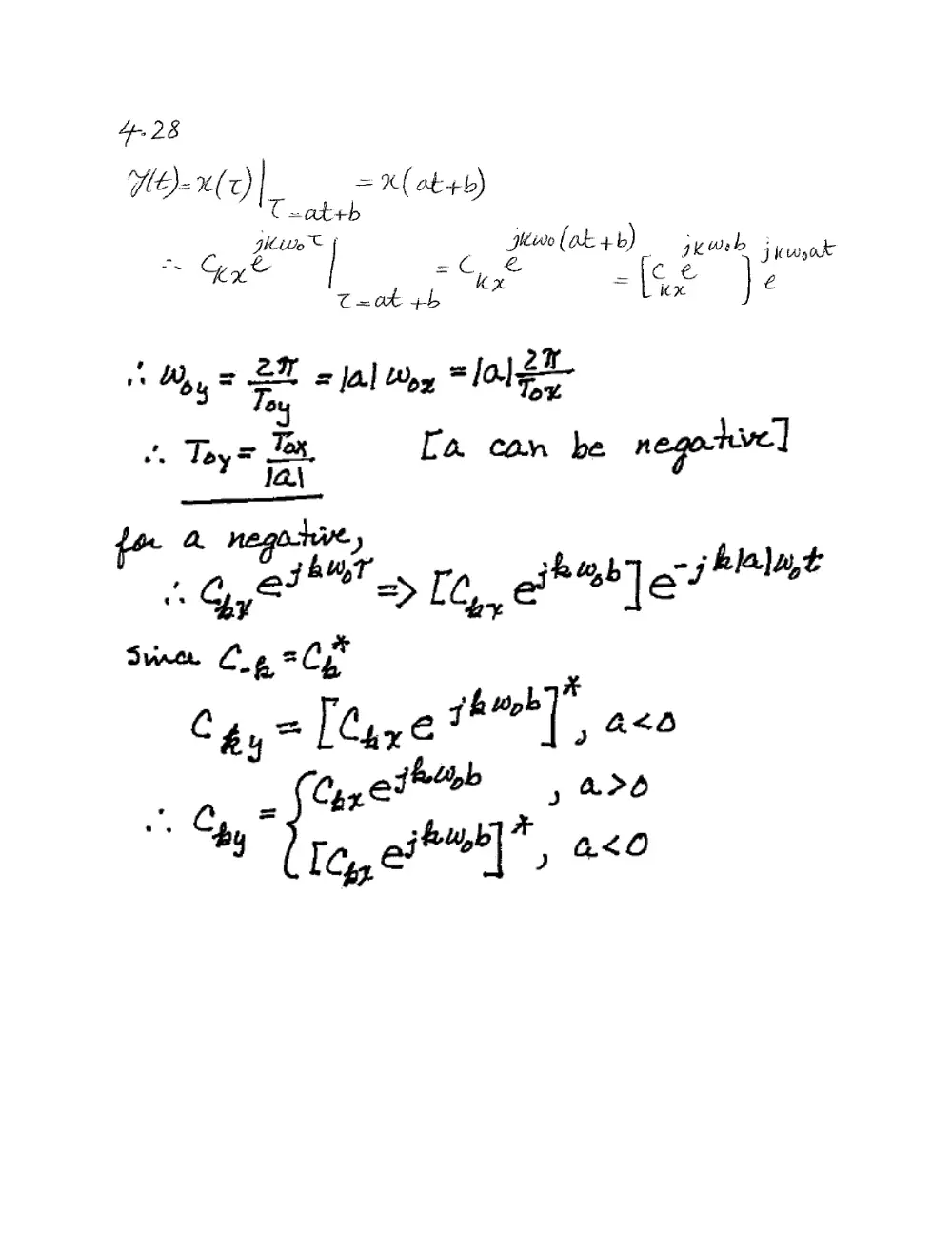
4.28
x(t) | = K(at+b
hawctltd
a ee] = Zero lok st) jew jywyak
KH =O y - [S € Je
Taak ab Kx