
EEN 340 Problems CHAPTER 5, Fall 2011
Notre Dame University–Louaize · Signals and Systems · 5 pages


More EEN 340 files
- Problems CHAPTER 4 · Fall 2011ChapterView
- Exam 1 With Solution · Spring 2016Exam · with solutionView
- Exam 1 · Summer 2011ExamView
- Exam 1 with Solution · Spring 2011Exam · with solutionView
- Exam 2 · Spring 2009ExamView
- Exam 1 with Solution · Spring 2008Exam · with solutionView
- Exam 2 · Fall 2006ExamView
- Exam 1 · Fall 2003ExamView
Show the text of this chapter
5.1
d. de™ sin(a@,t + @)u(t),b > 0
u= ety =sin(@,t + @)
A
at+ja@
—
el®_@ a
270° 2j
é 6
e [erode Seong
2y° 27
Aze!®
F = ola — _
(@) 2ja-@ (@-@,) 2yb-0
Ae “u(t) =
sin@= -jegt i 6
é
Ame"
d(@+@,)
5.8
use the derivate property
a {a K\ 2. = FAQ
Scle™ <3 qo (Bez) >
(b) pany from Table 5.1 Fle) Se artes)
By (A ae ee
5. (a\—?7 Ge) ave = Ee
- ~32t
@S 40s(at) _ 2fe?Set*| 24% 2e7
att t2+ | 2%1 e+
use Frequency: Shift and dualrty Properties
-/W-2]
Flo) = arf er e aie
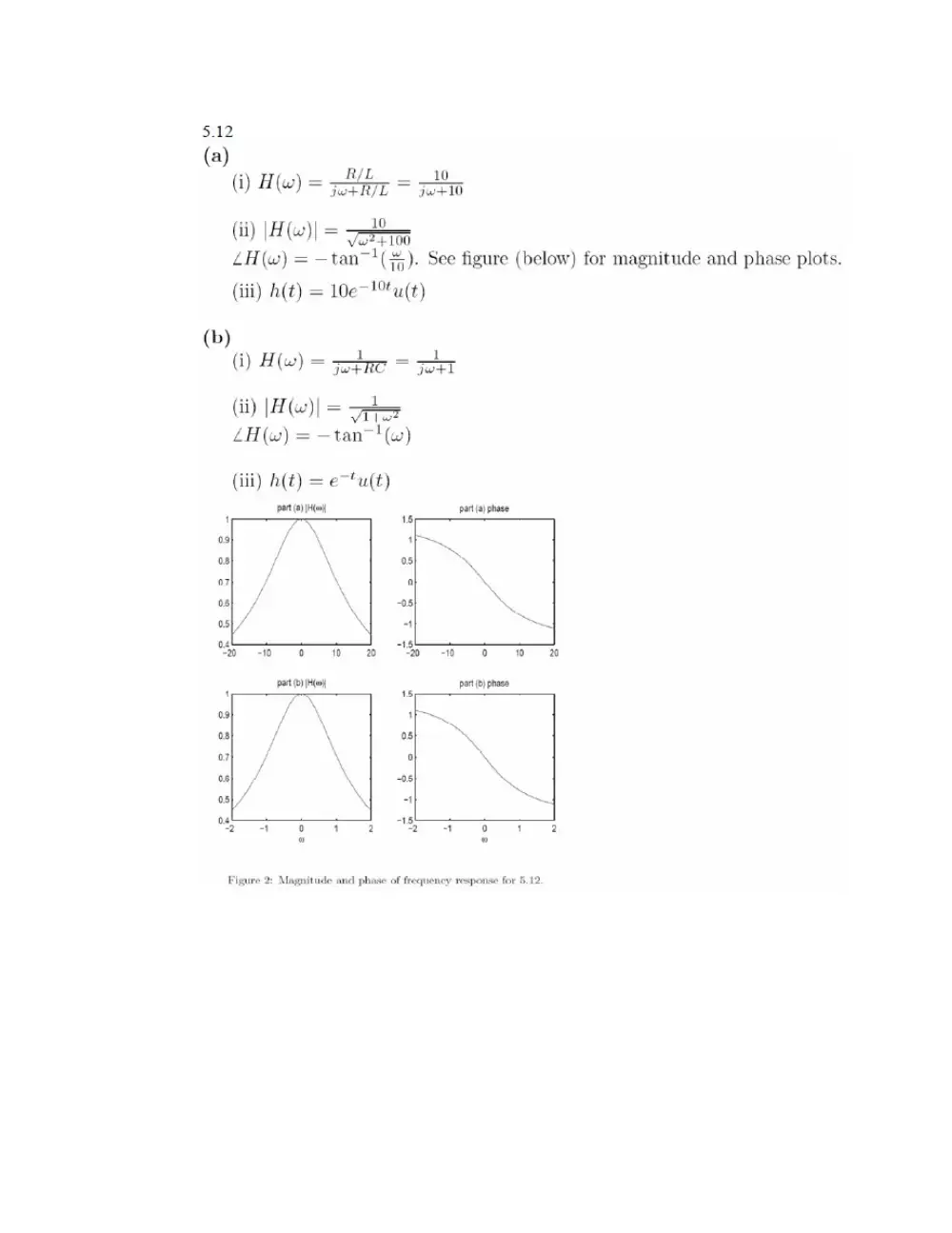
5.12
(a)
(i) He) = yr = ween
(i) H@)|= Se
LH(w) = —- tan71(#). See figure (below) for magnitude and phase plots.
(iii) h(t) = 10e~!°"u(t)
(b)
() He) = some = zabr
(ii) |H(w)| = za
Tle
ZLH(w) = —tan~!(w)
(iii) A(t) = e~tu(t)
part (3) |H4ooH{
part (0) |H(w
, 7
AX
09 / \ 1
08 / \ 05) ss
/ \ 8
or / \ 0
/ \
os} / x 05 me
05 Va NG 4 =
04 15
~ -1 f) 1 2 2 4 0 1 2
o ©
Figure 2: Magnitude and phase of frequency response for 5.12
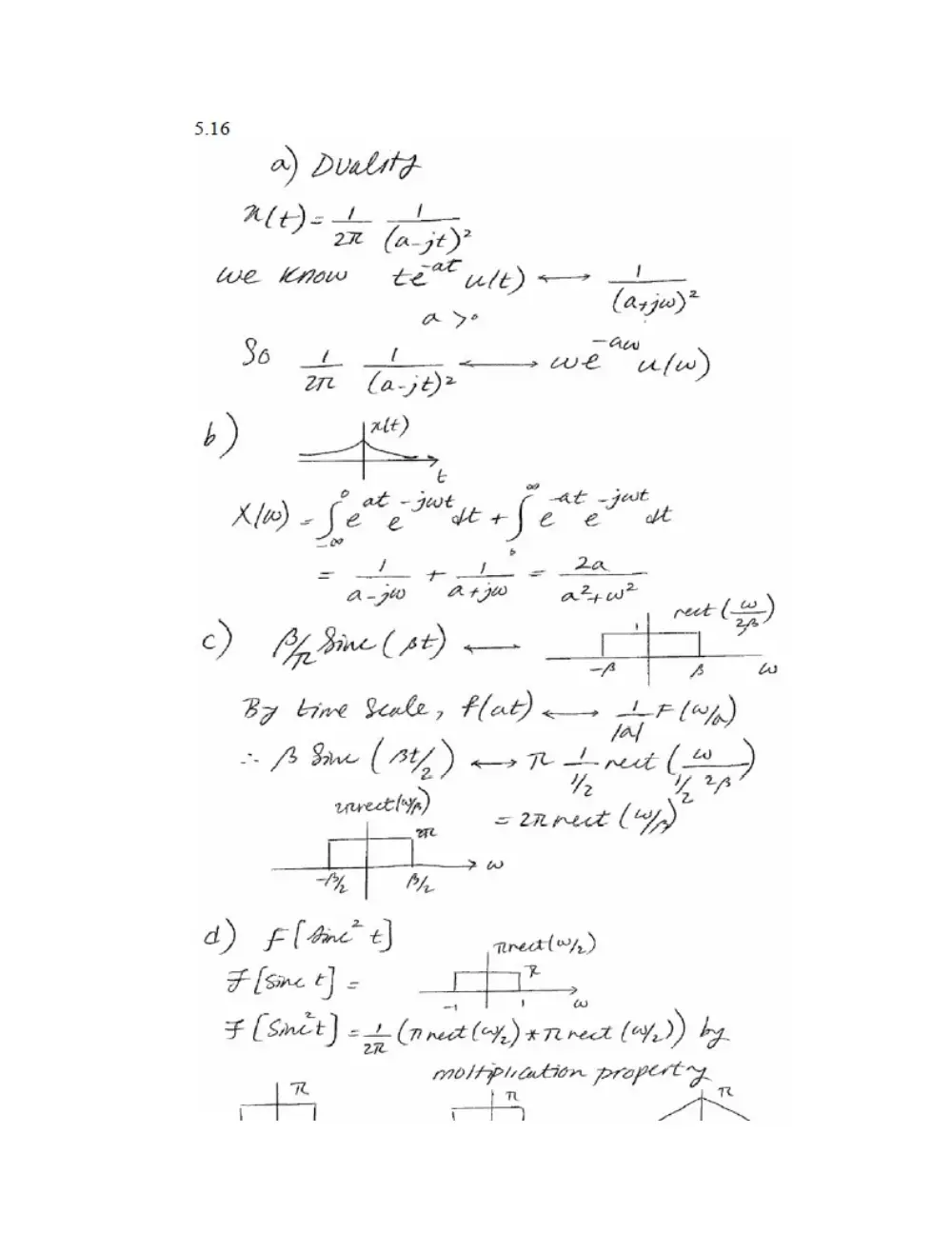
5.16
a (a-jt)*
b) am
X (we) - ls itty ée
- i “ps ! _ ae.
Anjo ALR aby es® 2)
C) Sine (st) — __[~ 17
molt ph ietion properl -
Fé HA re
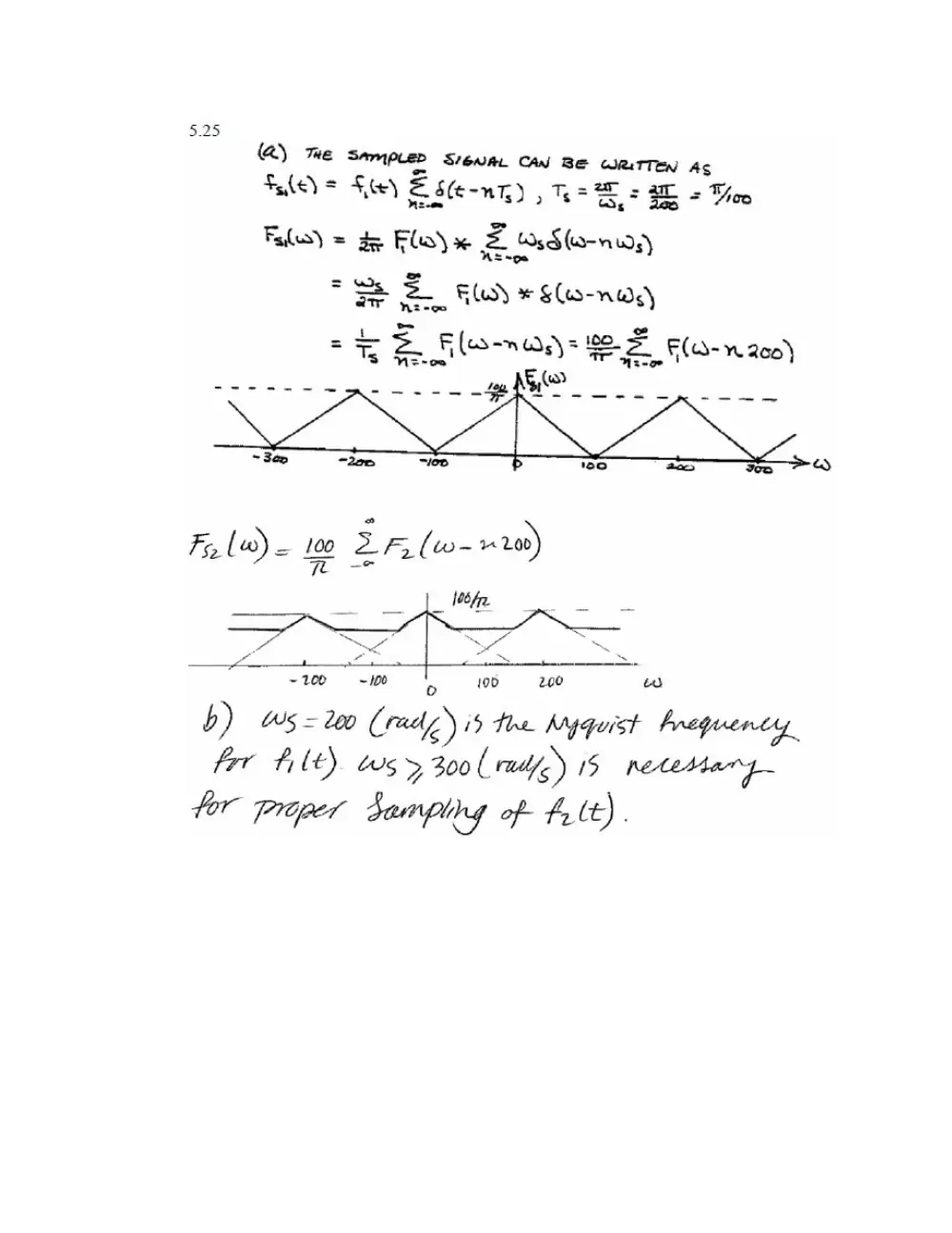
Q@) we Sampvep S/6WAL CAN BE WRiTTEN As
Sale) = Ate) E S(e-nn) , = = BL = View
Fas) = ge Fla) xe Z &sSlo-nw,)
_ fn
b) Ws = 200 (radg i's The Mygquist Frequenty
for 7,lt) tus > 300 ( radl/. 15 netestary
for Proper Sampling of- fy lt).
200
5.28
(a) P,(w) = P;(w)|H(w)|?
H(150) — 8/200(150 — 100) + 16 — 18
H(200) = 8/200(200 — 100) + 16 = 20
P,(w) = (207)0.55(w + 200) + (18?) 26(w + 150) + (187)25(w — 150) + (207)0.54(~ — 200)
Py(w) = 2005(w + 200) + 6485(u + 150) + 64856(~ — 150) + 2005(w — 200)
co)
700 GHB
73a - 19d 10d “$0 8 90 150
(b) Py(w) = Ppw)|H(w)?
H(—240) = H (240) = 21.6, H(—180) = H(180) = 19.2, H(—120) = H(120) = 16.8, H(—60) = H(60) =0
P,(w) = (21.62) [5(w +240) + 5(w—240)] + (19.22)[25 (w+ 180) +25(w—180)] + (16.8)(35(w-+120) +35 (w —120)]
P,(w) = 466,56[5(w +240) + 6(w — 240)] + 737.28[5(w + 180) + 5(w — 180)] + 846.72[5(w + 120) + 6(w — 120)]
Pylw) pete
“lap “2°
4p “180